Excelsior
Crab Apple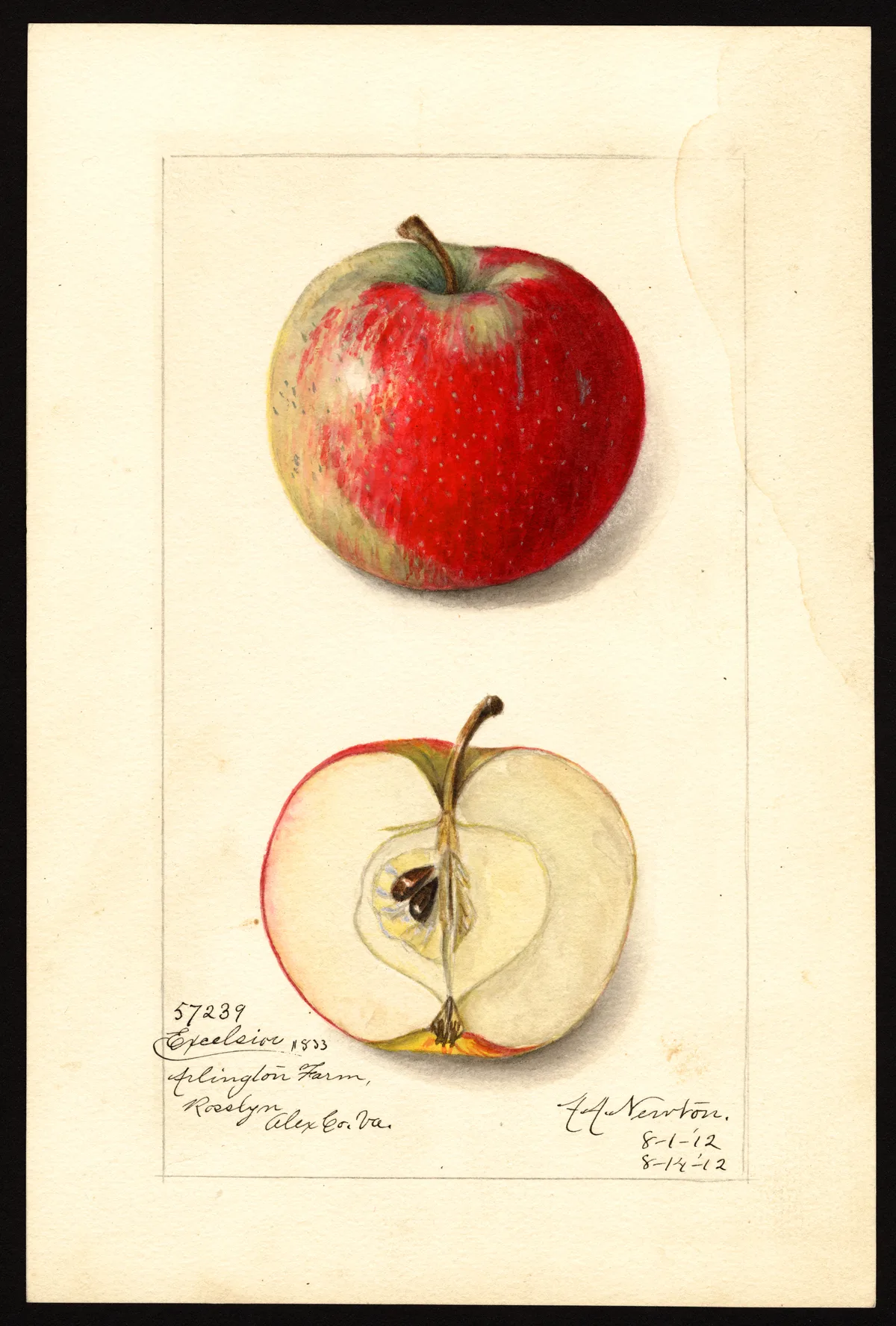
USDA Pomological Watercolor Collection
Excelsior
Origin/History
Excelsior was originated by Peter M. Gideon of Excelsior, Minnesota. According to Gideon (Am. Pom. Soc. Rpt., 1885:26, as quoted by Beach), "It came from seed of Wealthy which had a chance to be crossed with the Cherry Crab and also the Oldenburg." Hedrick similarly identifies it as a seedling of Wealthy with the Cherry crab as the other parent. Budd-Hansen describes it simply as "A seedling of Wealthy, originated by Peter M. Gideon, Excelsior, Minnesota, from whom it was received in 1888." The variety was first described in 1880 (Hedrick; Ill. Hort. Soc. Rpt., 1880). At the Central Experimental Farm, Agassiz BC, it was planted in the spring of 1896. Beach classes it among crabapples, noting the fruit is "very large for a crabapple being nearly as large as a medium sized apple," and Hedrick observes that Excelsior is "one of the few good dessert crabs, if, indeed, it should be called a crab," given its Wealthy maternal parentage.
Tree
Tree large, a good strong/vigorous grower, hardy, healthy, comes into bearing rather young, and yields full crops in alternate years (productive only in alternate seasons). Branches long and moderately stout (Beach) or long and stout (Hedrick). Form somewhat flat and spreading (Beach) or spreading (Hedrick), rather dense. Budd-Hansen, quoting Beach and Paddock (1894), describes the tree as "vigorous, upright, spreading." Twigs short, curved, stout; internodes medium. Bark dark brown tinged with red; slightly pubescent. Lenticels quite numerous, medium size, oval, slightly raised. Buds medium to large, plump, obtuse, free, slightly pubescent.
Fruit
Size: Very large for a crabapple — nearly as large as a medium-sized apple (Beach, Budd-Hansen); large and handsome (Hedrick); very large (Thomas). The Central Experimental Farm catalogue (1900) describes the fruit at Agassiz BC as "of medium size."
Form: Roundish-oblate (Thomas); roundish ovate to roundish oblate, symmetrical (Beach); round-ovate to round-oblate, symmetrical (Hedrick); roundish oblate (Budd-Hansen); roundish, oblong (Central Experimental Farm).
Stem: Long and slender (Thomas, Hedrick); rather long and slender, sometimes bracted (Beach, Budd-Hansen).
Cavity: Small, acute or approaching acuminate, narrow, rather shallow, often slightly russeted (Beach); small, acute, narrow, shallow, often russeted (Hedrick); narrow, rather shallow (Budd-Hansen).
Calyx: Rather large, closed; lobes reflexed (Beach); large, closed; lobes reflexed (Hedrick); rather large, closed (Budd-Hansen). Calyx tube wide, cone-shape. Stamens median (Hedrick) or median or above (Beach).
Basin: Shallow, moderately broad, obtuse, furrowed (Beach); shallow, broad, obtuse, furrowed (Hedrick); shallow, broad-plaited (Budd-Hansen).
Skin: Smooth, yellow, shaded and splashed with red over much of its surface; handsome in appearance. Dots numerous, russet. Thomas describes the skin as "yellow, shaded and splashed with red, sprinkled with many russet dots, handsome." Hedrick emphasizes the coloring is especially handsome — "yellow shaded and splashed with bright red, the latter giving the apples their prevailing color." The Central Experimental Farm catalogue describes the skin as "yellow with a bright red cheek."
Flesh/Flavor: Flesh whitish to white, firm, a little coarse (Beach) or coarse (Hedrick) or "not fine-grained" (Budd-Hansen), crisp, juicy, subacid. Beach notes "with some Siberian crab flavor yet agreeable for dessert use"; Hedrick gives "with Siberian crab flavor"; Budd-Hansen gives "with crab-apple flavor." Quality good to very good (Beach, Hedrick, Budd-Hansen); Thomas calls the flesh "white, juicy, good." The Central Experimental Farm catalogue describes the flesh as "white, crisp, juicy, mildly sub-acid, quality good." Excellent in quality for either dessert or culinary uses (Beach); a good dessert fruit and also excellent for culinary purposes (Hedrick).
Core/Seeds: Core large, decidedly abaxile (Beach) or abaxile (Hedrick); cells unsymmetrical, wide open; core lines clasping. Carpels elongated ovate, sometimes tufted. Seeds above medium size (Beach), long, moderately narrow (Beach) or narrow (Hedrick), acute, tufted.
Season
Early September (Beach, Hedrick). Begins to ripen about the first of September (Budd-Hansen, quoting Beach and Paddock). Early (Thomas). At Agassiz BC, season August (Central Experimental Farm). Hedrick notes that "the crop ripens earlier than that of any other crab."
Uses
Excellent for either dessert or culinary use. Beach considers it "one of the most desirable varieties of its class during early September" as grown at the New York Station. Hedrick describes it as both a good dessert fruit and excellent for culinary purposes.
Subtypes/Variants
Not described in source.
Other
Beach lists no synonyms ("SYNONYMS. None."). Beach's references include Ill. Hort. Soc. Rpt., 1880; Gideon, Am. Pom. Soc. Rpt., 1885:26; Rural N. Y., 45:184, 1886 (figs.); Bailey, An. Hort., 1892:238; Beach and Paddock, N. Y. Sta. An. Rpt., 13:580, 1894; Munson, Me. Sta. An. Rpt., 12:73, 1896; Lyon, U. S. Pom. Bul., 6:11, 1897; Am. Pom. Soc. Cat., 1897:11; Munson, Me. Sta. An. Rpt., 18:83, 1902; Thomas, 1903:348; Budd-Hansen, 1903:218; Farrand, Mich. Sta. Bul., 205:47, 1903; Powell and Fulton, U. S. B. P. I. Bul., 48:41, 1903. Hedrick illustrates the variety as Fig. 67.
Book Sources
Described in 4 period pomological works
Nursery Catalog Sources
Found in 4 catalogs (1906–1912) from Missouri
- Stark Bros. Nurseries & Orchards Co. , Louisiana , Missouri — 1906
- Stark Bros. Nurseries & Orchards Co. , Louisiana , Missouri — 1910
- Stark Bros. Nurseries & Orchards Co. , Louisiana , Missouri — 1911
- Stark Bros. Nurseries & Orchards Co. , Louisiana , Missouri — 1912
View original book sources (5)
— John J. Thomas, The American Fruit Culturist (1903)Excelsior. Very large, roundish-oblate; stem long and slender; skin yellow, shaded and splashed with red, sprinkled with many russet dots, handsome; flesh white, juicy, good. Early. Minnesota.
— S.A. Beach, The Apples of New York, Vol. 2 (1905)EXCELSIOR
REFERENCES. 1. Ill. Hort. Soc. Rpt., 1880. 2. Gideon, Am. Pom. Soc. Rpt., 1885:26. 3. Rural N. Y., 45:184. 1886. figs. 4. Bailey, An. Hort., 1892:238. 5. Beach and Paddock, N. Y. Sta. An. Rpt., 13:580. 1894. 6. Munson, Me. Sta. An. Rpt., 12:73. 1896. 7. Lyon, U. S. Pom. Bul., 6:11. 1897. 8. Am. Pom. Soc. Cat., 1897:11. 9. Munson, Me. Sta. An. Rpt., 18:83. 1902. 10. Thomas, 1903:348. 11. Budd-Hansen, 1903:218. 12. Farrand, Mich. Sta. Bul., 205:47. 1903. 13. Powell and Fulton, U. S. B. P. I. Bul., 48:41. 1903.
SYNONYMS. None.
Fruit very large for a crabapple being nearly as large as a medium sized apple. It is very attractive in appearance and excellent in quality for either dessert or culinary uses. As grown at this Station it appears to be one of the most desirable varieties of its class during early September. The tree is a good strong grower, hardy, healthy, comes into bearing rather young and yields full crops in alternate years.
Historical. Originated by Peter M. Gideon, Excelsior, Minn. “It came from seed of Wealthy which had a chance to be crossed with the Cherry Crab and also the Oldenburg” (2).
TREE.
Tree large with long, moderately stout branches. Form somewhat flat and spreading, rather dense. Twigs short, curved, stout; internodes medium. Bark dark brown tinged with red; slightly pubescent. Lenticels quite numerous, medium size, oval, slightly raised. Buds medium to large, plump, obtuse, free, slightly pubescent.
FRUIT.
Fruit very large. Form roundish ovate to roundish oblate, symmetrical. Stem rather long and slender, sometimes bracted. Cavity small, acute or approaching acuminate, narrow, rather shallow, often slightly russeted. Calyx rather large, closed; lobes reflexed. Basin shallow, moderately broad, obtuse, furrowed. Skin smooth, yellow, shaded and splashed with red over much of its surface. Dots numerous, russet. Calyx tube wide, cone-shape. Stamens median or above. Core large, decidedly abaxile; cells unsymmetrical, wide open; core lines clasping. Carpels elongated ovate, sometimes tufted. Seeds above medium size, long, moderately narrow, acute, tufted. Flesh whitish, firm, a little coarse, crisp, juicy, subacid, with some Siberian crab flavor yet agreeable for dessert use, good to very good in quality. Season early September.
— J.L. Budd & N.E. Hansen, American Horticultural Manual, Part II: Systematic Pomology (1914)Excelsior.—"A seedling of Wealthy, originated by Peter M. Gideon, Excelsior, Minnesota, from whom it was received in 1888. "Fruit very large for a crab, nearly as large as a medium-sized apple, roundish oblate; stem rather long and slender, sometimes bracted, and inserted in a narrow rather shallow cavity; calyx rather large, closed; set in a shallow, broad-plaited basin; skin smooth, yellow, sprinkled with numerous russet dots, and shaded or splashed with red over much of its surface; handsome in appearance; flesh white, not fine-grained, firm, juicy, subacid, with crab-apple flavor; good to very good in quality. Begins to ripen about the first of September. Tree vigorous, upright, spreading." (Beach and Paddock, N. Y. Exp. Sta. An. Rep., 1894.)
— U.P. Hedrick, Cyclopedia of Hardy Fruits (1922)EXCELSIOR. Fig. 67. Excelsior is one of the few good dessert crabs, if, indeed, it should be called a crab, for its maternal parent was Wealthy and the other the Cherry crab. The fruits are large and handsome, especially in coloring—yellow shaded and splashed with bright red, the latter giving the apples their prevailing color. Besides being a good dessert fruit, it is excellent for culinary purposes. The trees are exceptionally vigorous, hardy, healthy, and come in bearing young, but are productive only in alternate seasons. The crop ripens earlier than that of any other crab. The variety originated with Peter Gideon, Excelsior, Minnesota, and was first described in 1880.
Tree large, spreading, dense, with long, stout branches. Fruit very large, round-ovate to round-oblate, symmetrical; stem long and slender, sometimes bracted; cavity small, acute, narrow, shallow, often russeted; calyx large, closed; lobes reflexed; basin shallow, broad, obtuse, furrowed; skin smooth, yellow, shaded and splashed with red; dots numerous, russet; calyx-tube wide, cone-shape; stamens median; core large, abaxile; cells unsymmetrical, wide open; core-lines clasping; carpels elongated-ovate, sometimes tufted; seeds long, narrow, acute, tufted; flesh white, firm, coarse, crisp, juicy, subacid, with Siberian crab flavor; good to very good; early September.
— Central Experimental Farm, Central Experimental Farm, Agassiz BC — Catalogue of Fruit Trees under Test (Bulletin No. 3, 1900) (1900)Planted Spring 1896. Tree a vigorous grower. Fruit of medium size, roundish, oblong. Skin yellow with a bright red cheek. Flesh white, crisp, juicy, mildly sub-acid, quality good. Season August.