Cherry
Crab Apple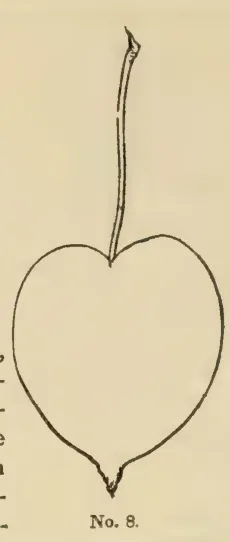
Cherry
Origin / History
Cherry is an old variety of unknown origin (Beach; Hedrick). Budd & Hansen describe it as "one of the oldest varieties," of the pure Pyrus baccata type, having deciduous calyx segments.
Tree
The tree is a pretty good grower, particularly on light soils, attains considerable size, and is quite a regular bearer (Beach). Hedrick characterizes it as remarkable for the large size, productiveness, and regularity in bearing of the trees, which may be further distinguished by their long, slender, curved branches.
- Vigor / form: Moderately vigorous (Beach); vigorous (Hedrick). Form upright spreading to roundish, open (Beach); upright-spreading, open (Hedrick), with long, slender, curved branches.
- Twigs: Moderately long, straight, moderately stout; internodes long (Beach).
- Bark: Clear reddish-brown tinged with olive-green, mottled with scarf-skin especially at the tips; slightly pubescent (Beach).
- Lenticels: Very scattering, small, roundish, not raised (Beach).
- Buds: Prominent, medium to large, plump, acute, free, not pubescent (Beach).
Fruit
Size
Small (Downing; Beach; Hedrick; Budd & Hansen); very small (Thomas). Desportes gives specific dimensions: one inch high, three-fourths of an inch in diameter.
Form
Sources differ. Desportes describes the fruit as ovoid, cordiform towards the stem, conic towards the eye. Downing calls it roundish ovate, pointed. Thomas gives round oblate. Beach gives oblate or roundish, ribbed. Hedrick gives oblate-round, ribbed. Budd & Hansen describe it as oblate, nearly regular or slightly angular, with a smooth surface.
Stem
Long to very long, slender, bracted (Beach; Hedrick); very long, slender (Thomas; Budd & Hansen). Desportes notes the eye is terminated by a small stalk, long, slender, curved.
Cavity
Rather broad, shallow, obtuse to slightly acute, somewhat russeted (Beach); broad, shallow, obtuse, russeted (Hedrick); regular, obtuse, wide, with a little broken russet (Budd & Hansen). Thomas dissents, calling the cavity narrow, shallow.
Calyx
Medium to large, usually closed or eventually deciduous (Beach; Hedrick); closed, with segments that as they fall off leave a round russet scar (Budd & Hansen); small (Thomas). Desportes describes the eye as large, projecting out of the surface, formed with a bundle of small wrinkles, crowded by segments of calyx. Budd & Hansen emphasize that the variety is of the pure Pyrus baccata type, having deciduous calyx segments.
Basin
Wide, shallow, obtuse, wrinkled (Beach; Hedrick); wide, shallow (Budd & Hansen); narrow, very shallow (Thomas).
Skin / Color
Pale yellow nearly covered with bright red, often striped with carmine and overspread with a thin bluish bloom (Beach); pale yellow covered with bright red, often striped with carmine and overspread with thin bloom (Hedrick); yellow, nearly covered with bright red, with blue bloom (Budd & Hansen); light yellow, spotted and blended with red (Downing); light yellow with red blush (Thomas). Desportes gives the color as yellowish lemon uniformly, nevertheless a little spotted with red on the sunny side.
Dots
Distinct, numerous, large, whitish or russet (Beach); distinct, numerous, large, white or russet (Hedrick); distinct, many, large, whitish (Budd & Hansen); small (Thomas).
Flesh / Flavor
Yellowish, rather coarse, juicy, crisp, mild subacid, somewhat astringent (Beach); yellow, coarse, juicy, crisp, mild subacid, astringent; fair (Hedrick); yellow, juicy, sub-acid astringent (Thomas); crisp, juicy, pleasant (Downing); crisp, juicy, pleasant acid (Budd & Hansen). Hedrick notes the fruits are rather too coarse to be wholly acceptable.
A distinctive trait: the fruit hangs long, almost even to drying, on the tree (Downing; Budd & Hansen).
Core / Seeds
Calyx tube funnel-form. Stamens marginal. Core large, axile; cells closed. Carpels broadly roundish or elliptical, emarginate, mucronate (Beach; Hedrick).
Season
Last of August to October (Beach); August to October (Hedrick); September, October (Downing; Budd & Hansen); August (Thomas).
Uses
Not described in source.
Subtypes / Variants
Not described in source.
Other
Cherry is classified as a crab (Hedrick) and was historically referenced under the synonym "Cherry Crab" by Warder (1867), Barry (1883), and the Montreal Horticultural Society Report (1884).
Book Sources
Described in 6 period pomological works
View original book sources (6)
— B. Desportes, The Horticulturist (1856)No. 8. Cherry Apple—Fruit, one inch high, three-fourths of an inch in diameter; form, ovoid, cordiform towards the stem, conic towards the eye; this is terminated by a small stalk, long, slender, curved; eye, large, projecting out of the surface, formed with a bundle of small wrinkles, crowded by segments of calyx; color, yellowish lemon uniformly, nevertheless a little spotted with red on the sunny side.
— A.J. Downing, The Fruits and Fruit Trees of America (1900)Cherry.
Fruit small, roundish ovate, pointed, light yellow, spotted and blended with red. Flesh crisp, juicy, pleasant, hangs long, almost even to drying on the tree. September, October.
— S.A. Beach, The Apples of New York, Vol. 2 (1905)CHERRY.
REFERENCES. 1. Warder, 1867:715. 2. Downing, 1869:422. 3. Barry, 1883:359. 4. Montreal Hort. Soc. Rpt., 1884:39. 5. Thomas, 1897:298. fig. 6. Budd-Hansen, 1903:217.
SYNONYMS. Cherry (2, 5, 6). Cherry Crab (1, 3, 4).
Cherry is an old variety of unknown origin. The tree is a pretty good grower, particularly on light soils, attains considerable size and is quite a regular bearer.
Tree.
Tree moderately vigorous with long, slender, curved branches. Form upright spreading to roundish, open. Twigs moderately long, straight, moderately stout; internodes long. Bark clear reddish-brown tinged with olive-green, mottled with scarf-skin especially at the tips; slightly pubescent. Lenticels very scattering, small, roundish, not raised. Buds prominent, medium to large, plump, acute, free, not pubescent.
Fruit.
Fruit small. Form oblate or roundish, ribbed. Stem long to very long, slender, bracted. Cavity rather broad, shallow, obtuse to slightly acute, somewhat russeted. Calyx medium to large, usually closed or eventually deciduous. Basin wide, shallow, obtuse, wrinkled. Skin pale yellow nearly covered with bright red, often striped with carmine and overspread with a thin bluish bloom. Dots distinct, numerous, large, whitish or russet. Calyx tube funnel-form. Stamens marginal. Core large, axile; cells closed. Carpels broadly roundish or elliptical, emarginate, mucronate. Flesh yellowish, rather coarse, juicy, crisp, mild subacid, somewhat astringent. Season last of August to October.
— John J. Thomas, The American Fruit Culturist (1903)Cherry. Very small, round oblate; light yellow, red blush, dots small; stem very long, slender; cavity narrow, shallow; calyx small; basin narrow, very shallow. Flesh yellow, juicy, sub-acid astringent. August. Fig. 484.
— J.L. Budd & N.E. Hansen, American Horticultural Manual, Part II: Systematic Pomology (1914)Cherry. — Of the pure Pyrus baccata type, having deciduous calyx segments. One of the oldest varieties.
Fruit small, oblate, nearly regular or slightly angular; surface smooth, yellow, nearly covered with bright red, with blue bloom; dots distinct, many, large, whitish; cavity regular, obtuse, wide, with a little broken russet; stem very long, slender; basin wide, shallow; calyx closed; segments as they fall off leave a round russet scar; flesh crisp, juicy, pleasant acid; the fruit hangs long, almost even to drying, on the tree. September, October.
— U.P. Hedrick, Cyclopedia of Hardy Fruits (1922)CHERRY. This crab is remarkable for the large size, productiveness, and regularity in bearing of the trees, which may be further distinguished by their long, slender, curved branches. The fruits are small, red, and rather too coarse to be wholly acceptable. Cherry is an old variety of unknown origin.
Tree vigorous, upright-spreading, open, with long, slender, curved branches. Fruit small, oblate-round, ribbed; stem long to very long, slender, bracted; cavity broad, shallow, obtuse, russeted; calyx medium to large, usually closed, eventually deciduous; basin wide, shallow, obtuse, wrinkled; skin pale yellow covered with bright red, often striped with carmine and overspread with thin bloom; dots distinct, numerous, large, white or russet; calyx-tube funnel-form; stamens marginal; core large, axile; cells closed; carpels broadly round or elliptical, emarginate, mucronate; flesh yellow, coarse, juicy, crisp, mild subacid, astringent; fair; August to October.