Borovitsky
Apple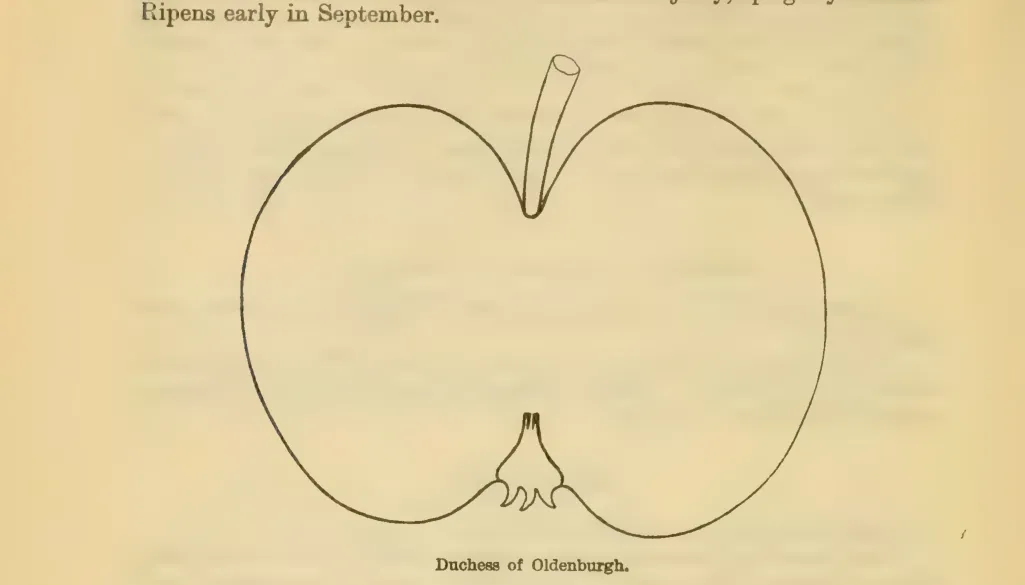
Origin & History
A Russian variety whose precise origin is not recorded. It was sent from the Taurida Gardens, near St. Petersburg, to the London Horticultural Society in 1824. It has been figured in the Pomological Magazine, Plate 10. Downing (1900) notes: "There may be a distinct variety under this name, but, so far as received by me, it has proved to be identical with Duchess of Oldenburg."
Tree
Hardy, grows freely, and bears well (Herefordshire Pomona).
Fruit
Size: The Herefordshire Pomona describes the fruit as above medium size, sometimes larger, about three inches and a quarter wide and two inches and a half high. Downing, Elliott, and Thomas all describe it as medium-sized.
Form: Round, and sometimes prominently ribbed on the sides and around the eye. Downing describes it as roundish, angular.
Stem: Long and slender, deeply inserted in a narrow and angular cavity.
Cavity: Narrow and angular.
Calyx: Eye large and closed, with long broad segments.
Basin: Deep and angular.
Skin: The Herefordshire Pomona describes the skin as smooth, greenish yellow on the shaded side, and streaked with broken patches of fine bright red on the side next the sun, sometimes assuming a beautiful dark crimson cheek; covered all over with numerous russety dots, particularly round the eye, where they are large, dark, and rough. Downing describes the skin as pale whitish yellow, faintly striped. Elliott describes it as pale green striped red.
Flesh & Flavor: Yellowish white (Herefordshire Pomona) or white (Downing, Elliott), firm, crisp, and very juicy, with a pleasant, brisk, and refreshing flavour. Downing, Elliott, and Thomas characterize the flavor as subacid.
Core & Seeds: Not described in source.
Season
Middle of August to the end of September.
Uses
An excellent early dessert apple of the first quality (Herefordshire Pomona).
Subtypes & Variants
Not described in source.
Book Sources
Described in 4 period pomological works
View original book sources (4)
— Woolhope Naturalists Field Club, The Herefordshire Pomona (1885)PLATE XXVII.
- BOROVITSKY.
[Syn : Duchess of Oldenburgh ; Smith's Beauty of Newark ; New Brunswick?]
A Russian variety, whose origin is nowhere given. It was sent from the Taurida Gardens, near St. Petersburgh, to the London Horticultural Society, in 1824. It has been figured in the Pomological Magazine, Plate 10.
Description. Fruit : above medium size, sometimes larger, about three inches and a quarter wide, and two inches and a half high ; round, and sometimes prominently ribbed on the sides, and around the eye. Skin : smooth, greenish yellow on the shaded side, and streaked with broken patches of fine bright red on the side next the sun, sometimes assuming a beautiful dark crimson cheek ; it is covered all over with numerous russety dots, particularly round the eye, where they are large, dark and rough. Eye : large and closed, with long broad segments, placed in a deep and angular basin. Stalk : long and slender, deeply inserted in a narrow and angular cavity. Flesh : yellowish white, firm, crisp and very juicy, with a pleasant, brisk and refreshing flavour.
An excellent early dessert apple of the first quality, in season from the middle of August, to the end of September.
The tree is hardy, grows freely and bears well.
— A.J. Downing, The Fruits and Fruit Trees of America (1900)Borovitsky.
A Russian Apple of medium size, roundish, angular. Skin pale whitish yellow, faintly striped. Flesh white, firm, subacid. August. There may be a distinct variety under this name, but, so far as received by me, it has proved to be identical with Duchess of Oldenburg.
— F.R. Elliott, The Western Fruit Book (1865)BOROVITSKY.
Foreign. Medium, roundish, pale green striped red ; flesh, white, sub-acid. August, September.
— John J. Thomas, The American Fruit Culturist (1903)Borovitsky. Medium, roundish, striped; firm, sub-acid. August. Russian.