Duchess of Oldenburgh
Apple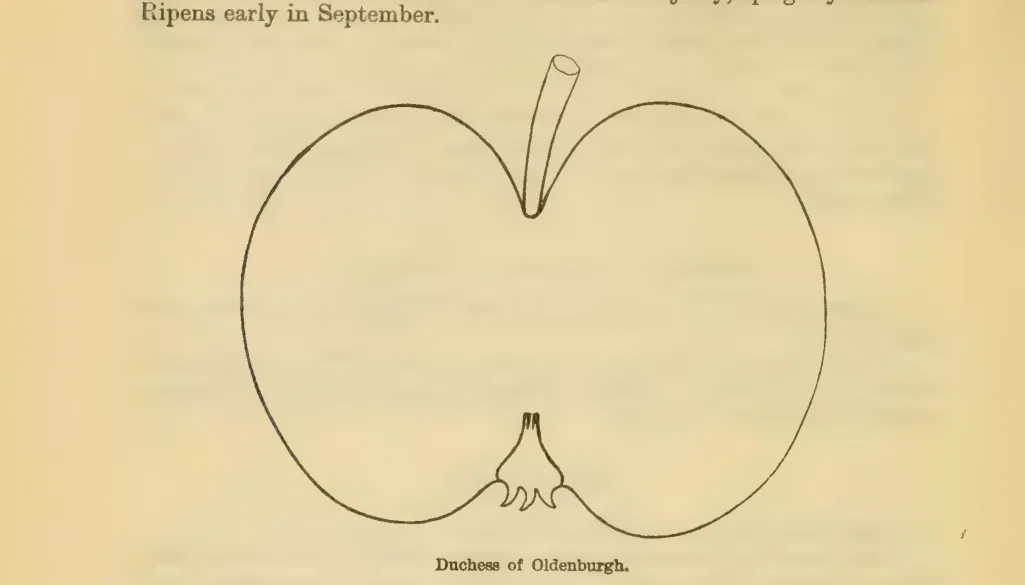
Duchess of Oldenburgh
Origin / History
A Russian apple, introduced to American cultivation from Russia and proving one of the most hardy and profitable varieties in cultivation, especially valued in northwestern sections and higher latitudes. Dr. Jno. A. Kennicott, the pioneer cultivator of Northern Illinois, considered it the ne plus ultra for that and higher latitudes. Reports from the Northwest are entirely satisfactory as to its hardiness. Known in some references under the names Smith's Beauty of Newark and New Brunswick. Elliott (1865) lists it simply as "Foreign," though the Russian origin is confirmed by Warder and Downing. It is noted as very fine at the North in Canada.
Tree
The tree is vigorous — Warder describes it as medium in size with a round head; Downing characterizes it as forming a roundish, upright, spreading head, requiring little or no pruning, and producing abundantly a fruit of fair, even, and regular size. Elliott notes vigorous growth with dark, upright shoots. The tree is perfectly hardy and reliably productive. Young shoots are described by Downing as smooth and reddish; Elliott describes them as dark and upright.
Fruit
Size: Medium in size (Warder, Downing); Elliott gives medium to large, suggesting the upper end of the size range can exceed what the other sources indicate.
Form: Regularly formed, roundish-oblate (Warder, Downing); Elliott describes it as roundish flattened — all three sources agree on the depressed, oblate character.
Stem: Warder gives the stem as medium to long and rather slender. Elliott gives it as short — a direct conflict between sources.
Cavity: Regular and acute (Warder); acuminate (Elliott) — essentially agreeing on a pointed, regular cavity. Not separately described by Downing.
Calyx / Eye: Large and closed (Warder); pretty large and nearly closed (Downing). Downing notes the calyx is set in a wide, even hollow.
Basin: Regular and pretty wide (Warder); wide and even (Downing, describing the hollow in which the calyx sits); deep (Elliott) — Warder and Downing emphasize width while Elliott emphasizes depth.
Skin: Smooth. The ground color is waxen-yellow to golden-yellow, partially to finely covered with distinct and regular stripes and splashes of brilliant red and carmine (Warder); Downing describes it as finely washed and streaked with red on a golden or yellow ground; Elliott describes it as light red, striped and splashed on yellow. All three sources agree on the smooth, yellow-ground, red-striped character. A bloom is present: Warder notes a light bloom such as is found on most Russian apples; Downing describes a faint blue bloom.
Flesh / Flavor: White (Warder); yellowish white (Elliott) — slight difference in flesh color between sources. Tender and juicy (Warder). Flavor is sour (Warder); sprightly subacid (Downing); sharp sub-acid (Elliott). On dessert quality, sources differ: Warder states it is unsuited for the dessert despite being attractive to the eye; Downing considers it passably good for dessert, though not of the first quality.
Core / Seeds: Not described in source.
Season
Ripens early in September (Downing). Elliott gives August and September.
Uses
Valuable for cooking and market (Warder, Downing, Elliott). Always commands a ready sale as a market apple (Downing). Warder is most emphatic that it is a cooking rather than a dessert apple; Downing allows it is passably good for dessert. Elliott emphasizes cooking and market value without addressing dessert quality.
Subtypes / Variants
Not described in source.
Other
The variety is noted for consistent, even, regular sizing that suits it well for market. Its hardiness is repeatedly emphasized across all three sources as its defining virtue for growers in northern and northwestern climates.
Book Sources
Described in 3 period pomological works
View original book sources (3)
— John A. Warder, American Pomology: Apples (1867)Duchess of Oldenburgh.
This very beautiful striped apple is from Russia, and has proved one of the hardiest apples in our trying climate. Reports from the Northwest are entirely satisfactory as to its hardiness.
Tree medium size, round-headed, sufficiently vigorous and perfectly hardy.
Fruit medium, regular, roundish-oblate; Surface smooth, waxen-yellow, partially covered with distinct and regular stripes and splashes of brilliant red and carmine; often having a light bloom, such as is found on most Russian apples.
Basin regular, pretty wide; Eye large and closed.
Cavity regular, acute; Stem medium to long, rather slender.
Flesh white, tender, juicy; Sour and suitable for cooking. Though attractive to the eye, it is unsuited for the dessert.
By Dr. Jno. A. Kennicott, the pioneer cultivator of Northern Illinois, this apple was considered the ne plus ultra for that and higher latitudes.
— A.J. Downing, The Fruits and Fruit Trees of America (1900)Duchess of Oldenburgh.
Smith's Beauty of Newark. New Brunswick.
This handsome Russian Apple proves one of the most hardy and profitable varieties in cultivation, and especially in our northwestern sections. The tree is vigorous, forming a roundish, upright, spreading head, requiring little or no pinning, and producing abundantly a fruit of fair, even, and regular size, that, although not of the first quality, always commands a ready sale, as it is valuable for market and cooking, and passably good for dessert. Young shoots smooth, reddish.
Fruit medium size, regularly formed, roundish oblate. Skin smooth, finely washed and streaked with red on a golden or yellow ground. Calyx pretty large and nearly closed, set in a wide, even hollow. There is a faint blue bloom on this fruit. The flesh is juicy, sprightly subacid. Ripens early in September.
— F.R. Elliott, The Western Fruit Book (1865)Duchess of Oldenburgh.
Foreign. Tree, vigorous, with dark, upright shoots, productive, valued for cooking and market. Fruit, medium to large, roundish flattened, light red, striped and splashed on yellow ; stem, short ; cavity, acuminate ; basin, deep; flesh, yellowish white, sharp sub-acid. August and September Very fine at the North in Canada.