Charlamoff
Apple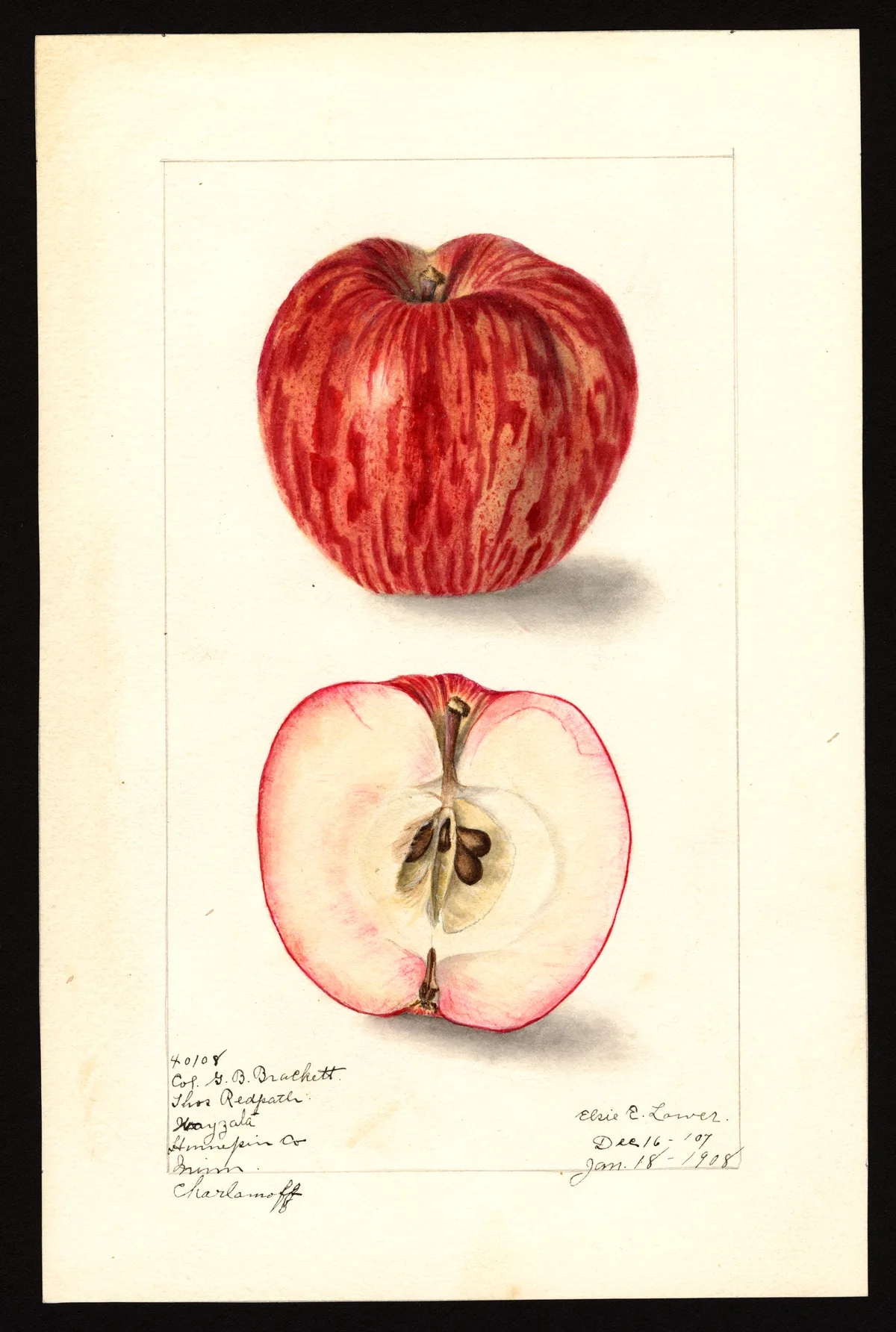
USDA Pomological Watercolor Collection
Charlamoff
Origin / History
Origin, Russia. A Russian variety of the Oldenburg type, imported for the Iowa Agricultural College by J. L. Budd. Hedrick dates its introduction from Europe to about 1880. Beach's references begin with a queried 1869 notice by Manning in Tilton's Journal of Horticulture. They continue with Budd's Iowa Horticultural Society report of 1880, the Montreal Horticultural Society reports of 1881 through 1883, Gibb in the Iowa Horticultural Society report of 1883, and the Iowa Agricultural College bulletin of 1885. Later come Schroeder in the Montreal Horticultural Society report of 1886–87, Bailey (1892), and Taylor in the Maine Pomological Society report (1892). The list closes with Butz in the Pennsylvania Station report (1895), the American Pomological Society catalogue (1899), Budd (1899), Macoun (1901), Hansen (1902, with figure), and Budd and Hansen (1903, with figure).
Macoun (cited by Beach) states that it has been grown in this country under several different names, the most common being Pointed Pipka and Arabka. S. B. Green records that the Charlamoff grown by Andrew Peterson, of Waconia, Minn., was for that reason called Peterson's Charlamoff. He proposed that "it might avoid confusion to name Peterson's Charlamoff Champagne." Hansen lists Pointed Pipka (No. 361) separately and says it "appears to be identical with Charlamoff."
Two varieties were imported under the name Charlamoff, and the name was given to the better one of the two. The other was grown by J. B. Mitchell (given by Beach as J. G. Mitchell) and A. G. Tuttle, and was named Schroeder (see Subtypes / Variants).
Hansen reports Charlamoff as one of the four varieties recommended by the Minnesota State Horticultural Society as of the first degree of hardiness, and calls it "a valuable variety for the far north." Beach reports that it does very well at Ottawa, Canada, and further north. Hedrick calls it suitable for the cold climate of the northern parts of the Great Plains and Canada. Beach adds that it is but little known among New York fruit growers, and that it may be found of some value in those sections of the state where superior hardiness is a prime requisite.
Tree
Tree spreading, vigorous, productive. In the Russian nomenclature committee's description reproduced by Hansen (Rus. Nom. Com.), it is a strong, regular, spreading grower, thick topped. There the whole tree has a distinct yellowish green aspect, and the leaves are large, lightish green with many red veins. Green finds the foliage and bark lighter than Duchess. On size the sources conflict: Patten finds it makes a large, spreading tree, while Hedrick calls it rather small and compact. At Agassiz, B.C., where it was planted in spring 1895, the tree is a strong grower.
Very hardy (Hedrick), though J. S. Harris does not think it "quite as hardy as Duchess."
Comes into bearing young, "reasonably young" in Patten's words. A reliable cropper, yielding fair to heavy crops biennially (Beach).
Fruit
Size: Medium to large, most often above medium. Hansen gives above medium to large, and the Agassiz station above medium. Hedrick gives medium, sometimes large. The committee description gives size 5 to 6.
Form: Oblong-conical. Hansen describes it as oblong, somewhat truncated, occasionally roundish truncated, angular, and ribbed, especially about the stem.
Stem: Medium to long. On thickness the sources conflict: slender in the committee description, stout according to Hedrick.
Cavity: Medium deep to deep, of medium width (Hedrick). Acute and ribbed, with a small radiating patch of russet (Hansen). Often with large lobes (committee description).
Calyx: Closed (Hansen) or nearly closed (committee description), but open according to Hedrick. Segments large. Tube funnel-shaped; stamens median (Hansen).
Basin: Wrinkled or corrugated. On depth the sources conflict: shallow (Hansen, who adds wide; Hedrick), deep in the committee description.
Skin: Light or pale yellow, greenish yellow in the committee description and whitish yellow at Agassiz. Striped, streaked, and splashed with red: dark crimson stripes and splashes, mixed red on the sunny side (Hansen); purplish-red (Hedrick); freely streaked and splashed with bright red (Agassiz station). Heavy blue bloom (Hansen).
Dots: White, minute, obscure (Hansen). Hedrick, by contrast, calls them few and distinct.
Flesh and flavor: Flesh white, often slightly stained with red next to the skin (Hansen). The committee description gives it as greenish white. Tender, juicy. On grain the sources conflict: fine-grained according to Hansen, coarse according to Hedrick, and "a little coarse, crisp" at Agassiz.
Flavor pleasant, acid to mild subacid. Hansen calls it "pleasant acid," and the committee description "pleasant, vinous acid." The Agassiz station gives "mildly acid, with a pleasant flavour," and Green and Hedrick mild subacid.
Quality "good" (Hansen, Hedrick, Agassiz station). Beach found it, as fruited at his Station, inferior to Oldenburg in quality.
Core and seeds: Core closed (Hansen).
Season
August into September. Most sources give August, the Agassiz station the last of August, and the committee description September. Beach says it ripens a little earlier than Oldenburg, and Hedrick gives "August or just before Oldenburg." Green finds Peterson's Charlamoff "generally a little later than Duchess."
It has the fault of remaining in prime condition for only a very short time (Macoun, cited by Beach).
Uses
"At its best it is a good dessert apple" (Macoun, cited by Beach).
Subtypes / Variants
A second, distinct variety was also imported under the name Charlamoff and grown by J. B. Mitchell and A. G. Tuttle. It is a flat apple of upright habit of tree, judged "not as valuable as many more of the same season," and it was decided to name it Schroeder. J. S. Harris likewise describes Tuttle's Charlamoff as "a flat apple, with upright habit of tree," and calls it "too near Duchess to be of special value." Tuttle himself wrote: "My Charlamoff is not as valuable as many more of the same season, yet I would put it in my list of the best fifty varieties." Mitchell would put Tuttle's Charlamoff in his list of the best sixteen varieties.
Other
Hansen notes: "In European nurseries Charlamofsky is a synonym of Duchess." A colored plate, under the name Pointed Pipka, appears in Butz's Pennsylvania Station report for 1895 (cited by Beach).
Book Sources
Described in 4 period pomological works
USDA Nomenclature (1905)
From W.H. Ragan, Nomenclature of the Apple, USDA Bulletin No. 56
This is considered distinct from C. of Prof. Budd.
Nursery Catalog Sources
Found in 12 catalogs (1900–1918) from Illinois, Missouri
- Central Experimental Farm , Dominion Department of Agriculture, Agassiz, British Columbia (under test; Bulletin No. 3, Second Series) — 1900
- Central Experimental Farm , Dominion Department of Agriculture, Agassiz, British Columbia (under test; Bulletin No. 3, Second Series) — 1900 — listed as Pointed Pipka
- Benjamin Buckman (personal inventory) , Farmingdale , Illinois — 1901
- Benjamin Buckman (personal inventory) , Farmingdale , Illinois — 1901 — listed as Champagne
- Benjamin Buckman (personal inventory) , Farmingdale , Illinois — 1901 — listed as Pointed Pipka
- Stark Bros. Nurseries & Orchards Co. , Louisiana , Missouri — 1906
- Stark Bros. Nurseries & Orchards Co. , Louisiana , Missouri — 1910
- Stark Bros. Nurseries & Orchards Co. , Louisiana , Missouri — 1911
- Stark Bros. Nurseries & Orchards Co. , Louisiana , Missouri — 1912
- Benjamin Buckman (personal inventory) , Farmingdale , Illinois — 1913
- Benjamin Buckman (personal inventory) , Farmingdale , Illinois — 1913 — listed as Pointed Pipka
- Stark Bros. Nurseries & Orchards Co. , Louisiana , Missouri — 1918
View original book sources (5)
— N.E. Hansen, A Study of Northwestern Apples (1902)Charlamoff (Pointed Pipka, Peterson's Charlamoff)—Origin, Russia. One of the four varieties recommended by the Minnesota State Horticultural Society as of the first degree of hardiness. Tree spreading, vigorous, productive.—Fruit above medium to large, oblong, somewhat truncated, occasionally roundish truncated, angular, ribbed, especially about the stem; surface light yellow, covered with dark crimson stripes and splashes, mixed red on sunny side, with a heavy blue bloom; dots white, minute, obscure; cavity deep, acute, ribbed, with small radiating patch of russet; stem medium to long; basin wide, shallow, corrugated; calyx closed, segments large. Core closed; tube funnel-shaped; stamens median; flesh white, fine grained, pleasant acid, often slightly stained with red next to skin, good. August.
CHARLAMOFF GROUP.
Charlamoff, 26 2; Peterson's Charlamoff; Champanskoe; Pointed Pipka, 36 1; Champagne, r 12 M. This Charlamoff is entirely distinct from the Charlamoff as grown by J. B. Mitchell and A. G. Tuttle, which is a flat apple of upright habit of tree, and not as valuable as many more of the same season. The Charlamoff of Mitchell and Tuttle it was decided to name Schroeder. In other words, two varieties have been imported under the name Charlamoff, and this name is now given to the better one of the two.
DESCRIPTION:
Charlamoff—Size, 5 to 6; form, oblong conical; color, greenish yellow striped and splashed with red; cavity, medium deep, often with large lobes; stem, medium slender; basin, deep, wrinkled; calyx, nearly closed; flesh, greenish white, tender; flavor, pleasant, vinous acid; season, September; origin, Russia; tree, strong, regular, spreading grower, thick topped; the whole tree has a distinct yellowish green aspect; leaves, large, lightish green with many red veins.
S. B. Green: The Charlamoff grown by Andrew Peterson, of Waconia, Minn., and hence called Peterson's Charlamoff, is generally a little later than Duchess; tree a spreading grower, with foliage and bark lighter than Duchess; flavor, a mild subacid.
J. S. Harris: I do not think this variety is quite as hardy as Duchess. The Charlamoff of Tuttle is a flat apple, with upright habit of tree, and is too near Duchess to be of special value.
A. G. Tuttle: My Charlamoff is not as valuable as many more of the same season, yet I would put it in my list of the best fifty varieties.
N. E. Hansen: In European nurseries Charlamofsky is a synonym of Duchess.
J. B. Mitchell: I would put Tuttle's Charlamoff in my list of the best sixteen varieties.
C. G. Patten: Peterson's Charlamoff I find makes a large, spreading tree, and bears reasonably young.
S. B. Green: It might avoid confusion to name Peterson's Charlamoff Champagne.
(Rus. Nom. Com.)
[Additional entry in this volume: "Pointed Pipka", pp. 86–86]
Pointed Pipka (No. 361)—Origin, Russia—Appears to be identical with Charlamoff; a valuable variety for the far north.
— S.A. Beach, The Apples of New York, Vol. 2 (1905)CHARLAMOFF.
REFERENCES. 1. (?) Manning, Tilt. Jour. Hort., 6:349. 1869. 2. Budd, Ia. Hort. Soc. Rpt., 1880:525. 3. Montreal Hort. Soc. Rpt., 1881:53, 156. 4. Ib., 1881-82:38. 5. Ib., 1883:83. 6. Gibb, Ia. Hort. Soc. Rpt., 1883:434. 7. Ia. Agr. Coll. Bul., 1885:10. 8. Schroeder, Montreal Hort. Soc. Rpt., 1886-87:77. 9. Bailey, An. Hort., 1892:236. 10. Taylor, Me. Pom. Soc. Rpt., 1892:57, 58. 11. Butz, Pa. Sta. Rpt., 1895:134. col. pl. 12. Am. Pom. Soc. Cat., 1899:16. 13. Budd, Ia. Sta. Bul., 41:66. 1899. 14. Macoun, Can. Dept. Agr. Bul., 37:37. 1901. 15. Hansen, S. D. Sta. Bul., 76:38. 1902. fig. 16. Budd-Hansen, 1903:61. fig.
SYNONYMS. Arabka (14). CHARLAMOFF (2, 3, 6, 8, 9, 10, 12, 13, 15). Charlamoff (3). (CHARLOMOSKI, 1)? CHARLAMOVSKOE (4). CHARLAMOWSKOE (3, 5). Charlamowskoe (6, 7). No. 105 (8). No. 262 (3, 5). Peterson's Charlamoff (16). POINTED PIPKA (11). Pointed Pipka (14, 16).
A Russian variety of the Oldenburg type imported for the Iowa Agricultural College by J. L. Budd. Macoun states that it has been grown under several different names in this country, the most common being Pointed Pipka and Arabka (14). Hansen declares that it is entirely distinct from the Charlamoff as grown by J. G. Mitchell and A. G. Tuttle which is a flat apple of upright habit of tree and not as valuable as many more of the same season.
It does very well at Ottawa, Canada, and further north. At its best it is a good dessert apple but it has the fault of remaining in prime condition for only a very short time (14). It ripens a little earlier than Oldenburg but as fruited at this Station is inferior to that variety in quality. It comes into bearing young and is a reliable cropper, yielding fair to heavy crops biennially. It is but little known among New York fruit growers. It may be found of some value in those sections of the state where superior hardiness is a prime requisite.
— J.L. Budd & N.E. Hansen, American Horticultural Manual, Part II: Systematic Pomology (1914)Charlamoff (Pointed Pipka, Peterson's Charlamoff). — Origin, Russia. One of the four varieties recommended by the Minnesota State Horticultural Society as of the first degree of hardiness. Tree spreading, vigorous, productive.
Charlamoff.
Fruit above medium to large, oblong, somewhat truncated, occasionally roundish truncated, angular, ribbed, especially about the stem; surface light yellow covered with dark crimson stripes and splashes, mixed red on sunny side, with a heavy blue bloom; dots white, minute, obscure; cavity, deep, acute, ribbed, with small radiating patch of russet; stem medium to long; basin wide, shallow, corrugated; calyx closed; segments large. Core closed; tube funnel-shaped; stamens median; flesh white, fine-grained, pleasant acid, often slightly stained with red next to skin, good. August.
— U.P. Hedrick, Cyclopedia of Hardy Fruits (1922)CHARLAMOFF. Arabka. Pointed Pipka.
Charlamoff is a Russian variety of the Oldenburg type, suitable for the cold climate of the northern parts of the Great Plains and Canada. It ripens a little earlier than Oldenburg, but is not so good in quality, and has the fault of remaining in good condition for only a short time. To offset these faults of the fruit, the trees come in bearing young and yield large crops biennially. It was introduced from Europe about 1880.
Tree rather small, compact, very hardy, spreading, productive, bearing biennially. Fruit of medium size, sometimes large, oblong-conical; skin pale yellow, splashed and streaked with purplish-red; dots few, distinct; cavity deep, of medium width; stem medium long, stout; basin shallow, wrinkled; calyx open; flesh white, coarse, juicy, mildly subacid, pleasant; quality good; August or just before Oldenburg.
— Central Experimental Farm, Central Experimental Farm, Agassiz BC — Catalogue of Fruit Trees under Test (Bulletin No. 3, 1900) (1900)Planted Spring 1895. Tree a strong grower. Fruit above medium size, oblong, conical. Skin whitish yellow, freely streaked and splashed with bright red. Flesh white, a little coarse, crisp, juicy, mildly acid, with a pleasant flavour, quality good. Season last of August.