Okabena
Apple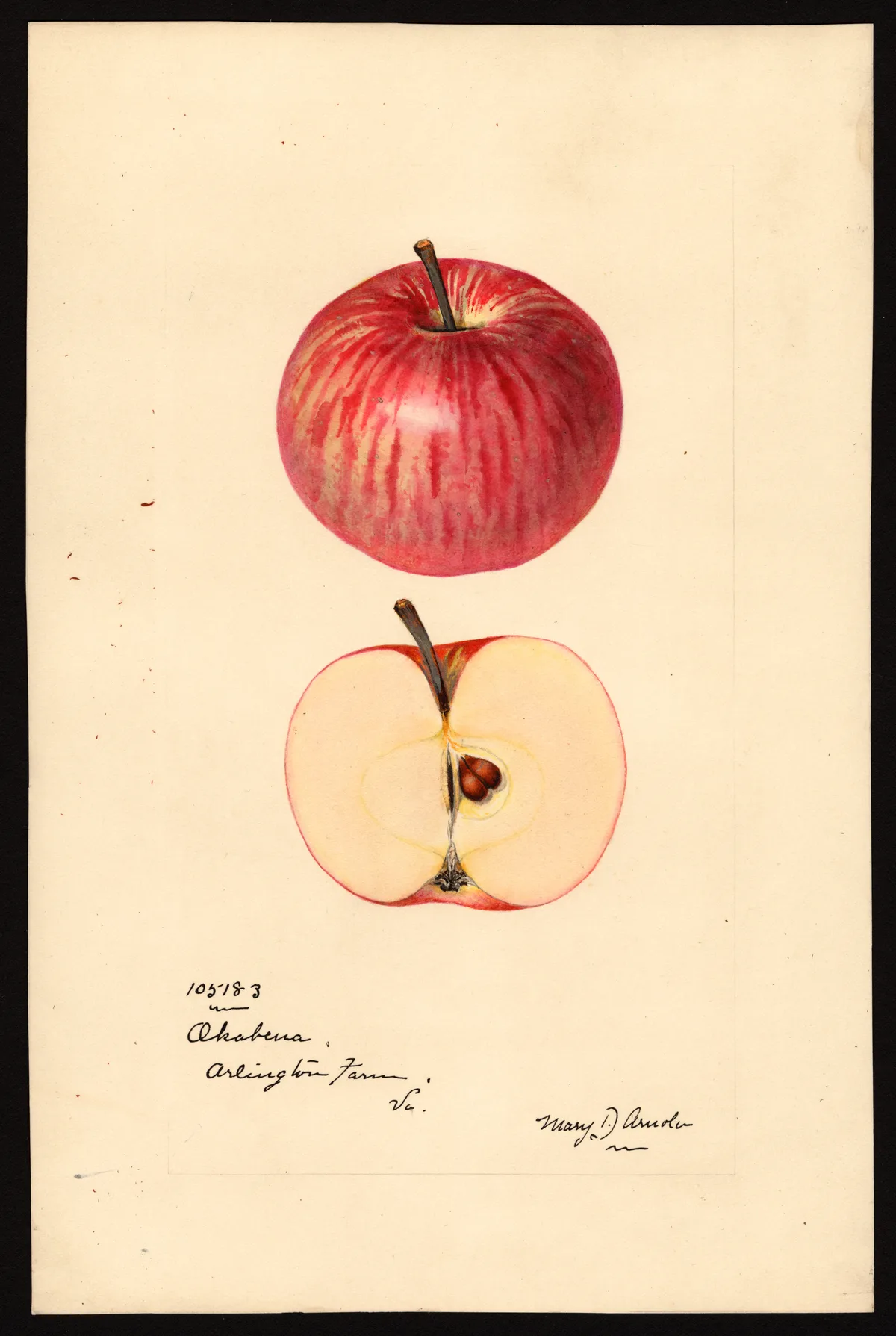
USDA Pomological Watercolor Collection
Okabena
Origin/History
Originated in 1871 near Worthington, Minnesota, from seed of Oldenburg said to be fertilized by Wealthy. Received for testing at this Station in 1892 from the Jewel Nursery Company, which introduced the variety. In 1899 it was given a place on the list of the American Pomological Society as a variety of value in the Upper Mississippi valley. Grown in the East only in an experimental way.
Tree
Not described in source.
Fruit
Not described in source.
Season
Autumn.
Uses
Not described in source.
Subtypes/Variants
Not described in source.
Other
Beach's assessment: Not particularly attractive in appearance; moderately good in quality. Not recommended for planting in New York.
Book Sources
Described in 1 period pomological work
Nursery Catalog Sources
Found in 3 catalogs (1912–1921) from Oregon
- Pacific Nursery Company , Portland , Oregon — 1912
- Union Nurseries , J.B. Weaver & Sons, Union , Oregon — 1915
- Benedict Nursery Co. , Portland , Oregon — 1921
View original book sources (1)
— S.A. Beach, The Apples of New York, Vol. 2 (1905)OKABENA.
REFERENCES. 1. Am. Pom. Soc. Rpt., 1887:132. 2. Ib., Cat., 1899:19. 3. Macoun, Can. Dept. Agr. Rpt., 1901:97. 4. Hansen, S. D. Sta. Bul., 76:78. 1902. fig. 5. Dickens and Greene, Kan. Sta. Bul., 106:54. 1902. 6. Munson, Me. Sta. An. Rpt., 18:84. 1902. 7. Budd-Hansen, 1903:141. fig.
SYNONYMS. OKABENA (1, 2, 3, 4, 5, 7). OKOBENA (6).
An autumn apple not particularly attractive in appearance, nor more than moderately good in quality. Not recommended for planting in New York.
Historical. Originated in 1871 near Worthington, Minn., from seed of Oldenburg said to be fertilized by Wealthy (7). Received for testing at this Station in 1892, from the Jewel Nursery Company which introduced this variety. In 1899 it was given a place on the list of the American Pomological Society as a variety of value in the Upper Mississippi valley (2). So far as we can learn it has been grown in the East only in an experimental way.