Milwaukee
Apple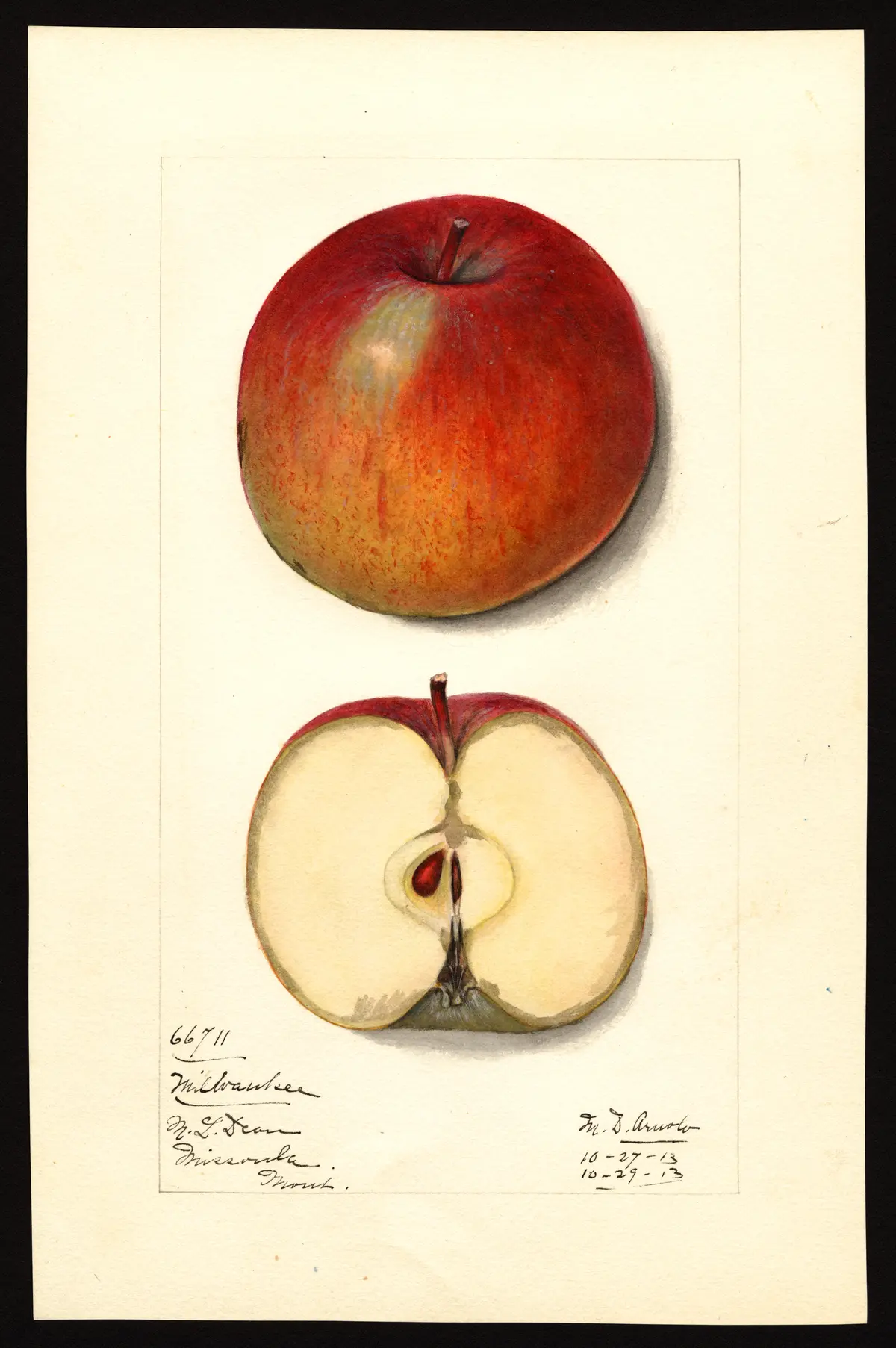
USDA Pomological Watercolor Collection
Milwaukee
Origin/History
Originated with George Jeffry, Milwaukee, Wis., from seed of Oldenburg.
Tree
Tree moderately vigorous; branches long, slender, crooked. Form open, upright, becoming rather spreading with laterals inclined to droop. Twigs medium to long, varying from irregularly curved to straight, moderately stout; internodes generally long. Bark dark reddish-brown approaching black, streaked with grayish scarf-skin, quite pubescent. Lenticels quite numerous, small to medium, roundish or elongated, not raised. Buds medium or below, plump, obtuse to somewhat acute, free or slightly appressed, pubescent.
Tree very hardy, healthy, a pretty good grower and a good cropper. Comes into bearing young and is almost an annual bearer.
Fruit
Fruit usually rather large, pretty uniform in size and shape. Form distinctly oblate, regular or obscurely ribbed; sides often unequal.
Stem pubescent, short.
Cavity rather large, acute to acuminate, deep, broad, furrowed, russeted and with outspreading brown russet rays.
Calyx pubescent, large, leafy, usually partly open, sometimes closed; lobes wide, long, acute.
Basin large, often oblique, deep, wide, abrupt to somewhat obtuse, furrowed, wrinkled.
Skin thin, tough, smooth, glossy, pale yellow or whitish more or less blushed with red which in highly colored specimens deepens to a lively pinkish-red, conspicuously mottled and striped with rose-carmine. Dots numerous, small, whitish, often submerged, occasionally russet.
Calyx tube urn-shape to somewhat funnel-form with short cylinder and wide limb. Stamens median.
Core distant, a little abaxile, usually small; cells sometimes unsymmetrical, closed or slightly open; core lines clasping. Carpels elliptical to roundish obcordate, mucronate, but slightly emarginate if at all.
Seeds few, often abortive, medium to short, wide, flat, obtuse.
Flesh whitish tinged with yellow, firm, somewhat coarse, crisp, very tender, very juicy, sprightly, brisk subacid, fair to good.
Season
In season from October to January. Some portion of the fruit may keep till February or March. In ordinary storage there is a rather high percentage of loss after early winter, but fruit which remains till spring retains well its acidity and quality.
Uses
Too briskly acid for a good dessert apple. Suitable for culinary use and for market. Would be more desirable for market if it had more red color.
Other
A winter fruit of the Oldenburg group, of good size and when highly colored fairly attractive in appearance, being clear yellow marked with bright red somewhat after the manner of Oldenburg. Appears worthy of testing in the northern and more elevated regions where hardiness is a prime requisite.
Book Sources
Described in 1 period pomological work
View original book sources (1)
— S.A. Beach, The Apples of New York, Vol. 1 (1905)MILWAUKEE.
REFERENCES. 1. Macoun, Can. Dept. Agr. Rpt., 1899:77. 2. Ib., Can. Hort., 23:452. 1900. 3. Hansen, S. D. Sta. Bul., 76:74. 1902. 4. Farrand, Mich. Sta. Bul., 205:45. 1903. 5. Erwin, Am. Pom. Soc. Rpt., 1903:252. 6. Budd-Hansen, 1903:128. fig. 7. National Nurseryman, March, 1905:52.
Milwaukee is a winter fruit of the Oldenburg group, of good size and when highly colored fairly attractive in appearance, being clear yellow marked with bright red somewhat after the manner of Oldenburg. It is too briskly acid for a good dessert apple, but rather is suitable for culinary use and for market. It would be more desirable for market if it had more red color. It is in season from October to January. Some portion of the fruit may keep till February or March, but in ordinary storage there is a rather high percentage of loss after early winter. The fruit which remains till spring retains well its acidity and quality. The tree is very hardy, healthy, a pretty good grower and a good cropper. It comes into bearing young and is almost an annual bearer. It appears to be worthy of testing in the northern and more elevated regions of the state where hardiness is a prime requisite.
Historical. Originated with George Jeffry, Milwaukee, Wis., from seed of Oldenburg (1, 3, 5, 6).
TREE.
Tree moderately vigorous; branches long, slender, crooked. Form open, upright, becoming rather spreading with laterals inclined to droop. Twigs medium to long, varying from irregularly curved to straight, moderately stout; internodes generally long. Bark dark reddish-brown approaching black, streaked with grayish scarf-skin, quite pubescent. Lenticels quite numerous, small to medium, roundish or elongated, not raised. Buds medium or below, plump, obtuse to somewhat acute, free or slightly appressed, pubescent.
FRUIT.
Fruit usually rather large, pretty uniform in size and shape. Form distinctly oblate, regular or obscurely ribbed; sides often unequal. Stem pubescent, short. Cavity rather large, acute to acuminate, deep, broad, furrowed, russeted and with outspreading brown russet rays. Calyx pubescent, large, leafy, usually partly open, sometimes closed; lobes wide, long, acute. Basin large, often oblique, deep, wide, abrupt to somewhat obtuse, furrowed, wrinkled.
Skin thin, tough, smooth, glossy, pale yellow or whitish more or less blushed with red which in highly colored specimens deepens to a lively pinkish-red, conspicuously mottled and striped with rose-carmine. Dots numerous, small, whitish, often submerged, occasionally russet.
Calyx tube urn-shape to somewhat funnel-form with short cylinder and wide limb. Stamens median.
Core distant, a little abaxile, usually small; cells sometimes unsymmetrical, closed or slightly open; core lines clasping. Carpels elliptical to roundish obcordate, mucronate, but slightly emarginate if at all. Seeds few, often abortive, medium to short, wide, flat, obtuse.
Flesh whitish tinged with yellow, firm, somewhat coarse, crisp, very tender, very juicy, sprightly, brisk subacid, fair to good.