Manx Codlin
Apple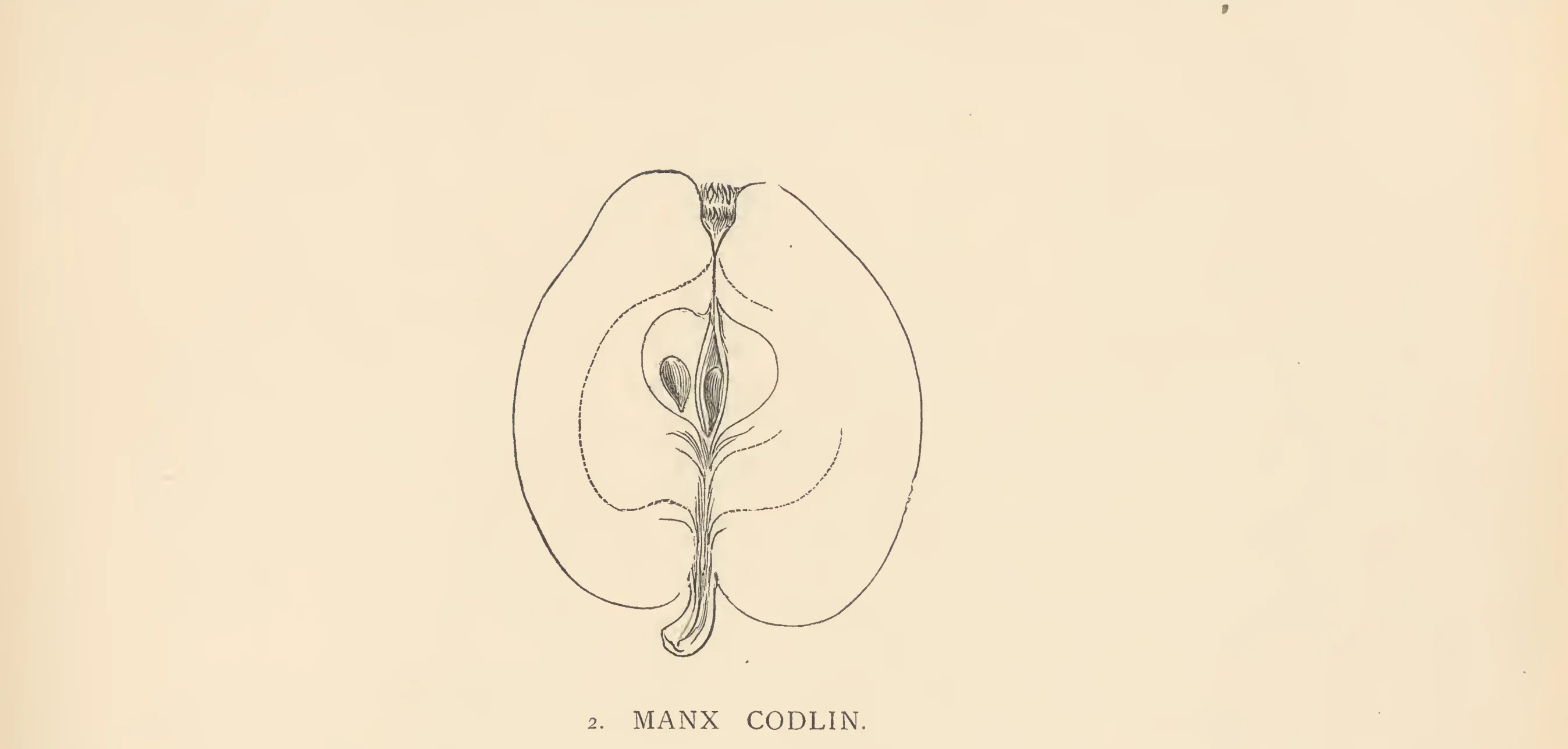
Manx Codlin
Origin / History
Raised by Mr. Kewley, of Ballanard, Isle of Man, and first fruited in 1815 (Bunyard, 1920). Elliott (1865) classes it as foreign. Downing calls it "an old English culinary Apple, long cultivated and esteemed here as well as abroad for its productiveness, hardiness of tree, and early bearing habit." Bunyard reports it "still much grown in the North of England" and "one of the best cooking apples there." Planted under test at the Central Experimental Farm, Agassiz, British Columbia, in spring 1896.
Tree
Tree very hardy and healthy (Herefordshire Pomona). Its size is in conflict between sources. The Herefordshire Pomona calls the tree not large, and Bunyard gives growth very compact and dwarfish. At Agassiz it was a vigorous grower.
Well adapted for growing as a bush on the paradise stock or as an espalier. Well suited for planting in exposed situations, and succeeds well in shallow soils (Herefordshire Pomona). Leaf narrow-oval, broadly serrate (Bunyard).
A very early and abundant bearer, often producing fruit when only two years old from the graft (Herefordshire Pomona); fertility great (Bunyard). An early bearer at Agassiz.
Fruit
Size: Medium; 2½ by 2½ (Bunyard).
Form: Conical, slightly angular to irregular and five-sided, oblique, with one side of the apex end higher than the other (Downing). The sources conflict on the outline. Elliott and Downing give roundish oblong and Bunyard oval-conical, while the Agassiz station calls it oblate, obliquely conical.
Stem: Three-quarters of an inch long, more or less fleshy, sometimes straight but generally obliquely inserted, and occasionally united to the fruit by a fleshy protuberance on one side of it (Herefordshire Pomona). Rather stout (Bunyard).
Cavity: Fairly deep, wide (Bunyard).
Calyx: Eye small to very small, closed.
Basin: Small, pretty deep, plaited (Herefordshire Pomona) or ribbed (Bunyard).
Skin: Smooth (Herefordshire Pomona). Greenish yellow at first, changing as it ripens to clear pale or light yellow; yellow-green (Bunyard). The sun side carries a slight red flush, a little blush at times, or a red cheek. The Herefordshire Pomona gives it tinged with rich orange on the side next the sun, sometimes, when fully exposed, assuming a clear bright red cheek. Downing gives a bronzed cheek in sun. The George Bunyard & Co. catalog gives pale greenish yellow, striped and spotted with red.
Dots: Not described in source.
Flesh and flavor: Yellowish white to white; firm, fine, crisp, juicy. Flavor brisk, subacid, pleasantly subacid (Agassiz), slightly perfumed (Herefordshire Pomona); acid (Bunyard). Quality "good" (Downing; Agassiz). The Herefordshire Pomona calls it an early culinary apple "of first-rate quality."
Core and seeds: Not described in source.
Season
An early apple. Most authors give ripe in August and in use until November; the Herefordshire Pomona has it ripe in the beginning of August. Elliott gives August alone. At Agassiz, British Columbia, the season was September and October. [NOTE: Source text may be incorrect — the George Bunyard & Co. catalog (1901) gives "Season Mar-Sept," which is incompatible with every other source's August-to-November season and is probably garbled.]
Uses
Culinary; "cooking only" (Elliott). The Herefordshire Pomona calls it "a very valuable early culinary apple," and the George Bunyard & Co. catalog calls it "a very fine kitchen apple."
Subtypes / Variants
Not described in source.
Other
Bunyard cites Ronalds, p. 3. Figured in the Herefordshire Pomona, Plate VI.
Book Sources
Described in 4 period pomological works
Nursery Catalog Sources
Found in 2 catalogs (1900–1911) from England
- Central Experimental Farm , Dominion Department of Agriculture, Agassiz, British Columbia (under test; Bulletin No. 3, Second Series) — 1900
- James Veitch & Sons , Ltd., Royal Exotic Nursery, Chelsea, London (also Coombe Wood, Langley, and Feltham) , England — 1911
View original book sources (6)
— F.R. Elliott, The Western Fruit Book (1865)Mank's Codlin. Irish Pitcher, | Frith Pitcher. Foreign. Medium, roundish oblong, pale yellow, red cheek in sun ; cooking only. August.
— Woolhope Naturalists Field Club, The Herefordshire Pomona (1885)Plate VI.
- MANX CODLIN.
[Syn: Irish Pitcher; Irish Codlin; Eve; Frith Pippin?]
Description.—Fruit; medium sized, conical, slightly angular. Skin smooth, greenish yellow at first, but changing as it ripens to clear pale yellow, tinged with rich orange on the side next the sun, but sometimes when fully exposed, assuming a clear bright red cheek. Eye; small and closed, set in a small, plaited, and pretty deep basin. Stalk; three quarters of an inch long, more or less fleshy, sometimes straight, but generally obliquely inserted, and occasionally united to the fruit by a fleshy protuberance on one side of it. Flesh; yellowish white, firm, brisk, juicy and slightly perfumed.
A very valuable early culinary apple of first-rate quality. It is ripe in the beginning of August and continues in use till November.
The tree is not large but very hardy and healthy, well adapted for growing as a bush on the paradise stock, or as an espalier. It is well suited for planting in exposed situations, and succeeds well in shallow soils. It is a very early and abundant bearer, often producing fruit when only two years old from the graft.
— A.J. Downing, The Fruits and Fruit Trees of America (1900)Mank's Codlin. Irish Pitcher. Frith Pitcher. Irish Codlin. Eve of Scotland. Frith Pippin. An old English culinary Apple, long cultivated and esteemed here as well as abroad for its productiveness, hardiness of tree, and early bearing habit. Fruit medium, roundish oblong conical, one side of apex end higher than the other, clear pale yellow, with a bronzed cheek in sun. Flesh yellowish white, fine crisp, brisk subacid. Good. August to November.
— E.A. Bunyard, A Handbook of Hardy Fruits (1920)MANK'S CODLIN. Ronalds, p. 3. F., Codlin de Mank ; G., Manck's Kuchenapfel. (Belmont, Eve, Irish Codlin, Pitcher.) Culinary, August to November, medium, 2½ by 2½, oval-conical, irregular, five sided. Colour, yellow-green with slight red flush. Flesh, firm, white, acid. Eye, very small, closed in a ribbed basin. Stem, rather stout, in a fairly deep, wide cavity. Growth, very compact and dwarfish ; fertility great. Leaf, narrow-oval, broadly serrate. Origin, this was raised by Mr. Kewley, of Ballanard, Isle of Man, and first fruited in 1815. It is still much grown in the North of England and is one of the best cooking apples there.
— Central Experimental Farm, Central Experimental Farm, Agassiz BC — Catalogue of Fruit Trees under Test (Bulletin No. 3, 1900) (1900)Planted Spring 1896. Tree a vigorous grower and an early bearer. Fruit medium, oblate, obliquely conical. Skin clear light yellow, with a little blush at times. Flesh white, crisp, juicy, pleasantly sub-acid, quality good. Season September and October.
— George Bunyard & Co., George Bunyard Fruit Catalogue (1901) (1901)Medium sized, pale greenish yellow striped and spotted with red. Season Mar-Sept. A very fine kitchen apple.