Bottle Greening
Apple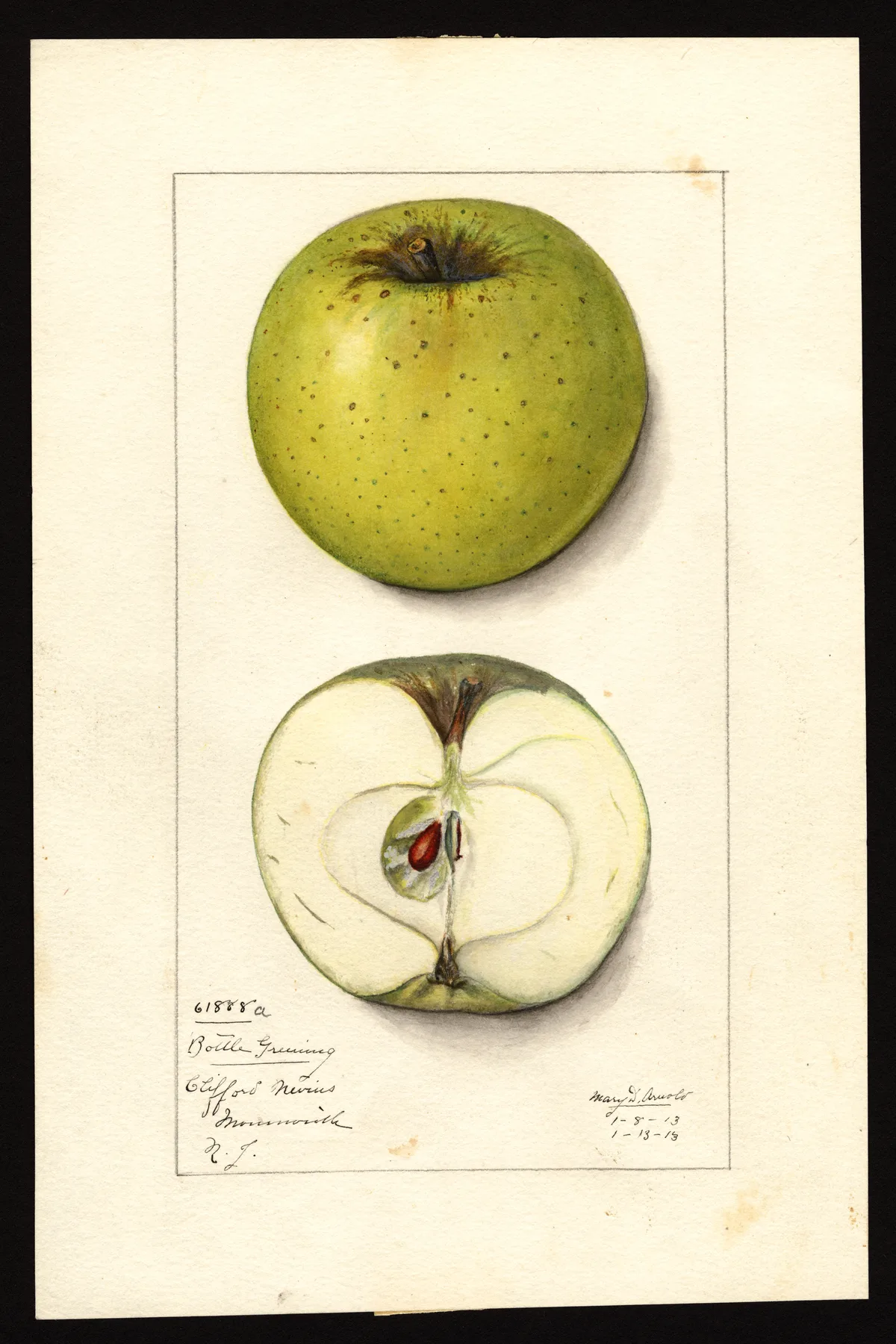
USDA Pomological Watercolor Collection
Bottle Greening
Origin/History
Bottle Greening originated as a chance seedling on a farm on the dividing line of New York and Vermont. The original tree was still standing about half a century before Beach's 1905 account. Its name is derived from a hollow in the trunk that workmen found a convenient place for keeping their "bottle." It was introduced to wider notice and disseminated by Eben Wight of Dorchester, Massachusetts (Downing). By the time of Beach's writing it was still handled by nurserymen but was not being much planted in New York state.
Tree
Tree medium in size (Beach), described by Downing as a fine, vigorous grower. Vigor characterized by Beach as moderate. Branches moderately long, stout, and crooked, with yellowish bark. Downing describes the form as spreading; Beach describes it as rather round and open. Twigs medium in length, straight, rather stout, with short to medium internodes. Bark on twigs olive-green mingled with reddish-brown, pubescent and covered with thin scarf-skin. Downing describes the young wood as reddish yellow, consistent with Beach's characterization of the branch bark as yellowish and the twig bark as olive-green with reddish-brown. Lenticels scattering, very small to medium, round, inconspicuous. Buds large to medium, broad, acute, appressed, heavily pubescent. Leaves medium, broad.
Fruit
Size: Medium to large (Beach). Downing gives no explicit size.
Form: Roundish oblate to ovate, inclined to conic, pretty regular, sometimes obscurely ribbed, fairly symmetrical; sides sometimes unequal (Beach). Downing describes the form simply as oblate inclining.
Stem: Rather short (both sources agree).
Cavity: Acuminate, moderately deep, rather broad; sometimes lipped, sometimes indistinctly furrowed or compressed (Beach). Downing describes the cavity simply as broad.
Calyx: Rather large, closed or somewhat open (Beach). Downing describes it as closed.
Basin: Abrupt, medium in depth, rather narrow to moderately wide, often slightly furrowed, sometimes wrinkled (Beach). Downing describes the basin as small and corrugated — somewhat at variance with Beach's "medium in depth, rather narrow to moderately wide."
Skin: Thin, tough, smooth. Ground color grass-green or yellowish, thinly washed or often deeply blushed with dull pinkish-crimson; not striped (Beach). Downing describes the color as greenish-yellow, shaded with dull crimson in the sun, with a slight bloom. The prevailing color is green, but the variety is more blushed than Rhode Island Greening (Beach). Dots few, usually submerged, pale and inconspicuous; a few scattering dots are russet (Beach). Downing describes the dots as light and thinly sprinkled.
Flesh and Flavor: Nearly white (Beach; Downing says white), moderately firm, very tender, very juicy, peculiarly aromatic, with a pleasant subacid flavor. Downing characterizes the texture as almost melting. Quality rated good to very good (Beach); Downing rates it Very Good. Described by Beach as excellent for culinary use and good for dessert.
Core and Seeds: Core rather small (both sources agree), somewhat abaxile; cells often closed towards the apex and open at the base; core lines slightly clasping. Carpels broad, roundish to obcordate. Seeds medium, acute. Calyx tube rather large, conical. Stamens median (Beach).
Season
Downing gives the season as January–February. Beach gives the full season as October to March or later, with a commercial season of October to January.
Uses
Much esteemed by a few growers for culinary use; good for dessert. Most growers and buyers find it unsatisfactory as a commercial apple. Said to succeed particularly well on sandy or gravelly loam, usually bearing annually. The fruit usually hangs well to the tree.
Other
Because of its tender skin and light color, the fruit shows the least bruise plainly and requires very careful handling. It is even more apt to scald in storage than Rhode Island Greening. The tree is regarded as healthy, hardy, and productive. Beach cites references in the American Journal of Horticulture and Florists' Companion (1:357, 1866–67), Downing (1872), Bailey's An. Hort. (1892), Lyon's Michigan Station bulletins (1898, 1899), Lyon's Michigan Horticultural Society Report (1890), and Waugh's Vermont Station Annual Report (1901).
Book Sources
Described in 2 period pomological works
Nursery Catalog Sources
Found in 2 catalogs (1893–1912) from Washington
- Milwaukie-Canby Nurseries , Canby, OR (and Milwaukie, OR) — 1893
- Ballygreen Nurseries , Hanford , Washington — 1912
View original book sources (2)
— A.J. Downing, The Fruits and Fruit Trees of America (1900)Bottle Greening. This variety was found near the Vermont and New York State line, and takes its name from a hollow in the original tree, where workmen were accustomed to keeping their bottle. It was introduced to notice and disseminated by Eben Wight, of Dorchester, Mass. Tree a fine grower, vigorous, spreading. Young wood reddish yellow. Fruit in form, oblate inclining greenish-yellow, shaded with dull crimson in the sun, a slight bloom, and thinly sprinkled with light dots. Stalk rather short. Cavity broad. Calyx closed. Basin small, corrugated. Flesh white, subacid, almost melting. Core small. Very good. January, February.
— S.A. Beach, The Apples of New York, Vol. 1 (1905)BOTTLE GREENING.
REFERENCES. 1. Amer. Jour. Hort. and Florists' Companion, 1:357. 1866-67. 2. Downing, 1872:103. 3. Bailey, An. Hort., 1892:235. 4. Lyon, Mich. Sta. Bul., 152:220. 1898. 5. Ibid., 169:179. 1899. 6. Lyon, Mich. Hort. Soc. Rpt., 1890:290. 7. Waugh, Vt. Sta. An. Rpt., 14:290. 1901.
Much esteemed by a few growers because the tree is healthy, hardy and productive, and the fruit is excellent for culinary use and good for dessert. It is rather attractive in color for an apple of the Greening class. Because of its tender skin and light color it shows the least bruise plainly. For this reason it requires very careful handling. It is even more apt to scald in storage than Rhode Island Greening. Most growers and buyers find it unsatisfactory as a commercial apple. It is said to succeed particularly well on sandy or gravelly loam, usually bearing annually. The fruit usually hangs well to the tree.
Historical. It originated as a chance seedling on a farm on the dividing line of New York and Vermont where the original tree was still standing about a half century ago. Its name is derived from the fact that workmen found the hollow in this old tree a convenient place for the "bottle" (1). It is still handled by nurserymen (3) but is not being much planted in this state.
TREE.
Tree medium in size, moderately vigorous; branches moderately long, stout, crooked, with yellowish bark. Form rather round and open. Twigs medium in length, straight, rather stout; internodes short to medium. Bark olive-green mingled with reddish-brown, pubescent and covered with thin scarf-skin. Lenticels scattering, very small to medium, round, inconspicuous. Buds large to medium, broad, acute, appressed, heavily pubescent. Leaves medium, broad.
FRUIT.
Fruit medium to large. Form roundish oblate to ovate, inclined to conic, pretty regular, sometimes obscurely ribbed, fairly symmetrical, sides sometimes unequal. Stem rather short. Cavity acuminate, moderately deep, rather broad, sometimes lipped, sometimes indistinctly furrowed or compressed. Calyx rather large, closed or somewhat open. Basin abrupt, medium in depth, rather narrow to moderately wide, often slightly furrowed, sometimes wrinkled. Skin thin, tough, smooth, grass-green, or yellowish, thinly washed or often deeply blushed with dull pinkish-crimson, not striped. Dots few, usually submerged, pale and inconspicuous; a few scattering ones are russet. Prevailing color green but more blushed than Rhode Island Greening. Calyx tube rather large, conical. Stamens median. Core rather small, somewhat abaxile; cells often closed towards apex and open at base; core lines slightly clasping. Carpels broad, roundish to obcordate. Seeds medium, acute. Flesh nearly white, moderately firm, very tender, very juicy, peculiarly aromatic, pleasant subacid, good to very good. Season October to March or later. Commercial season October to January.