Peck's Pleasant
Apple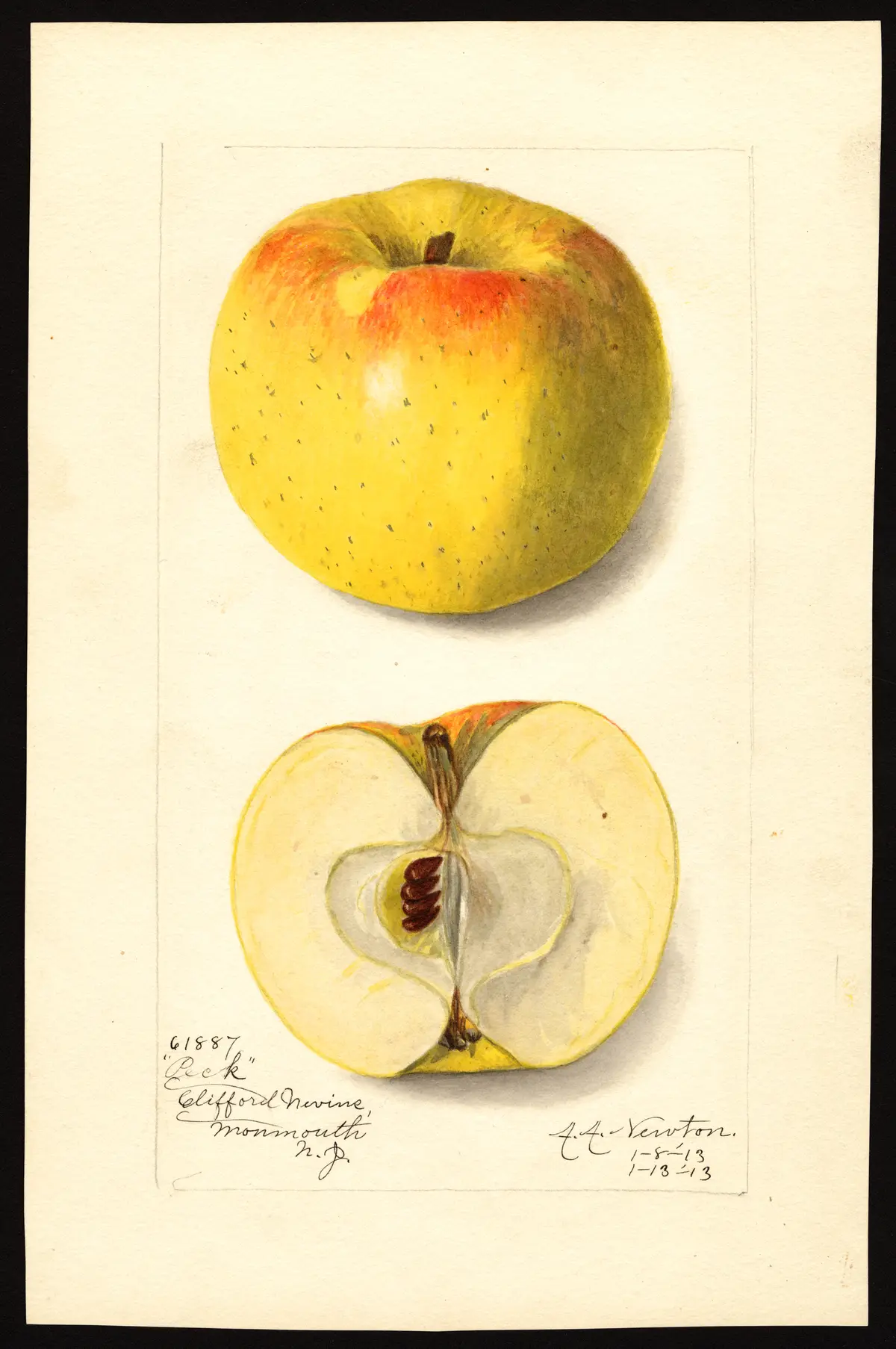
USDA Pomological Watercolor Collection
Peck's Pleasant
Origin / History
Peck's Pleasant is an American variety, a native of Rhode Island, where it originated early in the nineteenth century and was long cultivated, as well as in the northern part of Connecticut. In 1845 Downing expressed the opinion that it originated in Rhode Island and noted its longstanding cultivation in that state and in Northern Connecticut. Beach (1905) records that it had been pretty thoroughly disseminated throughout New York state but was found chiefly in the older orchards and was by then seldom or never planted. In 1890 Lyon reported concerning its status in Michigan that it was generally and deservedly popular, the fruit being beautiful and excellent, and the tree in habit like Rhode Island Greening but less vigorous. The variety has been said to be known locally in some portions of New York state under the name Dutch Greening. Beach places it in the same group with Green Newtown, Rhode Island Greening, and Perry Russet. Warder (1867) notes that this apple has been said to resemble the Newtown Pippin, but he could trace no resemblance except that both are green, and adds that there is no danger of the merest tyro in pomology confounding the two varieties; Downing, on the other hand, describes Peck's Pleasant as a first-rate fruit belonging to the Newtown Pippin class, considerably resembling the Yellow Newtown Pippin, with more tender flesh, and scarcely inferior to it in flavor. Thomas likewise compares the flavor to that of the Newtown Pippin. Warder also observes that there is a remarkable diversity in the fruit arising from the different soils and climates in which it is cultivated, North and South, and while, like many other varieties, its size is greatly developed in the South, its texture and flavor are depreciated in migrations southward; Thomas remarks that it is "tender far West." Hedrick (1922) notes that many spreading, lichen-covered ancients of this old sort are to be found in the dooryards and farm orchards of New York and New England, testimonials to the esteem in which lovers of fruit hold it.
Tree
Tree medium in size, healthy in some accounts but in others subject to root-rot and canker and not considered as long-lived nor as healthy as either Baldwin or Rhode Island Greening (Beach). Vigor variable across sources: Warder calls it moderately vigorous but productive and a regular bearer; Budd-Hansen call it spreading, of moderate vigor, productive and a regular bearer; Downing describes a moderate, upright spreading grower that bears regularly and well; Beach calls it moderately vigorous or a rather slow grower; Hedrick describes it as vigorous, upright-spreading or round, dense; Elliott describes the shoots as rather erect, slightly diverging, vigorous, and productive; Thomas calls the growth rather erect with shoots somewhat diverging, a good bearer with fruit always fair; the Central Experimental Farm (Agassiz BC, 1900) reports it a vigorous grower but a light bearer. Beach also notes it has the reputation of being often a shy bearer, that in some localities it may bear pretty regularly but only occasionally gives full crops, and that there is apt to be a rather high percentage of loss from ill-shapen, undersized, or otherwise unmarketable fruit. The apples on the lower branches of old trees are flat, while those on the upper branches are nearly conical (Downing). Form upright spreading or roundish, rather dense (Beach); upright-spreading or round, dense (Hedrick). Young shoots reddish brown, slightly downy (Downing). Twigs medium to short, nearly straight, moderately stout; internodes medium to short. Bark brown tinged with red often mingled with olive-green, lightly streaked with scarf-skin; slightly pubescent near tips. Lenticels quite numerous, small, oblong or roundish, not raised. Buds very deeply set in bark, medium to small, broad, plump, obtuse to acute, appressed to nearly free, pubescent (Beach).
Fruit
Size
Variable; medium (Lowther); above medium size (Downing, Central Experimental Farm); medium to sometimes large (Beach, Hedrick); medium to large (Elliott); large, often quite large (Thomas); large (Warder, Budd-Hansen). The better grades of the fruit are of good size and attractive appearance (Beach). Somewhat variable in shape and size.
Form
Flattened, globular, somewhat angular, or flattened, sometimes having a shallow sulcus or furrow on one side (Warder); roundish, a little ribbed, and slightly flattened, with an indistinct furrow on one side (Downing); roundish, slightly (sometimes very much) flattened, with an indistinct furrow on one side (Elliott); roundish, sometimes remotely oblong, often a little oblique, usually slightly flattened, smooth and regular (Thomas); roundish, somewhat angular or flattened, with a shallow furrow on one side (Budd-Hansen); oblate to roundish, sometimes a little inclined to conic, often obscurely ribbed or irregularly elliptical, sometimes with furrow on one side (Beach); oblate or round, sometimes conic, often ribbed or irregularly elliptical, sometimes with furrow on one side (Hedrick); round (Lowther); roundish (Central Experimental Farm).
Stem
Short, very thick, clubbed or knobby (Warder); peculiarly fleshy and flattened, short (Downing); very thick, fleshy, knobby, very short (Budd-Hansen); varies, mostly short and fleshy (Elliott); very short, one-fourth to one-half an inch long, thick, rarely longer and somewhat slender (Thomas); medium to short and usually thick or fleshy (Beach); short, thick or fleshy (Hedrick).
Cavity
Wide, but often lipped, brown (Warder); wide, rather wavy cavity (Downing, who notes the stalk is sunk in this); broad, open, and almost always with a slight ridge or wave on one side, connecting with stem (Elliott); wide, rather wavy (Budd-Hansen); variable, obtuse or sometimes acute, rather wide, shallow to deep, nearly symmetrical or a little furrowed, often lipped or compressed, sometimes partly russeted (Beach); obtuse, wide, shallow, often lipped or compressed, sometimes russeted (Hedrick).
Calyx
Small and open, calycinal segments being short (Warder); woolly, sunk in a narrow, abruptly, and pretty deeply sunk basin (Downing); medium size, usually segments half open (Elliott); open, basin abrupt, rather deep (Thomas); small, open; segments short (Budd-Hansen); pubescent, medium to rather large; lobes long, open or closed, sometimes distinctly separated at the base, rather obtuse (Beach); pubescent, large; lobes long, open or closed, sometimes separated at the base, obtuse (Hedrick).
Basin
Rather shallow and folded (Warder); narrow, abruptly, and pretty deeply sunk (Downing); round, regular (Elliott); abrupt, rather deep (Thomas); narrow, abrupt, rather deep (Budd-Hansen); varies from broad to rather narrow, from obtuse to abrupt, and from nearly symmetrical to irregular and furrowed or wrinkled (Beach); broad, obtuse, symmetrical, furrowed or wrinkled (Hedrick).
Skin
Surface smooth, yellow or orange, being sometimes faintly blushed (Warder); smooth, and when first gathered, green, with a little dark red; but when ripe a beautiful clear yellow, with bright blush on the sunny side and near the stalk (Downing); when first gathered, green, with a little dark red — when ripe, a beautiful clear yellow, with bright blush on sunny side (Elliott); light green, becoming yellow, with a brown blush (Thomas); surface smooth, a beautiful clear yellow, with bright blush (Budd-Hansen); yellowish with a bright blush on the sunny side (Central Experimental Farm); moderately thick, tough, smooth, green becoming bright waxen yellow with orange-red blush, sometimes partly deepening to pink; prevailing effect yellow (Beach); thick, tough, smooth, waxen yellow with orange-red blush (Hedrick); yellow-red (Lowther). Beach notes the color is good for a yellow apple, being at first predominantly green, but as the fruit approaches full maturity becomes waxen-yellow with an orange or pinkish blush. Hedrick: "unique in color waxen yellow with an orange or pinkish blush."
Dots
Gray, with white bases (Warder); scattered gray dots, marked across the skin (Downing); scattered gray dots which become small and almost indistinct near the apex (Elliott); few, gray, with white bases (Budd-Hansen); numerous, whitish and submerged or with russet point (Beach); numerous, white and submerged or with russet point (Hedrick).
Flesh / Flavor
Yellow, tender, breaking, fine-grained; flavor sub-acid and somewhat aromatic; of first quality in the North (Warder). Yellowish, fine-grained, juicy, crisp and tender, with a delicious, high aromatic sprightly subacid; very good or best (Downing). Yellowish white, fine grained, firm, yet tender, juicy, mild, aromatic, sub-acid (Elliott). Compact, very tender, with a mild, rich, fine, clear sub-acid, Newtown Pippin flavor; poor, if too ripe (Thomas). Yellowish, very tender, fine-grained, crisp, juicy, delicious aromatic, sprightly subacid, very good or best (Budd-Hansen). Yellowish, tender, juicy, mildly acid, with a fine aromatic flavour, quality very good (Central Experimental Farm). Tender, pleasantly flavored, very good to best in quality; more highly esteemed for dessert than for culinary uses; yellowish, firm, tender, crisp, fine-grained, juicy, pleasant subacid, aromatic, very good to best; toward the close of the season it becomes inferior in quality although it may appear to be still in good condition (Beach). Yellow, firm, tender, crisp, fine-grained, juicy, pleasant subacid, aromatic; very good to best (Hedrick). Tender-fleshed and perfumed (Hedrick). Quality: very good (Lowther).
Core / Seeds
Core large, closed, clasping the eye; seeds numerous, angular (Warder, Budd-Hansen — Budd-Hansen: core large, closed, clasping; seeds many, angular). Core medium (Elliott); seeds abundant, ovate, dark reddish brown (Elliott). Beach: calyx tube funnel-form; stamens basal; core medium to rather small, abaxile to nearly axile; cells not uniformly developed, usually closed or slit; core lines clasp the funnel cylinder; carpels rather tender, broadly roundish, often nearly truncate, emarginate, mucronate; seeds numerous, rather dark, long, narrow, acute, below medium or above, sometimes slightly tufted. Hedrick: core small, abaxile to axile; cells usually closed or slit; core-lines clasp the funnel cylinder; carpels tender, broadly round, often truncate, emarginate, mucronate; seeds numerous, dark, long, narrow, acute, sometimes tufted.
Season
December to January, or later (Warder); November to March (Downing); December to February, often keeps to April (Elliott); early winter (Thomas, Budd-Hansen); winter (Lowther); November and December (Central Experimental Farm); October to January (Hedrick); season for home use extends from October to March; ordinarily February is its commercial limit in Western New York, but in cold storage it may be held till April (Beach). The fruit very often scalds in storage, but it is less apt to do so if placed in cold storage immediately after picking (Beach). Toward the close of the season it becomes inferior in quality although it may appear to be still in good condition (Beach); poor, if too ripe (Thomas). Elliott notes that on sandy soils the fruit is of firmer texture than on clays, and keeps better, but is not so large.
Uses
Table, kitchen, or market (Warder); both kitchen and market (Lowther); the fruit commands a high price in the market (Downing); more highly esteemed for dessert than for culinary uses (Beach); distinctly a fruit for family use (Hedrick).
Subtypes / Variants
Not described in source.
Other
Not described in source.
Book Sources
Described in 8 period pomological works
- Warder, American Pomology: Apples (1867)
- Beach, The Apples of New York Vol. 1 (1905) — listed as PECK PLEASANT
- Downing, Fruits and Fruit Trees of America (1900)
- Elliott, The Western Fruit Book (1865)
- Lowther (ed.), Encyclopedia of Practical Horticulture (1914)
- Budd & Hansen, Systematic Pomology (1914) — listed as Peck Pleasant
- Hedrick, Cyclopedia of Hardy Fruits (1922) — listed as PECK PLEASANT
- Thomas, The American Fruit Culturist (1903) — listed as Peck Pleasant
Nursery Catalog Sources
Found in 16 catalogs (1845–1921) from California, Illinois, Massachusetts, Oregon, Washington
- Winship's Nursery (Brighton Nurseries , operated by the Winship family), Brighton (Boston) , Massachusetts — 1845
- Hovey & Co. , Cambridge , Massachusetts — 1849
- Azell Bowditch (Nursery / Fruit Catalog) , Boston , Massachusetts — 1850
- Felix Gillet , Barren Hill Nursery, Nevada City , California — 1884
- California Nursery Co. , Niles , California — 1889
- Milwaukie-Canby Nurseries , Canby, OR (and Milwaukie, OR) — 1893
- Sherwood Hall Nursery Co. , Timothy Hopkins (Menlo Park Nurseries), San Francisco / Menlo Park , California — 1893
- Woodburn Nurseries , Woodburn, Marion Co. , Oregon — 1894
- Central Experimental Farm , Dominion Department of Agriculture, Agassiz, British Columbia (under test; Bulletin No. 3, Second Series) — 1900
- Washington Nursery Co. , Toppenish , Washington — 1901
- Benjamin Buckman (personal inventory) , Farmingdale , Illinois — 1901
- Pacific Nursery Company , Portland , Oregon — 1912
- Washington Nursery Company , Toppenish , Washington — 1912
- Benjamin Buckman (personal inventory) , Farmingdale , Illinois — 1913
- Union Nurseries , J.B. Weaver & Sons, Union , Oregon — 1915
- Benedict Nursery Co. , Portland , Oregon — 1921
View original book sources (9)
— John A. Warder, American Pomology: Apples (1867)Peck's Pleasant.
This fine fruit is credited to Rhode Island. The tree is healthy, spreading, moderately vigorous, but productive, and a regular bearer. This apple is said to resemble the Newtown Pippin, but I have never been able to trace any resemblance, except that both are green; at any rate there is no danger of the merest tyro in pomology confounding the two varieties. There is, however, a remarkable diversity in the fruit arising from the different soils and climates in which it is cultivated, North and South, and while, like many other varieties, its size is greatly developed, its texture and flavor are depreciated in the migrations southward.
Fruit large, flattened, globular, somewhat angular, or flattened, sometimes having a shallow sulcus or furrow on one side; Surface smooth, yellow or orange, being sometimes faintly blushed; Dots gray, with white bases.
Basin rather shallow and folded; Eye small and open, calycinal segments being short.
Cavity wide, but often lipped, brown; Stem short, very thick, clubbed or knobby.
Core large, closed, clasping the eye; Seeds numerous, angular; Flesh yellow, tender, breaking, fine-grained; Flavor sub-acid and somewhat aromatic; of first quality in the North; Use, table, kitchen or market; Season, December to January, or later.
— A.J. Downing, The Fruits and Fruit Trees of America (1900)Peck's Pleasant.
Waltz Apple.
A first-rate fruit in all respects, belonging to the Newtown Pippin class. It has long been cultivated in Rhode Island, where, we think, it originated, and in the northern part of Connecticut, and deserves extensive dissemination. It considerably resembles the Yellow Newtown Pippin, with more tender flesh, and is scarcely inferior to it in flavor
Peck's Pleasant.
The tree is a moderate, upright spreading grower, but bears regularly and well, and the fruit commands a high price in the market. The apples on the lower branches of old trees are flat, while those on the upper branches are nearly conical. Young shoots reddish brown, slightly downy.
Fruit above medium size, roundish, a little ribbed, and slightly flattened, with an indistinct furrow on one side. Skin smooth, and when first gathered, green, with a little dark red; but when ripe a beautiful clear yellow, with bright blush on the sunny side and near the stalk, marked with scattered gray dots. The stalk is peculiarly fleshy and flattened, short, and sunk in a wide, rather wavy cavity. Calyx woolly, sunk in a narrow, abruptly, and pretty deeply sunk basin. Flesh yellowish, fine-grained, juicy, crisp and tender, with a delicious, high aromatic sprightly subacid. Very good or best. November to March.
— S.A. Beach, The Apples of New York, Vol. 1 (1905)PECK PLEASANT.
REFERENCES. 1. Kenrick, 1832:50. 2. Bull, Mag. Hort., 6:172. 1840. 3. Downing, 1845:126. fig. 4. Floy-Lindley, 1846:411 app. 5. Hovey, Mag. Hort., 14:249. 1848. 6. Thomas, 1849:183. 7. Horticulturist, 4:344. 1849. 8. Cole, 1849:125. 9. N. Y. Agr. Soc. Rpt., 1849:355. fig. 10. Emmons, Nat. Hist. N. Y., 3:84. 1851. col. pl. and fig. 11. Elliott, 1854:97. fig. 12. Hooper, 1857:69. 13. Mag. Hort., 26:101. 1860. 14. Am. Pom. Soc. Cat., 1862. 15. Mag. Hort., 30:162. 1864. 16. Warder, 1867:641. fig. 17. Downing, 1869:301. 18. Fitz, 1872:168. 19. Barry, 1883:351. 20. Rural N. Y., 46:202. 1887. 21. Ib., 47:749. 1888. 22. Wickson, 1889:247. 23. Lyon, Mich. Hort. Soc. Rpt., 1890:296. 24. Bailey, An. Hort., 1892:246. 25. Munson, Me. Sta. An. Rpt., 1893:133. 26. Taft, Mich. Sta. Bul., 105:109. 1894. 27. Alwood, Va. Sta. Bul., 130:135. 1901. 28. Van Deman, Rural N. Y., 60:37. 1901. 29. Budd-Hansen, 1903:147. 30. Powell and Fulton, U. S. B. P. I. Bul., 48:52. 1903. 31. Beach and Clark, N. Y. Sta. Bul., 248:137. 1904.
SYNONYMS. Dutch Greening. PECK (26). PECK'S PLEASANT (1, 2, 3, 4, 5, 6, 7, 8, 9, 10, 11, 12, 13, 14, 15, 18, 20, 21, 22, 23, 24, 25, 27, 28, 30). Waltz Apple (17). Watts Apple (12).
This variety evidently belongs in the same group with Green Newtown, Rhode Island Greening and Perry Russet. It is an old favorite for home use in many parts of the state. It is more highly esteemed for dessert than for culinary uses. The flesh is tender, pleasantly flavored and ranks very good to best in quality. The color is good for a yellow apple, being at first predominantly green, but as the fruit approaches full maturity it becomes waxen-yellow with an orange or pinkish blush. The fruit very often scalds in storage, but it is less apt to do so if placed in cold storage immediately after picking. Its season for home use extends from October to March. Ordinarily February is its commercial limit in Western New York, but in cold storage it may be held till April (31). The tree is somewhat subject to root-rot and canker and it is not considered as long-lived nor as healthy as either Baldwin or Rhode Island Greening. It has the reputation of being often a shy bearer. In some localities it may bear pretty regularly, but it is only occasionally that it gives full crops. The better grades of the fruit are of good size and attractive appearance, but there is apt to be a rather high percentage of loss from ill-shapen, undersized or otherwise unmarketable fruit. It is said to be known locally in some portions of the state under the name Dutch Greening.
Historical. In 1845 Downing expressed the opinion that Peck Pleasant originated in Rhode Island and stated that it had long been cultivated in that state and in Northern Connecticut (3). It has been pretty thoroughly disseminated throughout New York state but it is found chiefly in the older orchards and is now seldom or never planted. In 1890 Lyon (23) reported concerning the status of this variety in Michigan that it was generally and deservedly popular, the fruit being beautiful and excellent, and the tree in habit like Rhode Island Greening but less vigorous.
TREE. Tree medium in size, moderately vigorous or a rather slow grower. Form upright spreading or roundish, rather dense. Twigs medium to short, nearly straight, moderately stout; internodes medium to short. Bark brown tinged with red often mingled with olive-green, lightly streaked with scarf-skin; slightly pubescent near tips. Lenticels quite numerous, small, oblong or roundish, not raised. Buds very deeply set in bark, medium to small, broad, plump, obtuse to acute, appressed to nearly free, pubescent.
FRUIT. Fruit medium to sometimes large, somewhat variable in shape and size. Form oblate to roundish, sometimes a little inclined to conic, often obscurely ribbed or irregularly elliptical, sometimes with furrow on one side. Stem medium to short and usually thick or fleshy. Cavity variable, obtuse or sometimes acute, rather wide, shallow to deep, nearly symmetrical or a little furrowed, often lipped or compressed, sometimes partly russeted. Calyx pubescent, medium to rather large; lobes long, open or closed, sometimes distinctly separated at the base, rather obtuse. Basin varies from broad to rather narrow, from obtuse to abrupt, and from nearly symmetrical to irregular and furrowed or wrinkled. Skin moderately thick, tough, smooth, green becoming bright waxen yellow with orange-red blush, sometimes partly deepening to pink. Dots numerous, whitish and submerged or with russet point. Prevailing effect yellow. Calyx tube funnel-form. Stamens basal. Core medium to rather small, abaxile to nearly axile; cells not uniformly developed, usually closed or slit; core lines clasp the funnel cylinder. Carpels rather tender, broadly roundish, often nearly truncate, emarginate, mucronate. Seeds numerous, rather dark, long, narrow, acute, below medium or above, sometimes slightly tufted. Flesh yellowish, firm, tender, crisp, fine-grained, juicy, pleasant subacid, aromatic, very good to best. Toward the close of the season it becomes inferior in quality although it may appear to be still in good condition.
— Granville Lowther (ed.), Encyclopedia of Practical Horticulture (1914)Peck's Pleasant. Size: medium. Form: round. Color: yellow-red. Quality: very good. Use: both kitchen and market. Season: winter. Northern Division: 2 reporting stations (also reported in another division).
— F.R. Elliott, The Western Fruit Book (1865)Peck's Pleasant.
Waltz Apple.
American. Native of Rhode Island. Shoots, rather erect, slightly diverging, vigorous, productive. If on sandy soils, it is of firmer texture than on clays, and keeps better, but is not so large.
Fruit, medium to large; form, roundish, slightly (sometimes very much) flattened, with an indistinct furrow on one side; color, when first gathered, green, with a little dark red—when ripe, a beautiful clear yellow, with bright blush on sunny side, marked with scattered gray dots, which become small and almost indistinct near the apex; stem, varies, mostly short and fleshy; cavity, broad, open, and almost always with a slight ridge or wave on one side, connecting with stem; calyx, medium size, usually segments half open; basin, round, regular; flesh, yellowish white, fine grained, firm, yet tender, juicy, mild, aromatic, sub-acid; core, medium; seeds, abundant, ovate, dark reddish brown. December to February, often keeps to April.
— Central Experimental Farm, Central Experimental Farm, Agassiz BC — Catalogue of Fruit Trees under Test (Bulletin No. 3, 1900) (1900)Planted Spring 1890. Tree a vigorous grower, but a light bearer. Fruit above medium size, roundish. Skin yellowish with a bright blush on the sunny side. Flesh yellowish, tender, juicy, mildly acid, with a fine aromatic flavour, quality very good. Season November and December.
— John J. Thomas, The American Fruit Culturist (1903)Peck Pleasant.* Large, often quite large, roundish, sometimes remotely oblong, often a little oblique, usually slightly flattened; smooth and regular; color light green, becoming yellow, with a brown blush; stalk very short, one-fourth to one-half an inch long, thick, rarely longer and somewhat slender; calyx open, basin abrupt, rather deep; flesh compact, very tender, with a mild, rich, fine, clear sub-acid, Newtown Pippin flavor. Early winter; poor, if too ripe. Growth rather erect. Shoots somewhat diverging. A good bearer; fruit always fair. Fig. 473. R. I. Tender far West.
— J.L. Budd & N.E. Hansen, American Horticultural Manual, Part II: Systematic Pomology (1914)Peck Pleasant. — Origin, Rhode Island ; tree spreading, of moderate vigor, productive and a regular bearer.
Fruit large, roundish, somewhat angular, or flattened, and with a shallow furrow on one side; surface smooth, a beautiful clear yellow, with bright blush; dots few, gray, with white bases; cavity wide, rather wavy; stem very thick, fleshy, knobby, very short; basin narrow, abrupt, rather deep; calyx small, open; segments short. Core large, closed, clasping; seeds many, angular; flesh yellowish, very tender, fine-grained, crisp, juicy, delicious aromatic, sprightly subacid, very good or best. Early winter.
— U.P. Hedrick, Cyclopedia of Hardy Fruits (1922)PECK PLEASANT. Peck. This old favorite is still one of the standards of its season to gauge choicely good apples. The tender-fleshed, perfumed fruits, pleasantly flavored, beautiful and unique in color waxen yellow with an orange or pinkish blush please all the senses through which apples are appreciated. The trees, unfortunately, have many faults, being subject to root-rot and canker and seldom bearing large crops or a high percentage of first-class fruit. Peck Pleasant is distinctly a fruit for family use, and the many spreading, lichen-covered ancients of this old sort to be found in the dooryards and farm orchards of New York and New England are testimonials to the esteem in which lovers of fruit hold it. The variety originated in Rhode Island early in the nineteenth century.
Tree medium in size, vigorous, upright-spreading or round, dense. Fruit medium to large, variable in size, oblate or round, sometimes conic, often ribbed or irregularly elliptical, sometimes with furrow on one side; stem short, thick or fleshy; cavity obtuse, wide, shallow, often lipped or compressed, sometimes russeted; calyx pubescent, large; lobes long, open or closed, sometimes separated at the base, obtuse; basin broad, obtuse, symmetrical, furrowed or wrinkled; skin thick, tough, smooth, waxen yellow with orange-red blush; dots numerous, white and submerged or with russet point; core small, abaxile to axile; cells usually closed or slit; core-lines clasp the funnel cylinder; carpels tender, broadly round, often truncate, emarginate, mucronate; seeds numerous, dark, long, narrow, acute, sometimes tufted; flesh yellow, firm, tender, crisp, fine-grained, juicy, pleasant subacid, aromatic; very good to best; October to January.