Stanard
Apple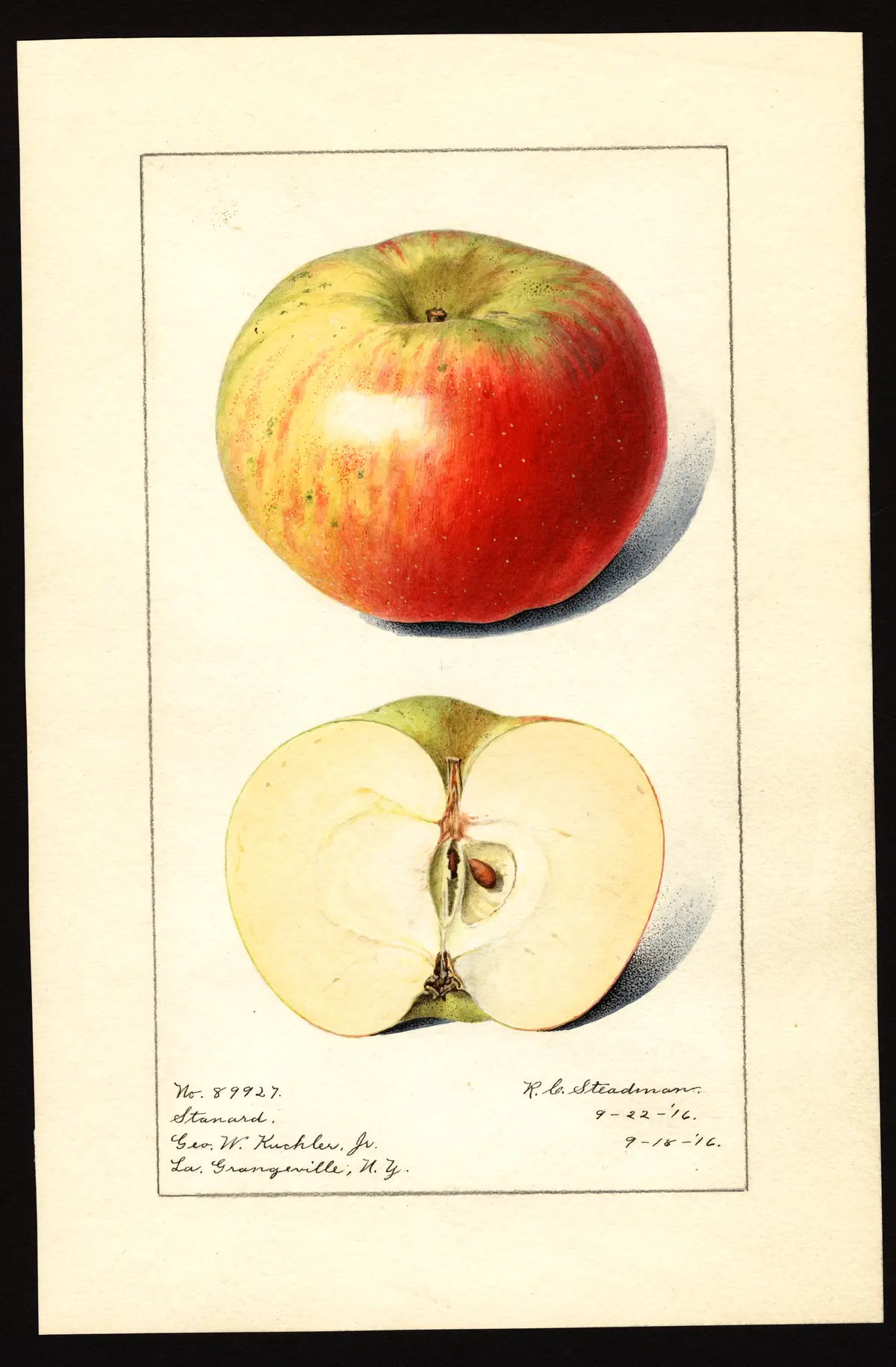
USDA Pomological Watercolor Collection
Stanard
Origin / History
Stanard is from Erie County, New York. In 1848 it was exhibited before the New York Agricultural Society as a new seedling by Benjamin Hodge, Jr., of Buffalo, by whom it was afterwards introduced (Beach). It made its way westward by the Lakes, distributed by Col. Hodge of Buffalo (Warder). The Hon. M. L. Dunlap of Champaign, Illinois, who "esteems it very highly," brought it to the notice of his western friends (Warder). Downing records it as extensively disseminated in Illinois and the West from Colonel B. Hodge, through "The Grove" nurseries.
Beach writes that it has been disseminated in portions of the Middle West. He adds that it has not won the favor of New York fruit growers and remains practically unknown in that state. He calls Stanard "a good apple" but does not recommend it for planting in New York.
Tree
Tree spreading, open, crooked and irregular, the trunk generally crooked. Moderately or rather vigorous (Beach); a rapid grower (Downing). Branches short, stout, curved. Very hardy (Warder). Downing calls it extremely hardy, enduring uninjured the most severe changes of the prairies.
Shoots large and downy. Twigs generally short, somewhat curved, rather stout; internodes medium to very short. Young wood reddish brown, downy. Bark dark reddish-brown mingled with olive-green, partly streaked with thin scarf-skin, heavily pubescent. Lenticels scattering, small to medium, often elongated, usually not raised (Beach).
Buds prominent, large, broad, plump, obtuse to acute, free or nearly so, quite pubescent (Beach). Dunlap reports the fruit buds large and the earliest in the orchard to swell, "but they do not open as soon as others."
Tree productive; comes into bearing young; an abundant, annual bearer. Dunlap says it bears "constantly, but fuller on alternate years." Beach says it alternates heavy with light crops.
Fruit
Size: Medium to large; most authors call it large. Downing gives medium to large; Beach gives large to above medium, somewhat variable in size, of good marketable size.
Form: Roundish to oblate, more or less conic: roundish conical, roundish oblate and slightly conical, oblate conic to roundish conic. Wide and flat at the base (Beach). Ribbed and angular (Warder) to regular or obscurely ribbed (Beach).
Stem: Short (Elliott); medium to long (Warder). Set in a deep cavity (Downing).
Cavity: Open (Elliott), deep (Downing), wide, acute, wavy, green (Warder).
Calyx: Closed. Eye large, segments long (Warder).
Basin: Medium, ribbed, folded and plaited.
Skin: Smooth. Ground dull green or yellowish-green, changing to yellow at maturity, overspread, splashed and striped with red. Warder gives "somewhat red, mixed and striped indistinctly." Showy (Dunlap); fairly attractive in general appearance (Beach). As grown at his Station it does not develop as bright red color as either Baldwin or Northern Spy (Beach).
Dots: Numerous, minute, white (Warder). Downing gives large russet specks.
Flesh and flavor: Flesh yellow, yellowish, or yellowish white, coarse to rather coarse, breaking, tender (Warder), juicy to very juicy. Flavor subacid, rich or rather rich, ranging to acid; Elliott calls it acid. Quality "good" (Warder) to "Very good" (Downing); Elliott places it at not quite "very good." Beach finds it decidedly inferior to Baldwin and Northern Spy in the texture, flavor, and quality of its flesh.
Core and seeds: Core small; globular, regular, closed or open (Warder). Seeds numerous, brown, angular (Warder); ovate pointed (Elliott).
Season
A winter apple, November into spring. Most authors give November or December through February or March; Thomas gives December. Beach says its season extends to January, but some portion of the fruit may be kept till spring. He gives its ordinary commercial limit as October, or in cold storage March or April.
Uses
Market and table (Warder). Superior for cooking (Downing). Dunlap calls it "one of our most profitable winter apples." Beach finds other varieties of its season superior to it for either home use or commercial purposes.
Subtypes / Variants
Not described in source.
Other
Not described in source.
Book Sources
Described in 5 period pomological works
Nursery Catalog Sources
Found in 5 catalogs (1894–1913) from Alabama, Illinois
- The Vineland Nurseries (Kelsey & Co. , Proprietors), St. Joseph, Missouri (Office: 13th and Atchison Sts., 2 Blocks East of the Citizens St. Car Line) — 1894 — listed as Stannard
- Alabama Nursery Co. , Huntsville , Alabama — 1900 — listed as Stannard
- Benjamin Buckman (personal inventory) , Farmingdale , Illinois — 1901 — listed as Stannard
- Phoenix Nursery Company (W. E. Rossney , President; Sidney Tuttle, Vice-President), Bloomington , Illinois — 1904 — listed as Stannard
- Benjamin Buckman (personal inventory) , Farmingdale , Illinois — 1913 — listed as Stannard
View original book sources (5)
— F.R. Elliott, The Western Fruit Book (1865)Stanard, Stanard's Seedling. From Erie Co., N. Y. Tree, productive. Fruit, large, roundish, yellow, overspread with red ; stem, short ; cavity, open ; calyx, closed ; basin ribbed ; core, small ; seeds, ovate pointed ; flesh, yellowish, coarse, juicy, acid ; not quite "very good." November to February.
— John A. Warder, American Pomology: Apples (1867)Stanard.
From Erie County, New York, this fruit has made its way westward, by the Lakes, having been distributed by Col. Hodge, of Buffalo, and brought to the notice of his western friends by Hon. M. L. Dunlap, of Champaign, Illinois, who esteems it very highly. I quote from his account of it:
"This proves one of our most profitable winter apples; the tree bears young and constantly, but fuller on alternate years; fruit large and showy, shoots large and downy; buds prominent, fruit buds large, and the earliest in the orchard to swell; but they do not open as soon as others. Tree spreading, trunk generally crooked." Very hardy.
Fruit large, roundish, conical, ribbed, angular; Surface smooth, yellowish-green, somewhat red, mixed and striped indistinctly; Dots numerous, minute, white.
Basin medium, folded and plaited; Eye large, closed; Segments long.
Cavity wide, acute, wavy, green; Stem medium to long.
Core small, globular, regular, closed or open; Seeds numerous, brown, angular; Flesh yellow, breaking, rather coarse, tender; Flavor acid to sub-acid, rich; Quality good; Use, market and table; Season, November to February.
— A.J. Downing, The Fruits and Fruit Trees of America (1900)Stanard. Stanard's Seedling.
An Apple extensively disseminated in Illinois and West, from Colonel B. Hodge, through "The Grove" nurseries. The tree is extremely hardy, enduring uninjured the most severe changes of the prairies. It is a crooked, spreading, irregular, but rapid grower; a young, abundant, and annual bearer. Young wood reddish brown, downy.
Fruit medium to large, roundish oblate, slightly conical, dull green, changing to yellow at maturity, splashed and striped with red, large russet specks. Stalk in a deep cavity. Calyx closed. Flesh yellowish white, rather coarse, very juicy, rather rich subacid. Very good. December to March. Superior for cooking.
— John J. Thomas, The American Fruit Culturist (1903)Stanard. Large, roundish, yellow and red; rather coarse, sub-acid. December. Erie County, N. Y.
— S.A. Beach, The Apples of New York, Vol. 1 (1905)STANARD.
REFERENCES. 1. N. Y. Agr. Soc. Trans., 1848:22, 276. 2. Emmons, Nat. Hist. N. Y., 3:78. 1851. 3. Elliott, 1854:158. 4. Warder, 1867:544. fig. 5. Downing, 1869:359. 6. Fitz, 1872:121. 7. Thomas, 1875:512. 8. Bailey, An. Hort., 1892:250. 9. Powell and Fulton, U. S. B. P. I. Bul., 48:56. 1903. 10. Beach and Clark, N. Y. Sta. Bul., 248:144. 1904.
SYNONYMS. Stanard's Seedling (3, 5). STANNARD (8). STANNARD'S SEEDLING (2).
Stanard is a good apple but other varieties of its season are superior to it for either home use or commercial purposes. The fruit is of good marketable size and fairly attractive in general appearance but as grown at this Station it does not develop as bright red color as either Baldwin or Northern Spy and is decidedly inferior to either of these varieties in the texture, flavor and quality of its flesh. Its season extends to January but some portion of the fruit may be kept till spring. Its ordinary commercial limit is October or in cold storage March or April (10). The tree is rather vigorous, comes into bearing early and is an annual bearer, alternating heavy with light crops. It is not recommended for planting in New York.
Historical. In 1848 Stanard was exhibited before the New York Agricultural Society as a new seedling by Benjamin Hodge, Jr., of Buffalo, by whom it was afterwards introduced (1). It has been disseminated in portions of the Middle West (4, 5, 8) but it has not won the favor of New York fruit growers and remains practically unknown in this state.
TREE.
Tree moderately vigorous; branches short, stout, curved. Form spreading, open. Twigs generally short, somewhat curved, rather stout; internodes medium to very short. Bark dark reddish-brown mingled with olive-green, partly streaked with thin scarf-skin, heavily pubescent. Lenticels scattering, small to medium, often elongated, usually not raised. Buds prominent, large, broad, plump, obtuse to acute, free or nearly so, quite pubescent.
FRUIT.
Fruit large to above medium, somewhat variable in size. Form oblate conic to roundish conic, wide and flat at the base, regular or obscurely ribbed;