American Golden Russet
Apple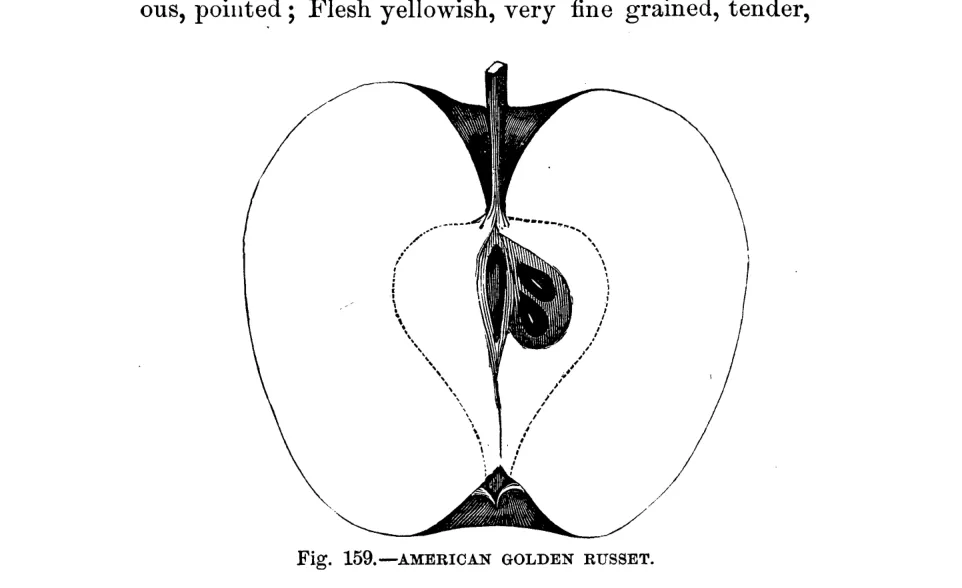
American Golden Russet
Origin/History
The American Golden Russet is one of the most widely admired table apples in cultivation, a universal favorite wherever delicacy of flavor and fineness of flesh are prized. It is widely grown in the West and in New England under the name Golden Russet. The name Sheep-nose, given by Coxe, was nearly obsolete by Downing's time (1900), surviving only in New Jersey. The variety is neither handsome nor large, yet earns its following through great productiveness and admirable flavor.
Tree
Both sources agree the tree has an upright growth habit. Warder describes it as vigorous, round-headed, and small, with large, healthy foliage. Downing describes it as thrifty, with upright shoots and bark of a dull reddish grayish brown color.
Fruit
Size and Form: The two sources differ slightly. Warder gives the size as small to medium and the form as round-conic, regular when perfect. Downing gives the size as below medium and the form as roundish-ovate.
Skin: Smooth (Warder). Color dull yellow (Downing) or yellow (Warder), covered with a thin russet — Downing describes it as sprinkled with a very thin russet. Warder notes the surface is sometimes faintly blushed.
Dots: Minute (Warder). Not described by Downing.
Stem: Long and slender (Warder: long, slender; Downing: rather long and slender).
Cavity: Acute, regular (Warder). Not described by Downing.
Calyx: Small, closed (Warder: eye small, closed; Downing: calyx closed).
Basin: Warder describes it as shallow and regular. Downing describes it as rather narrow. Both characterizations are preserved as they emphasize different aspects.
Flesh: Yellowish (both sources). Warder gives the fullest account: very fine grained, tender, when fully ripe almost melting like a pear, juicy, becoming dry when overripe. Downing concurs on the pear comparison, describing the flesh as resembling in texture that of a buttery pear more than that of an ordinary apple, and as very tender and juicy.
Flavor: Warder: sub-acid, rich, aromatic. Downing: mild, rich, spicy. Both rate quality as Best.
Core: Medium, closed, meeting the eye (Warder). Not described by Downing.
Seeds: Numerous, pointed (Warder). Not described by Downing.
Season
Warder gives November and December. Downing gives October to January.
Uses
Dessert (Warder). Downing does not give an explicit use designation but consistently treats it as a table apple.
Other
Warder notes that despite its excellence as a table apple, the American Golden Russet is not a profitable variety for orchard planting, as the fruit is very apt to be imperfect. He reports the best specimens he encountered came from the South and from sandstone soils. Downing, by contrast, emphasizes the variety's great productiveness as a key reason for its popularity.
Book Sources
Described in 2 period pomological works
Nursery Catalog Sources
Found in 6 catalogs (1850–1918) from Massachusetts, Missouri, Oregon
- Azell Bowditch (Nursery / Fruit Catalog) , Boston , Massachusetts — 1850
- St. Helena Nursery , Howell's Prairie, Marion County , Oregon — 1864
- Milwaukie-Canby Nurseries , Canby, OR (and Milwaukie, OR) — 1893
- Stark Bros. Nurseries & Orchards Co. , Louisiana , Missouri — 1898
- Stark Bros. Nurseries & Orchards Co. , Louisiana , Missouri — 1912
- Stark Bros. Nurseries & Orchards Co. , Louisiana , Missouri — 1918
View original book sources (2)
— John A. Warder, American Pomology: Apples (1867)American Golden Russet. BULLOCK'S PIPPIN, ETC.
This delicious table apple is a universal favorite with all who can appreciate delicacy of flavor and fineness of flesh in an apple, and yet it is not a profitable variety for orchard planting, because the fruit is very apt to be imperfect. The best I have seen were from the South, and sandstone soils.
Tree vigorous, upright, round-headed, small; Foliage large, healthy.
Fruit small to medium, round-conic, regular when perfect; Surface smooth, yellow, covered with thin russet, sometimes faintly blushed; Dots minute.
Basin shallow, regular; Eye small, closed.
Cavity acute, regular; Stem long, slender.
Core medium, closed, meeting the eye; Seeds numerous, pointed; Flesh yellowish, very fine grained, tender, when fully ripe almost melting, like a pear, juicy, becoming dry when over ripe; Flavor sub-acid, rich, aromatic; Quality very best; Use, dessert; Season, November and December.
— A.J. Downing, The Fruits and Fruit Trees of America (1900)American Golden Russet. Golden Russet. Bullock's Pippin. Sheep Nose. Little Pearmain.
The American Golden Russet is one of the most delicious and tender Apples, its flesh resembling more in texture that of a buttery Pear than that of an ordinary Apple. It is widely cultivated at the West and in New England as the Golden Russet, and though neither handsome nor large, is still a universal favorite, from its great productiveness and admirable flavor. The uncouth name of Coxe, Sheep-nose, is nearly obsolete, except in New Jersey, and we therefore adopt the present one, to which it is well entitled. The tree is thrifty, with upright shoots, dull reddish grayish brown.
Fruit below medium size, roundish-ovate, dull yellow, sprinkled with a very thin russet. Stalk rather long and slender. Calyx closed, and set in a rather narrow basin. Flesh yellowish, very tender, juicy, with a mild, rich, spicy flavor. Best. October to January.