Chenango
Apple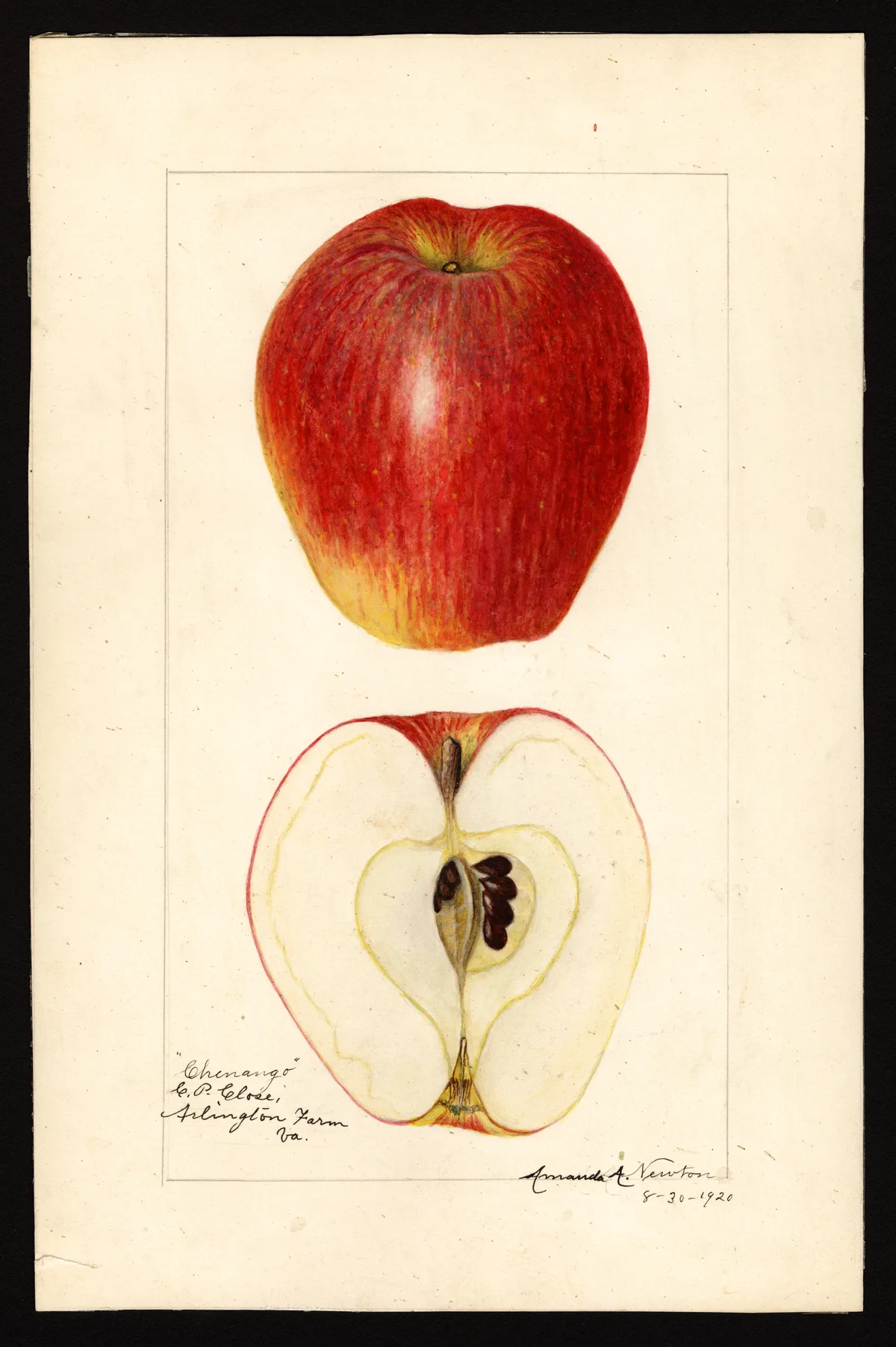
USDA Pomological Watercolor Collection
Chenango
Origin and History
Chenango originated in New York State; accounts differ as to the precise location, with some saying it arose in Lebanon, Madison County, and others holding that it was early brought into Chenango County by settlers from Connecticut. It has been known in cultivation for more than fifty years as of 1869 (Beach, citing Downing). By 1905 it was still propagated by nurserymen, though demand for the stock was quite limited.
Tree
Medium size, vigorous, with short, stout, curved branches. Form upright spreading to roundish, rather dense. Twigs long to medium, curved, moderately slender; internodes medium. Bark olive-green tinged with dull brown, lightly streaked with scarf-skin; pubescent. Lenticels scattering, small, round, not raised. Buds deeply set in bark, small, flat, obtuse, appressed, slightly pubescent.
The tree is an early and regular bearer, hardy, healthy, and pretty long-lived. Under favorable conditions it bears annually, alternating rather light with heavy crops.
Fruit
Size and Form: Above medium to large, though under unfavorable conditions it may be small and poorly colored. Form elongated ovate or oblong conic, slightly ribbed. (The Encyclopedia of Practical Horticulture codes the form as "obc" — oblong conic — consistent with Beach.)
Stem: Short to medium, moderately thick.
Cavity: Acute to acuminate, deep, narrow, often somewhat furrowed and compressed, usually not russeted.
Calyx: Medium to large, partly open or closed; lobes often separated at the base, long, broad, obtuse. Calyx tube long, funnel-shaped or nearly so. Stamens median.
Basin: Usually small, medium to rather shallow, narrow to moderately wide, obtuse to somewhat abrupt, furrowed, sometimes wrinkled.
Skin: Rather tough, smooth, glossy, yellowish-white, often almost entirely overspread and mottled with attractive pinkish-red, conspicuously striped and splashed with bright carmine. The overall appearance is described as beautiful. Dots few, small, inconspicuous, light-colored, often submerged.
Flesh and Flavor: White, moderately firm, tender, juicy, mild subacid, very aromatic. Quality good to very good. (The Encyclopedia of Practical Horticulture independently rates quality as "VG" — very good.)
Core and Seeds: Core rather large, abaxile; cells often unsymmetrical, wide open or closed; core lines clasping. Carpels broadly ovate to oval, smooth. Seeds small, moderately wide, plump, obtuse, not tufted.
Season and Storage
Season latter part of August and through September. The fruit begins to mature in September and ripens continuously during a period of several weeks; it should therefore receive more than one picking to secure the crop in best condition. The latest-ripening fruit may be kept in ordinary storage until November, but after that the color fades and quality deteriorates significantly even if the fruit remains apparently sound. The flesh is too tender for shipping.
Uses
Excellent dessert quality; also good for culinary uses. Recommended as an excellent variety for the home orchard. Some growers find it profitable for local or special markets, but other varieties of the same season are more desirable for general commercial planting.
Book Sources
Described in 2 period pomological works
Nursery Catalog Sources
Found in 9 catalogs (1890–1924) from California, Maryland, Massachusetts, New Jersey, Oregon, Pennsylvania
- William H. Moon Co. , Morrisville, Bucks County , Pennsylvania — 1890
- Rogers Nursery Co. , Moorestown , New Jersey — 1893
- Reading Nursery , Jacob W. Manning, Proprietor, Reading , Massachusetts — 1898
- Brown Brothers Co. , Continental Nurseries, Rochester, NY (also operated from Toronto, Canada) — 1899
- Brown Brothers Co. , Continental Nurseries, Rochester, NY (also operated from Toronto, Canada) — 1901
- Wm. J. Corse (successor to Robert Sinclair / Sinclair Nurseries) , Baltimore , Maryland — 1909
- Union Nurseries , J.B. Weaver & Sons, Union , Oregon — 1915
- Benedict Nursery Co. , Portland , Oregon — 1921
- Fresno Nursery Co. , Fresno , California — 1924
View original book sources (2)
— S.A. Beach, The Apples of New York, Vol. 2 (1905)CHENANGO.
REFERENCES. 1. Horticulturist, 9:475. 1854. 2. Am. Pom. Soc. Cat., 1869. 3. Downing, 1869:124. fig. 4. Thomas, 1875:199. 5. Ia. Hort. Soc. Rpt., 1879:472. 6. Montreal Hort. Soc. Rpt., 1879:24. 7. Barry, 1883:337. 8. Wickson, 1889:244. 9. Lyon, Mich. Hort. Soc. Rpt., 1890:290. 10. Bailey, An. Hort., 1892:236. 11. Ib., 1892:249. 12. Munson, Me. Sta. Rpt., 1893:132. 13. Burrill and McCluer, Ill. Sta. Bul., 45:317. 1896. 14. Waugh, Vt. Sta. An. Rpt., 14:291. 1901. 15. Atwood, Va. Sta. Bul., 130:120. 1901. 16. W. N. Y. Hort. Soc. Rpt., 1901:76. 17. Hansen, S. D. Sta. Bul., 76:39. 1902. 18. Can. Hort., 26:345. 1903. figs. 19. Budd-Hansen, 1903:62. 20. Farrand, Mich. Sta. Bul., 205:44. 1903. 21. Bruner, N. C. Sta. Bul., 182:20. 1903. 22. Beach and Clark, N. Y. Sta. Bul., 248:115. 1904.
SYNONYMS. Buckley (3, 4). CHENANGO (2, 9, 10, 14, 16, 17, 18, 19, 20, 21, 22). CHENANGO STRAWBERRY (1, 3, 4, 5, 6, 7, 8, 13, 15). Chenango Strawberry (10, 11, 14, 17, 18, 19, 22). CHENANGO Strawberry (12). Frank (3, 4). Jackson (3, 4). SHERWOOD'S FAVORITE (11). Sherwood's Favorite (3, 4, 6, 7, 12, 14, 17, 18, 19, 22). Smyrna (3). Strawberry (1, 3, 4).
Fruit beautiful in appearance, yellowish-white striped with red, of excellent dessert quality and good also for culinary uses. The tree is an early and regular bearer, hardy, healthy, and pretty long-lived. Under favorable conditions it is an annual bearer, alternating rather light with heavy crops. The fruit begins to mature in September and ripens continuously during a period of several weeks. For this reason it should have more than one picking in order to secure the crop in the best condition. The latest ripening fruit may be kept in ordinary storage till November, but after that the color fades and it deteriorates much in quality, even though it may remain apparently sound (22). The fruit does not ship well because its flesh is too tender. Some find it a profitable variety to grow for local or special markets, but other varieties of its season are more desirable than Chenango for general commercial planting. It is recommended as an excellent variety for the home orchard.
Historical. Chenango, according to some accounts, originated in Lebanon, Madison county, N. Y.; others say that it was early brought into Chenango county by settlers from Connecticut. It has certainly been known in cultivation for more than fifty years (3). It is still propagated by nurserymen but the demand for the stock is quite limited.
TREE.
Tree medium size, vigorous with short, stout, curved branches. Form upright spreading to roundish, rather dense. Twigs long to medium, curved, moderately slender; internodes medium. Bark olive-green tinged with dull brown, lightly streaked with scarf-skin; pubescent. Lenticels scattering, small, round, not raised. Buds deeply set in bark, small, flat, obtuse, appressed, slightly pubescent.
FRUIT.
Fruit above medium to large, but under unfavorable conditions it may be small and poorly colored. Form elongated ovate or oblong conic, slightly ribbed. Stem short to medium, moderately thick. Cavity acute to acuminate, deep, narrow, often somewhat furrowed and compressed, usually not russeted. Calyx medium to large, partly open or closed; lobes often separated at the base, long, broad, obtuse. Basin usually small, medium to rather shallow, narrow to moderately wide, obtuse to somewhat abrupt, furrowed, sometimes wrinkled.
Skin rather tough, smooth, glossy, yellowish-white, often almost entirely overspread and mottled with attractive pinkish-red, conspicuously striped and splashed with bright carmine. Dots few, small, inconspicuous, light colored, often submerged.
Calyx tube long, funnel-shape or nearly so. Stamens median.
Core rather large, abaxile; cells often unsymmetrical, wide open or closed; core lines clasping. Carpels broadly ovate to oval, smooth. Seeds small, moderately wide, plump, obtuse, not tufted.
Flesh white, moderately firm, tender, juicy, mild subacid, very aromatic, good to very good.
Season latter part of August and through September.
— Granville Lowther (ed.), Encyclopedia of Practical Horticulture (1914)Chenango (S'berry).... M | obc | gr | VG | b | a | 6* | 10* | 2*