Keswick
Apple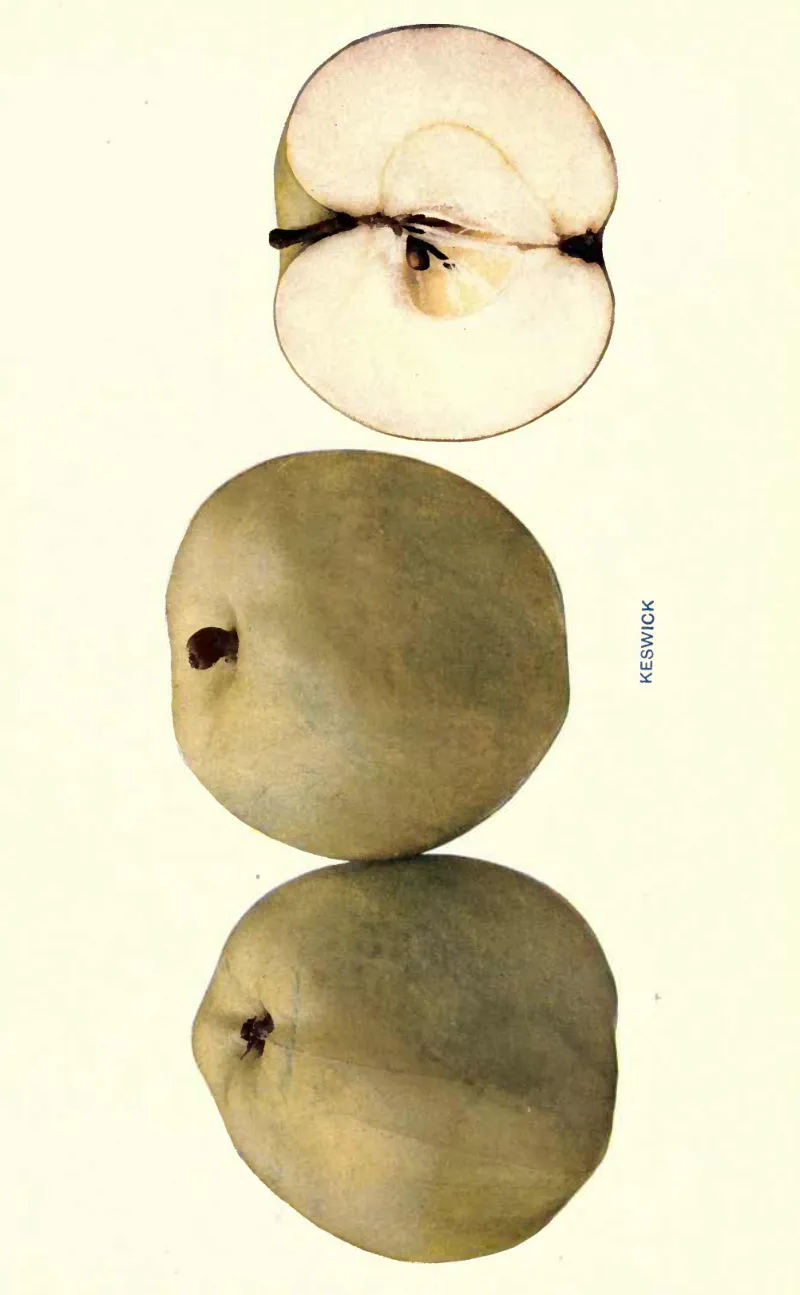
Keswick
Origin / History
English (Elliott says only "Foreign"). Hogg's account, printed in the Herefordshire Pomona and quoted by Beach, says it was "first discovered growing amongst a quantity of rubbish behind a wall at Gleaston Castle, near Ulverstone, and was first brought into notice by one John Sander, a nurseryman at Keswick, who, having propagated it, sent it out under the name of Keswick Codlin." Bunyard dates the origin at Gleaston Castle, Ulverstone, to about 1790 and credits Mr. John Sander of Keswick with the introduction.
Sir John Sinclair, in the Memoirs of the Caledonian Horticultural Society, records a tree planted twenty years before in the episcopal garden at Rose Castle, Carlisle. Beach dates the Memoirs 1813; the Pomona prints "(1813)" after "twenty years ago." Beach's earliest reference is Forsyth, 1824, and the London Horticultural Society Catalogue of 1831 lists it as No. 225. Beach distinguishes Keswick from the Codling or English Codling described by Coxe, Thacher, Forsyth and others.
In England the Herefordshire Pomona calls it "this excellent apple" and "one of the most valuable of our early culinary apples." Downing calls it "a noted English cooking Apple" and "one of the most profitable of orchard sorts for cooking or market." Bunyard finds it "much grown in North Britain" and "still appreciated for culinary use and its reliable cropping habits." Veitch calls it a "well-known early kitchen-apple."
Hedrick says it was brought to America and widely disseminated early in the nineteenth century. Warder calls it "an old English variety, which has greatly pleased the people of our country, who find it a valuable market and family fruit, particularly desirable in the North and Northwest." Elliott finds it "suited to Western soils" and "one of best," and Thomas says it "succeeds well at the West." Beach says it has long been known in this country, with very old trees in some orchards, but is "nowhere extensively cultivated." He finds it grown chiefly for home use and only to a very limited extent for local market, though "quite commonly listed by nurserymen." Hedrick calls it "an English apple of small value in America," to be "recommended more for its tree- than its fruit-characters." The Central Experimental Farm at Agassiz, British Columbia, planted it in spring 1890.
Tree
Tree hardy; Downing says very hardy. Vigor runs from medium (Bunyard's "growth, medium"; Agassiz's "medium grower") through moderately vigorous (Beach) to vigorous (Warder, Downing, Budd and Hansen). Beach calls it a good grower, medium to large, healthy and long-lived.
Form upright spreading to roundish; Downing gives a large, regular, upright, spreading, round head, and Bunyard calls the growth compact. Shoots "branching in a peculiar manner, dark" (Warder). Twigs moderately long, curved, stout; internodes short. Bark dull brown, heavily coated with gray scarf-skin, pubescent. Lenticels numerous, rather conspicuous, medium to small, round, not raised. Buds medium to large, prominent, broad, plump, obtuse, free, pubescent (Beach). Leaf long oval, curved serrate, grayish-green (Bunyard).
An early bearer, coming into bearing quite young; productive to very productive. Downing calls it "a great bearer," Veitch "very prolific cropping," and Bunyard's fertility is "immense." Agassiz finds it an early and constant bearer, and Beach says it yields good to very good crops almost annually. Sinclair says the Rose Castle tree "has never failed to bear a crop" in twenty years, calls it "a very copious bearer," and adds that "it flourishes best in a strong soil."
Fruit
Size: Medium to rather large, with five authors placing it above medium. Beach gives above medium to nearly large, not very uniform. The Herefordshire Pomona measures it two and three-quarter inches wide and the same in height; Bunyard gives 2¾ by 2½ inches. Sinclair calls it "of good size, considerably larger than the Carlisle Codlin."
Form: Conical: roundish conic to oblong conic, roundish ovate conical (Elliott), truncated (Warder). Rather broad at the base, sides frequently a little unequal (Beach). Ribbed, from a few obscure ribs (Downing; "obscurely ribbed," Budd and Hansen) to distinctly ribbed (Beach); Agassiz says often ribbed. Angular, "the angles on its sides running to the crown, where they form rather acute ridges round the eye" (Herefordshire Pomona). Bunyard alone calls the form regular.
Stem: Short, about a quarter of an inch (Herefordshire Pomona); Beach gives medium to short. Slender to rather thick, downy. Warder alone calls it long, and gives it as yellow.
Cavity: Depth conflicts. Elliott and Beach give shallow, Beach extending it to medium. The Herefordshire Pomona and Budd and Hansen give deep, and Downing describes the stem as deeply set. Acute (Warder; "variably acute," Beach), regular and even, rather narrow to moderately broad. Browned, or more or less russeted; Bunyard says "sometimes faintly russet with pearly spots showing below the skin."
Calyx: Closed; medium to large. Segments long, narrow to medium in width (Beach), nearly acuminate, connivent. Calyx tube medium in length, rather wide, bluntly cone-shaped (Beach). Stamens median (Beach; Budd and Hansen).
Basin: Furrowed, folded, angular, puckered or somewhat corrugated; Elliott calls the furrowing imperceptible. Depth conflicts: shallow and moderately narrow (Beach, Bunyard), medium (Warder), "pretty deep" or "rather deep" (Herefordshire Pomona, Budd and Hansen). Fleshy protuberances often alternate with the calyx lobes (Beach); Bunyard counts "five marked knobs around the eye."
Skin: Thin, tough, smooth, waxy. Greenish yellow to pale yellow, becoming light yellow (Thomas). "Rather pale yellow on the shaded side, but deeper yellow with an orange or blush tinge on the side next the sun" (Herefordshire Pomona). A faint blush or faint red flush on one side, which Beach says appears only sometimes; Elliott gives a brownish cheek in the sun. A raised or suture line: "one or two raised lines from stem to apex" (Elliott); "nearly always shows a raised line on one side of the fruit" (Bunyard); often a suture line extending out from the cavity (Beach).
Dots: Scattered, minute (Warder); light (Elliott); submerged, inconspicuous or russet (Beach).
Flesh and flavor: Flesh nearly white to pale yellowish white or palest yellow, also greenish white (Elliott) and greenish yellow (Warder). Fine-grained, tender, soft, very juicy; Agassiz alone calls it crisp.
Flavor acid, brisk and pleasant; "an apple of fine tartness and flavour" (Sinclair). Beach gives brisk subacid, "too acid for dessert unless very ripe."
Quality for cooking is good in most verdicts; Warder gives "good to very good for its use — cooking," Thomas "quality moderate," and Hedrick "fair to good."
Core and seeds: Core variable, medium (Elliott) to large, abaxile, open and clasping (Warder). Cells wide open (Beach), ovate lanceolate (Budd and Hansen). Core lines meeting. Carpels variable, roundish ovate (Beach). Seeds numerous and angular (Warder), ovate (Elliott); very light brown, very small, medium in width, short, very plump, acute (Beach).
Season
Used for cooking from June and ripe from August into autumn. Most authors give August through September or October; Lowther's table gives early autumn. Veitch gives July and August. Downing has it gathered for tarts as early as August and in use till November.
The fruit may be cooked in June (Warder). The Herefordshire Pomona says it may be used for tarts "so early as the end of June, but it is in perfection during August and September." Thomas says it ripens in September "but may be used for cooking in summer." Budd and Hansen say it cooks well even when half-grown. Sinclair says it "may be used early in Autumn."
Beach says it comes into season late in August or early in September and ripens continuously during a period of several weeks. It is not adapted for storage; its commercial limit in ordinary storage is September and early October. It "does not stand heat well before going into storage and goes down quickly." The flesh "becomes mealy after being kept for a month" (Herefordshire Pomona).
Uses
Chiefly culinary, for tarts and cooking. Beach says it is "particularly esteemed on account of its excellence for culinary use." Budd and Hansen call it "excellent for culinary use." Thomas calls it "fine for cooking," and Agassiz "a fine apple for cooking." Elliott says it is valued for cooking. Veitch calls it "excellent for cooking, being rapidly cooked." Also a market and family fruit (Warder); Lowther's table gives "both kitchen and market."
Subtypes / Variants
Not described in source.
Other
Lowther's table gives the form code "re" and division reports "3*," meaning it was reported by three stations, the asterisk indicating more than one of the three U.S. divisions. Bunyard cites Ronalds, p. 3.
Book Sources
Described in 10 period pomological works
- Beach, The Apples of New York Vol. 2 (1905)
- Hedrick, Cyclopedia of Hardy Fruits (1922)
- Warder, American Pomology: Apples (1867) — listed as Keswick Codling
- Bunyard, A Handbook of Hardy Fruits (1920) — listed as KESWICK CODLIN
- The Herefordshire Pomona (1876–1885) — listed as KESWICK CODLIN
- Budd & Hansen, Systematic Pomology (1914)
- Downing, Fruits and Fruit Trees of America (1900) — listed as Keswick Codlin
- Elliott, The Western Fruit Book (1865) — listed as Keswick Codlin
- Lowther (ed.), Encyclopedia of Practical Horticulture (1914) — listed as Keswick Codlin
- Thomas, The American Fruit Culturist (1903) — listed as Keswick Codlin
Nursery Catalog Sources
Found in 17 catalogs (1889–1912) from California, England, Illinois, Missouri, Oregon, Washington
- California Nursery Co. , Niles , California — 1889 — listed as Keswick Codlin
- Sherwood Hall Nursery Co. , Timothy Hopkins (Menlo Park Nurseries), San Francisco / Menlo Park , California — 1893 — listed as Keswick Codlin
- The Vineland Nurseries (Kelsey & Co. , Proprietors), St. Joseph, Missouri (Office: 13th and Atchison Sts., 2 Blocks East of the Citizens St. Car Line) — 1894 — listed as Keswick Codlin
- Woodburn Nurseries , Woodburn, Marion Co. , Oregon — 1894 — listed as Keswick Codlin
- Kelway & Son , Langport, Somerset , England — 1897 — listed as Keswick Codlin
- Brown Brothers Co. , Continental Nurseries, Rochester, NY (also operated from Toronto, Canada) — 1899 — listed as Keswick Codlin
- George Bunyard & Co. , Royal Nurseries, Maidstone, Kent , England — 1900 — listed as Keswick Codlin
- Central Experimental Farm , Dominion Department of Agriculture, Agassiz, British Columbia (under test; Bulletin No. 3, Second Series) — 1900 — listed as Keswick Codlin
- Washington Nursery Co. , Toppenish , Washington — 1901 — listed as Keswick Codlin
- Brown Brothers Co. , Continental Nurseries, Rochester, NY (also operated from Toronto, Canada) — 1901 — listed as Keswick Codlin
- Mountain Grove Nurseries (Tippin & Moore , Proprietors; Geo. T. Tippin, J. W. Tippin, J. C. Moore), Mountain Grove , Missouri — 1901 — listed as Keswick Codlin
- Pacific Nursery Company (W. O. Hudson & A. D. Hudson) , Tangent , Oregon — 1903 — listed as Keswick Codlin
- Phoenix Nursery Company (W. E. Rossney , President; Sidney Tuttle, Vice-President), Bloomington , Illinois — 1904 — listed as Keswick Codlin
- Washington Nursery Company , Toppenish , Washington — 1909 — listed as Keswick Codlin
- James Veitch & Sons , Ltd., Royal Exotic Nursery, Chelsea, London (also Coombe Wood, Langley, and Feltham) , England — 1911 — listed as Keswick Codlin
- Pacific Nursery Company , Portland , Oregon — 1912 — listed as Keswick Codlin
- Washington Nursery Company , Toppenish , Washington — 1912 — listed as Keswick Codlin
View original book sources (12)
— F.R. Elliott, The Western Fruit Book (1865)Keswick Codlin.
Foreign. Very productive. Tree, hardy ; valued for cooking, and suited to Western soils ; one of best. Fruit, medium or above, roundish ovate, conical ; greenish yellow, with brownish cheek in sun, and light dots, one or two raised lines from stem to apex ; stem, slender ; cavity, shallow ; calyx, closed ; basin, furrowed imperceptibly : core, medium ; seeds, ovate ; flesh, greenish or yellowish white, tender, acid, September and October.
— John A. Warder, American Pomology: Apples (1867)Keswick Codling.
An old English variety, which has greatly pleased the people of our country, who find it a valuable market and family fruit, particularly desirable in the North and Northwest.
Tree vigorous, hardy, productive, an early bearer; Shoots branching in a peculiar manner, dark.
Fruit medium, oblong, conical, truncated, ribbed; Surface smooth, pale yellow; Dots scattered, minute.
Basin medium, folded; Eye medium to large, closed.
Cavity acute, regular, browned; Stem long, yellow.
Core large, open, clasping; Seeds numerous, angular; Flesh greenish yellow, fine-grained, tender, juicy; Flavor acid; Quality good to very good for its use — cooking; Season, August to October.
The fruit may be cooked in June,
— Woolhope Naturalists Field Club, The Herefordshire Pomona (1885)
- KESWICK CODLIN.
This excellent apple was first discovered growing amongst a quantity of rubbish behind a wall at Gleaston Castle, near Ulverstone, and was first brought into notice by one John Sander, a nurseryman at Keswick, who, having propagated it, sent it out under the name of Keswick Codlin.
Description.—Fruit; above medium size, two inches and three quarters wide, and the same in height; conical angular in its outline, the angles on its sides running to the crown, where they form rather acute ridges round the eye. Skin; rather pale yellow on the shaded side, but deeper yellow with an orange or blush tinge on the side next the sun. Eye; closed with long narrow segments, and set in a pretty deep and rather puckered basin. Stalk; about a quarter of an inch long, downy, inserted in a deep cavity, which is marked with russet. Flesh; pale yellowish white, very juicy, tender and soft, with a brisk and pleasant flavour, but becomes mealy after being kept for a month.
One of the most valuable of our early culinary apples. It may be used for tarts so early as the end of June, but it is in perfection during August and September.
In the Memoirs of the Caledonian Horticultural Society, Sir John Sinclair says: "The Keswick Codlin tree has never failed to bear a crop since it was planted in the episcopal garden at Rose Castle, Carlisle, twenty years ago (1813). It is an apple of fine tartness and flavour, and may be used early in Autumn. The tree is a very copious bearer, and the fruit is of good size, considerably larger than the Carlisle Codlin. It flourishes best in a strong soil."
— A.J. Downing, The Fruits and Fruit Trees of America (1900)Keswick Codlin. A noted English cooking Apple, which may be gathered for tarts as early as the month of August, and continues in use till November. It is an early and a great bearer and a vigorous tree, and is one of the most profitable of orchard sorts for cooking or market. Tree very hardy, forming a large, regular, upright, spreading, round head. Keswick Codlin. Fruit a little above the middle size, rather conical, with a few obscure ribs. Stalk short and deeply set. Calyx rather large. Skin greenish yellow, washed with a faint blush on one side. Flesh yellowish white, juicy, with a pleasant acid flavor.
— John J. Thomas, The American Fruit Culturist (1903)Keswick Codlin.* Rather large, somewhat conical, and ribbed; greenish yellow, becoming light yellow; stalk short, deep set; calyx rather large; juicy, pleasant acid, quality moderate. Succeeds well at the West. Fine for cooking; very productive, bears early. Ripens in September but may be used for cooking in summer. English.
— S.A. Beach, The Apples of New York, Vol. 2 (1905)KESWICK.
REFERENCES. 1. Forsyth, 1824:132. 2. London Hort. Soc. Cat., 1831:No. 225. 3. Kenrick, 1832:189. 4. Floy-Lindley, 1833:25. 5. Downing, 1845:187. 6. Thomas, 1849:156. 7. Emmons, Nat. Hist. N. Y. 3:37. 1851. 8. Barry, 1851:280. 9. Elliott, 1854:141. 10. Barry, Horticulturist, 10:87. 1855. 11. Gregg, 1857:37. 12. Hooper, 1857:25, 49, 107, 111. 13. Am. Pom. Soc. Cat., 1860. 14. Mead, Horticulturist, 17:150. 1862. 15. Warder, 1867:688. fig. 16. Fitz, 1872:160. 17. Hogg, 1884:122. 18. Wickson, 1889:243. 19. Lyon, Mich. Hort. Soc. Rpt., 1890:294. 20. Bailey, An. Hort., 1892:242. 21. Taft, Mich. Sta. Bul., 105:108. 1894. 22. Lyon, Ib., 118:60. 1895. 23. Ib., 143:200. 1897. 24. Bunyard, Jour. Roy. Hort. Soc., 1898:354. 25. Dickens and Greene, Kan. Sta. Bul., 106:53. 1902. 26. Farrand, Mich. Sta. Bul., 205:45. 1903. 27. Budd-Hansen, 1903:110. 28. Beach and Clark, N. Y. Sta. Bul., 248:128. 1904.
SYNONYMS. CODLIN, KESWICK (1, 2, 24). KESWICK (19, 21, 22, 23, 26, 27, 28). KESWICK CODLIN (3, 4, 5, 6, 7, 8, 9, 10, 11, 12, 13, 14, 16, 17, 18, 19, 20, 24, 25). Keswick Codlin (27, 28). KESWICK CODLING (15). No. 225 (2).
This variety is particularly esteemed on account of its excellence for culinary use. It is not adapted for storage, its commercial limit in ordinary storage being September and early October. It comes into season late in August or early in September and ripens continuously during a period of several weeks. It does not stand heat well before going into storage and goes down quickly (28). The fruit is of good medium size to rather large, greenish-yellow, sometimes with faint blush; flesh brisk subacid. It is grown chiefly for home use and only to a very limited extent for local market. The tree is a good grower, hardy, healthy, long-lived, comes into bearing quite young and yields good to very good crops almost annually. This is distinct from the Codling or English Codling described by Coxe, Thacher, Forsyth and others.
Historical. Hogg (17) states that: "This excellent apple was first discovered growing among a quantity of rubbish behind a wall at Gleaston Castle, near Ulverstone, and was first brought into notice by one John Sander, a nurseryman at Keswick, who, having propagated it, sent it out under the name of Keswick Codlin. In the Memoirs of the Caledonian Horticultural Society, 1813, Sir John Sinclair says: 'The Keswick Codlin tree has never failed to bear a crop since it was planted in the episcopal garden at Rose Castle, Carlisle, twenty years ago.'"
It has long been known in this country and very old trees of it are found in some orchards but it is nowhere extensively cultivated being grown chiefly for home use. It is quite commonly listed by nurserymen (20).
TREE. Tree medium to large, moderately vigorous. Form upright spreading to roundish. Twigs moderately long, curved, stout; internodes short. Bark dull brown, heavily coated with gray scarf-skin; pubescent. Lenticels numerous, rather conspicuous, medium to small, round, not raised. Buds medium to large, prominent, broad, plump, obtuse, free, pubescent.
FRUIT. Fruit above medium to nearly large, not very uniform. Form roundish conic or inclined to oblong conic, rather broad at the base, distinctly ribbed; sides frequently a little unequal. Stem medium to short, slender to rather thick. Cavity variably acute, medium in depth, to shallow, rather narrow to moderately broad, more or less russeted. Calyx medium size, closed; lobes long, medium in width, nearly acuminate. Basin shallow, moderately narrow, furrowed or angular, often with fleshy protuberances alternating with the calyx lobes. Skin thin, tough, smooth, waxy, pale greenish or yellow, sometimes with a faint blush and often with a suture line extending out from the cavity. Dots submerged, inconspicuous or russet. Calyx tube medium in length, rather wide, bluntly cone-shape. Stamens median. Core variable, large, abaxile; cells wide open; core lines meeting. Carpels variable, roundish ovate. Seeds very light brown, very small, medium in width, short, very plump, acute. Flesh nearly white, fine, tender, very juicy, brisk subacid, good for culinary use, too acid for dessert unless very ripe. Season August and September.
— J.L. Budd & N.E. Hansen, American Horticultural Manual, Part II: Systematic Pomology (1914)Keswick (Keswick Codlin).— Of English origin; tree vigorous, very productive, and an early bearer. Excellent for culinary use as it cooks well even when half-grown.
Fruit rather large, somewhat conical, angular, obscurely ribbed; surface pale greenish yellow on shaded side, on sunny side deeper yellow with faint blush; cavity deep, russeted; stem short, downy; basin rather deep, somewhat corrugated; calyx closed; segments long, narrow, connivent; cells ovate lanceolate, abaxile; tube conical; stamens median; flesh pale yellowish white, very juicy, tender, brisk, pleasant acid, good for cooking. September and October, but may be used as early as August.
— Granville Lowther (ed.), Encyclopedia of Practical Horticulture (1914)Keswick Codlin. Size: medium. Form: "re". Color: greenish yellow. Quality: good. Use: both kitchen and market. Season: early autumn. Division reports: 3* (reported by 3 stations, with the asterisk indicating the variety is reported in more than one of the three U.S. divisions).
— E.A. Bunyard, A Handbook of Hardy Fruits (1920)KESWICK CODLIN. Ronalds, p. 3. G., Keswicker Kuchenapfel. Culinary, August to September, medium, 2¾ by 2½, conical, regular. Colour, yellow with faint red flush. Flesh, soft, palest yellow, acid. Eye, closed, in a shallow basin which has five marked knobs around the eye. Stem, short, in a rather narrow even cavity, sometimes faintly russet with pearly spots showing below the skin. Growth, medium, compact; fertility immense. Leaf, long oval, curved serrate, greyish-green. Origin, at Gleaston Castle, Ulverstone, about 1790. Introduced by Mr. John Sander, Keswick. Much grown in North Britain. Still appreciated for culinary use and its reliable cropping habits. Nearly always shows a raised line on one side of the fruit.
— U.P. Hedrick, Cyclopedia of Hardy Fruits (1922)KESWICK. Keswick Codlin. This is an English apple of small value in America. The variety may be recommended more for its tree- than its fruit-characters. It was brought to America and widely disseminated early in the nineteenth century.
Tree large, vigorous, upright-spreading. Fruit large, round-conic or oblong-conic, broad at the base, ribbed, sides frequently unequal; stem short, slender to thick; cavity variably acute, shallow, narrow, russeted; calyx closed; lobes long, medium in width, acuminate; basin shallow, narrow, furrowed or angular, often with fleshy protuberances alternating with the calyx-lobes; skin thin, tough, smooth, waxy, yellow, sometimes with a faint blush and often with a suture line extending out from the cavity; dots submerged, inconspicuous or russeted; calyx-tube wide, bluntly cone-shape; stamens median; core variable, large, abaxile; cells wide open; core-lines meeting; carpels variable, round-ovate; seeds light brown, small, short, plump, acute; flesh white, fine, tender, juicy, brisk subacid; fair to good; August and September.
— Central Experimental Farm, Central Experimental Farm, Agassiz BC — Catalogue of Fruit Trees under Test (Bulletin No. 3, 1900) (1900)Planted Spring 1890. Tree a medium grower and an early and constant bearer. Fruit above medium size, oblong, conical, often ribbed. Skin greenish yellow, with a faint blush. Flesh yellowish white, crisp, juicy and pleasantly acid, quality good. A fine apple for cooking. Season August.
— James Veitch & Sons, Veitch's Fruit Trees (1911) (1911)(Well-known early kitchen-apple, very prolific cropping, excellent for cooking, being rapidly cooked). July & Aug.