Early Harvest
Pear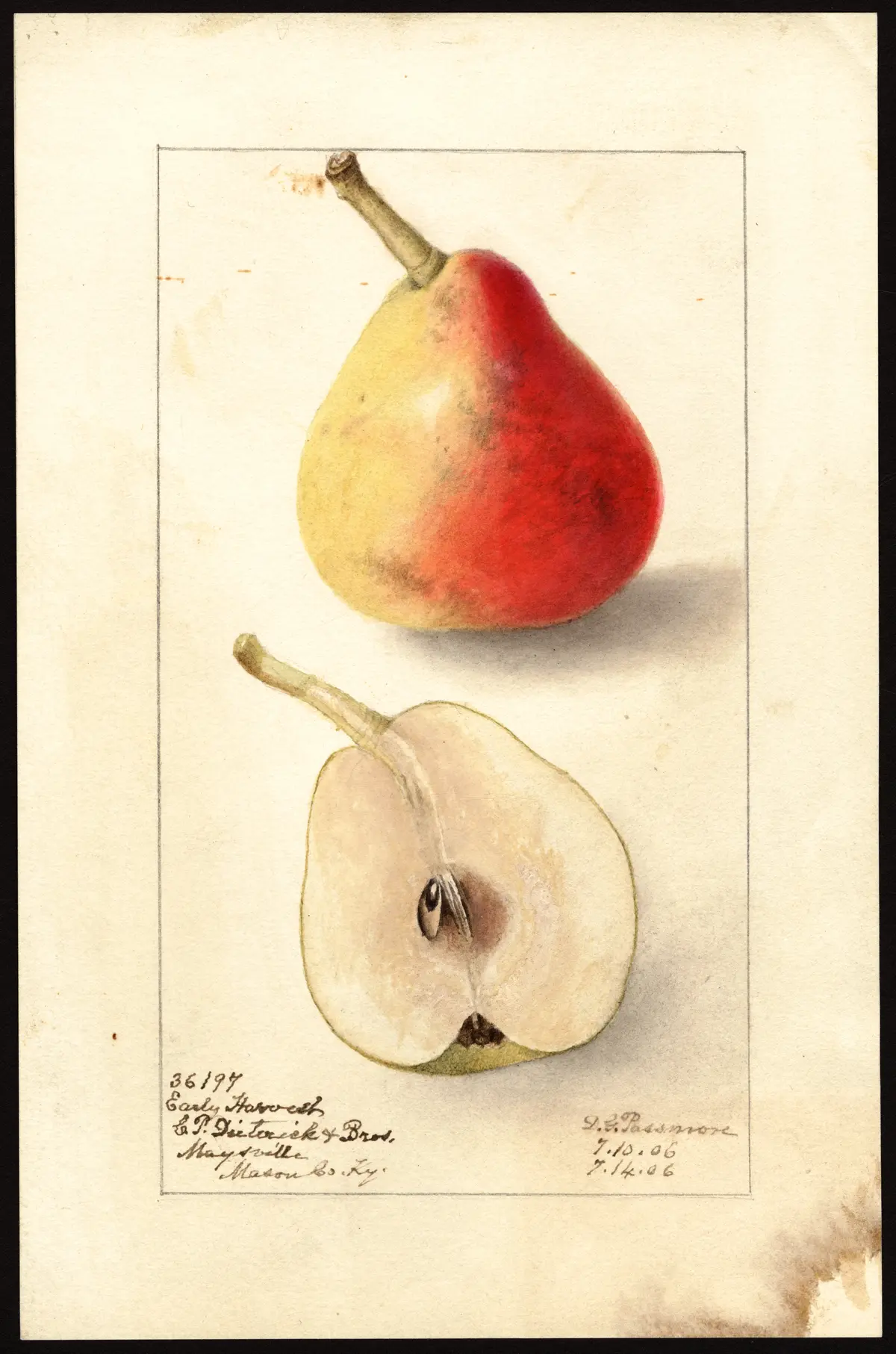
USDA Pomological Watercolor Collection
Early Harvest
Origin / History
Brought to Middletown, Kentucky, from Maryland by Captain William Chambers about 1800, with several other varieties. By the rules of pomological nomenclature the pear should be called Chambers, as it was first known (Hedrick). The name Early Harvest was given by Kentucky growers because of its extreme earliness, and became so closely associated with the variety that it is the only name with which the public is familiar. In 1875 the variety was added to the fruit catalog-list of the American Pomological Society under the name Chambers.
Budd and Hansen list it from Ohio. Hedrick finds it more popular in the Middle West than in any other part of the country, and hardly worth growing in New York, where there are many better pears of its season.
Tree
Tree large, very vigorous, upright-spreading, dense-topped, very hardy, productive with age, long-lived. Trunk very stocky, shaggy. Branches thick, shaggy, zigzag, dull reddish-brown mingled with green, heavily covered with grayish scarf-skin, marked with numerous, large, elongated lenticels. Branchlets very thick, straight, long, with long internodes, dull olive-green mingled with light brown, smooth, glabrous, with numerous very conspicuous, raised lenticels, variable in size.
Leaf-buds small, short, obtuse, appressed; leaf-scars prominent. Leaves 3½ in. long, 2¼ in. wide; apex very abruptly pointed; margin glandless, varying from finely serrate to entire; petiole slender, 1¼ to 1½ in. long. Flowers open early, showy, 1¼ to 1½ in. across, well distributed, averaging 7 buds in a cluster; pedicels 1 in. long, thinly pubescent.
Trees healthy, regular and heavy bearers; Budd and Hansen note the hardiness and free bearing of the tree. Nurserymen report the tree difficult to propagate, and fruit-growers find it slow in coming into bearing; the growth is usually straggling and difficult to manage in nursery or orchard.
Fruit
Size: Large, 3½ in. long, 3 in. wide; large and handsome for an early fruit.
Form: Obovate-obtuse-pyriform, symmetrical.
Stem: Very thick, fleshy at its juncture with the cavity.
Cavity: Obtuse, shallow, narrow, often slightly wrinkled and drawn up in fleshy folds around the base of the stem.
Calyx: Small, open; lobes short, obtuse; calyx-tube very long, narrow.
Basin: Shallow, narrow, obtuse, slightly wrinkled.
Skin: Thin, smooth. Color pale yellow, more or less overspread on the exposed cheek with a pinkish blush, mingled with stripes of carmine (occasionally so, Hedrick 1922). Budd and Hansen describe the fruit as golden yellow with a bright red cheek.
Dots: Numerous, small, greenish-russet, obscure.
Flesh and flavor: Flesh yellowish, firm, granular, crisp, somewhat tough, variable in juiciness. Quality poor (Hedrick); "hardly good" (Budd and Hansen).
Core and seeds: Core large, closed, axile, with clasping core-lines. Seeds wide, short, plump, obtuse.
Season
Ripens in August (Hedrick); one month earlier than Bartlett (Budd and Hansen). Rots at the core soon after ripening.
Uses
Grown quite extensively for market, in Ohio, on account of its size, beauty, and the hardiness and free bearing of the tree (Budd and Hansen). Hedrick finds the fruit so poor in quality that the variety is hardly worth growing; the pears are large and handsome for early fruits, and the trees healthy, regular and heavy bearing.
Subtypes / Variants
Not described in source.
Other
Not described in source.
Book Sources
Described in 3 period pomological works
Nursery Catalog Sources
Found in 5 catalogs (1894–1907) from Illinois, Oregon
- The Vineland Nurseries (Kelsey & Co. , Proprietors), St. Joseph, Missouri (Office: 13th and Atchison Sts., 2 Blocks East of the Citizens St. Car Line) — 1894
- The Dalles Nurseries , The Dalles , Oregon — 1901
- Benjamin Buckman (personal inventory) , Farmingdale , Illinois — 1901
- Phoenix Nursery Company (W. E. Rossney , President; Sidney Tuttle, Vice-President), Bloomington , Illinois — 1904
- Russellville Nursery Co. , Montavilla Station, Portland, OR (three miles east of Portland, one mile from Montavilla car line) — 1907
View original book sources (3)
— J.L. Budd & N.E. Hansen, American Horticultural Manual, Part II: Systematic Pomology (1914)Early Harvest. — Large, golden yellow, with bright red cheek; quality hardly good. Yet it is grown quite extensively for market on account of its size, beauty, and the hardiness and free bearing of the tree. Ripens one month earlier than Bartlett. Ohio.
— U.P. Hedrick, The Pears of New York (1921)EARLY HARVEST
- Neb. Hort. Soc. Rpt. 129. 1890. 2. Budd-Hansen Am. Hort. Man. 2:243. 1903. Chambers. 3. Horticulturist 25:263, fig. 1870. 4. Tilton Jour. Hort. 8:293. 1870. 5. Mass. Hort. Soc. Rpt. 157. 1874. 6. Am. Pom. Soc. Cat. 32. 1875. 7. Downing Fr. Trees Am. 3rd App. 174. 1881. 8. Can. Hort. 26:130. 1903. 9. Ont. Dept. Agr. Fr. Ont. 151, fig. 1914.
The fruits of Early Harvest are so poor in quality and rot at the core so soon after ripening, that the variety is hardly worth growing in New York, where there are many better pears of its season. To offset these defects, the pears are large and handsome for early fruits, and the trees are healthy and regular and heavy bearers. The pear is characterized by a thick, fleshy stem and a large closed core. Nurserymen report that the tree is difficult to propagate, and fruit-growers find that it is slow in coming in bearing; the growth is usually straggling and difficult to manage in nursery or orchard. The variety is more popular in the Middle West than in any other part of the country.
This variety appears to have been brought to Middletown, Kentucky, from Maryland by Captain William Chambers about 1800, with several other varieties. According to the rules of pomological nomenclature, this pear should be called Chambers as it was first known. The name Early Harvest was given the variety by Kentucky growers because of its extreme earliness, and became so closely associated with the variety that to-day it is the only one with which the public is familiar. In 1875 this variety was added to the fruit catalog-list of the American Pomological Society under the name Chambers.
Tree large, very vigorous, upright-spreading, dense-topped, very hardy, productive with age, long-lived; trunk very stocky, shaggy; branches thick, shaggy, zigzag, dull reddish-brown mingled with green and heavily covered with grayish scarf-skin, marked with numerous, large, elongated lenticels; branchlets very thick, straight, long, with long internodes, dull olive-green mingled with light brown, smooth, glabrous, with numerous very conspicuous, raised lenticels, variable in size.
Leaf-buds small, short, obtuse, appressed; leaf-scars prominent. Leaves 3½ in. long, 2¼ in. wide; apex very abruptly pointed; margin glandless, varying from finely serrate to entire; petiole 1¼ in. long, slender. Flowers open early, showy, 1¼ in. across, well distributed, average 7 buds in a cluster; pedicels 1 in. long, thinly pubescent.
Fruit ripens in August; large, 3½ in. long, 3 in. wide, obovate-obtuse-pyriform, symmetrical; stem very thick, fleshy at its juncture with the cavity; cavity obtuse, shallow, narrow, often slightly wrinkled and drawn up in fleshy folds around the base of the stem; calyx small, open; lobes short, obtuse; basin shallow, narrow, obtuse, slightly wrinkled; skin thin, smooth; color pale yellow, more or less overspread on the exposed cheek with a pinkish blush, with stripes of carmine; dots numerous, small, greenish-russet, obscure; flesh yellowish, firm, granular, crisp, somewhat tough, variable in juiciness; quality poor. Core large, closed, axile, with clasping core-lines; calyx-tube very long, narrow; seeds wide, short, plump, obtuse.
— U.P. Hedrick, Cyclopedia of Hardy Fruits (1922)EARLY HARVEST.
Chambers.
The fruits of Early Harvest are so poor in quality, and rot at the core so soon after ripening, that the variety is hardly worth growing. To offset these defects, the pears are large and handsome for early fruits, and the trees are healthy, regular, and heavy bearers. The pear is characterized by a thick, fleshy stem and a large, closed core. Nurserymen report that the tree is difficult to propagate, and fruit-growers find that it is slow in coming in bearing; the growth is usually straggling and difficult to manage in nursery or orchard. The variety is more popular in the Middle West than in any other part of the country. This variety appears to have been brought to Middletown, Kentucky, from Maryland by Captain William Chambers about 1800.
Tree large, very vigorous, upright-spreading, dense-topped, very hardy, productive, long-lived; trunk very stocky, shaggy; branches thick, shaggy, zigzag, dull reddish-brown mingled with green and heavily marked with numerous large, elongated lenticels. Leaves 3½ inches long, 2¼ inches wide; apex very abruptly pointed; margin glandless, varying from finely serrate to entire; petiole 1½ inches long, slender. Flowers open early, showy, 1½ inches across, well distributed, average 7 buds in a cluster. Fruit ripens in August; large, obovate-obtuse-pyriform, symmetrical; stem very thick, fleshy at its juncture with the cavity; cavity obtuse, shallow, narrow, often wrinkled and drawn up in fleshy folds about the base of the stem, calyx small, open; lobes short, obtuse; basin shallow, narrow, obtuse, wrinkled; skin thin, smooth; color pale yellow, more or less overspread on the cheek with a pinkish blush, occasionally mingled with stripes of carmine; dots numerous, small, greenish-russet, obscure; flesh yellowish, firm, granular, crisp, somewhat tough, variable in juiciness; quality poor; core large, closed, axile, with clasping core-lines; calyx-tube very long, narrow; seeds wide, short, plump, obtuse.