Koonce
Pear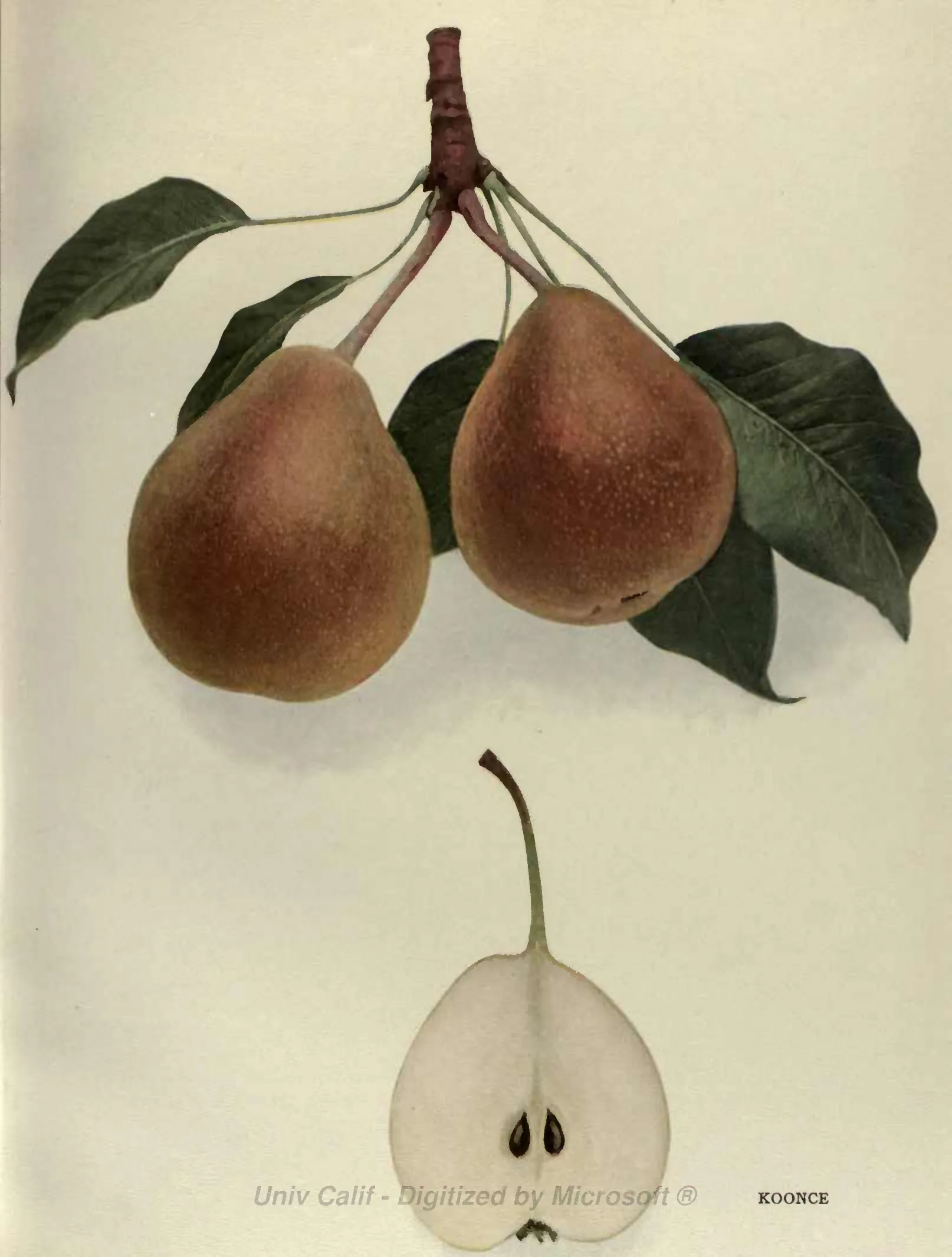
Koonce
Origin / History
Koonce originated in southern Illinois. Hedrick says no one seems to know by whom, at what time, or in what locality in the state. The variety "has been grown for more than thirty years." The American Pomological Society added it to its list of fruits in 1909. Budd and Hansen list it under Illinois. It is cited in the Illinois Horticultural Society reports of 1889 and 1895, the American Pomological Society report of 1897, the Budd-Hansen Manual of 1903, the Chico Nursery catalog of 1904, and an Ontario Department of Agriculture publication of 1914.
Hedrick calls it a popular early variety, grown rather commonly in nearly every pear region in the United States and listed by nearly all nurserymen. Its tree-characters are more notable than those of its fruits. The pears are better in quality than those of Early Harvest or Lawson, with which it often competes, but hardly as attractive in appearance, being rather small and often irregular in shape.
Tree
Tree medium in size and vigor, upright-spreading, scraggly, open-topped, hardy, productive. Hedrick says the trees make a splendid showing in the nursery (a "good showing" in his Cyclopedia) and are hardy and productive in the orchard, though of but medium size and rather straggling at maturity. Trunk shaggy. Branches zigzag, dark brownish-red, covered with thick grayish scarf-skin, with few lenticels. Branchlets thick, long, with long internodes, dull light brown, smooth, glabrous, sprinkled with small, raised, elongated lenticels.
Leaf-buds small, short, conical, pointed, plump, appressed; leaf-scars prominent. Flower-buds short, obtuse or conical, plump, free.
Leaves 2½ in. long, 1½ in. wide, stiff; apex taper-pointed; margin glandular, finely serrate; petiole 1¼ in. long. The Cyclopedia gives the leaf 1¾ in. wide and the petiole 1¾ in. Flowers showy, 1⅛ in. across (1¼ in. in the Cyclopedia), in dense clusters averaging 5 buds to the cluster; pedicels ½ in. long, slender, pubescent.
Fruit
Size: Medium; 2⅝ in. long, 2¼ in. wide. The Cyclopedia gives 2¾ in. long and 2¾ in. wide. Hedrick calls the pears rather small.
Form: Pyriform (Budd and Hansen). Obovate-obtuse-pyriform, with unequal sides, often irregular in shape (Hedrick).
Stem: One inch long (Budd and Hansen). Thick, 1½ in. long (Hedrick; 1¼ in. in the Cyclopedia).
Cavity: Medium-sized, regular, shallow (Budd and Hansen). Obtuse, shallow, narrow, compressed, lipped or often drawn up in a wrinkled fold about the base of the stem (Hedrick).
Calyx: Open; lobes separated at the base, narrow, acuminate. Calyx-tube short, wide, conical.
Basin: Obtuse, gently furrowed.
Skin: Thick, tough, roughish. Pale greenish-yellow (greenish yellow, Budd and Hansen), with a dull reddish-brown blush spreading over the exposed cheek (a bronze cheek, Budd and Hansen). Hedrick calls the color unusually bright, especially on the red cheek.
Dots: Numerous, very small, greenish-russet, conspicuous (Hedrick). Small, russet (Budd and Hansen).
Flesh and flavor: Whitish, granular especially at the center, medium tender, juicy, aromatic, sweet but vinous; quality "good" (Hedrick). Budd and Hansen give the flesh white, granular, and the flavor "poor."
Core and seeds: Core small, closed, with clasping core-lines. Seeds small, narrow, short, plump, acute.
Season
Ripens in August. The pears decay quickly after maturity.
Uses
Suitable only for home and local markets (Hedrick). Used for market and kitchen in Illinois (Budd and Hansen).
Subtypes / Variants
Not described in source.
Other
Not described in source.
Book Sources
Described in 3 period pomological works
Nursery Catalog Sources
Found in 30 catalogs (1890–1920) from Arkansas, Illinois, Maryland, Massachusetts, Missouri, Nebraska, New Jersey, Oregon, Pennsylvania, Washington
- William H. Moon Co. , Morrisville, Bucks County , Pennsylvania — 1890
- Rogers Nursery Co. , Moorestown , New Jersey — 1893
- The Lovett Company , Little Silver , New Jersey — 1896
- Reading Nursery , Jacob W. Manning, Proprietor, Reading , Massachusetts — 1898
- Stark Bros. Nurseries & Orchards Co. , Louisiana , Missouri — 1898
- Brown Brothers Co. , Continental Nurseries, Rochester, NY (also operated from Toronto, Canada) — 1899
- Central Experimental Farm , Dominion Department of Agriculture, Agassiz, British Columbia (under test; Bulletin No. 3, Second Series) — 1900
- Washington Nursery Co. , Toppenish , Washington — 1901
- Brown Brothers Co. , Continental Nurseries, Rochester, NY (also operated from Toronto, Canada) — 1901
- Yarbrough Bros. , Stephens , Arkansas — 1901
- Benjamin Buckman (personal inventory) , Farmingdale , Illinois — 1901
- Phoenix Nursery Company (W. E. Rossney , President; Sidney Tuttle, Vice-President), Bloomington , Illinois — 1904
- Stark Bros. Nurseries & Orchards Co. , Louisiana , Missouri — 1906
- Carlton Nursery Co. , Carlton , Oregon — 1909
- Wm. J. Corse (successor to Robert Sinclair / Sinclair Nurseries) , Baltimore , Maryland — 1909
- Washington Nursery Company , Toppenish , Washington — 1909
- Island Nurseries & Fruit Farm , Vashon (Vashon Island) , Washington — 1910
- Stark Bros. Nurseries & Orchards Co. , Louisiana , Missouri — 1910
- Galbraith Nursery Co. (DeWitt Hansen , Pres.-Mgr.), Fairbury , Nebraska — 1911
- Island Nurseries & Fruit Farm , Vashon (Vashon Island) , Washington — 1911
- Stark Bros. Nurseries & Orchards Co. , Louisiana , Missouri — 1911
- Pacific Nursery Company , Portland , Oregon — 1912
- Stark Bros. Nurseries & Orchards Co. , Louisiana , Missouri — 1912
- Washington Nursery Company , Toppenish , Washington — 1912
- Island Nurseries & Fruit Farm , Vashon (Vashon Island) , Washington — 1914
- Island Nurseries & Fruit Farm , Vashon (Vashon Island) , Washington — 1915
- Island Nurseries & Fruit Farm , Vashon (Vashon Island) , Washington — 1916
- Island Nurseries & Fruit Farm , Vashon (Vashon Island) , Washington — 1917
- Oregon Nursery Co. , Orenco , Oregon — 1920
- Washington Nursery Company , Toppenish, Washington (on Yakima Indian Reservation) - [undated; companion to the 1912 "Sixth Edition" descriptive catalogue; same cover design and incorporated 1903 date; dated as c.1912]
View original book sources (3)
— J.L. Budd & N.E. Hansen, American Horticultural Manual, Part II: Systematic Pomology (1914)Koonce. — Medium, pyriform; color greenish yellow with bronze cheek, and small russet dots; stem one inch long, inserted in medium-sized regular shallow cavity. Flesh white, granular, flavor poor. Used for market and kitchen in Illinois. Illinois.
— U.P. Hedrick, The Pears of New York (1921)KOONCE
- Ill. Hort. Soc. Rpt. 139. 1889. 2. Ibid. 55. 1895. 3. Am. Pom. Soc. Rpt. 44. 1897. 4. Budd-Hansen Am. Hort. Man. 2:251. 1903. 5. Chico Nur. Cat. 12. 1904. 6. Am. Pom. Soc. Cat. 41. 1909. 7. Ont. Dept. Agr. Fr. Ont. 168. 1914.
Koonce is a popular early variety grown rather commonly in nearly every pear region in the United States. It is listed by nearly all nurserymen. Its tree-characters are more notable than those of its fruits. The trees make a splendid showing in the nursery and are hardy and productive in the orchard, although of but medium size and rather straggling at maturity. The pears are better in quality than those of Early Harvest or Lawson, with which it often competes, but are hardly as attractive in appearance, being rather small and often irregular in shape. The color is unusually bright, especially on the red cheek. The pears decay quickly after maturity and are suitable only for home and local markets.
This pear originated in southern Illinois but no one seems to know by whom, or at what time, or in what locality in the State. The variety has been grown for more than thirty years. The American Pomological Society added Koonce to its list of fruits in 1909.
Tree medium in size and vigor, upright-spreading, scraggly, open-topped, hardy, productive; trunk shaggy; branches zigzag, dark brownish-red, covered with thick grayish scarf-skin, with few lenticels; branchlets thick, long, with long internodes, dull light brown, smooth, glabrous, sprinkled with small, raised, elongated lenticels.
Leaf-buds small, short, conical, pointed, plump, appressed; leaf-scars prominent.
Leaves 2½ in. long, 1½ in. wide, stiff; apex taper-pointed; margin glandular, finely serrate; petiole 1¼ in. long. Flower-buds short, obtuse or conical, plump, free; flowers showy, 1⅛ in. across, in dense clusters, average 5 buds in a cluster; pedicels ½ in. long, slender, pubescent.
Fruit ripens in August; medium in size, 2⅝ in. long, 2¼ in. wide, obovate-obtuse-pyriform, with unequal sides; stem 1½ in. long, thick; cavity obtuse, shallow, narrow, compressed, lipped or often drawn up in a wrinkled fold about the base of the stem; calyx open; lobes separated at the base, narrow, acuminate; basin obtuse, gently furrowed; skin thick, tough, roughish; color pale greenish-yellow, with a dull reddish-brown blush spreading over the exposed cheek; dots numerous, very small, greenish-russet, conspicuous; flesh whitish, granular especially at the center, medium tender, juicy, aromatic, sweet but vinous; quality good. Core small, closed, with clasping core-lines; calyx-tube short, wide, conical; seeds small, narrow, short, plump, acute.
— U.P. Hedrick, Cyclopedia of Hardy Fruits (1922)KOONCE. Koonce is a popular early variety grown rather commonly in nearly every pear region in the United States. The trees make a good showing in the nursery and are hardy and productive in the orchard, although of but medium size and rather straggling at maturity. The pears are better in quality than those of Early Harvest or Lawson, with which it often competes, but are hardly as attractive in appearance, as they are small and often irregular in shape. The color is unusually bright, especially on the red cheek. The pears decay quickly after maturity and are suitable only for home and local markets.
This pear originated in southern Illinois, but by whom or at what time does not appear. The variety has been grown for more than thirty years.
Tree upright-spreading, scraggly, open-topped, hardy, productive; trunk shaggy; branches zigzag, dark brownish-red, with few lenticels. Leaves 2½ inches long, 1¾ inches wide, stiff; apex taper-pointed; margin glandular, finely serrate; petiole 1¾ inches long. Flowers showy, 1¼ inches across, in dense clusters, average buds in a cluster. Fruit ripens in August; medium in size, 2¾ inches long, 2¾ inches wide, obovate-obtuse-pyriform, with unequal sides; stem 1¼ inches long, thick; cavity obtuse, shallow, narrow, compressed, lipped or often drawn up in a wrinkled fold about the base of the stem; calyx open; lobes separated at the base, narrow, acuminate; basin obtuse, gently furrowed; skin thick, tough, roughish; color pale greenish-yellow with a dull reddish-brown blush spreading over the exposed cheek; dots numerous, very small, greenish-russet, conspicuous; flesh whitish, granular especially at the center, medium tender, juicy, aromatic, sweet but vinous; quality good; core small, closed, with clasping core-lines; calyx-tube short, wide, conical; seeds small, narrow, short, plump, acute.