Lawson
Pear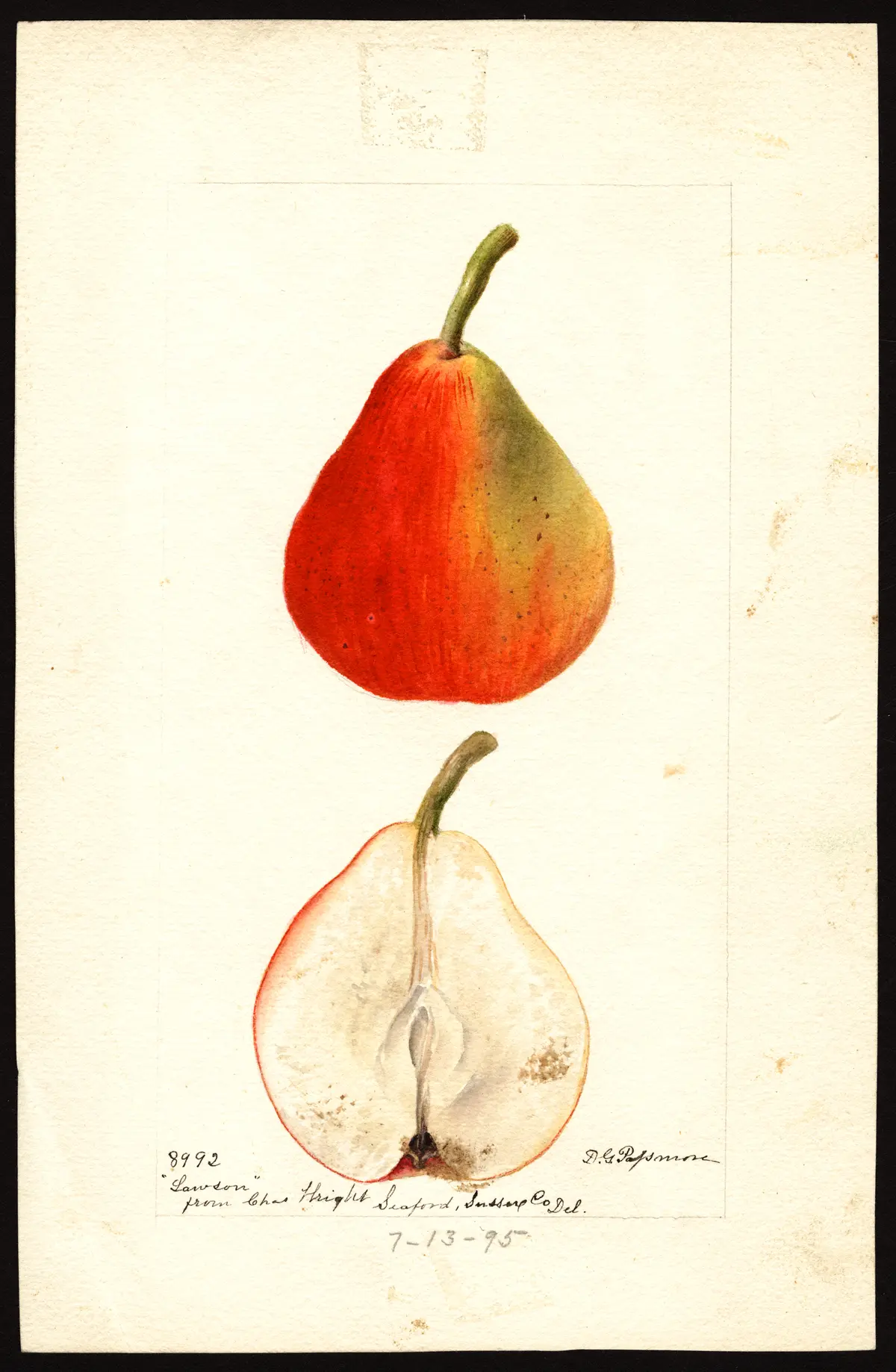
USDA Pomological Watercolor Collection
Lawson
Origin / History
Lawson originated on the farm of a Mr. Lawson in Ulster County, New York, about 1800. Hedrick dates it from the appearance of the original tree, which was still standing in 1900; Budd and Hansen likewise give New York as its home. It was introduced toward the end of the nineteenth century under the name Comet, "by reason of its color," and so is sometimes known as Lawson Comet.
Hedrick's earliest cited notices are in the Rural N. Y. of 1884 and 1885 and the Gard. Mon. of 1885, the latter carrying it under both Lawson and Comet. Later notices appear in Gard. & For. and the Van Lindley catalog in 1892, Ontario in 1914, and a California treatise on pear growing in 1918. The American Pomological Society added Lawson to its fruit-catalog in 1899.
Hedrick writes that although Lawson had been grown for more than a hundred years in New York ("in the East," in his Cyclopedia), "the variety has never made headway in this State, but seems to be attracting much attention on the Pacific slope." Thomas calls it "valuable South," and Budd and Hansen describe it as grown in the South.
Tree
Tree medium in size, vigorous, upright, dense-topped, very productive, characterized by tall, upright growth. Hedrick calls it fairly healthy, hardy, and free from blight, though the tree description in his Cyclopedia adds "not always hardy." Comes into bearing at 8 or 10 years (Thomas).
Branches slender, zigzag, reddish-brown overlaid with grayish scarf-skin, marked with numerous raised, large lenticels. Branchlets slender, very long, with characteristically long internodes, rough, zigzag, marked with numerous large, raised, conspicuous lenticels.
Leaves 3½ inches long and 1½ inches wide in Hedrick's Pears of New York; his Cyclopedia gives 3¼ inches long and 1¾ inches wide. Apex abruptly pointed; margin glandless, serrate; petiole ¾ inch long.
Flowers early, showy, in dense clusters, 6 or 8 buds in a cluster; 1¼ inches across in the Pears of New York, 1¾ inches in the Cyclopedia. Pedicels 1 inch long, thick.
Fruit
Size: Medium to large; Hedrick calls it large. The Pears of New York gives the fruit as 2¾ inches long and 2½ inches wide; the Cyclopedia gives 2¾ inches long and 3¼ inches wide.
Form: Obovate, inclined to pyriform. Hedrick gives it as varying from obovate-obtuse-pyriform to globular-obtuse-pyriform, with unequal sides, and adds that the fruits are often irregular in shape.
Stem: Thick or stout, curved or inclined. Hedrick calls it woody and Budd and Hansen fleshy. Hedrick gives the length as ⅝ inch in the Pears of New York and ¾ inch in the Cyclopedia. Budd and Hansen give three-quarters of an inch.
Cavity: Very small and narrow, often with a lip drawn up around one side of the stem (Hedrick); slight (Budd and Hansen).
Calyx: Partly open; lobes narrow, often reflexed. Calyx-tube short, wide (Hedrick).
Basin: Narrow, obtuse, gently furrowed (Hedrick); broad, shallow, slightly corrugated (Budd and Hansen).
Skin: Thin, tender, smooth. Pale yellow or yellowish, overspread on the exposed cheek with a bright red blush, which the Cyclopedia calls bright, pinkish-red. Thomas gives the color as crimson or yellow. Hedrick writes that "of all early pears, the fruit of Lawson best satisfies the eye for bright colors," and that it is as brightly colored as the brilliant Vermont Beauty or as Mount Vernon.
Dots: Numerous, small, greenish or russet, obscure (Hedrick); scattering brown specks (Budd and Hansen).
Flesh and flavor: Flesh whitish, often salmon-color (Hedrick). Firm, crisp, breaking, tough; quite coarse (Budd and Hansen); juicy to medium juicy.
Budd and Hansen call it sweet; Hedrick finds it "lacking sweetness." Budd and Hansen rate the quality "fair to good." Hedrick rates it "poor" and writes that in quality the fruits "are never more than mediocre," which his Cyclopedia gives as simply "mediocre."
Core and seeds: Core unusually small, closed, with clasping core-lines; Hedrick counts the small core an outstanding character. Seeds short, wide, plump, obtuse, few in number. The pears are sometimes nearly or quite seedless in the Pears of New York; the Cyclopedia says often.
Season
Early summer to August; Hedrick gives the fruit as ripening in August. The pears ripen early and quickly, but the core seldom softens unduly (Hedrick).
Uses
A culinary market variety (Budd and Hansen).
Subtypes / Variants
Not described in source.
Other
Not described in source.
Book Sources
Described in 4 period pomological works
Nursery Catalog Sources
Found in 16 catalogs (1891–1912) from Alabama, Florida, Illinois, Missouri, New Jersey, Oregon, Washington
- Missouri Nursery Co. , Louisiana , Missouri — 1891
- Glen St. Mary Nurseries (G.L. Taber , Proprietor), Glen St. Mary , Florida — 1893
- The Vineland Nurseries (Kelsey & Co. , Proprietors), St. Joseph, Missouri (Office: 13th and Atchison Sts., 2 Blocks East of the Citizens St. Car Line) — 1894
- Woodburn Nurseries , Woodburn, Marion Co. , Oregon — 1894
- Multnomah Nurseries , Russellville , Oregon — 1894
- The Lovett Company , Little Silver , New Jersey — 1896
- Alabama Nursery Co. , Huntsville , Alabama — 1900
- Central Experimental Farm , Dominion Department of Agriculture, Agassiz, British Columbia (under test; Bulletin No. 3, Second Series) — 1900
- Washington Nursery Co. , Toppenish , Washington — 1901
- Benjamin Buckman (personal inventory) , Farmingdale , Illinois — 1901
- Mountain Grove Nurseries (Tippin & Moore , Proprietors; Geo. T. Tippin, J. W. Tippin, J. C. Moore), Mountain Grove , Missouri — 1901
- Phoenix Nursery Company (W. E. Rossney , President; Sidney Tuttle, Vice-President), Bloomington , Illinois — 1904
- The Dalles Nurseries , The Dalles , Oregon — 1906
- Washington Nursery Company , Toppenish , Washington — 1909
- Pacific Nursery Company , Portland , Oregon — 1912
- Washington Nursery Company , Toppenish , Washington — 1912
View original book sources (4)
— John J. Thomas, The American Fruit Culturist (1903)Lawson. (Comet.) Medium to large, crimson or yellow; flesh crisp and juicy. Early summer. Comes in bearing at 8 or 10 years. Valuable South.
— J.L. Budd & N.E. Hansen, American Horticultural Manual, Part II: Systematic Pomology (1914)Lawson. — Medium to large, obovate, inclined to pyriform; color yellowish with red cheek and scattering brown specks; stalk three-quarters of an inch long, stout, fleshy, inclined, and inserted in slight cavity; basin broad, shallow, slightly corrugated. Flesh whitish, quite coarse, breaking, and sweet, quality fair to good. A culinary market variety grown in the South. New York.
— U.P. Hedrick, The Pears of New York (1921)LAWSON
- Rural N. Y. 43:651, fig. 385. 1884. 2. Gard. Mon. 27:282. 1885. 3. Rural N. Y. 44:693. 1885. 4. Gard. & For. 5:414. 1892. 5. Van Lindley Cat. 22. 1892. 6. Am. Pom. Soc. Cat. 36. 1899. 7. Ont. Dept. Agr. Fr. Ont. 168. 1914. 8. Cal. Com. Hort. Pear Grow. Cal. 7:266, fig. 67. 1918.
Comet. 9. Gard. Mon. 27:144. 1885. Cometbirne. 10. Mathieu Nom. Pom. 198. 1889.
Of all early pears, the fruit of Lawson best satisfies the eye for bright colors. It is as brightly colored as the brilliant Vermont Beauty or as Mount Vernon. Another outstanding character is the small core, which, though the pears ripen early and quickly, seldom softens unduly. The pears are sometimes nearly or quite seedless. Unfortunately, the fruits are often irregular in shape, and in quality are never more than mediocre. The tree is fairly healthy, vigorous, hardy, and free from blight, and is characterized by its tall, upright growth. Although grown for more than a hundred years in New York, the variety has never made headway in this State, but seems to be attracting much attention on the Pacific slope.
This pear originated on the farm of a Mr. Lawson in Ulster County, New York, about 1800, judging from the appearance of the original tree which was standing in 1900. The variety was introduced toward the end of the nineteenth century under the name Comet by reason of its color, so that it is sometimes known as Lawson Comet. The American Pomological Society added Lawson to its fruit-catalog in 1899.
Tree medium in size, vigorous, upright, dense-topped, very productive; branches slender, zigzag, reddish-brown overlaid with grayish scarf-skin, marked with numerous raised, large lenticels; branchlets slender, very long, with characteristically long internodes, rough, zigzag, marked with numerous large, raised, conspicuous lenticels. Leaves 3½ in. long, 1½ in. wide; apex abruptly pointed; margin glandless, serrate; petiole ¾ in. long. Flowers early, showy, 1¼ in. across, in dense clusters, 6 or 8 buds in a cluster; pedicels 1 in. long, thick.
Fruit ripens in August; large, 2¾ in. long, 2½ in. wide, varies from obovate-obtuse-pyriform to globular-obtuse-pyriform, with unequal sides; stem ⅝ in. long, thick, curved, woody; cavity very small and narrow, often with a lip drawn up around one side of the stem; calyx partly open; lobes narrow, often reflexed; basin narrow, obtuse, gently furrowed; skin thin, tender, smooth; color pale yellow, overspread on the exposed cheek with a bright red blush; dots numerous, small, greenish or russet, obscure; flesh whitish or often salmon-color, firm, tough, medium juicy, lacking sweetness; quality poor. Core unusually small, closed, with clasping core-lines; calyx-tube short, wide; seeds short, wide, plump, obtuse, few in number.
— U.P. Hedrick, Cyclopedia of Hardy Fruits (1922)LAWSON. Comet.
Of all early pears, the fruits of Lawson best satisfy the eye for bright colors. They are as brightly colored as the brilliant Vermont Beauty or as Mount Vernon. Another outstanding character is the small core, which, though the pears ripen early and quickly, seldom soften unduly. The pears are often nearly or quite seedless. Unfortunately, the fruits are often irregular in shape, and in quality are mediocre. The tree is fairly healthy, vigorous, hardy, and free from blight, and is characterized by its tall, upright growth. Although grown for more than a hundred years in the East, the variety has never made headway here, but seems to be attracting much attention on the Pacific slope.
This pear originated on the farm of a Mr. Lawson, Ulster County, New York, about 1800.
Tree medium in size, vigorous, upright, dense-topped, not always hardy, very productive; branches slender, zigzag, reddish-brown, marked with numerous raised large lenticels. Leaves 3¼ inches long, 1¾ inches wide; apex abruptly pointed; margin glandless, serrate; petiole ¾ inches long. Flowers early, showy, 1¾ inches across, in dense clusters, 6 or 8 buds in a cluster. Fruit ripens in August; large, 2¾ inches long, 3¼ inches wide, obovate-obtuse-pyriform, with unequal sides; stem ¾ inch long, thick, curved, woody; cavity very small and narrow, often with a lip drawn up around one side of the stem; calyx partly open; lobes narrow, often reflexed; basin narrow, obtuse, gently furrowed; skin thin, tender, smooth; color pale yellow overspread on the exposed cheek with a bright, pinkish-red blush; dots numerous, small, greenish or russet, obscure; flesh whitish or often salmon-color, firm, tough, medium juicy, lacking sweetness; quality poor; core unusually small, closed, with clasping core-lines; calyx-tube short, wide; seeds short, wide, plump, obtuse, few in number.