Mount Vernon
Pear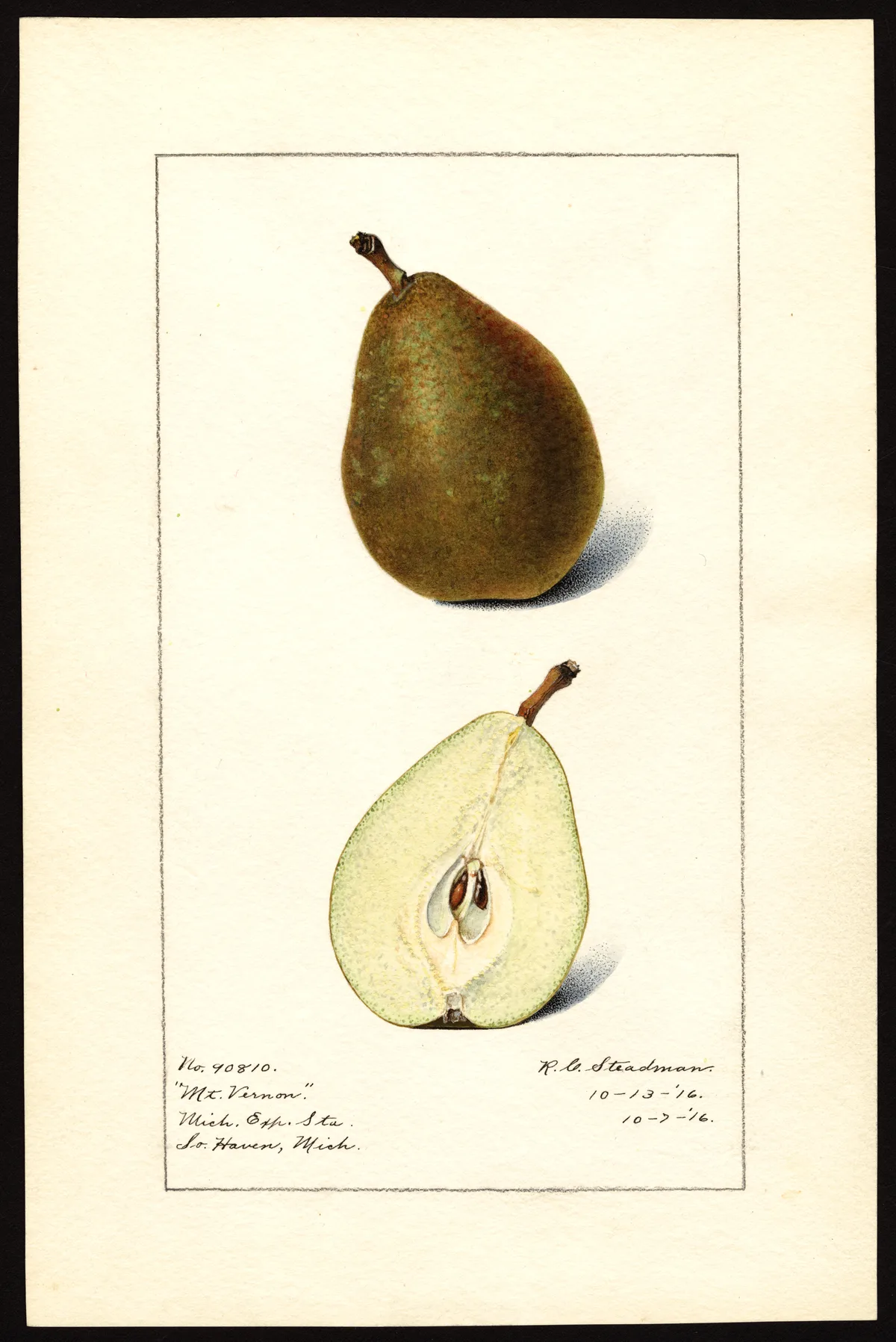
USDA Pomological Watercolor Collection
Mount Vernon
Origin/History
Mount Vernon originated as a chance seedling in the grounds (garden) of Samuel Walker, Roxbury, Massachusetts, who named it Mount Vernon. Downing places the origin at the end of the first half of the nineteenth century (Hedrick's Pears of New York), and Hedrick's Cyclopedia of Hardy Fruits dates the origin to about 1847. The variety was grown in several states (Budd-Hansen). Hedrick notes that as a distinct type, and because the pears ripen at a season when there are few other varieties of this fruit, Mount Vernon has a prominent place in the list of worthy American pears. Bibliographic references cited by Hedrick include Am. Jour. Hort. 3:144, figs. 1868; Downing Fr. Trees Am. 818, 1869; Horticulturist 24:307, fig. 1869; Horticulturist 26:361, 1871; Am. Pom. Soc. Cat. 20, 1871; Horticulturist 27:204, 1872; and Budd-Hansen Am. Hort. Man. 2:256, 1903.
Tree
Downing describes the tree as a vigorous grower and an early bearer, with young wood yellow reddish brown. The Central Experimental Farm catalogue (planted Spring 1890) reports the tree as a strong grower but a shy bearer.
Hedrick (Pears of New York) describes the tree as large, vigorous, spreading, with many drooping branches, dense-topped, hardy, productive, long-lived. The head is small (Cyclopedia notes "small, dense head"), with numerous, short, stocky branches, many of which droop, giving the top a quite distinct aspect. Trunk stocky; in the Cyclopedia, trunk is described as stocky, medium to rough. Branches thick, shaggy (Cyclopedia: somewhat shaggy), reddish-brown, overcast with gray scarf-skin, marked by few large lenticels. Branchlets thick, with short internodes, grayish-brown, smooth, glabrous, with a few large, raised lenticels.
Leaf-buds variable in shape, usually free. Leaves (Pears of New York) 3½ inches long, 1½ inches wide; (Cyclopedia of Hardy Fruits) 2½ inches long, 1¼ inches wide; oval, medium to thick, leathery; apex taper-pointed; margin crenate, tipped with rudimentary glands; petiole 1¼ inches long. Flower-buds large, long, conical or pointed, free. Flowers 1⅛ inches across (Pears of New York) or 1¾ inches across (Cyclopedia), in dense clusters, 7 to 9 buds in a cluster (Pears of New York; Cyclopedia reads "to buds in a cluster"). Pedicels ⅞ inch long, slender, lightly pubescent, pale green, with a faint tinge of red.
Fruit
Size
Downing: medium or above. Thomas: medium. Budd-Hansen: medium to large. Hedrick: medium in size. The Central Experimental Farm catalogue gives medium size. Hedrick (Pears of New York) gives dimensions of 2⅜ inches long, 2⅜ inches wide, uniform in size; Hedrick (Cyclopedia of Hardy Fruits) gives 2¾ inches long, 2¾ inches wide, uniform in size, though the Cyclopedia also lists "small size" among the chief defects.
Form
Downing: varying in form, but generally roundish obtuse pyriform. Thomas: obovate, irregular. Budd-Hansen: roundish, obtuse pyriform. Central Experimental Farm: roundish, pyriform. Hedrick (Pears of New York): roundish-obtuse-pyriform, irregular, with unequal sides, variable in shape. Hedrick (Cyclopedia of Hardy Fruits): oblong-pyriform, with unequal sides. The top-shaped form is noted as giving the pear a unique appearance, with lack of uniformity in shape listed as a chief defect (Hedrick, Pears of New York; Cyclopedia also cites lack of uniformity in shape).
Stem / Stalk
Downing: stalk short, inserted by a lip, with little or no depression. Thomas: stalk very short, oblique, scarcely sunk. Budd-Hansen: stalk short, inclined by raised lip. Hedrick (Pears of New York): stem 1 inch long, thick, usually curved. Hedrick (Cyclopedia of Hardy Fruits): stem ¾ inch long, thick, usually curved.
Cavity
Downing: little or no depression. Thomas: scarcely sunk. Hedrick (Pears of New York): cavity obtuse, very shallow and narrow, russeted, furrowed, often very heavily lipped, so that the stem appears to be inserted under a fleshy enlargement. Hedrick (Cyclopedia of Hardy Fruits): cavity obtuse, shallow and narrow, russeted, furrowed, often heavily lipped.
Calyx
Downing: small, closed, with short segments. Hedrick (Pears of New York): calyx open; lobes short, narrow, acute to acuminate. Hedrick (Cyclopedia of Hardy Fruits): calyx open; lobes short, narrow, acuminate.
Basin
Thomas: shallow, smooth. Hedrick (Pears of New York): narrow, obtuse, smooth, usually symmetrical. Hedrick (Cyclopedia of Hardy Fruits): narrow, obtuse, smooth, symmetrical.
Skin / Color
Downing: light russet on a yellow ground, brownish red in the sun. Thomas: dull brownish russet, with a red cheek. Budd-Hansen: color yellowish, netted, and nearly covered with light yellowish russet. Central Experimental Farm: yellowish, with a reddish cheek, and a little russet. Hedrick (both works): skin granular, roughened by russet, dull; color light russet overspreading a greenish-yellow ground, with a brownish-red blush on the exposed cheek, dotted and netted with russet. Hedrick characterizes the overall appearance as having reddish-russet color giving the pear a unique appearance (though noting in Pears of New York that the russet color is not well brought out in the accompanying color-plate).
Dots
Hedrick (both works): dots numerous, small, russet, obscure.
Flesh / Flavor
Downing: yellowish, granulated, juicy, melting, slightly vinous and slightly aromatic. Very good. Thomas: greenish-white, a little coarse, rich, vinous, aromatic. Budd-Hansen: yellowish, granular, juicy, melting, quite vinous, quality good. Central Experimental Farm: yellowish, juicy, granular with an aromatic flavour. Hedrick (Pears of New York): white, with a faint tinge of yellow, often with a green tinge under the skin, granular, tender and melting, juicy, sweet, aromatic, with a vinous tendency; quality good to very good. Hedrick (Cyclopedia of Hardy Fruits): flesh with a faint tinge of yellow, granular, tender and melting, juicy, sweet, aromatic; quality good to very good. Hedrick (both works) further characterizes the quality of the fruits with greenish-yellow, granular, spicy, piquant flesh, calling these very distinct characters.
Core / Seeds
Hedrick (both works): core large, closed, with clasping core-lines (Cyclopedia: corelines); calyx-tube short, wide, conical; seeds variable in size, wide, long, plump, acute, many abortive.
Season
Downing: November, December. Thomas: October, November. Budd-Hansen: not stated explicitly beyond fruit description. Central Experimental Farm: November. Hedrick: fruit ripe in late October and November. The variety ripens its crop in early winter from which time, under good conditions, it may be kept until mid-winter — a season in which there are few good pears.
Uses
Hedrick: the variety is worthy when a winter pear is wanted whether for home or market.
Subtypes/Variants
Not described in source.
Other
Hedrick (Pears of New York) notes that the trees are unusually satisfactory in most of the characters of importance in a good pear-tree.
Book Sources
Described in 5 period pomological works
Nursery Catalog Sources
Found in 19 catalogs (1894–1917) from Alabama, Illinois, Oregon, Washington
- The Vineland Nurseries (Kelsey & Co. , Proprietors), St. Joseph, Missouri (Office: 13th and Atchison Sts., 2 Blocks East of the Citizens St. Car Line) — 1894
- Woodburn Nurseries , Woodburn, Marion Co. , Oregon — 1894
- Alabama Nursery Co. , Huntsville , Alabama — 1900
- Central Experimental Farm , Dominion Department of Agriculture, Agassiz, British Columbia (under test; Bulletin No. 3, Second Series) — 1900
- Washington Nursery Co. , Toppenish , Washington — 1901
- Benjamin Buckman (personal inventory) , Farmingdale , Illinois — 1901
- Phoenix Nursery Company (W. E. Rossney , President; Sidney Tuttle, Vice-President), Bloomington , Illinois — 1904
- Washington Nursery Company , Toppenish , Washington — 1909
- Island Nurseries & Fruit Farm , Vashon (Vashon Island) , Washington — 1910
- Island Nurseries & Fruit Farm , Vashon (Vashon Island) , Washington — 1911
- Pacific Nursery Company , Portland , Oregon — 1912
- Vineland Nurseries Company , Clarkston , Washington — 1912
- Washington Nursery Company , Toppenish , Washington — 1912
- Van Holderbeke Nursery Co. , Incorporated, Spokane, Washington (nurseries at Otis Orchards WA, Pasadena WA, Kennewick WA) — 1913
- Benjamin Buckman (personal inventory) , Farmingdale , Illinois — 1913
- Island Nurseries & Fruit Farm , Vashon (Vashon Island) , Washington — 1914
- Island Nurseries & Fruit Farm , Vashon (Vashon Island) , Washington — 1915
- Island Nurseries & Fruit Farm , Vashon (Vashon Island) , Washington — 1916
- Island Nurseries & Fruit Farm , Vashon (Vashon Island) , Washington — 1917
View original book sources (6)
— A.J. Downing, The Fruits and Fruit Trees of America (1900)Mount Vernon.
Walker's Seedling.
A chance seedling, originated in the grounds of Samuel Walker, Roxbury, Mass., and by him named Mount Vernon. The tree is a vigorous grower, and an early bearer. Young wood yellow reddish brown.
Fruit medium or above, varying in form, but generally roundish obtuse pyriform, light russet on a yellow ground, brownish red in the sun. Stalk short, inserted by a lip, with little or no depression. Calyx small, closed, with short segments. Flesh yellowish, granulated, juicy, melting, slightly vinous and slightly aromatic. Very good. November, December.
— John J. Thomas, The American Fruit Culturist (1903)Mount Vernon.* (Walker's Seedling.) Medium, obovate, irregular; dull brownish russet, with a red cheek; stalk very short, oblique, scarcely sunk; basin shallow, smooth; flesh greenish-white, a little coarse, rich, vinous, aromatic. October, November. Roxbury, Mass.
— J.L. Budd & N.E. Hansen, American Horticultural Manual, Part II: Systematic Pomology (1914)Mount Vernon. — Medium to large, roundish, obtuse pyriform; color yellowish, netted, and nearly covered with light yellowish russet; stalk short, inclined by raised lip. Flesh yellowish, granular, juicy, melting, quite vinous, quality good. Grown in several States. Massachusetts.
— U.P. Hedrick, The Pears of New York (1921)MOUNT VERNON
- Am. Jour. Hort. 3:144, figs. 1868. 2. Downing Fr. Trees Am. 818. 1869. 3. Horticulturist 24:307, fig. 1869. 4. Ibid. 26:361. 1871. 5. Am. Pom. Soc. Cat. 20. 1871. 6. Horticulturist 27:204. 1872. 7. Budd-Hansen Am. Hort. Man. 2:256. 1903.
As a distinct type, and because the pears ripen at a season when there are few other varieties of this fruit, Mount Vernon has a prominent place in the list of worthy American pears. The top-shaped form and reddish-russet color give the pear a unique appearance, and with the greenish-yellow, granular, spicy, piquant flesh constitute very distinct characters in its quality. Unfortunately, the russet color is not well brought out in the accompanying color-plate. Lack of uniformity in shape and size are the chief defects in the appearance of the pears. The variety is valuable because it ripens its crop in early winter from which time, under good conditions, it may be kept until mid-winter, a season in which there are few good pears. The trees are unusually satisfactory in most of the characters of importance in a good pear-tree. The tree is vigorous but the head is small, with numerous, short, stocky branches, many of which droop. The aspect given the top by these peculiarities is quite distinct. The variety is worthy when a winter pear is wanted whether for home or market.
This pear, which is very distinct from any other variety, originated from a chance seedling in the garden of Samuel Walker, Roxbury, Massachusetts, at the end of the first half of the nineteenth century.
Tree large, vigorous, spreading, with many drooping branches, dense-topped, hardy, productive, long-lived; trunk stocky; branches thick, shaggy, reddish-brown, overcast with gray scarf-skin, marked by few large lenticels; branchlets thick, with short internodes, grayish-brown, smooth, glabrous, with a few large, raised lenticels.
Leaf-buds variable in shape, usually free. Leaves 3½ in. long, 1½ in. wide, oval, medium to thick, leathery; apex taper-pointed; margin crenate, tipped with rudimentary glands; petiole 1¼ in. long. Flower-buds large, long, conical or pointed, free; flowers 1⅛ in. across, in dense clusters, 7 to 9 buds in a cluster; pedicels ⅞ in. long, slender, lightly pubescent, pale green, with a faint tinge of red.
Fruit ripe in late October and November; medium in size, 2⅜ in. long, 2⅜ in. wide, uniform in size, roundish-obtuse-pyriform, irregular, with unequal sides, variable in shape; stem 1 in. long, thick, usually curved; cavity obtuse, very shallow and narrow, russeted, furrowed, often very heavily lipped, so that the stem appears to be inserted under a fleshy enlargement; calyx open; lobes short, narrow, acute to acuminate; basin narrow, obtuse, smooth, usually symmetrical; skin granular, roughened by russet, dull; color light russet overspreading a greenish-yellow ground, with a brownish-red blush on the exposed cheek, dotted and netted with russet; dots numerous, small, russet, obscure; flesh white, with a faint tinge of yellow, often with a green tinge under the skin, granular, tender and melting, juicy, sweet, aromatic, with a vinous tendency; quality good to very good. Core large, closed, with clasping core-lines; calyx-tube short, wide, conical; seeds variable in size, wide, long, plump, acute, many abortive.
— U.P. Hedrick, Cyclopedia of Hardy Fruits (1922)MOUNT VERNON. Fig. 90. As a distinct type, and because the pears ripen at a season when there are few other varieties of this fruit, Mount Vernon has a prominent place in the list of worthy American pears. The top shape and reddish-russet color make this a unique pear in appearance, and the greenish-yellow, granular, spicy, piquant flesh constitute very distinct characters in the quality of the fruits. Lack of uniformity in shape and small size are the chief defects. The variety becomes further valuable because it ripens in early winter, and under good conditions may be kept until midwinter. The tree is vigorous but has a small, dense head with numerous, short, stocky branches, many of which droop, the aspect given the top by these peculiarities being quite distinct. The variety is worthy when a winter pear is wanted whether for home or market.
Mount Vernon originated from a chance seedling in the garden of Samuel Walker, Roxbury, Massachusetts, about 1847.
Tree large, vigorous, spreading, with many drooping branches, dense-topped, hardy, productive, long-lived; trunk stocky, medium to rough; branches thick, somewhat shaggy, reddish-brown, marked by few large lenticels. Leaves 2½ inches long, 1¼ inches wide, oval, medium to thick, leathery; apex taper-pointed; margin crenate, tipped with rudimentary glands; petiole 1¼ inches long. Flowers 1¾ inches across, in dense clusters, to buds in a cluster.
Fruit ripe in late October and November; medium in size, 2¾ inches long, 2¾ inches wide, uniform in size, oblong-pyriform, with unequal sides; stem ¾ inch long, thick, usually curved; cavity obtuse, shallow and narrow, russeted, furrowed, often heavily lipped; calyx open; lobes short, narrow, acuminate; basin narrow, obtuse, smooth, symmetrical; skin granular, roughened by russet, dull; color light russet overspreading a greenish-yellow ground, with a brownish-red blush on the exposed cheek, dotted and netted with russet; dots numerous, small, russet, obscure; flesh with a faint tinge of yellow, granular, tender and melting, juicy, sweet, aromatic; quality good to very good; core large, closed, with clasping corelines; calyx-tube short, wide, conical; seeds variable in size, wide, long, plump, acute, many abortive.
— Central Experimental Farm, Central Experimental Farm, Agassiz BC — Catalogue of Fruit Trees under Test (Bulletin No. 3, 1900) (1900)Planted Spring 1890. Tree a strong grower but a shy bearer. Fruit of medium size, roundish, pyriform. Skin yellowish, with a reddish cheek, and a little russet. Flesh yellowish, juicy, granular with an aromatic flavour. Season November.