Lady
Apple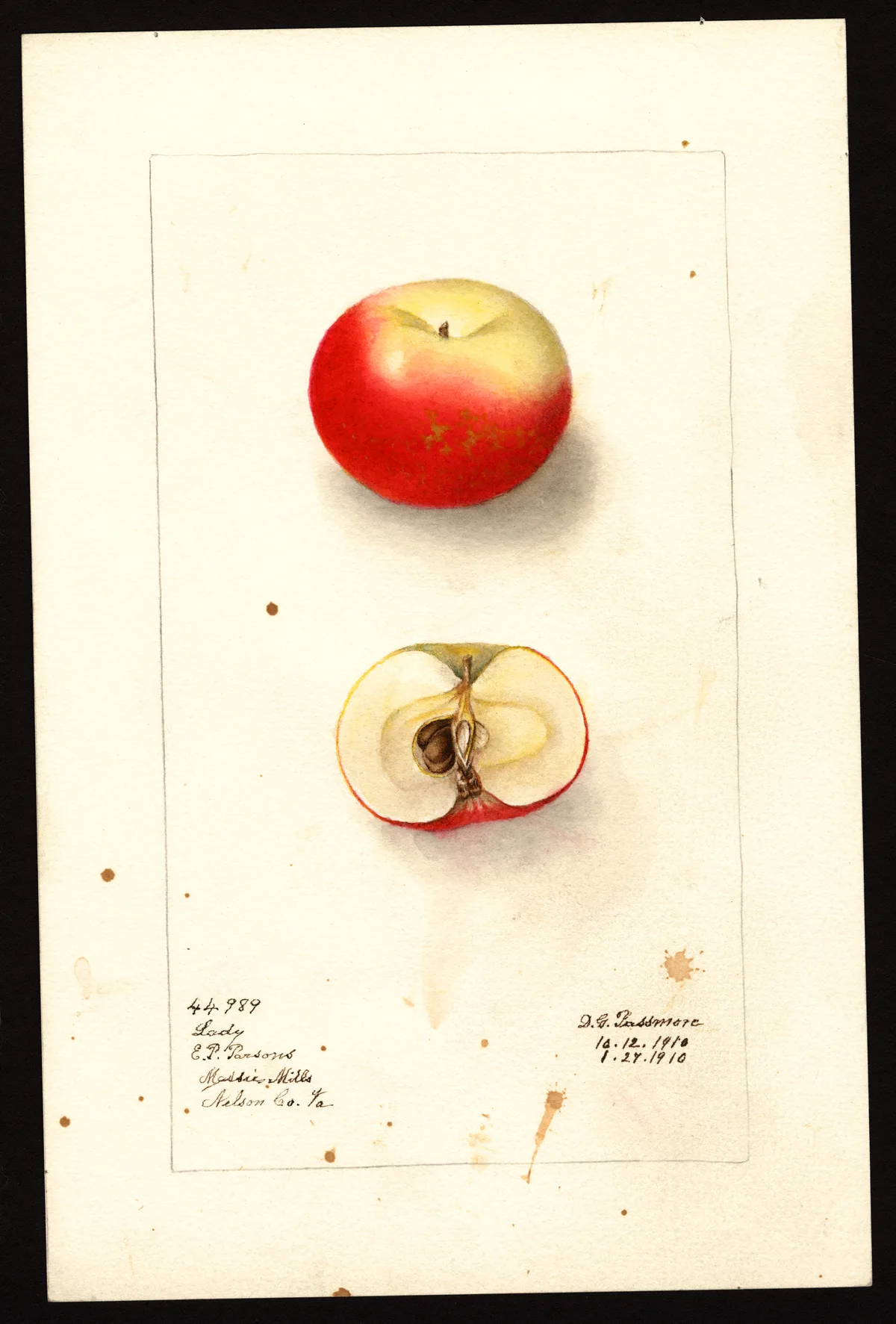
USDA Pomological Watercolor Collection
Lady
Origin/History
Lady is a very old French variety, known abroad almost universally by the name Api (with various modifying terms). According to Leroy, who gives an excellent historical account of this variety, it has been in cultivation in France for at least three hundred years; Hedrick likewise states it has been grown in France under the name Api for over three hundred years and was one of the first European apples to be brought to America. Bunyard notes its origin is of great antiquity, possibly dating from Roman days, and that it was known in England in the seventeenth century. It was imported into America from France; Coxe records that in France it is sometimes called Long-bois, or Longwood. In New York the name Lady arose "from the beauty of its appearance" (Coxe). Downing observes that although it is nearly always known abroad as Api, "the name of Lady Apple has become too universal here to change it now." Beach notes it has been sparingly disseminated throughout this country from the Atlantic to the Pacific, and has long been recognized in the New York market as one of the most desirable apples for fancy trade at the holiday season. Warder describes it as a beautiful little French apple "fully naturalized in our country" that has received the enthusiastic admiration of the American people. Thomas attributes it to France.
Tree
The tree is of medium or somewhat dwarfish size (Beach, Warder, Coxe), and Hedrick describes it as vigorous, dwarf, dense, and erect. It is at first moderately vigorous but eventually becomes a rather slow grower (Beach); Beach also notes it is but a moderate grower. The growth habit is remarkably straight and upright, with upright, almost black shoots (Coxe, Downing), forming an almost pyramidal head "like that of a Pear tree" (Elliott) — a very upright, small, close, dense head (Downing, Bunyard, Beach, Hedrick). Branches are erect and rather slender. The form is rather dense and erect. Twigs are long and slender, or on old trees rather short, with short internodes. Bark is bright brown approaching black, partly overlaid with thin scarf-skin, slightly pubescent towards the tips; the wood is dark, approaching to black (Coxe). Lenticels are numerous, conspicuous, round or sometimes elongated, usually medium to small, sometimes large. Buds are usually large, rather narrow, acute to acuminate, plump, quite pubescent, free. Foliage is small (Coxe, Downing, Elliott, Warder, Beach), crowded, curled, and very dark (Warder); leaves are not large and rather narrow (Beach, Hedrick). Bunyard describes the leaf as small, oval, upfolded, shallow crenate.
The tree is healthy and productive (Warder), and the variety appears to succeed in all soils (Elliott); Beach notes it does fairly well on any good apple soil, but a warm, gravelly or sandy loam seems to suit it best, developing to a marked degree the characteristically beautiful color and delicate high flavor on which its value chiefly depends. The fruit is borne in clusters (Coxe, Downing, Elliott, Hedrick, Beach) on short spurs (Beach, Hedrick), and the branches are full of short spurs. The fruit hangs well to the tree (Beach, Hedrick) and may be left on the tree till severe frosts (Downing); Coxe notes it "hangs late on the tree." It is a late but abundant bearer (Coxe); it requires ten or more years before bearing much, after which it is very productive (Elliott). Beach states it does not come into bearing young, but in favorable locations, after it reaches maturity, it is a reliable cropper, bearing heavy crops biennially or in rare instances nearly annually. Hedrick offers a more negative assessment: "The trees are not very satisfactory, being small, very dense in growth, unproductive, and come in bearing late." Bunyard calls it fertile. The upright habit of the limbs together with the smallness of the apples makes the picking of the fruit unusually expensive (Beach). The variety is very susceptible to apple-scab fungus, by which it is often seriously damaged (Beach, Hedrick); particular pains must be taken to protect it from the attacks of insects and fungi. Thomas describes the tree as "rather tender."
Fruit
Size and Form
Fruit is quite small to very small (all sources agree); Bunyard gives dimensions of 2 by 1¾ inches. The crop is pretty uniform in size and shape when well grown (Beach). Form is usually oblate / quite flat / flattened (Coxe, Elliott, Warder, Downing, Thomas, Budd-Hansen, Bunyard, Lowther), but Beach notes it varies to roundish inclined to conic, and Hedrick gives oblate to round-conic; it is often obscurely ribbed and symmetrical. Budd-Hansen note it is regular, sometimes unequal. Warder calls it very regular. In the rich soils of the West it is apt to be too large and has generally failed to meet the requisitions, but it succeeds well in Michigan and the neighboring region of Indiana (Warder).
Stem and Cavity
Stem is short (Coxe, Elliott, Bunyard) or of medium length (Downing) or medium to long (Budd-Hansen); Beach and Hedrick describe it as medium and slender. The stem is deeply inserted (Downing), and the stalk is deep set (Thomas). Cavity is deep (Coxe, Elliott, Warder, Budd-Hansen), pretty large and wide (Beach), large and wide (Hedrick), obtuse to acute (Beach) or obtuse (Warder, Budd-Hansen, Hedrick), regular (Warder, Budd-Hansen), gently furrowed (Beach, Hedrick), sometimes thinly russeted (Beach, Hedrick); Bunyard describes it as rather wide. Budd-Hansen note green rays and stellate russet in the cavity. Warder calls it acute.
Calyx and Basin
Calyx is small (Elliott, Downing, Warder, Beach, Hedrick) and closed (Warder, Budd-Hansen, Beach, Hedrick); eye is small and closed (Warder), or half open in a shallow wide basin (Bunyard). Lobes are small and acute (Beach, Hedrick). Segments are divergent (Budd-Hansen). Basin is rather wide and shallow (Beach, Hedrick, Bunyard, Budd-Hansen) to moderately deep (Beach), obtuse (Beach, Hedrick), narrowly ridged and wrinkled (Beach, Hedrick), furrowed (Elliott), with small plaits (Downing), or slightly corrugated (Budd-Hansen). Warder calls it medium and rather abrupt.
Skin
Skin is smooth (Coxe, Downing, Warder, Beach, Hedrick), glossy or polished (Downing, Warder, Budd-Hansen, Beach, Hedrick), and shining (Warder). Beach and Hedrick describe it as moderately thick and tough. Ground color is a clear pale yellow, lemon yellow, or whitish (Beach, Elliott, Downing, Hedrick, Budd-Hansen), described by Coxe as "brilliant yellow when ripe" and by Warder as "pale waxen yellow." This is overlaid with a brilliant deep red blush, dark red cheek, bright carmine, or rich crimson (Coxe, Elliott, Thomas, Downing, Warder, Budd-Hansen, Bunyard, Beach, Hedrick), often irregular and sharply outlined against the ground color (Beach, Hedrick), and contrasting finely with the ground color wherever the fruit has been shaded by a leaf (Warder). Budd-Hansen describe the red as "approaching to crimson on sunny side." Lowther summarizes the color as yellow-red. The prevailing effect is beautiful bright red and yellow (Beach). Dots are minute (Warder), inconspicuous (Beach, Hedrick), whitish or with russet point (Beach, Hedrick), or obscure, numerous, white, and minute (Budd-Hansen).
Flesh and Flavor
Flesh is white (Coxe, Elliott, Warder, Downing, Budd-Hansen, Beach, Hedrick), firm (Beach, Hedrick), fine-grained (Beach, Hedrick), crisp (Coxe, Elliott, Downing, Budd-Hansen, Beach, Hedrick), breaking (Coxe, Warder), tender (Elliott, Thomas, Downing, Warder, Budd-Hansen, Bunyard, Beach, Hedrick), and juicy (Elliott, Downing, Warder, Budd-Hansen, Beach, Hedrick); Budd-Hansen call it very juicy. The juice is mild and agreeable (Coxe). Flavor is described as very delicate (Coxe), pleasant (Downing), mild sub-acid (Warder, Beach, Hedrick) becoming nearly sweet (Beach), or simply sweet (Budd-Hansen); Budd-Hansen add it is slightly perfumed; Beach and Hedrick call it pleasantly aromatic; Bunyard describes the flesh as aromatic. Thomas describes the flavor as sub-acid, delicate, and "flavor good." Quality is rated good to very good for dessert (Beach, Hedrick); Budd-Hansen call it excellent; Lowther rates quality as very good.
Core and Seeds
Core is small (Coxe, Elliott, Beach, Hedrick), regular and wide (Warder), closed (Warder, Budd-Hansen, Beach, Hedrick), and axile (Beach, Hedrick); cells are symmetrical and closed (Beach, Hedrick), or obovate, axile, slit (Budd-Hansen). Core lines are clasping (Beach, Hedrick). Calyx tube is conical (Budd-Hansen, Hedrick) or conical or somewhat funnel-form with short truncate cylinder (Beach); Hedrick gives conical with short truncate cylinder. Stamens are marginal (Budd-Hansen, Beach, Hedrick). Carpels are smooth, roundish or inclined to elliptical (round or elliptical per Hedrick), emarginate, mucronate (Beach, Hedrick). Axis is very short (Warder). Seeds are plump, wide, obtuse, and completely fill the cells (Beach, Hedrick); Budd-Hansen describe them as plump, short, and numerous; Warder calls them numerous; Coxe notes they are small, short, and wide.
Season
Season is December to May (Elliott, Downing, Budd-Hansen, Beach, Hedrick), December until March (Warder), winter and spring (Thomas), winter (Lowther), or November to April (Bunyard). It keeps well during the winter (Coxe). The apples keep well until April or May, but are in greatest demand during the holiday season (Hedrick). Beach notes that properly handled, it may be held in cold storage till summer, but there is little demand for it after the holiday season, and as it keeps well enough in ordinary storage till midwinter there is but little occasion for holding it in cold storage. When it does not color properly, it is of little value for anything but cider, being too small either for general market purposes or for culinary use (Beach).
Uses
Lady is a much admired dessert apple (Coxe) — a fancy little dessert apple (Budd-Hansen), an exquisite little dessert fruit (Downing), and especially adapted as an ornament to the table (Warder). Beach calls it strikingly beautiful and especially suitable for decorative use and for dessert. Warder lists "ornament and dessert" as uses. It is one of the most profitable varieties wherever produced in proper size and color, commanding fancy prices at the period of Christmas decorations (Warder); Thomas notes it sometimes sells for $10 a barrel. Downing calls it a great bearer and a profitable sort for the orchardist, bringing the highest price of any fancy apple in the market. Beach notes it is in some cases grown with profit and often sells at very high prices, but in New York it is grown to a limited extent only and in restricted localities. It is also recognized as the "Christmas Apple" (Hedrick). Hedrick emphasizes the apples are of highest quality, most suitable for dessert and for decorative purposes. Lowther lists uses as "both kitchen and market." Coxe observes that "no trees make a more handsome appearance in an orchard." Bunyard provides a dissenting opinion: "It is hardly worthy of cultivation except as a curiosity." Downing concludes: "No amateur's collection should be without it."
Subtypes/Variants
Downing describes four other varieties of the Lady group, and Beach notes that of these the Large Lady apple appears to be the only one which has been disseminated to any considerable extent in New York state. Lady often produces seedlings which have a general similarity to the parent (Beach); some have found their way into cultivation but none has superseded the Lady.
Api Noir (Black Lady Apple) — Differs from the Lady only in the color, which is nearly black. In shape, size, season, and flavor, it is nearly the same. From its unusually dark hue it is a singular and interesting fruit, but of poor flavor. (Downing)
Api Étoile (Star Lady Apple) — The true Api Étoile, figured and described by Poiteau in the Pomologie française, is another very distinct variety; the fruit is of the same general character but having five prominent angles, which give it the form of a star. This variety is rather scarce, the common Lady Apple being frequently sent out for it by French nurserymen. It keeps until quite late in the spring, when its flavor becomes excellent, though in winter it is rather dry. The growth of the tree resembles that of the other Apis. (Downing)
Api Gros (Large Lady Apple) — Of similar habit in growth of the tree to the true Lady Apple; the fruit a trifle larger, more roundish, less brightly colored, and quite inferior in quality (Downing). Beach notes it is seldom or never intentionally planted by the fruit grower but sometimes has been cultivated by mistake in place of the true Lady. It is easily distinguished from the true Lady because the bark of the twigs is not so nearly black, the fruit is more nearly round, has a very shallow basin, and is a little larger and less highly colored than the Lady. It is an undesirable variety.
Api Gros Pomme de Rose (Rose-colored Lady Apple) — Fruit of medium size, roundish, pale yellow, washed with bright rosy red. Flesh yellowish white, fine-grained, juicy, crisp, aromatic. (Downing)
Helen — An apple of the Lady class much larger than Lady and fully as attractive in color. The flesh is very white, crisp, juicy and of mild agreeable flavor. It is grown by R. N. Lewis of Red Hook, Dutchess county, N. Y., who reports that the tree is productive and that the fruit keeps late and brings good prices. (Beach)
Highland Beauty — Another Lady seedling, described separately by Beach.
Le Grand M. Smith seedlings — One of the most remarkable lots of Lady seedlings which came to the New York Station's attention was that originated by Le Grand M. Smith of Nyack, N. Y., a brief notice of which was published in 1895 (Rural N. Y., 54:106). Some of these may be as desirable as the Lady. (Beach)
Other
Beach notes that the fruit needs to be entirely perfect to meet with favor as an ornament to the table; unfortunately it is often overgrown and irregularly developed (Warder). Lowther's geographic reporting data: Northern Division — 3 reporting stations (also reported in another division); Central Division — 4 reporting stations (also reported in another division).
Book Sources
Described in 10 period pomological works
- Beach, The Apples of New York Vol. 1 (1905)
- Warder, American Pomology: Apples (1867)
- Budd & Hansen, Systematic Pomology (1914)
- Coxe, A View of the Cultivation of Fruit Trees (1817) — listed as Pomme D'Apis
- Downing, Fruits and Fruit Trees of America (1900)
- Lowther (ed.), Encyclopedia of Practical Horticulture (1914)
- Hedrick, Cyclopedia of Hardy Fruits (1922)
- Bunyard, A Handbook of Hardy Fruits (1920) — listed as Api
- Elliott, The Western Fruit Book (1865)
- Thomas, The American Fruit Culturist (1903)
Nursery Catalog Sources
Found in 40 catalogs (1845–1921) from Alabama, California, Massachusetts, Missouri, Oregon, Washington
- Winship's Nursery (Brighton Nurseries , operated by the Winship family), Brighton (Boston) , Massachusetts — 1845
- Hovey & Co. , Cambridge , Massachusetts — 1849
- Azell Bowditch (Nursery / Fruit Catalog) , Boston , Massachusetts — 1850
- St. Helena Nursery , Howell's Prairie, Marion County , Oregon — 1864
- Hutchison Nursery , James Hutchison, Oakland , California — 1881
- Felix Gillet , Barren Hill Nursery, Nevada City , California — 1884
- Felix Gillet , Barren Hill Nursery, Nevada City , California — 1888
- Felix Gillet , Barren Hill Nursery, Nevada City , California — 1889
- California Nursery Co. , Niles , California — 1889
- Felix Gillet , Barren Hill Nursery, Nevada City , California — 1890
- Felix Gillet , Barren Hill Nursery, Nevada City , California — 1891
- Puyallup & Yakima Nurseries , Puyallup, Washington (Lock Box 191) and North Yakima , Washington — 1892
- Milwaukie-Canby Nurseries , Canby, OR (and Milwaukie, OR) — 1893
- Sherwood Hall Nursery Co. , Timothy Hopkins (Menlo Park Nurseries), San Francisco / Menlo Park , California — 1893
- Multnomah Nurseries , Russellville , Oregon — 1894
- Woodburn Nurseries , Woodburn, Marion Co. , Oregon — 1894
- Felix Gillet , Barren Hill Nursery, Nevada City , California — 1895
- Felix Gillet , Barren Hill Nursery, Nevada City , California — 1897
- Alabama Nursery Co. , Huntsville , Alabama — 1900
- Central Experimental Farm , Dominion Department of Agriculture, Agassiz, British Columbia (under test; Bulletin No. 3, Second Series) — 1900
- Washington Nursery Co. , Toppenish , Washington — 1901
- S.L. Watkins , Grizzly Flats, El Dorado County , California — 1901
- Henderson Luelling / Traveling Nursery (historical recall) , Oregon — 1904
- The Dalles Nurseries , The Dalles , Oregon — 1906
- Stark Bros. Nurseries & Orchards Co. , Louisiana , Missouri — 1906
- Russellville Nursery Co. , Montavilla Station, Portland, OR (three miles east of Portland, one mile from Montavilla car line) — 1907
- Washington Nursery Company , Toppenish , Washington — 1909
- Carlton Nursery Co. , Carlton , Oregon — 1909
- Stark Bros. Nurseries & Orchards Co. , Louisiana , Missouri — 1910
- Stark Bros. Nurseries & Orchards Co. , Louisiana , Missouri — 1911
- Pacific Nursery Company , Portland , Oregon — 1912
- Washington Nursery Company , Toppenish , Washington — 1912
- Stark Bros. Nurseries & Orchards Co. , Louisiana , Missouri — 1912
- Vineland Nurseries Company , Clarkston , Washington — 1912
- Ballygreen Nurseries , Hanford , Washington — 1912
- J. B. Pilkington , Nurseryman, Portland, OR (nurseries near Newberg, forty miles from Portland) — 1913
- Union Nurseries , J.B. Weaver & Sons, Union , Oregon — 1915
- J.B. Pilkington , Portland , Oregon — 1916
- Oregon Nursery Co. , Orenco , Oregon — 1920
- Benedict Nursery Co. , Portland , Oregon — 1921
View original book sources (10)
— William Coxe, A View of the Cultivation of Fruit Trees (1817)NO. 28. POMME D'APIS.
This apple is called in New-York the Lady apple from the beauty of its appearance; it is of a very small size, and flat form; the colour when ripe, a brilliant yellow, with a dark red cheek; the skin smooth, the flesh white, crisp, breaking, and of a very delicate taste, with very little core; the juice mild and agreeable, the seeds small, short and wide: the tree grows remarkably straight, with upright branches; and is of middling size. In France, from whence it was imported, it is sometimes called Long-bois, or Longwood; the fruit grows in clusters; it is a late but abundant bearer; it keeps well during the winter, and hangs late on the tree: it is a much admired dessert apple; no trees make a more handsome appearance in an orchard; the leaves are small, and the wood dark, approaching to a black.
— F.R. Elliott, The Western Fruit Book (1865)Lady Apple. Api, Petit Api, Pomme d'Api, Pomme Rose, | Petit Api Rouge, Pomme d'Api Rouge, Gros Api Rouge.
Foreign. Trees, very upright, forming almost pyramidal heads, like that of a Pear tree, producing the fruit in clusters; require to be ten or more years old, ere bearing much; after which, very productive. Shoots, very dark color, straight, erect, leaves small; appears to succeed in all soils, and the fruit, though small, from its beauty, always commands a high price.
Fruit, small; form, flat; color, brilliant red, on light, clear yellow; very glossy; stem, short; cavity, deep; calyx, small; basin, furrowed; flesh, white, crisp, tender, juicy; core, small. December to May.
— John A. Warder, American Pomology: Apples (1867)Lady.
API PETIT, ETC.
This beautiful little French apple has been fully naturalized in our country, and has received the enthusiastic admiration of the American people. The fruit needs to be entirely perfect to meet with favor as an ornament to the table, for which use it is especially adapted; unfortunately it is often overgrown and irregularly developed. Wherever produced in proper size and color, it is one of the most profitable varieties, commanding fancy prices at the period of Christmas decorations. In the rich soils of the West it is apt to be too large, and has generally failed to meet the requisitions; but it succeeds well in Michigan, and the neighboring region of Indiana.
Tree of medium size, very close and upright, healthy and productive; Shoots very dark; the foliage small, crowded, curled, and very dark.
Fruit very small, quite flat, very regular; Surface very smooth, shining or polished, of a pale waxen yellow, nearly covered with bright carmine, which contrasts finely with the ground color, wherever the fruit has been shaded by a leaf; Dots minute.
Basin medium, rather abrupt; Eye small, closed.
Cavity acute, deep, regular; Stem short.
Core regular, wide, closed; Seeds numerous; Axis very short; Flesh white, breaking, tender and juicy when ripe; with a mild sub-acid flavor; Use ornament and dessert; Season December until March.
— A.J. Downing, The Fruits and Fruit Trees of America (1900)Lady Apple. Api. Api Petit. Pomme Rose. Pomme d'Api Rouge. Petit Api Rouge. Gros Api Rouge.
An exquisite little dessert fruit, the pretty size and beautiful color of which render it a universal favorite ; as it is a great bearer, it is also a profitable sort for the orchardist, bringing the highest price of any fancy apple in the market. It is an old French variety, and is nearly always known abroad by the name of Api ; but the name of Lady Apple has become too universal here to change it now. No amateur's collection should be without it.
Fruit quite small, but regularly formed and flat. Skin smooth and glossy, with a brilliant deep red cheek, contrasting with a lively lemon yellow ground. Stalk of medium length, and deeply inserted. Calyx small, sunk in a basin with small plaits. Flesh white, crisp, tender, and juicy, with a pleasant flavor. The tree has upright, almost black shoots, with small leaves ; forms a very upright, small head, and bears its fruit in bunches. The latter is very hardy, and may be left on the tree till severe frosts. The Lady Apple is in use from December to May.
The Api Noir, or Black Lady Apple, differs from the foregoing sort only in the color, which is nearly black. In shape, size, season, and flavor, it is nearly the same. It is, from its unusually dark hue, a singular and interesting fruit — poor flavor.
The true Api Etoile, or Star Lady Apple, figured and described by Poiteau, in the Pomologie francaise, is another very distinct variety ; the fruit is of the same general character, but having five prominent angles, which give it the form of a star. This variety is rather scarce, the common Lady Apple being frequently sent out for it by French nurserymen. It keeps until quite late in the spring, when its flavor becomes excellent, though in winter it is rather dry. The growth of the tree resembles that of the other Apis.
The Api Gros, or Large Lady Apple, is of a similar habit in growth of the tree to the true Lady Apple, the fruit a trifle larger, more roundish, less brightly colored, and quite inferior in quality.
The Api Gros Pomme de Rose, or Rose-colored Lady Apple, is also another variety, with fruit of medium size, roundish, pale yellow, washed with bright rosy red. Flesh yellowish white, fine-grained, juicy, crisp, aromatic.
— John J. Thomas, The American Fruit Culturist (1903)Lady Apple.* (Pomme d'Api.) Quite small, regular, flat; a brilliant deep-red cheek on light clear yellow; stalk and calyx deep set; flesh tender, delicate, sub-acid, flavor good. A fancy dessert apple, sometimes selling for $10 a barrel. Winter and spring. Tree rather tender. France.
— S.A. Beach, The Apples of New York, Vol. 1 (1905)LADY.
REFERENCES. 1. Duhamel, 1768:309. 2. Knoop, 1771:68. 3. Forsyth, 1803:49. 4. Coxe, 1817:117. fig. 5. Thacher, 1822:129. 6. Ronalds, 1831:63. 7. Cat. Hort. Soc. London, 1831. 8. Kenrick, 1832:47. 9. Floy-Lindley, 1833:87. 10. Manning, 1838:59. 11. Downing, 1845:115. fig. 12. Cole, 1849:130. 13. Thomas, 1849:181, 189. fig. 14. Emmons, Nat. Hist. N. Y., 3:89. 1851. col. pl. No. 47. 15. Am. Pom. Soc. Cat., 1852. 16. Elliott, 1854:87. 17. Hovey, Mag. Hort., 20:29. 1854. 18. Hooper, 1857:52. 19. Lucas, 1859:557. 20. Warder, 1867:411. 21. Fitz, 1872:166. 22. Downing, 1872:244. 23. Leroy, 1873:65. fig. 24. Barry, 1883:348. 25. Hogg, 1884:8. 26. Lyon, Mich. Hort. Soc. Rpt., 1890:294. 27. Wickson, 1891:248. 28. Bailey, An. Hort., 1892:243. 29. Bredsted, 2:210. 1893. 30. Woolverton, Ont. Fr. Stas. An. Rpt., 3:10. 1896. figs. 31. Budd-Hansen, 1903:111. fig. 32. Beach and Clark, N. Y. Sta. Bul. 248:128. 1904.
SYNONYMS. Almindelig (29). API (1, 23, 25, 29, 30). Api (11, 16, 18, 22, 31). Api eller (29). Api Fin (23). Api Ordinaire (23). Api Petit (11, 12, 20, 22, 25). Api Rose (23). Api Rouge (25). Apy Rouge (23). Cardinale (23). Christmas Apple (32). Gros Api Rouge (11, 16, 22). KLEINER API (19). LADY APPLE (5, 8, 9, 11, 12, 13, 14, 16, 17, 18, 21, 22, 24). Lady Apple (4, 10, 23, 25). Lille Api (29). Long Bois (23). PETIT API (6, 7). Petit Api (16, 18). Petit Apis (23). Petit Api Rose (23). Petit Api Rouge (11, 16, 22, 23, 25). POMME D'API (2, 3). Pomme d'Api (8, 9, 13, 16, 21, 25). Pomme d'Api Rouge (11, 16, 22). POMME D'APIS (4). Pomme Rose (11, 16, 18, 22). Pomone d'Apis (5).
A strikingly beautiful little apple especially suitable for decorative use and for dessert. In New York it is grown to a limited extent only and in restricted localities. It is in some cases grown with profit and often sells at very high prices. It does fairly well on any good apple soil, but a warm, gravelly or sandy loam seems to suit it best, developing to a marked degree the characteristically beautiful color and delicate high flavor of this variety, upon which its value chiefly depends. The upright habit of the limbs, together with the smallness of the apples, makes the picking of the fruit unusually expensive. The branches are full of short spurs upon which the fruit is borne in clusters. The fruit hangs well to the tree. The tree is but a moderate grower and does not come into bearing young, but in favorable locations, after it reaches maturity, it is a reliable cropper, bearing heavy crops biennially or in rare instances nearly annually. In order to grow Lady most successfully, particular pains must be taken to protect it from the attacks of insects and fungi, particularly from the apple scab fungus, by which it is often seriously damaged. When well grown, the crop is pretty uniform in size and shape and satisfactory in color and quality. It does not always color properly, and is then of little value for anything but cider, being too small either for general market purposes or for culinary use. Properly handled, it may be held in cold storage till summer, but there is little demand for it after the holiday season, and as it keeps well enough in ordinary storage till midwinter there is but little occasion for holding it in cold storage.
Historical. According to Leroy, who gives an excellent historical account of this variety, the Lady apple, or as it is there known, Api, has been in cultivation in France for at least three hundred years. It has been sparingly disseminated throughout this country from the Atlantic to the Pacific. It has long been recognized in the New York market as one of the most desirable apples for fancy trade at the holiday season.
TREE. Tree at first moderately vigorous, eventually becomes a rather slow grower; size medium or somewhat dwarfish; branches erect, rather slender. Form rather dense, erect. Twigs long and slender, or on old trees rather short; internodes short. Bark bright brown approaching black, partly overlaid with thin scarf-skin, slightly pubescent towards the tips. Lenticels numerous, conspicuous, round or sometimes elongated, usually medium to small, sometimes large. Buds usually large, rather narrow, acute to acuminate, plump, quite pubescent, free. Leaves not large, rather narrow.
FRUIT. Fruit small to very small, uniform in size and shape. Form usually oblate but varies to roundish inclined to conic, often obscurely ribbed, symmetrical. Stem medium, slender. Cavity pretty large and wide, obtuse to acute, moderately shallow to deep, gently furrowed, sometimes thinly russeted. Calyx small, closed; lobes small, acute. Basin rather wide, shallow to moderately deep, obtuse, narrowly ridged and wrinkled. Skin moderately thick, tough, smooth, glossy with a deep red blush which is often irregular and sharply outlined against the clear pale yellow or whitish ground color. Dots whitish or with russet point, inconspicuous. Prevailing effect beautiful bright red and yellow. Calyx tube conical or somewhat funnel-form with short truncate cylinder. Stamens marginal. Core small, axile; cells symmetrical, closed; core lines clasping. Carpels smooth, roundish or inclined to elliptical, emarginate, mucronate. Seeds plump, wide, obtuse, completely filling the cells. Flesh white, firm, fine-grained, crisp, rather tender, juicy, pleasantly aromatic, mild subacid becoming nearly sweet, good to very good for dessert. Season December to May.
OTHER VARIETIES OF THE LADY GROUP.
The Lady often produces seedlings which have a general similarity to the parent. Some of these have found their way into cultivation but up to the present time none of them has superseded the Lady. Downing (22) mentions besides the Lady four other varieties of the Lady group, namely: the BLACK LADY APPLE (Api Noir), the STAR LADY APPLE (Api Étoile), the LARGE LADY APPLE (Api Gros), and the ROSE-COLORED LADY APPLE (Api Gros Pomme de Rose). Of these the Large Lady apple appears to be the only one which has been disseminated to any considerable extent in this state. It is seldom or never intentionally planted by the fruit grower but sometimes it has been cultivated by mistake in place of the true Lady. It is easily distinguished from the true Lady because the bark of the twigs is not so nearly black, the fruit is more nearly round, has a very shallow basin and is a little larger and less highly colored than the Lady. It is an undesirable variety.
Seedlings. Fruits of different seedlings of the Lady have from time to time been received at this Station. None of these has been sufficiently tested as yet to show whether it is worthy of being introduced into general cultivation. One of the most remarkable lot of Lady seedlings which has come to our attention is that originated by Le Grand M. Smith of Nyack, N. Y., a brief notice of which was published in 1895.¹ Some of these may be as desirable as the Lady.
HELEN is an apple of the Lady class much larger than Lady and fully as attractive in color. The flesh is very white, crisp, juicy and of mild agreeable flavor. It is grown by R. N. Lewis of Red Hook, Dutchess county, N. Y., who reports that the tree is productive and that the fruit keeps late and brings good prices.
HIGHLAND BEAUTY, another Lady seedling, is described on a previous [page].
¹Rural N. Y., 54:106. 1895.
— J.L. Budd & N.E. Hansen, American Horticultural Manual, Part II: Systematic Pomology (1914)Lady. — A very old French variety, known abroad by the name of Api; a fancy little dessert apple noted for its beautiful color and excellent quality.
Fruit quite small, regular, sometimes unequal, flattened; surface smooth, polished, pale yellow with brilliant deep red, approaching to crimson on sunny side; dots obscure, numerous, white, minute; cavity wide, deep, regular, obtuse, with green rays and stellate russet; stem medium to long; basin wide, shallow, slightly corrugated; calyx closed; segments divergent. Core closed; cells obovate, axile, slit; tube conical; stamens marginal; seeds plump, short, numerous; flesh white, crisp, tender, very juicy, sweet, slightly perfumed, excellent. December to May.
— Granville Lowther (ed.), Encyclopedia of Practical Horticulture (1914)Lady. Size: small. Form: flat. Color: yellow-red. Quality: very good. Use: both kitchen and market. Season: winter. Northern Division: 3 reporting stations (also reported in another division). Central Division: 4 reporting stations (also reported in another division).
— E.A. Bunyard, A Handbook of Hardy Fruits (1920)API. Ronalds, 32. F., Api ; G., Kleine Api. (Api rouge, Api petit, Lady.) Dessert, November to April, very small, 2 by 1¾, flat, regular. Colour, bright yellow, rich crimson flush. Flesh, tender, aromatic. Eye, half open in a shallow wide basin. Stem short in a rather wide cavity. Growth, upright, very slender making a small close tree, fertile. Leaf, small, oval, upfolded, shallow crenate. Origin, of great antiquity ; possibly dating from Roman days. Known in this country in the seventeenth century. It is hardly worthy of cultivation except as a curiosity.
Api Petit : see Api.
Api Rouge : see Api.
Aporta : see Emperor Alexander.
Arbroath Pippin : see Oslin.
Aromatic Pippin : see Kerry Pippin.
— U.P. Hedrick, Cyclopedia of Hardy Fruits (1922)LADY. Fig. 31. Api. Christmas Apple. This variety is known wherever apples are grown, usually, except in America, under the name Api with some modifying term. Its popularity is due to its beautiful miniature fruits which are of highest quality, most suitable for dessert and for decorative purposes. The apples keep well until April or May, but are in greatest demand during the holiday season. The trees are not very satisfactory, being small, very dense in growth, unproductive, and come in bearing late. The fruit is borne in clusters on short spurs and hangs well to the tree. The variety is very susceptible to the apple-scab fungus. Lady has been in cultivation in France, under the name Api, for over three hundred years, and was one of the first European apples to be brought to America. Tree vigorous, dwarf, dense, erect; branches erect, slender. Leaves narrow. Fruit very small, uniform in size and shape, oblate to round-conic, obscurely ribbed, symmetrical; stem slender; cavity large and wide, obtuse, shallow, gently furrowed, sometimes thinly russeted; calyx small, closed; lobes small, acute; basin wide, shallow, obtuse, narrowly ridged and wrinkled; skin thick, tough, smooth, glossy with a deep red blush which is often irregularly and sharply outlined against the pale yellow ground-color; dots white or with russet points, inconspicuous; calyx-tube conical with short, truncate cylinder; stamens marginal; core small, axile; cells symmetrical, closed; core-lines clasping; carpels smooth, round or elliptical, emarginate, mucronate; seeds plump, wide, obtuse, completely filling the cells; flesh white, firm, fine-grained, crisp, tender, juicy, aromatic, mild subacid; good to very good; December to May.