Roundway Magnum Bonum
Apple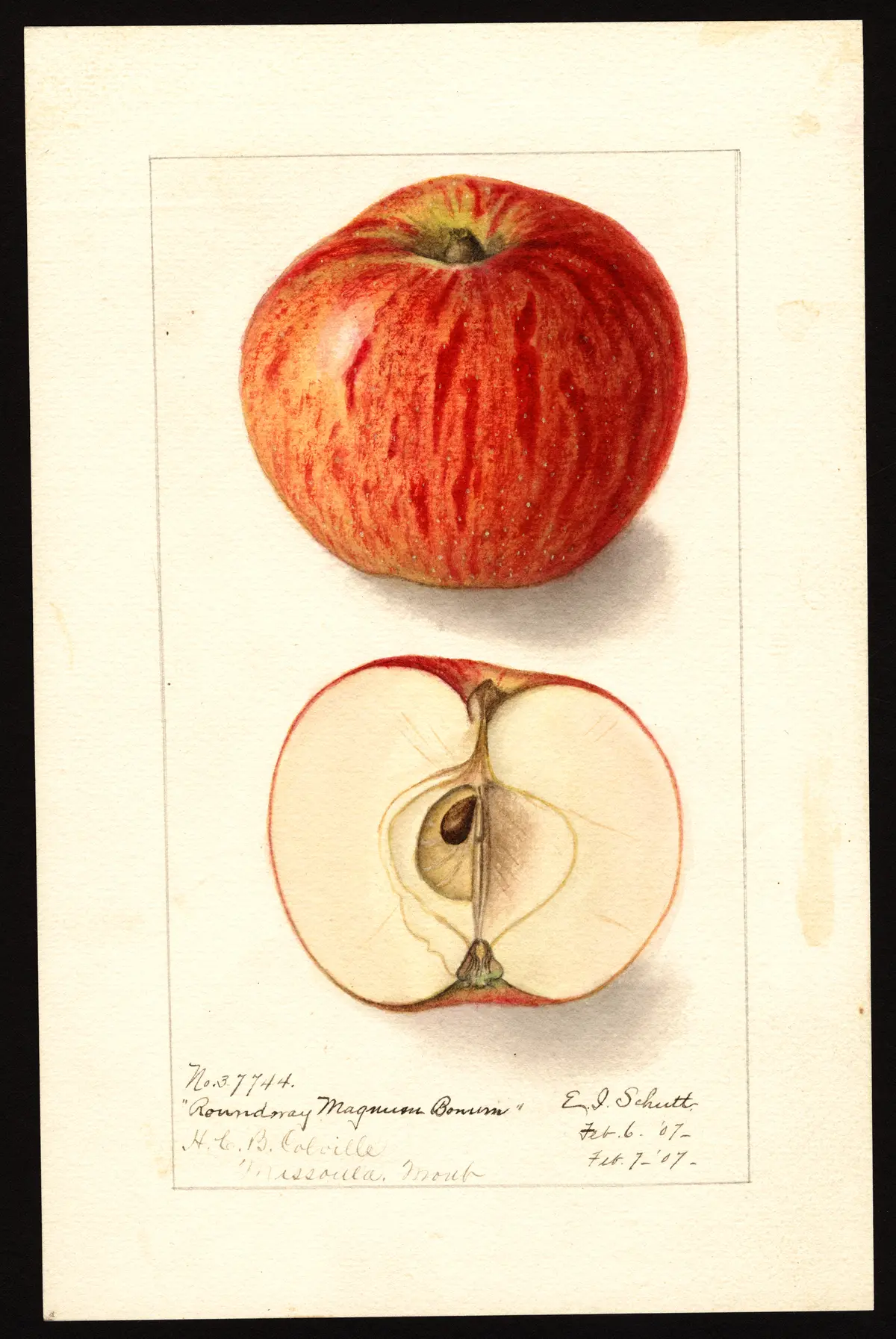
USDA Pomological Watercolor Collection
Roundway Magnum Bonum
Origin / History
Raised at Roundway Park, Devizes, and brought to notice about 1864. George Bunyard & Co. (1901) call it an old variety that had almost fallen out of culture, which on trial they had "no hesitation in calling it the best dessert kind," worthy of a place in the most select garden list, much richer in flavor than Cox's Orange or Ribston, and needing only to be tasted to secure appreciation. The same firm (1914) call the fruit "but little known," deserving to be placed high amongst the best flavored sorts, and not to be judged from an unpromising exterior. E.A. Bunyard (1920) calls it a fruit of remarkable flavor, deserving wider cultivation.
Tree
Growth spreading; fertility moderate (E.A. Bunyard). Fruitful on Paradise; in cold soils, try on a wall (1901 catalogue). Leaf large, dark, held out, slightly upcupped and undulating, boldly curved serrate, very downy below.
Fruit
Size: Large to very large; 3 by 2½ (E.A. Bunyard).
Form: Flat, conical; Rambour shape, uneven, ribbed (1914 catalogue).
Stem: Stout.
Cavity: Wide, deep.
Calyx: Eye a little open.
Basin: Broad, irregular.
Skin: Yellowish green or greenish yellow, with dull brown flush (E.A. Bunyard) or broken russet (1914 catalogue), and a few broad, broken, dark stripes. Exterior unpromising.
Dots: Not described in source.
Flesh and flavor: Flesh greenish yellow or yellowish; firm and rather dry (E.A. Bunyard), crisp (1914 catalogue), or melting (1901 catalogue). Flavor very sweet and pear like (E.A. Bunyard); "remarkably rich" (1914 catalogue); very aromatic and richly flavored, brisk and agreeable (1901 catalogue).
Core and seeds: Not described in source.
Season
November to March; E.A. Bunyard gives till March. Do not gather too early.
Uses
Dessert or culinary; the 1901 catalogue ranks it the best dessert kind and says that in tarts or baked it is "a perfect sweetmeat."
Subtypes / Variants
Not described in source.
Other
Not described in source.
Book Sources
Described in 1 period pomological work
Nursery Catalog Sources
Found in 8 catalogs (1897–1917) from England, Illinois
- Kelway & Son , Langport, Somerset , England — 1897
- George Bunyard & Co. , Royal Nurseries, Maidstone, Kent , England — 1900
- Central Experimental Farm , Dominion Department of Agriculture, Agassiz, British Columbia (under test; Bulletin No. 3, Second Series) — 1900
- Benjamin Buckman (personal inventory) , Farmingdale , Illinois — 1901
- Thomas Rivers & Son , Sawbridgeworth, Hertfordshire , England — 1913
- Benjamin Buckman (personal inventory) , Farmingdale , Illinois — 1913
- George Bunyard & Co. , Royal Nurseries, Maidstone, Kent , England — 1914
- George Bunyard & Co. , Royal Nurseries, Maidstone, Kent , England — 1917
View original book sources (3)
— E.A. Bunyard, A Handbook of Hardy Fruits (1920)ROUNDWAY MAGNUM BONUM. Dessert or culinary, till March, large, 3 by 2½, flat, conical. Colour, yellowish-green with dull brown flush and a few broad broken stripes. Flesh, firm, greenish-yellow, rather dry, flavour very sweet and pear like. Eye, a little open in a broad irregular basin. Stem, stout in a wide deep cavity. Growth, spreading; fertility, moderate. Leaf, large, dark, held out, slightly upcupped and undulating, boldly curved serrate, very downy below. Origin, raised at Roundway Park, Devizes, and brought to notice about 1864. A fruit of remarkable flavour, deserving wider cultivation.
— George Bunyard & Co., George Bunyard Fruit Catalogue (1901) (1901)Large; this old variety had almost fallen out of culture, but on trial we have no hesitation in calling it the best dessert kind. It is melting in flesh, very aromatic and richly flavoured, brisk and agreeable; fruitful on Paradise, and worthy of a place in the most select garden list. Much richer in flavour than Cox's Orange or Ribston, and only needs to be tasted to secure appreciation. Do not gather too early, and try on a wall, in cold soils. In tarts or baked it is a perfect sweetmeat.
— George Bunyard & Co., George Bunyard Catalog of Fruit Trees (1914) (1914)Dessert; Nov.-March. Very large, Rambour shape, uneven, ribbed, greenish-yellow with broken russet and a few dark stripes; flesh yellowish, crisp, of remarkably rich flavour. This fruit is but little known, but deserves to be placed high amongst the best flavoured sorts, and must not be judged from an unpromising exterior. Raised at Roundway Park, Devizes, and brought to notice about 1864. F.C.