Cox Orange
Apple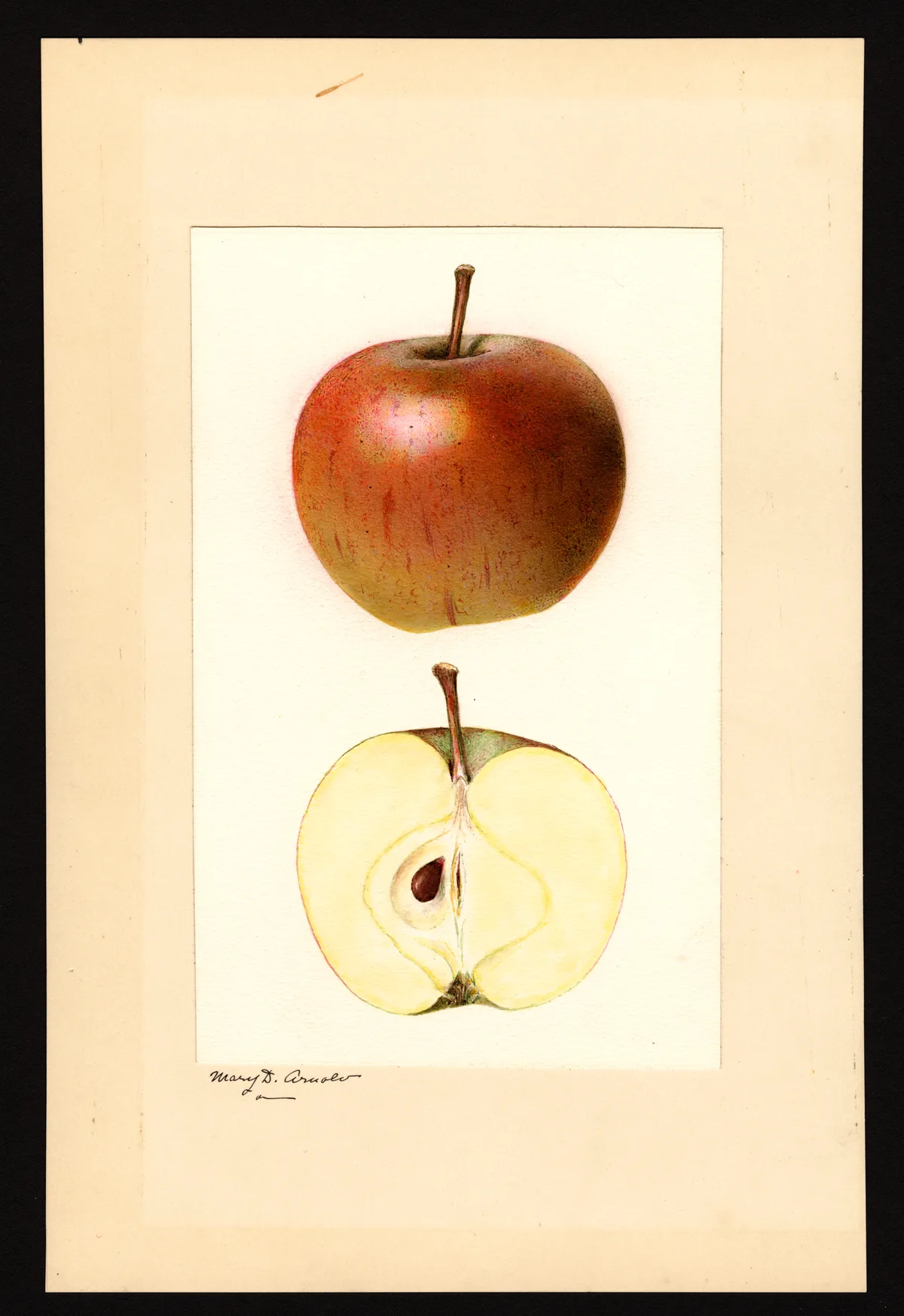
USDA Pomological Watercolor Collection
Cox Orange
Origin / History
Cox Orange is an English variety. Most sources state it was raised in 1830 from a pip (seed) of the Ribston Pippin by Mr. Cox at Colnbrook Lawn (or "Colnbrook Lawns"), near Slough, Buckinghamshire, England (Herefordshire Pomona; Beach; Hedrick). Bunyard's Handbook of Hardy Fruits gives an earlier date, stating it was "raised in 1825, by Mr. Cox, a retired brewer of Colnbrook Lawn, near Slough, and introduced by Mr. Charles Turner, about 1850." Beach notes the variety was sometimes propagated by American nurserymen but had never been extensively planted in America, with cultivation not increasing as of 1905. Hedrick reports it was introduced in America as early as 1850 but was as yet found only sparingly on the Atlantic seaboard, noting that although fruits attain the same perfection in America as in Europe, the trees in America are unthrifty and unfruitful on standard stocks and must be given special care on a dwarfing stock. Bunyard describes it as "generally considered to be the richest flavoured of English Apples." The Herefordshire Pomona ranks it in excellence with the Ribstone Pippin, Golden Harvey, and Nonpareil, calling it more beautiful than any of them, and "the best modern addition to the dessert table." Thomas notes it is "very popular in England."
Tree
The tree is of medium size or above, moderately vigorous (Beach), though Herefordshire Pomona and Bunyard describe it as "not vigourous in growth" and "slender" in growth with "moderate" fertility. Hedrick describes it as vigorous, upright, thickly branched, dense, with slender branches. Form upright, thickly branched, dense (Beach; Hedrick). Branches rather slender. It is well adapted for dwarfing on the Paradise stock (Herefordshire Pomona; Downing; Beach), and on the Paradise or Doucin stock (Beach), where it bears freely. The Herefordshire Pomona specifies it is admirably adapted for dwarfs and pyramids because of its limited vigor, succeeding best on the Paradise stock when it bears freely. Downing calls it "a free bearer." The Central Experimental Farm catalogue (planted Spring 1894) records the tree as "a moderate grower and a free producer." Stark Bros. notes it "does extremely well in the north" and is "one of the best bearers" (George Bunyard 1901) and "free cropper" (George Bunyard 1914).
Twigs long to medium, rather slender, irregularly crooked; internodes medium or below. Bark olive-green somewhat mottled with reddish-brown, slightly pubescent. Lenticels numerous, conspicuous, medium size, oblong, raised. Buds medium size to rather small, roundish, obtuse, appressed, pubescent.
Leaves small to medium size and inclined to be narrow (Beach); small and narrow (Hedrick). Bunyard describes the leaf as "narrow, rather pale, undulated, upfolded, crenate."
Fruit
Size
Medium (Herefordshire Pomona; Thomas; Lowther; Bunyard); medium, oblate (Downing); medium or above (Beach); medium or large (Hedrick); medium to large size (Stark Bros.); medium sized (George Bunyard 1901, 1914); large (Thomas Rivers); below medium in size (Central Experimental Farm). Bunyard gives specific dimensions of 2¾ by 2½ inches. Pretty uniform in size and shape (Beach; Hedrick).
Form
Roundish-ovate, even and regular in outline (Herefordshire Pomona); oblate (Downing; Lowther); roundish-oblate (Thomas); roundish oblate, sometimes slightly inclined to conic, regular or faintly ribbed, symmetrical, axis sometimes oblique (Beach); round-oblate, sometimes conic, regular or faintly ribbed, symmetrical, axis sometimes oblique (Hedrick); round, conical, regular (Bunyard); oblate conical (Central Experimental Farm).
Stem
Stalk half an inch long, somewhat fleshy (Herefordshire Pomona). Stem usually obliquely inclined, short, thick, sometimes long (Beach; Hedrick). Bunyard describes the stem as "moderately stout."
Cavity
Moderately deep, with a slight swelling on one side, and covered with russet extending over the base (Herefordshire Pomona). Cavity obtuse to somewhat acuminate, rather shallow to moderately deep, rather narrow, often somewhat russeted (Beach). Cavity obtuse, shallow, narrow, often russeted (Hedrick). Bunyard describes a "wide shallow cavity, always a little russeted."
Calyx / Eye
Eye small and open, filled with stamens and with short erect segments (Herefordshire Pomona). Calyx rather small, closed or partly open (Beach); calyx small, closed or open (Hedrick). Bunyard describes the eye as "half closed, segments reflexed."
Basin
Set in a somewhat shallow saucer-like basin which is entirely lined with russet (Herefordshire Pomona). Basin rather shallow and obtuse to moderately deep and abrupt, rather narrow to moderately wide, smooth or slightly furrowed (Beach). Basin shallow and obtuse to deep and abrupt, narrow, smooth or furrowed (Hedrick). Bunyard describes a "very shallow slightly ribbed basin, often russeted."
Skin
Sources broadly agree on a yellow ground with red overlay and russet, though descriptions vary in emphasis. Herefordshire Pomona: greenish yellow and streaked with red in the shade, but dark red where exposed to the sun, this colour extending over three fourths of the whole surface; over the coloured parts are patches and traces of ash-grey russet forming a smooth and firm crust. Downing: yellowish, shaded, splashed and slightly mottled nearly over the whole surface with crimson. Thomas: yellow with some red over the surface. Beach: skin rather thin, tough, smooth, attractive, washed with orange-red deepening to bright red and mottled and splashed with carmine, over a deep yellow background. Hedrick: skin thin, tough, smooth, washed with orange-red deepening to bright red and mottled and splashed with carmine over a deep yellow background. Lowther: yellow-red. Bunyard: golden yellow with brownish-red flush, and russet and faint stripes. Central Experimental Farm: skin yellowish, shaded and splashed with crimson. George Bunyard 1901: yellow with deep orange flush. Stark Bros.: yellow shaded, splashed and slightly tinted with red. George Bunyard 1914: dull and striped red on golden yellow.
Beach notes that when highly colored it is attractive, with the red predominant.
Dots
Dots conspicuous, large, areolar with pale gray or russet center (Beach; Hedrick).
Flesh / Flavor
Flesh yellowish, very tender in the grain, crisp, juicy and sweet, with a fine perfume (Herefordshire Pomona). Flesh yellowish, rather firm, juicy, brisk, rich, subacid (Downing). Rich sub-acid, very good (Thomas). Flesh yellow, firm, nearly fine, crisp, tender, very juicy, rich, sprightly subacid or becoming mild subacid, decidedly aromatic, very good to best (Beach). Flesh yellow, firm, fine, crisp, tender, very juicy, rich, sprightly subacid, aromatic; very good to best (Hedrick). Flesh tender, yellow, juicy and of the highest flavour (Bunyard). Flesh yellowish, crisp, juicy, brisk, rich, sub-acid, aromatic, quality very good (Central Experimental Farm). Flesh firm, fine-grained, juicy and of fine flavor, and good quality (Stark Bros.). Crisp, juicy, and rich flavour (George Bunyard 1914). George Bunyard 1901 calls it "one of the finest flavored apples." Bunyard's Handbook calls it "generally considered to be the richest flavoured of English Apples." Quality is rated very good (Lowther; Beach; Hedrick) to "very good to best" (Beach; Hedrick), and Beach calls it "one of the best in quality of the English dessert apples."
Core / Seeds / Carpels
Core small (Downing). Core medium size, somewhat abaxile; cells usually symmetrical, open or closed; core lines clasping the funnel cylinder (Beach). Core of medium size, abaxile; cells usually symmetrical, open or closed; core-lines clasping the funnel cylinder (Hedrick). Calyx tube cone-shape or funnel-form, stamens median to basal (Beach); calyx-tube cone-shaped, stamens median (Hedrick). Carpels thin, obovate to obcordate, emarginate, usually smooth (Beach); carpels thin, obovate to obcordate, emarginate, smooth (Hedrick). Seeds reddish-brown, above medium size, wide, obtuse to acute, often abortive (Beach); seeds reddish-brown, large, wide, obtuse, often abortive (Hedrick).
Season
October to February (Herefordshire Pomona); September, October (Downing); Autumn (Thomas); late September to early winter (Beach text); late September to January (Beach formal; Hedrick); early autumn (Lowther); November to March (Bunyard); October (Central Experimental Farm); October to December (George Bunyard 1914); October to January (Thomas Rivers). Stark Bros. calls it "a splendid keeper."
Uses
Dessert (Herefordshire Pomona; Bunyard; George Bunyard 1914; Thomas Rivers); family use (Lowther); "a first rate sort both for market and table" (George Bunyard 1914); "reliable for markets" (Stark Bros.). Beach notes it is not recommended for commercial planting but is a desirable variety for the home orchard. The Herefordshire Pomona declares it "the best modern addition to the dessert table; excellent in flavour, and very handsome" and recommends it "should take its place in every garden, however small."
Subtypes / Variants
Not described in source.
Other
Not described in source.
Book Sources
Described in 7 period pomological works
- Beach, The Apples of New York Vol. 2 (1905)
- The Herefordshire Pomona (1876–1885) — listed as COX'S ORANGE PIPPIN
- Hedrick, Cyclopedia of Hardy Fruits (1922)
- Bunyard, A Handbook of Hardy Fruits (1920) — listed as COX'S ORANGE
- Downing, Fruits and Fruit Trees of America (1900) — listed as Cox's Orange Pippin
- Lowther (ed.), Encyclopedia of Practical Horticulture (1914) — listed as Cox's Orange (Pippin)
- Thomas, The American Fruit Culturist (1903) — listed as Cox's Orange Pippin
Nursery Catalog Sources
Found in 27 catalogs (1888–1917) from California, England, Illinois, Missouri, Oregon, Washington
- Felix Gillet , Barren Hill Nursery, Nevada City , California — 1888 — listed as Cox's Orange Pippin
- Felix Gillet , Barren Hill Nursery, Nevada City , California — 1889 — listed as Cox's Orange Pippin
- Felix Gillet , Barren Hill Nursery, Nevada City , California — 1890 — listed as Cox's Orange Pippin
- Felix Gillet , Barren Hill Nursery, Nevada City , California — 1891 — listed as Cox's Orange Pippin
- Felix Gillet , Barren Hill Nursery, Nevada City , California — 1895 — listed as Cox's Orange Pippin
- Felix Gillet , Barren Hill Nursery, Nevada City , California — 1897 — listed as Cox's Orange Pippin
- Kelway & Son , Langport, Somerset , England — 1897 — listed as Cox's Orange Pippin
- Stark Bros. Nurseries & Orchards Co. , Louisiana , Missouri — 1898 — listed as Cox's Orange Pippin
- George Bunyard & Co. , Royal Nurseries, Maidstone, Kent , England — 1900 — listed as Cox's Orange Pippin
- Central Experimental Farm , Dominion Department of Agriculture, Agassiz, British Columbia (under test; Bulletin No. 3, Second Series) — 1900 — listed as Cox's Orange Pippin
- Washington Nursery Co. , Toppenish , Washington — 1901 — listed as Cox's Orange Pippin
- Benjamin Buckman (personal inventory) , Farmingdale , Illinois — 1901 — listed as Cox's Orange Pippin
- Stark Bros. Nurseries & Orchards Co. , Louisiana , Missouri — 1906 — listed as Cox's Orange Pippin
- Washington Nursery Company , Toppenish , Washington — 1909 — listed as Cox's Orange Pippin
- Stark Bros. Nurseries & Orchards Co. , Louisiana , Missouri — 1910 — listed as Cox's Orange Pippin
- Island Nurseries & Fruit Farm , Vashon (Vashon Island) , Washington — 1910 — listed as Cox's Orange Pippin
- Stark Bros. Nurseries & Orchards Co. , Louisiana , Missouri — 1911 — listed as Cox's Orange Pippin
- *Better Fruit* magazine mentions — 1911 — listed as Cox's Orange Pippin
- Island Nurseries & Fruit Farm , Vashon (Vashon Island) , Washington — 1911 — listed as Cox's Orange Pippin
- James Veitch & Sons , Ltd., Royal Exotic Nursery, Chelsea, London (also Coombe Wood, Langley, and Feltham) , England — 1911 — listed as Cox's Orange Pippin
- Ballygreen Nurseries , Hanford , Washington — 1912 — listed as Cox's Orange Pippin
- Pacific Nursery Company , Portland , Oregon — 1912 — listed as Cox's Orange Pippin
- Washington Nursery Company , Toppenish , Washington — 1912 — listed as Cox's Orange Pippin
- Thomas Rivers & Son , Sawbridgeworth, Hertfordshire , England — 1913 — listed as Cox's Orange Pippin
- Benjamin Buckman (personal inventory) , Farmingdale , Illinois — 1913 — listed as Cox's Orange Pippin
- George Bunyard & Co. , Royal Nurseries, Maidstone, Kent , England — 1914 — listed as Cox's Orange Pippin
- George Bunyard & Co. , Royal Nurseries, Maidstone, Kent , England — 1917 — listed as Cox's Orange Pippin
View original book sources (12)
— Woolhope Naturalists Field Club, The Herefordshire Pomona (1885)COX'S ORANGE PIPPIN.
This excellent apple is said to have been produced in 1830 from a pip of the Ribstone Pippin, by Mr. Cox, at Colnbrook Lawns, near Slough, Buckinghamshire.
Description.—Fruit: medium sized; roundish-ovate, even and regular in outline; Skin: greenish yellow and streaked with red in the shade, but dark red where exposed to the sun, and this colour extends over three fourths of the whole surface. Over the coloured parts are patches and traces of ash-grey russet forming a smooth and firm crust. Eye : small and open, filled with stamens and with short erect segments, set in a somewhat shallow saucer-like basin which is entirely lined with russet. Stalk : half an inch long, somewhat fleshy, set in a moderately deep cavity, which has a slight swelling on one side, and is covered with russet extending over the base. Flesh : yellowish, very tender in the grain, crisp, juicy and sweet, with a fine perfume.
This beautiful apple is the best modern addition to the dessert table ; excellent in flavour, and very handsome. It is in season from October to February.
The tree is not vigourous in growth and for this reason is admirably adapted for dwarfs and pyramids. It succeeds best on the paradise stock when it bears freely. It should take its place in every garden, however small, it ranks in excellence with the Ribstone Pippin, Golden Harvey, and Nonpareil, and is more beautiful than any of them.
— A.J. Downing, The Fruits and Fruit Trees of America (1900)Cox's Orange Pippin. An English variety much esteemed for dessert. Tree is well adapted for dwarfing on the paradise stock, and a free bearer. Fruit medium, oblate, yellowish, shaded, splashed and slightly mottled nearly over the whole surface with crimson. Flesh yellowish, rather firm, juicy, brisk, rich, subacid. Core small. Very Good. September, October.
— John J. Thomas, The American Fruit Culturist (1903)Cox's Orange Pippin. Medium, roundish-oblate, yellow with some red over the surface; rich sub-acid, very good. Autumn. Very popular in England.
— S.A. Beach, The Apples of New York, Vol. 2 (1905)COX ORANGE.
References. 1. Horticulturist, 13:168. 1858. 2. Downing, 1869:135. 3. Leroy, 1873:517. fig. 4. Am. Pom. Soc. Cat., 1881:8. 5. Hogg, 1884:55. 6. Thomas, 1885:507. 7. Bailey, An. Hort., 1892:237. 8. Bunyard, Jour. Roy. Hort. Soc., 1898:356. 9. Willard, Rural N. Y., 58:754. 1899. 10. Thomas, Garden, 59:34. 1901. figs.
Synonyms. Cos Orange (3). Cox Orange (8). Cox's Orange (3). Cox's Orange Pippin (1, 2, 4, 5, 6, 7, 9, 10). Cox's Orange Pippin (3). Orange de Cox (3). Reinette Orange de Cox (3).
One of the best in quality of the English dessert apples; in season from late September to early winter. The fruit is of medium size or above medium, red and yellow. When highly colored it is attractive, with the red predominant. The tree is a moderate grower and productive. It is well adapted for growing on dwarf stock, either Paradise or Doucin. It is not recommended for commercial planting, but it is a desirable variety for the home orchard.
Historical. Cox Orange is said to have originated in 1830 from seed of Ribston, at Colnbrook Lawn near Slough, Bucks, England (5). It is sometimes propagated by American nurserymen but it has never been extensively planted in this country and its cultivation is not increasing.
Tree.
Tree medium size or above, moderately vigorous with rather slender branches. Form upright, thickly branched, dense. Twigs long to medium, rather slender, irregularly crooked; internodes medium or below. Bark olive-green somewhat mottled with reddish-brown, slightly pubescent. Lenticels numerous, conspicuous, medium size, oblong, raised. Buds medium size to rather small, roundish, obtuse, appressed, pubescent. Leaves small to medium size and inclined to be narrow.
Fruit.
Fruit medium or above, pretty uniform in size and shape. Form roundish oblate, sometimes slightly inclined to conic, regular or faintly ribbed, symmetrical, axis sometimes oblique. Stem usually obliquely inclined, short, thick, sometimes long. Cavity obtuse to somewhat acuminate, rather shallow to moderately deep, rather narrow, often somewhat russeted. Calyx rather small, closed or partly open. Basin rather shallow and obtuse to moderately deep and abrupt, rather narrow to moderately wide, smooth or slightly furrowed. Skin rather thin, tough, smooth, attractive, washed with orange-red deepening to bright red and mottled and splashed with carmine, over a deep yellow background. Dots conspicuous, large, areolar with pale gray or russet center. Calyx tube cone-shape or funnel-form. Stamens median to basal.
Core medium size, somewhat abaxile; cells usually symmetrical, open or closed; core lines clasping the funnel cylinder. Carpels thin, obovate to obcordate, emarginate, usually smooth. Seeds reddish-brown, above medium size, wide, obtuse to acute, often abortive.
Flesh yellow, firm, nearly fine, crisp, tender, very juicy, rich, sprightly subacid or becoming mild subacid, decidedly aromatic, very good to best.
Season late September to January.
— Granville Lowther (ed.), Encyclopedia of Practical Horticulture (1914)Cox's Orange (Pippin). Size: medium. Form: oblate. Color: yellow-red. Quality: very good. Use: family. Season: early autumn. No division reporting stations recorded.
— E.A. Bunyard, A Handbook of Hardy Fruits (1920)COX'S ORANGE. Her. Pom., 16. F., Orange de Cox; G., Cox's Orangen Reinette. Dessert, November to March, medium, 2¾ by 2½, round, conical, regular. Colour, golden yellow with brownish-red flush, and russet and faint stripes. Flesh, tender, yellow, juicy and of the highest flavour. Eye, half closed, segments reflexed, in a very shallow slightly ribbed basin, often russeted. Stem, moderately stout, in a wide shallow cavity, always a little russeted. Growth, slender; fertility, moderate. Leaf, narrow, rather pale, undulated, upfolded, crenate. Origin, raised in 1825, by Mr. Cox, a retired brewer of Colnbrook Lawn, near Slough, and introduced by Mr. Charles Turner, about 1850. Generally considered to be the richest flavoured of English Apples.
— U.P. Hedrick, Cyclopedia of Hardy Fruits (1922)COX ORANGE. Cox's Orange Pippin. Beautiful to sight and delicious in taste, Cox Orange is one of the choicest of apples. Unfortunately, though the fruits attain the same perfection here as in Europe, the trees in America are unthrifty and unfruitful on standard stocks, and must be given special care on a dwarfing stock. The variety is said to have originated in 1830 from seed of Ribston, at Colnbrook Lawn, Bucks, England. Introduced in America as early as 1850, it is as yet found but sparingly on the Atlantic seaboard.
Tree medium or above, vigorous, upright, thickly branched, dense, with slender branches. Leaves small and narrow. Fruit medium or large, uniform in size and shape, round-oblate, sometimes conic, regular or faintly ribbed, symmetrical, axis sometimes oblique; stem obliquely inclined, short, thick, sometimes long; cavity obtuse, shallow, narrow, often russeted; calyx small, closed or open; basin shallow and obtuse to deep and abrupt, narrow, smooth or furrowed; skin thin, tough, smooth, washed with orange-red deepening to bright red and mottled and splashed with carmine over a deep yellow background; dots conspicuous, large, areolar with pale gray or russet center; calyx-tube cone-shaped; stamens median; core of medium size, abaxile; cells usually symmetrical, open or closed; core-lines clasping the funnel cylinder; carpels thin, obovate to obcordate, emarginate, smooth; seeds reddish-brown, large, wide, obtuse, often abortive; flesh yellow, firm, fine, crisp, tender, very juicy, rich, sprightly subacid, aromatic; very good to best; late September to January.
— Central Experimental Farm, Central Experimental Farm, Agassiz BC — Catalogue of Fruit Trees under Test (Bulletin No. 3, 1900) (1900)Planted Spring 1894. Tree a moderate grower and a free producer. Fruit below medium in size, oblate conical. Skin yellowish, shaded and splashed with crimson. Flesh yellowish, crisp, juicy, brisk, rich, sub-acid, aromatic, quality very good. Season October.
— George Bunyard & Co., George Bunyard Fruit Catalogue (1901) (1901)Medium sized yellow with deep orange flush. One of the finest flavored apples and one of the best bearers. A. B. H. S.
— Stark Bros. Nurseries & Orchards Co., Stark Bros. Year Book (1910) (1910)Yellow shaded, splashed and slightly tinted with red. Flesh firm, fine-grained, juicy and of fine flavor, and good quality. A splendid keeper. Does extremely well in the north. Medium to large size. Fine quality. Reliable for markets. One of the best. NCS
— George Bunyard & Co., George Bunyard Catalog of Fruit Trees (1914) (1914)Dessert; Oct.-Dec. Medium-sized, dull and striped red on golden yellow. Free cropper. Crisp, juicy, and rich flavour. A first rate sort both for market and table. (H, B.T., P.)
— Thomas Rivers & Son, Thomas Rivers Catalogue of Fruits (1914) (1914)large; a good apple; a first-class dessert apple D Oct.-Jan.