James Grieve
Apple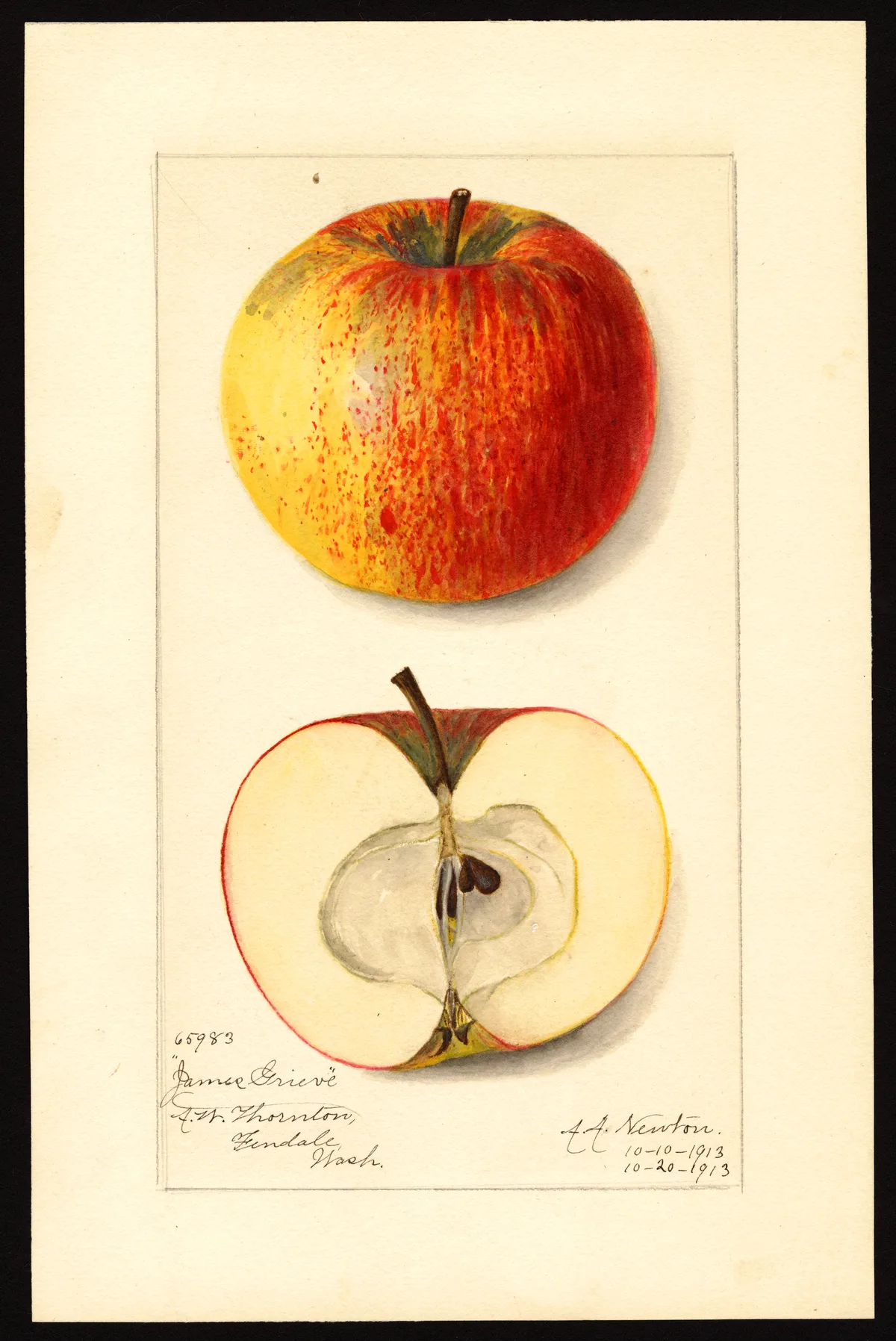
USDA Pomological Watercolor Collection
James Grieve
Origin / History
James Grieve is a seedling of Pott's Seedling, raised by Mr. James Grieve, after whom it is named. It was introduced to commerce by Messrs. Dickson of Edinburgh about 1890. A dessert apple from Scotland. It received the Award of Merit of the Royal Horticultural Society on October 12th, 1897 (George Bunyard & Co., 1901). Veitch records the F.C.C., and George Bunyard & Co. (1914) mark it F.C.
George Bunyard & Co. called it "one of the best apples recently introduced," which "may be styled an early Cox's Orange" (1901), and later "one of the very best of recent introduction" (1914). E. A. Bunyard (1920) judged it "a most excellent fruit quite the best of its season."
Tree
Growth vigorous, rather upright (E. A. Bunyard), compact (George Bunyard & Co., 1914). Leaf rather long, dark green, very finely crenate (E. A. Bunyard). Tree of hardier constitution than Cox's Orange (Veitch); it "succeeds where Cox's is tender" (George Bunyard & Co., 1901). Very fertile and prolific, a first-rate and reliable bearer. E. A. Bunyard names its faults in the South as liability to rot and to fall prematurely.
Fruit
Size: Medium. E. A. Bunyard gives medium to large and measures it 3 by 3.
Form: Round, conical, slightly irregular (E. A. Bunyard). George Bunyard & Co. (1914) call it even in shape.
Stem: Moderately long, knobbed at the end.
Cavity: Deep, rather narrow.
Calyx: Eye closed.
Basin: Rather deep and even, the sides a little plaited.
Skin: Pale creamy yellow to lemon-yellow, with a crimson flush and stripes. George Bunyard & Co. (1914) describe it as striped red, and Veitch gives a red flush on the exposed side. Of handsome appearance (George Bunyard & Co., 1901).
Dots: Not described in source.
Flesh and flavor: Flesh yellow to pale yellow, very juicy. E. A. Bunyard and George Bunyard & Co. (1914) call it tender, while Veitch calls it firm. Flavor fine and high, "excellent" in E. A. Bunyard's words and "remarkably high" in George Bunyard & Co.'s (1914). Veitch gives it "the flavour of Cox's Orange."
Core and seeds: Not described in source.
Season
September to October.
Uses
Dessert. George Bunyard & Co. (1914) call it "unequalled in its season for market or private use."
Subtypes / Variants
Not described in source.
Other
E. A. Bunyard cites the reference "Deutsh. Obstb., 1910., 133." George Bunyard & Co. (1901) offered dwarf trees at 2/6.
Book Sources
Described in 1 period pomological work
Nursery Catalog Sources
Found in 7 catalogs (1897–1917) from England
- Kelway & Son , Langport, Somerset , England — 1897
- George Bunyard & Co. , Royal Nurseries, Maidstone, Kent , England — 1900
- Central Experimental Farm , Dominion Department of Agriculture, Agassiz, British Columbia (under test; Bulletin No. 3, Second Series) — 1900
- James Veitch & Sons , Ltd., Royal Exotic Nursery, Chelsea, London (also Coombe Wood, Langley, and Feltham) , England — 1911
- Thomas Rivers & Son , Sawbridgeworth, Hertfordshire , England — 1913
- George Bunyard & Co. , Royal Nurseries, Maidstone, Kent , England — 1914
- George Bunyard & Co. , Royal Nurseries, Maidstone, Kent , England — 1917
View original book sources (4)
— E.A. Bunyard, A Handbook of Hardy Fruits (1920)JAMES GRIEVE. Deutsh. Obstb., 1910., 133. Dessert, September to October, medium to large, 3 by 3, round, conical, slightly irregular. Colour, pale creamy yellow, with crimson flush and stripes. Flesh, tender, very juicy, yellow, of excellent flavour. Eye, closed in a rather deep even basin, of which the sides are a little plaited. Stem, moderately long, knobbed at end, in a deep rather narrow cavity. Growth, vigorous, rather upright ; very fertile. Leaf, rather long, dark green, very finely crenate. Origin, a seedling from Pott's Seedling, raised by Mr. James Grieve, and introduced by Messrs. Dickson, of Edinburgh, about 1890. A most excellent fruit quite the best of its season ; its faults in the South are liability to rot and to fall prematurely.
— George Bunyard & Co., George Bunyard Fruit Catalogue (1901) (1901)Medium, a dessert fruit from Scotland, of fine flavour; it succeeds where Cox's is tender; first-rate bearer, and of handsome appearance. A.M., R.H.S., Oct. 12th, 1897. One of the best apples recently introduced, may be styled an early Cox's Orange. Dwarfs, 2/6.
— James Veitch & Sons, Veitch's Fruit Trees (1911) (1911)medium size, skin yellow with a red flush on the exposed side, flesh firm, pale yellow with the flavour of Cox's Orange. but the tree is of hardier constitution than that variety, a prolific bearer. F.C.C. ... Sept. & Oct.
— George Bunyard & Co., George Bunyard Catalog of Fruit Trees (1914) (1914)Dessert; Sept.-Oct. Medium, even in shape, lemon-yellow striped red; flesh tender, very juicy, of remarkably high flavour; growth vigorous, compact, reliable bearer; one of the very best of recent introduction; unequalled in its season for market or private use. Named after its raiser; introduced to commerce by Messrs. Dicksons, Edinburgh, about 1890. F.C.