Houblon
Apple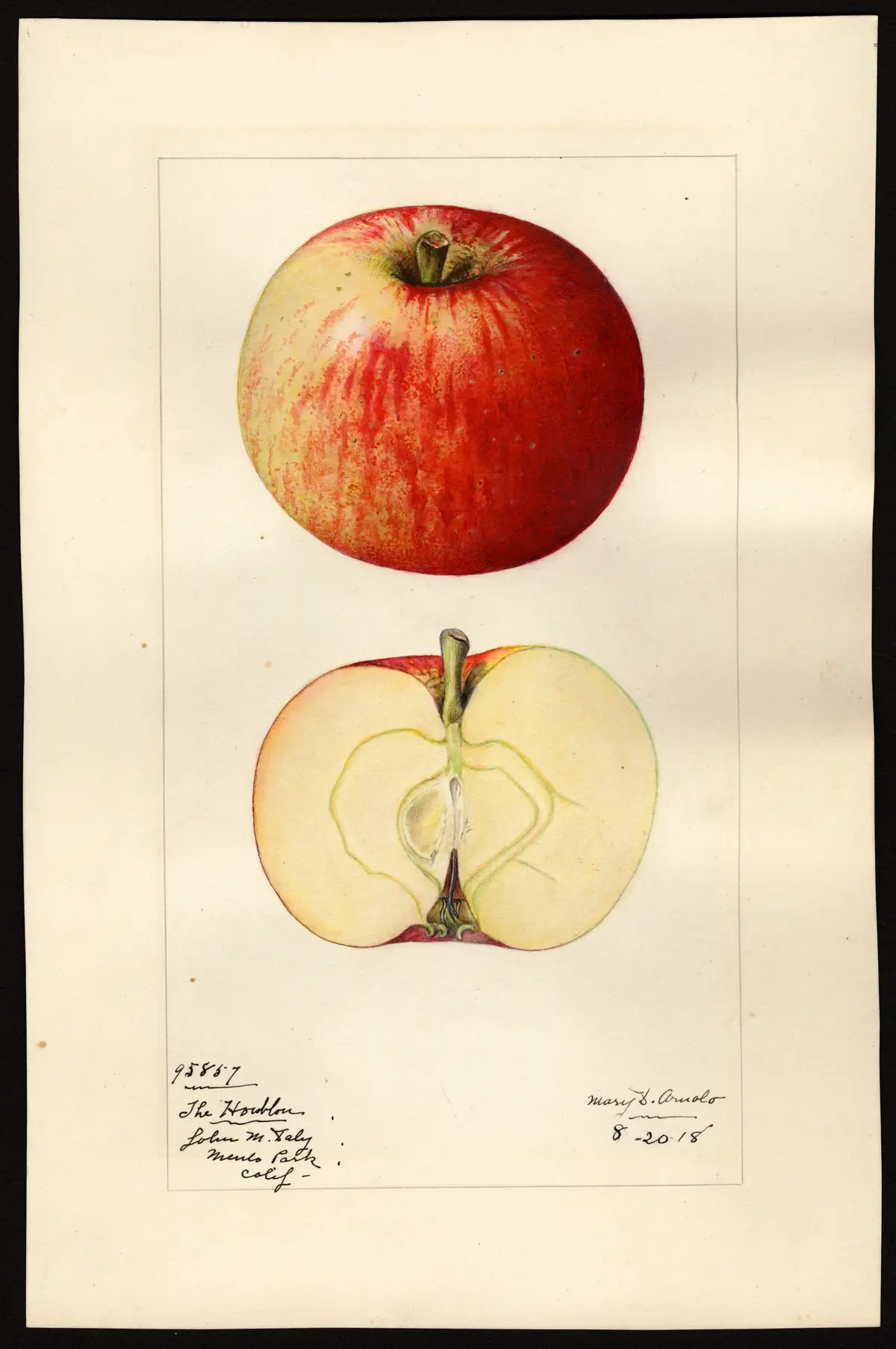
USDA Pomological Watercolor Collection
Houblon
Origin / History
Raised by Mr. Charles Ross from Cox's Orange Pippin, of which it is a seedling, and introduced to notice in 1901. Listed in Gardeners' Chronicle, 1902, p. 11. Awarded the A.M. George Bunyard & Co. call it rather larger and darker than Cox's Orange Pippin, with much of the rich flavor of the Queen of Apples. E.A. Bunyard calls it "an attractive fruit very nearly first-class in flavour."
Tree
Growth moderate; fertile, the fertility moderate according to E.A. Bunyard. Leaf roundish, rather dark, flat, a little undulating, crenate or shallow serrate, variable.
Fruit
Size: Small to medium, 2¼ by 1⅞ (E.A. Bunyard); medium (Veitch and George Bunyard & Co.). Rather larger than Cox's Orange Pippin (George Bunyard & Co.).
Form: Round, flattened, very regular.
Stem: Long and thin.
Cavity: Moderately russet.
Calyx: Eye closed.
Basin: Very shallow.
Skin: Orange-yellow with dark crimson stripes and russet veinings (E.A. Bunyard); dark crimson with golden russet (George Bunyard & Co.), darker than Cox's Orange Pippin. Color "very attractive" (Veitch).
Dots: Not described in source.
Flesh and flavor: Flesh firm, yellow. Flavor good (E.A. Bunyard); very highly flavored, with much of the rich flavor of the Queen of Apples (George Bunyard & Co.). E.A. Bunyard: "very nearly first-class in flavour."
Core and seeds: Not described in source.
Season
November to January; most authors give December to January.
Uses
Dessert.
Subtypes / Variants
Not described in source.
Other
Not described in source.
Book Sources
Described in 1 period pomological work
Nursery Catalog Sources
Found in 1 catalog (1911) from England
- James Veitch & Sons , Ltd., Royal Exotic Nursery, Chelsea, London (also Coombe Wood, Langley, and Feltham) , England — 1911 — listed as The Houblon
View original book sources (3)
— E.A. Bunyard, A Handbook of Hardy Fruits (1920)HOUBLON. Gard. Chron., 1902, p. 11. Dessert, December to January, small to medium, 2¼ by 1⅞, flattened, round, very regular. Colour, orange-yellow with dark crimson stripes and russet veinings. Flesh, firm, yellow, of good flavour. Eye, closed, in a very shallow basin. Stem, long and thin in a moderately russet cavity. Growth, moderate; fertility moderate. Leaf, roundish, rather dark, flat, a little undulating, crenate or shallow serrate, variable. Origin, raised by Mr. Charles Ross, and introduced in 1901. An attractive fruit very nearly first-class in flavour.
— James Veitch & Sons, Veitch's Fruit Trees (1911) (1911)medium size, a seedling from Cox's Orange Pippin, with a very attractive colour. A.M. ... Nov. to Jan.
— George Bunyard & Co., George Bunyard Catalog of Fruit Trees (1914) (1914)Dessert; Dec.-Jan. Medium, round, flat; dark crimson with golden russet; flesh firm, very highly flavoured; growth moderate, fertile. This seedling from Cox's Orange is rather larger, darker, and having much of the rich flavour of the Queen of Apples. Raised by Mr. Chas. Ross, and introduced to notice in 1901. A.M.