Golden Knob
Apple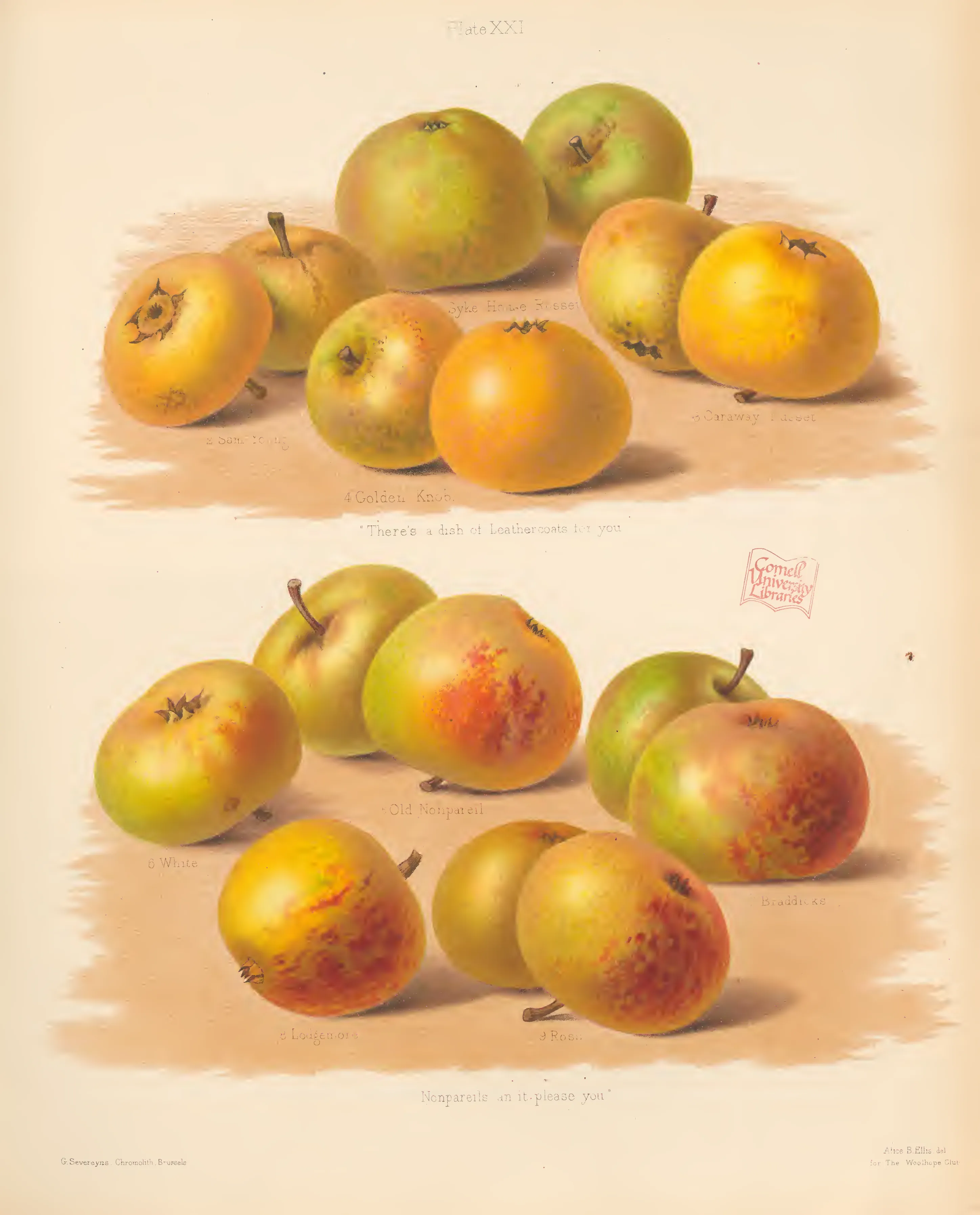
Golden Knob
Origin/History
The precise history of this variety is not recorded. It has been extensively cultivated in the Kentish orchards, where, according to Mr. Lewis A. Kellick, there are many trees some 100 years old at the time of the Herefordshire Pomona's writing (1885). It is figured by Ronalds, Plate xxxii. Bunyard (1920) gives the origin as probably English, noting it was popular in markets in the early nineteenth century and still grown in Kentish orchards at his time of writing, with a variety "of distinct flavour."
Tree
Vigor and habit: The Herefordshire Pomona describes the tree as very hardy, growing to a very large size, with a drooping umbrageous character, and bearing freely. Downing corroborates, calling the tree vigorous and productive. Bunyard, however, characterizes growth as only moderate, with the tree fertile. This discrepancy in reported vigor may reflect rootstock differences or selection strain.
Form: Bears freely as a standard; well adapted on the paradise stock for dwarf growth as a pyramid or espalier (Herefordshire Pomona).
Leaf: Fairly large, very dark, slightly upfolded, coarsely serrate (Bunyard).
Fruit
Size: Very small (Bunyard), described as below middle-size (Herefordshire Pomona) and small (Downing). Bunyard gives dimensions of 2¼ inches wide by 1¾ inches tall.
Form: Roundish (Herefordshire Pomona); roundish oblate (Downing); round, flattened, and regular (Bunyard).
Stem: Very short (Herefordshire Pomona; Bunyard). Set in a very narrow cavity (Bunyard).
Cavity: Very narrow (Bunyard).
Calyx: Open generally, with long segments (Herefordshire Pomona). Open (Bunyard).
Basin: Small and shallow (Bunyard).
Skin: Pale green at first, becoming yellowish green as it attains maturity, much covered with russet; on the side next the sun it becomes yellow with an orange tinge (Herefordshire Pomona). Downing describes it as golden yellow with some russet and a tinge of red in the sun. Bunyard characterizes the color as orange-brown, covered with russet. The three accounts are consistent with a russet-dominated fruit that progresses from pale green through golden yellow to orange-brown as it ripens, with sun-exposed sides taking on warmer tones.
Flesh and flavor: Firm (Herefordshire Pomona; Bunyard). Color is greenish white (Downing) or greenish yellow (Bunyard). Juicy and crisp (Downing). The Herefordshire Pomona and Downing describe the flavor as brisk and sweet; Bunyard gives it as sub-acid with good flavour. The Herefordshire Pomona adds "pleasant flavour." Bunyard further notes it is "of distinct flavour."
Core/Seeds: Not described in sources.
Season
The Herefordshire Pomona and Downing agree on a season of December to March. Bunyard extends the season to May, listing it as a dessert apple until that month. This late-keeping character was notably commercially valuable.
Uses
A good late-keeping dessert apple (Herefordshire Pomona; Bunyard). The Herefordshire Pomona notes it is one of the most remunerative varieties sent to the London market, and at Christmas would bring as good a price as the Ribston Pippin, the Golden Harvey, and other choice sorts.
Subtypes/Variants
Not described in sources.
Other
The variety is listed under the synonyms "Old Maid" and "Old Lady" in Bunyard, and as "Kentish Golden Knob" in the Herefordshire Pomona.
Book Sources
Described in 3 period pomological works
Nursery Catalog Sources
Found in 2 catalogs (1901–1913) from Illinois
- Benjamin Buckman (personal inventory) , Farmingdale , Illinois — 1901
- Benjamin Buckman (personal inventory) , Farmingdale , Illinois — 1913
View original book sources (3)
— Woolhope Naturalists Field Club, The Herefordshire Pomona (1885)
- GOLDEN KNOB. [Syn: Kentish Golden Knob.] The precise history of this variety is not recorded. It has been extensively cultivated in the Kentish orchards, says Mr. Lewis A. Kellick, where there are many trees, some 100 years old. It is figured by Ronalds, Pl. xxxii. Description.—Fruit: below middle-size, roundish. Skin: pale green, becoming yellowish green as it attains maturity, much covered with russet; on the side next the sun it becomes yellow with an orange tinge. Eye: open generally, with long segments. Stalk: very short. Flesh: firm, with a brisk, juicy, sweet and pleasant flavour. A good late keeping dessert apple, in season from December to March. It is one of the most remunerative sent to the London market, and at Christmas will bring as good a price as the Ribston Pippin, the Golden Harvey, and other choice sorts. The tree is very hardy, grows to a very large size, with a drooping umbrageous character, and bears freely. It will succeed as a standard, but is well adapted on the paradise stock for dwarf growth as a pyramid or espalier.
— A.J. Downing, The Fruits and Fruit Trees of America (1900)Golden Knob. Tree vigorous, productive. Fruit small, roundish oblate, golden yellow, some russet and tinge of red in sun. Flesh greenish white, crisp, juicy, brisk, sweet. December to March.
— E.A. Bunyard, A Handbook of Hardy Fruits (1920)GOLDEN KNOB. Ronalds, p. 32. (Old Maid, Old Lady.) Dessert, till May, very small, 2¼ by 1¾, round, flattened, regular. Colour, orange-brown, covered with russet. Flesh, firm, greenish-yellow, sub-acid, good flavour. Eye, open in a small shallow basin. Stem, very short in a very narrow cavity. Growth, moderate; fertile. Leaf, fairly large, very dark, slightly upfolded, coarsely serrate. Origin, probably English; popular in markets in the early nineteenth century. Still grown in Kentish orchards; of distinct flavour.