Nonpareil
Apple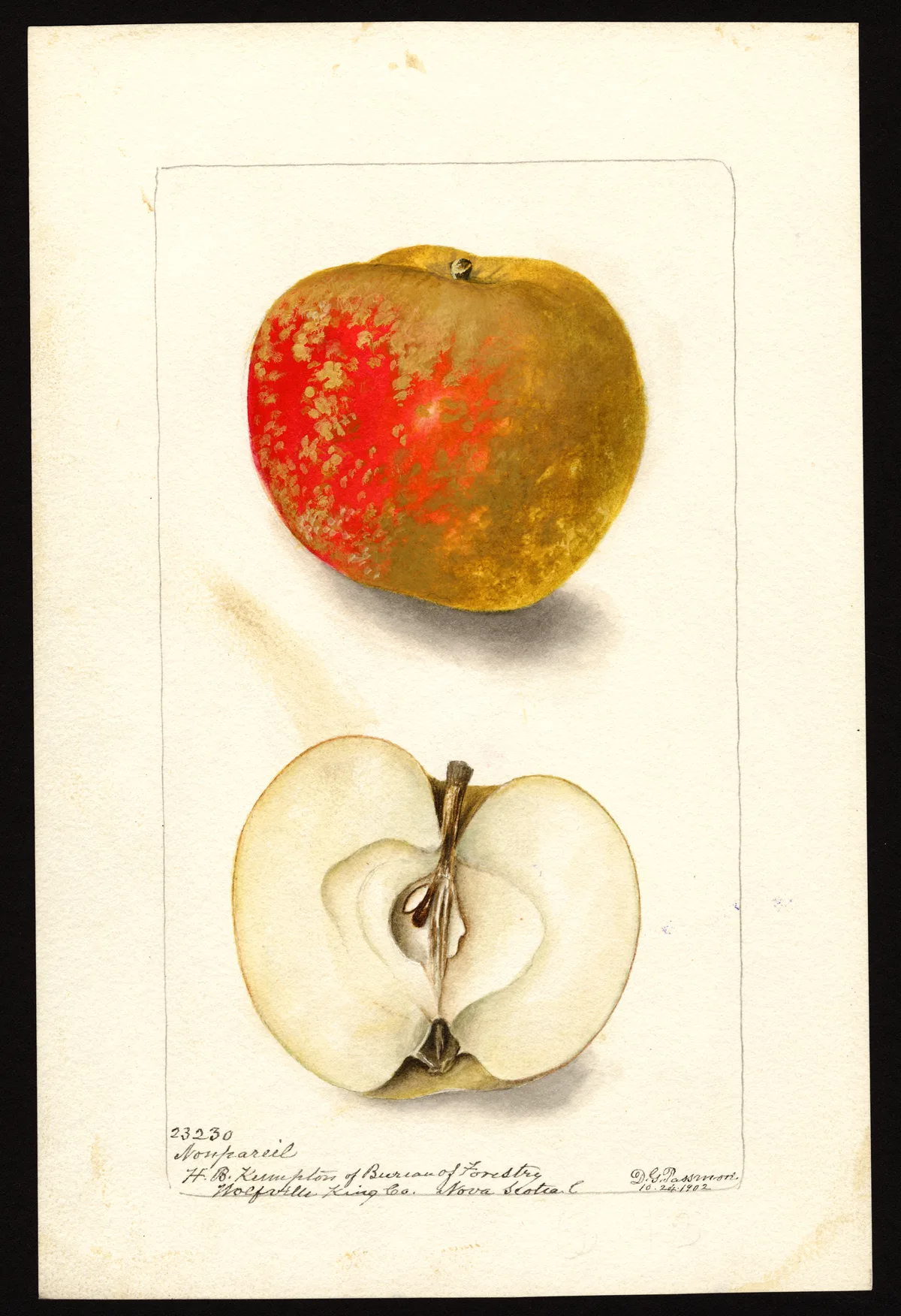
USDA Pomological Watercolor Collection
Nonpareil
Origin/History
Nonpareil is an old variety, generally believed to have come originally from France, though it has been cultivated in England for more than two hundred years. Switzer wrote: "It is no stranger in England . . . There are trees of them about the Ashtons in Oxfordshire of about a hundred years old, which (as they have it by tradition) were first brought out of France and planted by a Jesuit in Queen Mary or Queen Elizabeth's time." Bunyard records the origin as unrecorded, but known in England since about 1600.
The Herefordshire Pomona notes it is strange that an apple of such excellence, and held in such estimation as Nonpareil has always been, should have received so little notice from almost all the early continental Pomologists. It is not mentioned in the long list of the Jardinier François of 1653, nor by De la Quintinye or the Jardinier Solitaire. Schabol enumerates it, but it is not noticed by Bretonnerie. It is first described by Duhamel, and subsequently by Knoop. In the Chartreux Catalogue it is said "elle est forte estimée en Angleterre." Among English writers, Switzer is the first to notice it; it is not mentioned by Rea, Worlidge, or Ray, nor enumerated in the list of Leonard Meager. It is figured by Lindley (Pl. 86) and by Ronalds (Pl. xxxiv).
In America it is little esteemed. Thomas calls it "English—of little value here." Coxe notes that in America it "does not appear to be so highly flavoured in our climate as in England, where it is thought to be their finest table fruit."
Tree
Tree of straight and upright form, of regular growth (Coxe); free upright grower, productive (Downing); vigorous grower and productive (Central Experimental Farm). Bunyard describes growth as moderate, upright spreading, with moderate fertility. The Herefordshire Pomona notes the tree grows well and freely, but scarcely reaches middle size; it is an excellent bearer, but rather a tender tree. It will succeed well as a standard, and on the paradise stock is well adapted for dwarf growth in a pot, as a pyramid, or as an espalier. In the Northern counties and in Scotland it does not succeed as a standard, and when grown there under the protection of a wall the fruit is wanting in the fine delicate rich flavour of that grown for the South. Elliott, in contrast, describes it as a "poor bearer."
Leaf (Bunyard): medium, narrow, pea green, held up, much upfolded, boldly curved serrate.
Fruit
Size
Sources vary. Coxe: about the middling size. Elliott: medium. Herefordshire Pomona: medium sized. Downing: medium. Thomas: rather small. Bunyard: small, 2½ by 2 inches. Central Experimental Farm: below medium in size. Veitch's: medium size. Thomas Rivers: medium size.
Form
Flat (Coxe); flat (Elliott); roundish, broad at the base and narrow towards the apex, apt to be more full on one side than the other (Herefordshire Pomona); roundish conical (Downing); roundish ovate (Thomas); round conical, regular (Bunyard); roundish, flat (Central Experimental Farm).
Stem
An inch long, set in a round and pretty deep cavity, which is lined with russet (Herefordshire Pomona). Bunyard: stem fairly long, in a moderate, even cavity.
Cavity
Round and pretty deep, lined with russet (Herefordshire Pomona); moderate, even (Bunyard).
Calyx / Eye
Rather prominent, very slightly if at all depressed, half open, with broad segments, which are reflexed at the tips (Herefordshire Pomona). Bunyard: eye open, in a very shallow basin.
Basin
Very shallow (Bunyard). Herefordshire Pomona notes the eye is very slightly if at all depressed.
Skin
Coxe: rough, of a dull green, partaking of a small portion of russet, mixed with black clouds and spots. Elliott: yellowish reddish brown. Herefordshire Pomona: yellowish green, covered with large patches of thin grey russet, and dotted with small brown russetty dots, with occasionally a tinge of dull red on the side next the sun. Downing: yellowish green, with patches of dull russet, and red in the sun. Thomas: greenish-yellow. Bunyard: yellowish-green with red-brown flush and covered with russet, with some large conspicuous dots at base. Central Experimental Farm: greenish yellow, with a thin russet, over nearly the whole surface. Veitch's: golden-yellow, flushed with orange-red.
Flesh / Flavor
Coxe: rather dry, has a sprightly taste, but does not appear to be so highly flavoured in our climate as in England, where it is thought to be their finest table fruit. Elliott: firm, crisp. Herefordshire Pomona: greenish white, delicate, crisp, rich, and juicy, abounding in a particularly rich, vinous, and aromatic flavour. Downing: crisp, juicy, vinous, aromatic, mild acid; quality Good. Thomas: rich, acid. Bunyard: tender, greenish, aromatic. Central Experimental Farm: yellowish, crisp, juicy, sprightly, quality very good. Veitch's: small, crisp, juicy and highly flavoured, an old favourite, flesh sweet and firm. Thomas Rivers: loose, juicy and excellent, a prime.
Herefordshire Pomona calls it "one of the most highly esteemed and popular of all our dessert apples."
Core / Seeds
Bunyard notes obovate cells. He adds: "The obovate cells and conspicuous dots serve to distinguish it from the White Nonpareil."
Season
Coxe: ripens in November, and keeps through the winter. Elliott: December, January. Herefordshire Pomona: in season from January to May. Downing: December, March. Thomas: December. Bunyard: dessert, till March. Central Experimental Farm: December and January. Veitch's: keeps well; January to May. Thomas Rivers: December to March (also mentions October to March in one line).
Uses
Dessert / table fruit. In England thought to be their finest table fruit (Coxe). One of the most highly esteemed and popular of all dessert apples (Herefordshire Pomona). Veitch's: "liked by everyone," an old favourite. Thomas Rivers: "a prime."
Subtypes / Variants
Not described in source, aside from Bunyard's note distinguishing Nonpareil from the White Nonpareil by its obovate cells and conspicuous dots.
Other
Thomas Rivers includes an unattached line: "large, it is an essential quality in Pearmains — Oct.-March," which does not appear to describe Nonpareil directly but is preserved here for completeness.
Book Sources
Described in 6 period pomological works
- Coxe, A View of the Cultivation of Fruit Trees (1817) — listed as English Nonpareil
- Bunyard, A Handbook of Hardy Fruits (1920)
- Downing, Fruits and Fruit Trees of America (1900)
- Thomas, The American Fruit Culturist (1903)
- Elliott, The Western Fruit Book (1865) — listed as Old Nonpareil
- The Herefordshire Pomona (1876–1885) — listed as Old Nonpareil
Nursery Catalog Sources
Found in 5 catalogs (1896–1913) from England, Illinois, Missouri
- Stark Bros. Nurseries & Orchards Co. , Louisiana , Missouri — 1896
- Central Experimental Farm , Dominion Department of Agriculture, Agassiz, British Columbia (under test; Bulletin No. 3, Second Series) — 1900
- Benjamin Buckman (personal inventory) , Farmingdale , Illinois — 1901 — listed as Old Nonpareil
- James Veitch & Sons , Ltd., Royal Exotic Nursery, Chelsea, London (also Coombe Wood, Langley, and Feltham) , England — 1911 — listed as Old Nonpareil
- Benjamin Buckman (personal inventory) , Farmingdale , Illinois — 1913 — listed as Old Nonpareil
View original book sources (9)
— William Coxe, A View of the Cultivation of Fruit Trees (1817)NO. 97. ENGLISH NONPAREIL. This apple is about the middling size; the form is flat; the skin rough, of a dull green, partaking of a small portion of russet, mixed with black clouds and spots: the flesh is rather dry, has a sprightly taste, but does not appear to be so highly flavoured in our climate as in England, where it is thought to be their finest table fruit; the tree is of a straight and upright form; regular growth, and great fruitfulness; it ripens in November, and keeps through the winter.
— F.R. Elliott, The Western Fruit Book (1865)Old Nonpareil. Non Pareille. Foreign. Medium, flat, yellowish reddish brown ; flesh, firm, crisp ; poor bearer. December, January.
— Woolhope Naturalists Field Club, The Herefordshire Pomona (1885)
- OLD NONPAREIL.
[Syn : Nonpareil ; English Nonpareil ; Hunt's Nonpareil ; Lovedon's Pippin ; Reinette Nonpareil ; Nonpareil d'Angleterre ; Duc d'Arsel ; Grüne Reinette]
It is generally believed that the Nonpareil came originally from France, though, as Switzer says, "It is no stranger in England . . . There are trees of them about the Ashtons in Oxfordshire of about a hundred years old, which (as they have it by tradition) were first brought out of France and planted by a Jesuit in Queen Mary or Queen Elizabeth's time."
It is strange that an apple of such excellence, and held in such estimation as the Nonpareil has always been, should have received so little notice from almost all the early continental Pomologists. It is not mentioned in the long list of the Jardinier François of 1653, nor even by De la Quintinye, or the Jardinier Solitaire. Schabol enumerates it, but it is not noticed by Bretonnerie. It is first described by Duhamel, and subsequently by Knoop. In the Chartreux Catalogue it is said "elle est forte estimee en Angleterre." Among the writers of our own country, Switzer is the first to notice it. It is not mentioned by Rea, Worlidge, or Ray, neither is it enumerated in the list of Leonard Meager. In America it is little esteemed. It has been cultivated in England for more than two hundred years. It is figured by Lindley, Pl. 86 ; and by Ronalds, Pl. xxxiv.
Description.—Fruit : medium sized, roundish, broad at the base and narrow towards the apex, apt to be more full on one side than the other. Skin : yellowish green, covered with large patches of thin grey russet, and dotted with small brown russetty dots, with occasionally a tinge of dull red on the side next the sun. Eye : rather prominent, very slightly if at all depressed, half open, with broad segments, which are reflexed at the tips. Stalk : an inch long, set in a round and pretty deep cavity, which is lined with russet. Flesh : greenish white, delicate, crisp, rich, and juicy, abounding in a particularly rich, vinous, and aromatic flavour.
One of the most highly esteemed and popular of all our dessert apples. It is in season from January to May.
The tree grows well and freely, but scarcely reaches the middle size. It is an excellent bearer, but rather a tender tree. It will succeed well as a standard, but on the paradise stock it is well adapted for dwarf growth in a pot ; as a pyramid ; or an espalier.
In the Northern counties and in Scotland it does not succeed as a standard, and when grown there under the protection of a wall the fruit is wanting in the fine delicate rich flavour of that grown for the South.
— A.J. Downing, The Fruits and Fruit Trees of America (1900)Nonpareil.
English Nonpareil. Old Nonpareil. Original Nonpareil. Hunt's Nonpareil. Loveden's Pippin. Reinette Nonpareil. Nonpareil d'Angleterre. Duc d'Arsel. Grune Reinette.
An old English variety. Tree free upright grower, productive. Fruit medium, roundish conical, yellowish green, with patches of dull russet, and red in the sun. Flesh crisp, juicy, vinous, aromatic, mild acid. Good. December, March.
— John J. Thomas, The American Fruit Culturist (1903)Nonpareil, or Old Nonpareil. Rather small, roundish ovate, greenish-yellow; rich, acid. December. English—of little value here.
— E.A. Bunyard, A Handbook of Hardy Fruits (1920)NONPAREIL. Her. Pom., 21. F., Nonpareille ancienne; G., Alter Nonpareil. (English Nonpareil, Hunt's Nonpareil, Original Nonpareil.) Dessert, till March, small, 2½ by 2, round conical, regular. Colour, yellowish-green with red-brown flush and covered with russet, with some large conspicuous dots at base. Flesh, tender, greenish, aromatic. Eye, open, in a very shallow basin. Stem, fairly long in a moderate, even cavity. Growth, moderate, upright spreading; fertility, moderate; Leaf, medium, narrow, pea green, held up, much upfolded, boldly curved serrate. Origin, unrecorded; known in England since about 1600. This fruit is worthy of all commendation. The obovate cells and conspicuous dots serve to distinguish it from the White Nonpareil.
Nonpareille d'Angleterre: see Ribston Pippin.
— Central Experimental Farm, Central Experimental Farm, Agassiz BC — Catalogue of Fruit Trees under Test (Bulletin No. 3, 1900) (1900)Planted Spring 1894. Tree a vigorous grower and productive. Fruit below medium in size, roundish, flat. Skin greenish yellow, with a thin russet, over nearly the whole surface. Flesh yellowish, crisp, juicy, sprightly, quality very good. Season December and January.
— James Veitch & Sons, Veitch's Fruit Trees (1911) (1911)medium size, golden-yellow, flushed with orange-red, keeps well and liked by everyone.
small, crisp, juicy and highly flavoured, as old favourite, flesh sweet and firm. Jan. to May
— Thomas Rivers & Son, Thomas Rivers Catalogue of Fruits (1914) (1914)large, it is an essential quality in Pearmains - Oct.-March
medium size, loose, juicy and excellent; a prime - Dec.-March