Esopus Spitzenburg: Difference between revisions
Bot: Heritage variety data import |
Bot: enrich variety page from Variety Finder data (esopus-spitzenberg-apple) |
||
| (4 intermediate revisions by the same user not shown) | |||
| Line 2: | Line 2: | ||
|name=Esopus Spitzenburg | |name=Esopus Spitzenburg | ||
|species=Apple | |species=Apple | ||
|at_clarno=yes | |at_clarno=yes | ||
|clarno_year=2025 | |clarno_year=2025 | ||
}} | }} | ||
[[File:USDA_Pomological_Esopus_Spitzenburg_POM00002143.webp|thumb|right|320px|USDA Pomological Watercolor by Newton, Amanda Almira (Yakima, Yakima, Washington). <small>Public domain. USDA National Agricultural Library.</small>]] | |||
''' | Size medium, wholly covered with bright red or faintly striped with darker red and yellow; firm, very crisp, sub-acid; strong aroma and a peculiarly pleasing flavor. Profitable chiefly in a few very favored sections of the Pacific Northwest. NC | ||
'''Read the full entry:''' [https://heritageapplecorps.org/varieties/esopus-spitzenberg-apple/ Esopus Spitzenberg on the Variety Finder] for deeper history, every book quote, and all nursery catalog references. | |||
== | == Quick Facts == | ||
* [[ | {| class="wikitable" | ||
* [[ | |- | ||
| '''Type''' || Apple | |||
|- | |||
| '''Season''' || Winter | |||
|- | |||
| '''Flavor''' || subacid, aromatic, spicy | |||
|- | |||
| '''Uses''' || fresh eating, cooking, preserves | |||
|- | |||
| '''Keeping quality''' || Good | |||
|- | |||
| '''Size''' || Above Medium | |||
|- | |||
| '''Shape''' || Oblong | |||
|- | |||
| '''Skin color''' || red, yellow, russet, striped | |||
|- | |||
| '''Flesh''' || Yellow crisp | |||
|- | |||
| '''Origin''' || New York, USA | |||
|} | |||
== Synonyms == | |||
Aesopus Spitzenberg, Aesopus Spitzenburgh, ESOPUS SPITZENBURG, Esopus, Esopus Spitzemberg, Esopus Spitzenburg, Esopus Spitzenburgh, Flushing Spitzemberg, Flushing Spitzenberg, Flushing Spitzenberg (irrig), Spitszenburgh, Spitz, Spitzemberg, Spitzenberg, Spitzenbergh, Spitzenburg, Spitzenburgh, Spitzenburgh, Esopus, True Spitsenburgh, True Spitzenburgh, Æsopus Spitsenburgh, Æsopus Spitzemberg, Æsopus Spitzenberg, Æsopus Spitzenburg, Æsopus Spitzenburgh | |||
== Origin and History == | |||
Originated at Esopus, Ulster County, New York, on the Hudson River, a famous apple district originally settled by the Low Dutch. The exact date of origin is not authentically recorded, but the variety was well known in cultivation in New York and adjoining states more than a century before 1905, placing its origin some years previous to 1800. Coxe (1817) reports it as said to have originated in the vicinity of Albany, and notes that it was supposed to deteriorate when transplanted south of the Highlands on the Hudson River; he considered the Flushing Spitzenberg of Long Island to be essentially the same variety, the difference being of the slightest shade and probably produced by soil, aspect, or cultivation in mountainous versus flat country. Warder (1867) observed that as the fruit moved westward and southward it changed character, becoming larger and more irregular, less brilliantly colored, less highly flavored, and less productive. Throughout New York it was long considered the first of apples and was generally regarded as equal to the [https://heritageapplecorps.org/varieties/green-newtown-pippin-apple/ Newtown Pippin] and unsurpassed as a dessert fruit by any other variety. By the time of Beach (1905) it had scattered through the oldest orchards of the State, was known in cultivation in Europe, and was one of the recognized commercial varieties in certain apple-growing districts of the Rocky Mountain region, Washington, and Oregon. Hedrick (1922) reports it had long been grown from the Atlantic to the Pacific and was found in nearly every large market on the continent in season, often under the sobriquet "Spitz." Within New York, the fruit develops good color and quality in most apple-growing regions but does particularly well in favorable localities in Schoharie and Greene counties and along Lake Champlain (Beach). Thomas notes it succeeds best in New York, its native State. | |||
== Fruit == | |||
=== Size === | |||
Sources generally agree on medium to large, with some variation. Coxe: a large apple. Warder: medium to large. Downing: large. Beach: below medium to large, pretty uniform in size and shape. Lowther: medium to large. Thomas: rather large. Budd-Hansen: large. Hedrick: medium to large, sufficiently uniform in size and shape to make this an ideal apple for fancy packages. Central Experimental Farm: medium size. Elliott: above medium, large when carefully grown. | |||
=== Form === | |||
Oblong, tapering roundly to the eye (Downing, Coxe); conical, ribbed, irregular (Warder); rather broad and flat at the base, varying from oblong rounding towards the cavity to roundish ovate or to roundish inclined to conic, somewhat irregular and obscurely ribbed (Beach, Lowther, Hedrick, Hedrick adds "beautifully formed in an oblong-conic mould"); flattened at base, oblong, tapering roundly toward the eye, considerably ribbed and irregular in its surface, and almost always slightly angular (Elliott); round-ovate, slightly conical (Thomas); large, regular, oblong, slightly tapering, truncated (Budd-Hansen); medium size, oblong, tapering to the eye (Central Experimental Farm). | |||
=== Stem / Stalk === | |||
Sources differ on stem length. Coxe: of moderate length, planted in a deep hollow, the end projecting a little beyond the level of the fruit. Downing: rather long, three-fourths of an inch, and slender, projecting beyond the base. Thomas: three-fourths of an inch long, rather slender. Warder: long. Elliott: varying, sometimes short and stout, at others long and slender. Beach, Lowther, Hedrick: stem medium. Budd-Hansen: stem medium, slender. | |||
=== Cavity === | |||
Deep, acute, regular, or wavy (Warder); wide (Downing); deep, regular, open (Elliott); acute or somewhat acuminate, deep, wide, red or yellow or with outspreading rays of thin yellowish-russet (Beach, Hedrick); wavy, deep, wide, light brown (Budd-Hansen). | |||
=== Calyx / Eye === | |||
Eye small, closed (Warder, Elliott); calyx small and closed (Downing); calyx medium to small, closed or somewhat open (Beach); calyx small, closed or open (Hedrick); calyx small, closed, segments divergent (Budd-Hansen). Calyx tube not very large, often elongated, cone-shape (Beach); calyx-tube elongated, cone-shape (Hedrick); tube conical (Budd-Hansen). Stamens below medium to above (Beach); stamens median (Hedrick, Budd-Hansen). | |||
=== Basin === | |||
Shallow, slightly furrowed (Downing, Thomas, Budd-Hansen, "smooth or slightly furrowed"); deep, ribbed or folded, often leather-cracked (Warder); almost abrupt, furrowed (Elliott); not large, often oblique at brim, abrupt, moderately narrow, shallow to medium in depth, sometimes compressed, usually furrowed and wrinkled (Beach); often oblique, abrupt, narrow, shallow, sometimes compressed, furrowed and wrinkled (Hedrick). | |||
=== Skin / Surface === | |||
Skin smooth (Coxe, Warder, Budd-Hansen). The colour a lively and brilliant red approaching to a scarlet, with numerous small yellow spots (Coxe). Surface smooth, yellow, covered with bright red, marbled and mixed, striped more or less distinctly; dots numerous, large, irregular, gray, always elongated near the base (Warder). Skin smooth, nearly covered with rich, lively red, dotted with distinct yellowish russet dots; on the shaded side a yellowish ground with streaks and broken stripes of red (Downing). Skin tough, sometimes waxy, slightly roughened by the russet dots, deep rich yellow often almost completely covered with bright red inconspicuously striped with darker red, in the sun deepening to a very dark, almost purplish blush, marked with pale yellow and russet dots which are small and numerous toward the basin, but are apt to be larger and much elongated toward the cavity (Beach, Lowther, Hedrick, Hedrick describes "a commingling of light and dark red laid on a rich yellow background with a dark red blush on the cheek to the sun, the whole surface being sprinkled with yellow and russet dots contrasting well with the red"). Surface a high rich red, rather obscurely striped (Thomas). Rich, lively red on yellow ground, dotted and marbled with yellow russet (Elliott). Surface smooth, almost wholly covered with clear bright nearly solid red, on shaded side yellow, tinged and streaked with red; dots distinct, numerous, small, gray (Budd-Hansen). Skin yellow, nearly covered with bright red and sprinkled with yellowish dots (Central Experimental Farm). | |||
=== Flesh / Flavor === | |||
Flesh yellow (all sources agree). Texture and flavor descriptions: | |||
* Coxe: yellow, and singularly rich, juicy and sprightly. | |||
* Warder: rich, yellow, breaking, juicy at the North, more fibrous than crisp at the South. Flavor quite acid till ripe, when it is rich, saccharine, highly aromatic, giving the idea of the Spitzenberg flavor; quality best. | |||
* Downing: yellow, rather firm, crisp, juicy, with a delicious rich, brisk flavor. Best. | |||
* Beach: tinged with yellow, firm, moderately fine, crisp, rather tender, juicy, aromatic, sprightly subacid, very good to best. | |||
* Lowther: tinged with yellow, firm, fine, crisp, tender, juicy, aromatic, subacid. | |||
* Hedrick: yellow, firm, fine, crisp, tender, juicy, aromatic, sprightly subacid; very good to best. Flavor subacid, rich, spicy, and aromatic. | |||
* Thomas: yellow, firm, crisp, spicy, rather acid, nearly unequalled in its high rich flavor. | |||
* Elliott: yellow, crisp, a little tough, exceedingly high flavored and delicious. | |||
* Budd-Hansen: yellow, crisp, firm, juicy, rich, delicious, brisk, spicy subacid, best. | |||
* Central Experimental Farm: yellow, firm, crisp, juicy, with a rich flavour, quality very good. | |||
The variety is the standard of excellence for apples of the [https://heritageapplecorps.org/varieties/baldwin-apple/ Baldwin] class, to which it naturally belongs (Beach, Lowther). When well grown it is handsomely colored and unexcelled in flavor and quality (Beach); fruits are unexcelled in quality and most pleasing in appearance (Hedrick). | |||
=== Core / Seeds === | |||
Core large, closed; seeds long, pointed (Warder). Seeds in a hollow core (Downing). Core regular, ovate, rounded in form; seeds large (Elliott). Core medium to rather large, abaxile; cells often unsymmetrical and open but sometimes closed; core lines slightly clasping; carpels large, roundish ovate, mucronate, tufted; seeds large, long, wide, acute, dark shaded with light brown (Beach, Hedrick, Hedrick: "core-lines clasping"). Core open; cells ovate, slit; seeds large, light colored, flat (Budd-Hansen). | |||
== Season == | |||
Coxe: maturity about Christmas. Warder: December to February. Downing: December to February. Elliott: January to March. Thomas: keeps through winter. Budd-Hansen: November to February. Beach: November to February or later; in cold storage may be held till June. Lowther: November to February, in cold storage until June. Hedrick: November to February; keep in cold storage until June. Central Experimental Farm: December and January. It is in season between [https://heritageapplecorps.org/varieties/rhode-island-greening-apple/ Rhode Island Greening] and [https://heritageapplecorps.org/varieties/baldwin-apple/ Baldwin] (Beach), and is quite variable in keeping quality in different seasons and in different localities. The fruit is well adapted for handling in cold storage, ships well, and withstands well all the usages of marketing. | |||
== Uses == | |||
A choice dessert fruit, generally considered equal to the [https://heritageapplecorps.org/varieties/green-newtown-pippin-apple/ Newtown Pippin] and unsurpassed as a dessert fruit by any other variety (Downing, Budd-Hansen). Use, dessert and kitchen (Warder). One of the best apples known either for canning or for general culinary uses (Beach); excellent for dessert and one of the very best for culinary purposes (Lowther); about the best to eat out of hand, and very good for all culinary purposes as well (Hedrick). Has long had a well-established reputation in market, always sells well, is well suited for marketing in boxes or fancy packages, and often brings fancy prices (Beach, Lowther, Hedrick). | |||
== Illustrations == | |||
<gallery mode="packed" heights="240"> | |||
File:USDA_Pomological_Esopus_Spitzenburg_POM00002143.webp|USDA Pomological Watercolor by Newton, Amanda Almira (Yakima, Yakima, Washington) | |||
File:USDA_Pomological_Esopus_Spitzenburg_POM00002334.webp|USDA Pomological Watercolor by Schutt, Ellen Isham (Yakima, Yakima, Washington) | |||
File:USDA_Pomological_Esopus_Spitzenburg_POM00002336.webp|USDA Pomological Watercolor by Schutt, Ellen Isham (Yakima, Yakima, Washington) | |||
File:USDA_Pomological_Esopus_Spitzenburg_POM00002146.jpg|USDA Pomological Watercolor by Heiges, Bertha (Australia) | |||
File:USDA_Pomological_Esopus_Spitzenburg_POM00002145.jpg|USDA Pomological Watercolor by Steadman, Royal Charles (Hood River, Hood River, Oregon) | |||
File:USDA_Pomological_Esopus_Spitzenburg_POM00002151.jpg|USDA Pomological Watercolor by Shull, James Marion (Hood River, Hood River, Oregon) | |||
</gallery> | |||
<small>U.S. Department of Agriculture Pomological Watercolor Collection. Rare and Special Collections, National Agricultural Library, Beltsville, MD 20705</small> | |||
== Sources == | |||
* John A. Warder, American Pomology: Apples (1867). Public domain. | |||
* S.A. Beach, The Apples of New York Vol. 1 (1905). Public domain. | |||
* A.J. Downing, Fruits and Fruit Trees of America (1869). Public domain. | |||
* F.R. Elliott, The Western Fruit Book (1865). Public domain. | |||
* John J. Thomas, The American Fruit Culturist (1903). Public domain. | |||
* J.L. Budd & N.E. Hansen, American Horticultural Manual, Part II: Systematic Pomology (1914). Public domain. | |||
* Coxe, A View of the Cultivation of Fruit Trees (1817). Public domain. | |||
* Granville Lowther (ed.), Encyclopedia of Practical Horticulture (1914). Public domain. | |||
* H.H. Fisher, A Survey of Apple Clones in the United States (USDA ARS, 1963). Public domain. | |||
* U.P. Hedrick, Cyclopedia of Hardy Fruits (1922). Public domain. | |||
* USDA Pomological Watercolor Collection, U.S. National Agricultural Library. | |||
* 74 historical nursery catalog references (see [https://heritageapplecorps.org/varieties/esopus-spitzenberg-apple/ Variety Finder] for the full list). | |||
* '''Full entry with all citations:''' [https://heritageapplecorps.org/varieties/esopus-spitzenberg-apple/ Esopus Spitzenberg on the Variety Finder] | |||
== Trees of this Variety in Our Collection == | |||
{{#ask: [[Has variety::Esopus Spitzenburg]] | |||
|?Has orchard=Orchard | |||
|?Has field tag=Tag | |||
|?Has condition=Condition | |||
|format=table | |||
|sort=Has orchard, Has field tag | |||
}} | |||
[[Category:Varieties]] | [[Category:Varieties]] | ||
[[Category:Apple Trees]] | [[Category:Apple Trees]] | ||
[[Category:Preserved at Clarno]] | [[Category:Preserved at Clarno]] | ||
Latest revision as of 13:20, 28 April 2026
| Esopus Spitzenburg | |
|---|---|
| Species | Apple |
| Trees Found | 2 |
| Orchards | Lithgow Springs,McCoin Upper |
| Preserved | Clarno Arboretum(2025) |
Size medium, wholly covered with bright red or faintly striped with darker red and yellow; firm, very crisp, sub-acid; strong aroma and a peculiarly pleasing flavor. Profitable chiefly in a few very favored sections of the Pacific Northwest. NC Read the full entry: Esopus Spitzenberg on the Variety Finder for deeper history, every book quote, and all nursery catalog references.
Quick Facts
| Type | Apple |
| Season | Winter |
| Flavor | subacid, aromatic, spicy |
| Uses | fresh eating, cooking, preserves |
| Keeping quality | Good |
| Size | Above Medium |
| Shape | Oblong |
| Skin color | red, yellow, russet, striped |
| Flesh | Yellow crisp |
| Origin | New York, USA |
Synonyms
Aesopus Spitzenberg, Aesopus Spitzenburgh, ESOPUS SPITZENBURG, Esopus, Esopus Spitzemberg, Esopus Spitzenburg, Esopus Spitzenburgh, Flushing Spitzemberg, Flushing Spitzenberg, Flushing Spitzenberg (irrig), Spitszenburgh, Spitz, Spitzemberg, Spitzenberg, Spitzenbergh, Spitzenburg, Spitzenburgh, Spitzenburgh, Esopus, True Spitsenburgh, True Spitzenburgh, Æsopus Spitsenburgh, Æsopus Spitzemberg, Æsopus Spitzenberg, Æsopus Spitzenburg, Æsopus Spitzenburgh
Origin and History
Originated at Esopus, Ulster County, New York, on the Hudson River, a famous apple district originally settled by the Low Dutch. The exact date of origin is not authentically recorded, but the variety was well known in cultivation in New York and adjoining states more than a century before 1905, placing its origin some years previous to 1800. Coxe (1817) reports it as said to have originated in the vicinity of Albany, and notes that it was supposed to deteriorate when transplanted south of the Highlands on the Hudson River; he considered the Flushing Spitzenberg of Long Island to be essentially the same variety, the difference being of the slightest shade and probably produced by soil, aspect, or cultivation in mountainous versus flat country. Warder (1867) observed that as the fruit moved westward and southward it changed character, becoming larger and more irregular, less brilliantly colored, less highly flavored, and less productive. Throughout New York it was long considered the first of apples and was generally regarded as equal to the Newtown Pippin and unsurpassed as a dessert fruit by any other variety. By the time of Beach (1905) it had scattered through the oldest orchards of the State, was known in cultivation in Europe, and was one of the recognized commercial varieties in certain apple-growing districts of the Rocky Mountain region, Washington, and Oregon. Hedrick (1922) reports it had long been grown from the Atlantic to the Pacific and was found in nearly every large market on the continent in season, often under the sobriquet "Spitz." Within New York, the fruit develops good color and quality in most apple-growing regions but does particularly well in favorable localities in Schoharie and Greene counties and along Lake Champlain (Beach). Thomas notes it succeeds best in New York, its native State.
Fruit
Size
Sources generally agree on medium to large, with some variation. Coxe: a large apple. Warder: medium to large. Downing: large. Beach: below medium to large, pretty uniform in size and shape. Lowther: medium to large. Thomas: rather large. Budd-Hansen: large. Hedrick: medium to large, sufficiently uniform in size and shape to make this an ideal apple for fancy packages. Central Experimental Farm: medium size. Elliott: above medium, large when carefully grown.
Form
Oblong, tapering roundly to the eye (Downing, Coxe); conical, ribbed, irregular (Warder); rather broad and flat at the base, varying from oblong rounding towards the cavity to roundish ovate or to roundish inclined to conic, somewhat irregular and obscurely ribbed (Beach, Lowther, Hedrick, Hedrick adds "beautifully formed in an oblong-conic mould"); flattened at base, oblong, tapering roundly toward the eye, considerably ribbed and irregular in its surface, and almost always slightly angular (Elliott); round-ovate, slightly conical (Thomas); large, regular, oblong, slightly tapering, truncated (Budd-Hansen); medium size, oblong, tapering to the eye (Central Experimental Farm).
Stem / Stalk
Sources differ on stem length. Coxe: of moderate length, planted in a deep hollow, the end projecting a little beyond the level of the fruit. Downing: rather long, three-fourths of an inch, and slender, projecting beyond the base. Thomas: three-fourths of an inch long, rather slender. Warder: long. Elliott: varying, sometimes short and stout, at others long and slender. Beach, Lowther, Hedrick: stem medium. Budd-Hansen: stem medium, slender.
Cavity
Deep, acute, regular, or wavy (Warder); wide (Downing); deep, regular, open (Elliott); acute or somewhat acuminate, deep, wide, red or yellow or with outspreading rays of thin yellowish-russet (Beach, Hedrick); wavy, deep, wide, light brown (Budd-Hansen).
Calyx / Eye
Eye small, closed (Warder, Elliott); calyx small and closed (Downing); calyx medium to small, closed or somewhat open (Beach); calyx small, closed or open (Hedrick); calyx small, closed, segments divergent (Budd-Hansen). Calyx tube not very large, often elongated, cone-shape (Beach); calyx-tube elongated, cone-shape (Hedrick); tube conical (Budd-Hansen). Stamens below medium to above (Beach); stamens median (Hedrick, Budd-Hansen).
Basin
Shallow, slightly furrowed (Downing, Thomas, Budd-Hansen, "smooth or slightly furrowed"); deep, ribbed or folded, often leather-cracked (Warder); almost abrupt, furrowed (Elliott); not large, often oblique at brim, abrupt, moderately narrow, shallow to medium in depth, sometimes compressed, usually furrowed and wrinkled (Beach); often oblique, abrupt, narrow, shallow, sometimes compressed, furrowed and wrinkled (Hedrick).
Skin / Surface
Skin smooth (Coxe, Warder, Budd-Hansen). The colour a lively and brilliant red approaching to a scarlet, with numerous small yellow spots (Coxe). Surface smooth, yellow, covered with bright red, marbled and mixed, striped more or less distinctly; dots numerous, large, irregular, gray, always elongated near the base (Warder). Skin smooth, nearly covered with rich, lively red, dotted with distinct yellowish russet dots; on the shaded side a yellowish ground with streaks and broken stripes of red (Downing). Skin tough, sometimes waxy, slightly roughened by the russet dots, deep rich yellow often almost completely covered with bright red inconspicuously striped with darker red, in the sun deepening to a very dark, almost purplish blush, marked with pale yellow and russet dots which are small and numerous toward the basin, but are apt to be larger and much elongated toward the cavity (Beach, Lowther, Hedrick, Hedrick describes "a commingling of light and dark red laid on a rich yellow background with a dark red blush on the cheek to the sun, the whole surface being sprinkled with yellow and russet dots contrasting well with the red"). Surface a high rich red, rather obscurely striped (Thomas). Rich, lively red on yellow ground, dotted and marbled with yellow russet (Elliott). Surface smooth, almost wholly covered with clear bright nearly solid red, on shaded side yellow, tinged and streaked with red; dots distinct, numerous, small, gray (Budd-Hansen). Skin yellow, nearly covered with bright red and sprinkled with yellowish dots (Central Experimental Farm).
Flesh / Flavor
Flesh yellow (all sources agree). Texture and flavor descriptions:
- Coxe: yellow, and singularly rich, juicy and sprightly.
- Warder: rich, yellow, breaking, juicy at the North, more fibrous than crisp at the South. Flavor quite acid till ripe, when it is rich, saccharine, highly aromatic, giving the idea of the Spitzenberg flavor; quality best.
- Downing: yellow, rather firm, crisp, juicy, with a delicious rich, brisk flavor. Best.
- Beach: tinged with yellow, firm, moderately fine, crisp, rather tender, juicy, aromatic, sprightly subacid, very good to best.
- Lowther: tinged with yellow, firm, fine, crisp, tender, juicy, aromatic, subacid.
- Hedrick: yellow, firm, fine, crisp, tender, juicy, aromatic, sprightly subacid; very good to best. Flavor subacid, rich, spicy, and aromatic.
- Thomas: yellow, firm, crisp, spicy, rather acid, nearly unequalled in its high rich flavor.
- Elliott: yellow, crisp, a little tough, exceedingly high flavored and delicious.
- Budd-Hansen: yellow, crisp, firm, juicy, rich, delicious, brisk, spicy subacid, best.
- Central Experimental Farm: yellow, firm, crisp, juicy, with a rich flavour, quality very good.
The variety is the standard of excellence for apples of the Baldwin class, to which it naturally belongs (Beach, Lowther). When well grown it is handsomely colored and unexcelled in flavor and quality (Beach); fruits are unexcelled in quality and most pleasing in appearance (Hedrick).
Core / Seeds
Core large, closed; seeds long, pointed (Warder). Seeds in a hollow core (Downing). Core regular, ovate, rounded in form; seeds large (Elliott). Core medium to rather large, abaxile; cells often unsymmetrical and open but sometimes closed; core lines slightly clasping; carpels large, roundish ovate, mucronate, tufted; seeds large, long, wide, acute, dark shaded with light brown (Beach, Hedrick, Hedrick: "core-lines clasping"). Core open; cells ovate, slit; seeds large, light colored, flat (Budd-Hansen).
Season
Coxe: maturity about Christmas. Warder: December to February. Downing: December to February. Elliott: January to March. Thomas: keeps through winter. Budd-Hansen: November to February. Beach: November to February or later; in cold storage may be held till June. Lowther: November to February, in cold storage until June. Hedrick: November to February; keep in cold storage until June. Central Experimental Farm: December and January. It is in season between Rhode Island Greening and Baldwin (Beach), and is quite variable in keeping quality in different seasons and in different localities. The fruit is well adapted for handling in cold storage, ships well, and withstands well all the usages of marketing.
Uses
A choice dessert fruit, generally considered equal to the Newtown Pippin and unsurpassed as a dessert fruit by any other variety (Downing, Budd-Hansen). Use, dessert and kitchen (Warder). One of the best apples known either for canning or for general culinary uses (Beach); excellent for dessert and one of the very best for culinary purposes (Lowther); about the best to eat out of hand, and very good for all culinary purposes as well (Hedrick). Has long had a well-established reputation in market, always sells well, is well suited for marketing in boxes or fancy packages, and often brings fancy prices (Beach, Lowther, Hedrick).
Illustrations
-
USDA Pomological Watercolor by Newton, Amanda Almira (Yakima, Yakima, Washington)
-
USDA Pomological Watercolor by Schutt, Ellen Isham (Yakima, Yakima, Washington)
-
USDA Pomological Watercolor by Schutt, Ellen Isham (Yakima, Yakima, Washington)
-
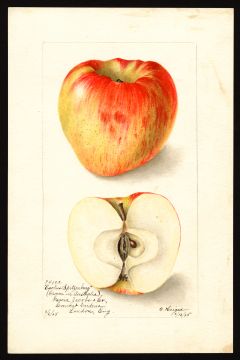 USDA Pomological Watercolor by Heiges, Bertha (Australia)
 -
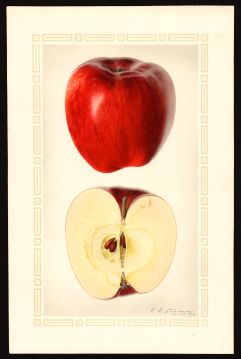 USDA Pomological Watercolor by Steadman, Royal Charles (Hood River, Hood River, Oregon)
 -
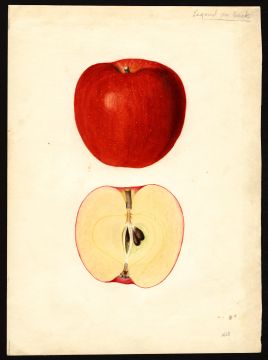 USDA Pomological Watercolor by Shull, James Marion (Hood River, Hood River, Oregon)


U.S. Department of Agriculture Pomological Watercolor Collection. Rare and Special Collections, National Agricultural Library, Beltsville, MD 20705
Sources
- John A. Warder, American Pomology: Apples (1867). Public domain.
- S.A. Beach, The Apples of New York Vol. 1 (1905). Public domain.
- A.J. Downing, Fruits and Fruit Trees of America (1869). Public domain.
- F.R. Elliott, The Western Fruit Book (1865). Public domain.
- John J. Thomas, The American Fruit Culturist (1903). Public domain.
- J.L. Budd & N.E. Hansen, American Horticultural Manual, Part II: Systematic Pomology (1914). Public domain.
- Coxe, A View of the Cultivation of Fruit Trees (1817). Public domain.
- Granville Lowther (ed.), Encyclopedia of Practical Horticulture (1914). Public domain.
- H.H. Fisher, A Survey of Apple Clones in the United States (USDA ARS, 1963). Public domain.
- U.P. Hedrick, Cyclopedia of Hardy Fruits (1922). Public domain.
- USDA Pomological Watercolor Collection, U.S. National Agricultural Library.
- 74 historical nursery catalog references (see Variety Finder for the full list).
- Full entry with all citations: Esopus Spitzenberg on the Variety Finder
Trees of this Variety in Our Collection
| Orchard | Tag | Condition | |
|---|---|---|---|
| Lithgow Springs Tree 106 | Lithgow Springs | 106 | poor |
| McCoin Upper Tree 48 | McCoin Upper | 48 | poor |