Green Newtown Pippin
Apple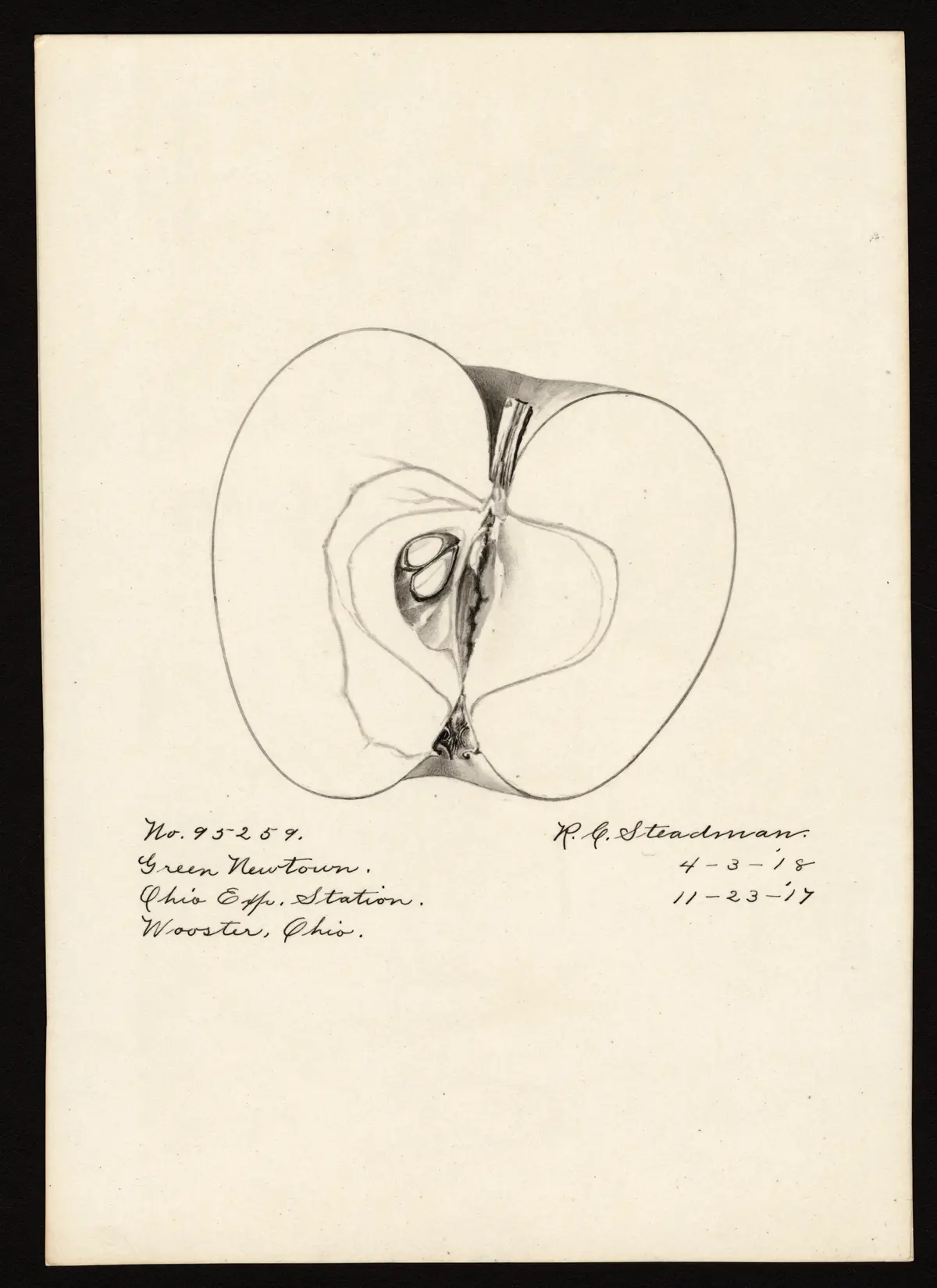
USDA Pomological Watercolor Collection
Editor's Note
Green Newtown Pippin
Origin / History
A native American apple, originating at Newtown, Long Island (Coxe, Warder, Downing, Elliott, Thomas, Budd & Hansen, Hedrick). The original tree came into bearing early in the eighteenth century, and the variety was soon widely grown (Hedrick). In 1759 samples were sent to Benjamin Franklin in England, where they attracted much attention; John Bartram, the Quaker botanist, soon after sent grafts to England; and Thomas Jefferson was growing the variety at Monticello in 1778 (Hedrick). Coxe (1817) treated it as a variety of the preceding kind ("Newtown Pippin"), noting that although he could never perceive a difference in the trees, there is certainly a perceptible one in the fruit. Warder regarded this as probably the original Newtown Pippin, but by no means the more common (which is the Yellow Newtown Pippin). Downing and Elliott both state explicitly that Green Newtown Pippin is entirely distinct from Yellow Newtown Pippin. Hedrick, however, takes the contrary view, holding that "some pomologists maintain that there is a Yellow Newtown, a distinct variety from Green Newtown; but the differences in color are due to differences in soil or climate — two varieties do not exist."
Downing notes that "The Newtown Pippin stands at the head of all Apples, and is, when in perfection, acknowledged to be unrivalled in all the qualities which constitute a high-flavored dessert apple, to which it combines the quality of long keeping without the least shrivelling, retaining its high flavor to the last. It commands the highest price in Covent Garden Market, London." Budd & Hansen echo Downing and add that it is "one of the highest-priced varieties for the English market." Coxe found it "every where the finest apple in our orchards, very far superior to all other kinds for exportation: in productiveness, they are surpassed by no apple of any season; they are the fairest and freest from rot of any highly flavoured apple we have." Coxe had eaten them in high perfection raised in some of the Patowmack counties of Virginia, and from trees growing in New York, New Jersey and Pennsylvania. Thomas notes it is "one of the best fruits for foreign markets" and that it is extensively grown in Virginia and California. Hedrick states the apple can be grown in perfection only in certain regions, naming Hood River, Oregon; the Albemarle region, Virginia; and along the Hudson River, New York; and that experiments at the Experiment Station, Geneva, New York, show that it is a most excellent apple to use in breeding.
Cultural requirements: Downing notes it "requires a pretty strong, deep, warm soil to attain its full perfection, and in the orchard it should be well manured every two or three years." Elliott specifies "a rich limestone clay soil, or a warm, sandy, rich loam, well dressed with lime and bone dust, in order to secure healthy wood, and fair, smooth fruit. On sandy soils, abounding more or less with iron, we have never seen good fruit grown of this variety." Elliott adds that "On the rich limestone soils of Ohio, and farther west, this and the Yellow Newtown Pippin succeed, and produce fruit even superior to the world-renowned Pell Orchard." Budd & Hansen note "It has rarely succeeded well in New England and is tender westward."
Tree
Of rather slender and slow growth (Downing); growth slender, slow (Elliott); rather slow, slender growth (Budd & Hansen); rather slow grower or moderately vigorous, of medium size or sometimes becoming large (Beach); moderately vigorous, of medium size (Hedrick). Even while young, always remarkable for its rough bark (Downing, Thomas, Budd & Hansen). As an orchard tree, a fine round head, with branches diverging, pendent (Elliott). Form spreading or roundish, rather dense (Beach); spreading or roundish, dense (Hedrick). Laterals shorter, twisted, spreading and drooping more than those of the Yellow Newtown (Beach). Twigs medium in length and thickness, pubescent near tips; internodes medium to rather long (Beach). Bark clear dark brownish-red, lightly streaked with scarf-skin (Beach). Lenticels quite numerous, medium or below, somewhat elongated, raised, rather conspicuous (Beach). Buds medium, broad, plump, obtuse, free, slightly pubescent (Beach).
Coxe could not perceive a difference between Green Newtown Pippin and Yellow Newtown Pippin in the trees; Elliott likewise states "it is difficult, if not impossible to detect one from the other by the wood."
The fruit is liable to be spotted with black spots when not grown on healthy trees (Downing); "very liable to black spots or scabs, unless under high, rich, and constant cultivation" (Thomas); "liable to black spots or scabs unless the trees are given constant cultivation and plenty of manure" (Budd & Hansen).
Fruit
Size
Medium (Coxe, Warder cites medium to large, Downing, Elliott, Budd & Hansen, Lowther); medium or rather large (Thomas); medium to very large, pretty uniform in size but rather variable in form and coloring (Beach); medium to large, uniform in size but variable in form and coloring (Hedrick). Downing gives "about three inches in diameter, and two and a half deep."
Form
Rather oblong (Coxe); globular, flattened, sometimes obscurely ribbed (Warder); roundish, a little irregular in its outline, caused by two or three obscure ribs on the sides — and broadest at the base, next the stalk (Downing); roundish, oblong flattened (Elliott); roundish, oblique, slightly irregular, remotely conical or else a little flattened (Thomas); roundish, broadest at the base, next the stem, with two or three obscure ribs extending to the basin, giving it irregularity in outline (Budd & Hansen); usually roundish oblate and more or less angular (Beach); usually round-oblate and more or less angular, with an oblique axis, sometimes elliptical (Hedrick); roundish (oblate) (Lowther). As grown in Southeastern New York it often has an oblique axis and is sometimes decidedly elliptical, but in Western New York the tendency of the fruit to grow with an oblique axis is less marked and the fruit is less often elliptical and more nearly symmetrical (Beach).
Stem
Long, slender (Warder); half an inch long, rather slender, deeply sunk in a wide, funnel-shaped cavity (Downing); slender (Elliott); short, deep set (Thomas); half an inch long, rather slender, deeply sunk (Budd & Hansen); medium or short (Beach, Hedrick).
Cavity
Wide, wavy, brown (Warder); wide, funnel-shaped (Downing); acuminate, regular (Elliott); surrounded by thin, dull, whitish russet rays (Thomas); wide, deep, funnel-shaped, lined with delicate russet which extends over part of base (Budd & Hansen); deep, acuminate to acute, broad or compressed, often sending out rays of russet (Beach); deep, acuminate, broad or compressed, often with rays of russet (Hedrick). Downing also describes "delicate russet rays around the stalk."
Calyx / Eye
Eye small, closed (Warder); calyx quite small and closed (Downing); calyx small (Elliott, Budd & Hansen, Thomas implied through basin/setting); calyx small, closed (Budd & Hansen); calyx rather small to medium, closed or nearly so; lobes rather small, acute (Beach); calyx small, closed or nearly so; lobes small, acute (Hedrick).
Basin
Shallow, folded (Warder); narrow and shallow (Downing); deep, abrupt, hollowed, and slightly wrinkled (Elliott); narrow, shallow (Thomas); small, narrow, shallow (Budd & Hansen); medium in width and depth, furrowed and often somewhat wrinkled (Beach); medium in width and depth, furrowed and often wrinkled (Hedrick). The basin descriptions disagree on depth: Warder, Downing, Thomas, and Budd & Hansen all describe it as shallow (and small/narrow), while Elliott describes it as deep, abrupt, and hollowed; Beach and Hedrick describe it as medium in width and depth.
Skin / Color
Skin green and smoother than the (Yellow) Newtown (Coxe); surface smooth, green, becoming yellowish green when fully ripe, sometimes bronzy, and always showing white irregular striae near the base when first gathered (Warder); color dull green, becoming olive green when ripe, with a faint, dull brownish blush on one side (Downing); dull green when first gathered, becoming, when ripe, a yellowish green (Elliott); dull green becoming yellowish green, often with a dull brownish blush (Thomas); surface dull green, becoming olive green or greenish yellow at maturity, with faint reddish brown blush on sunny side (Budd & Hansen); skin rather tough, smooth or slightly roughened with brownish-russet dots, grass-green at fruit harvest but sometimes pretty yellow later, and often showing some brownish or brownish-pink color, especially near the base (Beach); skin tough, smooth or roughened with brownish-russet dots, grass-green at fruit harvest but yellow later, often showing brownish-pink especially near the base (Hedrick); greenish yellow (Lowther).
Dots / Surface Markings
Dots scattered, minute, dark (Warder); small gray specks, with delicate russet rays around the stalk (Downing); small minute russet dots, with occasional spots or blotches of russet, and, grown on alluvial soils South, patches of dark green mould (Elliott); dots small, gray, russet, numerous (Budd & Hansen); white submerged dots are especially numerous toward the eye and whitish scarf-skin stripes extend over the base (Beach); dots submerged, numerous toward the eye, white scarf-skin over the base (Hedrick); brownish-russet dots (Beach, Hedrick). Warder additionally notes "always showing white irregular striae near the base when first gathered."
Flesh / Flavor
Flesh whiter, crisper, and more juicy than the (Yellow) Newtown (Coxe); flesh greenish white, crisp, tender, juicy; flavor acid, aromatic, rich, very agreeable; quality best (Warder); flesh greenish white, very juicy, crisp, with a fine aroma, and an exceedingly high and delicious flavor; best (Downing); flesh greenish white, very fine-grained, juicy, crisp, sprightly, perfumed (Elliott); flesh greenish white, juicy, crisp, fine-grained, with a high, fine flavor (Thomas); flesh greenish white, very juicy, firm, crisp, fine-grained, fine aroma and exceedingly high and delicious flavor, best (Budd & Hansen); flesh yellowish or tinged with green according to the color of the fruit, firm, crisp, tender, moderately fine-grained, juicy, sprightly, with a fine aromatic subacid flavor, best (Beach); flesh yellow, firm, crisp, tender, fine-grained, juicy, sprightly, with a fine aromatic subacid flavor; best (Hedrick); quality very good (Lowther). Downing also notes that "It commands the highest price in Covent Garden Market, London," and that it "retain[s] its high flavor to the last."
Core / Seeds
Core round, regular, closed, meeting the eye; seeds pointed, plump, dark (Warder); core compact; seeds dark brown, ovate (Elliott); cells obovate, axile; tube conical; stamens median (Budd & Hansen); calyx tube long, funnel-shape to nearly conical; stamens median to basal; core small to medium, somewhat abaxile; cells fairly symmetrical, closed or nearly so; core lines clasping; carpels broadly roundish or roundish obcordate, emarginate, tufted; seeds tufted, medium or above, dark, narrow, acuminate (Beach); calyx-tube long, funnel-shape; stamens median; core small, abaxile; cells symmetrical, closed; core-lines clasping; carpels broadly roundish or round-obcordate, emarginate, tufted; seeds tufted, dark, narrow, acuminate (Hedrick).
Season
December to March (Warder); in eating from December to May, but in the finest perfection in March (Downing); February to May (Elliott, Beach, Hedrick); keeps through spring, and retains remarkably its freshness (Thomas); December to May, but at its best in March (Budd & Hansen); winter (Lowther). One of the finest keeping apples (Downing); combines the quality of long keeping without the least shrivelling, retaining its high flavor to the last (Downing, quoted in Budd & Hansen).
Uses
Dessert, cooking (Warder); high-flavored dessert apple (Downing, Budd & Hansen); both kitchen and market (Lowther). One of the best fruits for foreign markets (Thomas); finest apple in our orchards, very far superior to all other kinds for exportation; the fairest and freest from rot of any highly flavoured apple we have (Coxe); commands the highest price in Covent Garden Market, London (Downing); one of the highest-priced varieties for the English market (Budd & Hansen).
Subtypes / Variants
Not described in source — but see history above regarding the disagreement between sources over whether Yellow Newtown Pippin constitutes a distinct variety or merely a color variant arising from differences in soil or climate (Coxe, Warder, Downing, Elliott, Thomas, Budd & Hansen treat Green and Yellow Newtown Pippin as related but distinct; Hedrick maintains "two varieties do not exist," with the color differences attributable to soil or climate).
Other
In productiveness, surpassed by no apple of any season (Coxe).
Book Sources
Described in 9 period pomological works
- Warder, American Pomology: Apples (1867)
- Beach, The Apples of New York Vol. 1 (1905)
- Downing, Fruits and Fruit Trees of America (1900)
- Elliott, The Western Fruit Book (1865)
- Budd & Hansen, Systematic Pomology (1914) — listed as Green Newtown
- Coxe, A View of the Cultivation of Fruit Trees (1817)
- Lowther (ed.), Encyclopedia of Practical Horticulture (1914)
- Hedrick, Cyclopedia of Hardy Fruits (1922)
- Thomas, The American Fruit Culturist (1903)
Nursery Catalog Sources
Found in 13 catalogs (1845–1913) from California, Illinois, Massachusetts
- Winship's Nursery (Brighton Nurseries , operated by the Winship family), Brighton (Boston) , Massachusetts — 1845
- Hovey & Co. , Cambridge , Massachusetts — 1849
- Azell Bowditch (Nursery / Fruit Catalog) , Boston , Massachusetts — 1850
- Joseph Breck & Co. , Boston , Massachusetts — 1855
- Felix Gillet , Barren Hill Nursery, Nevada City , California — 1884
- Felix Gillet , Barren Hill Nursery, Nevada City , California — 1888
- Felix Gillet , Barren Hill Nursery, Nevada City , California — 1889
- Felix Gillet , Barren Hill Nursery, Nevada City , California — 1890
- Felix Gillet , Barren Hill Nursery, Nevada City , California — 1891
- Felix Gillet , Barren Hill Nursery, Nevada City , California — 1895
- Felix Gillet , Barren Hill Nursery, Nevada City , California — 1897
- Benjamin Buckman (personal inventory) , Farmingdale , Illinois — 1901
- Benjamin Buckman (personal inventory) , Farmingdale , Illinois — 1913
View original book sources (9)
— William Coxe, A View of the Cultivation of Fruit Trees (1817)NO. 73. GREEN NEWTON PIPPIN.
This is a variety of the preceding kind; although I could never perceive a difference in the trees, there is certainly a perceptible one in the fruit. The Green Pippin is rather more oblong in form, the skin is green, and smoother, the flesh whiter, crisper, and more juicy. I have eaten them in high perfection, raised in some of the Patowmack counties of Virginia, and from trees growing in New-York, New-Jersey and Pennsylvania; when produced from trees advantageously situated, and well cultivated, they are every where the finest apple in our orchards, very far superior to all other kinds for exportation: in productiveness, they are surpassed by no apple of any season; they are the fairest and freest from rot of any highly flavoured apple we have.
— John A. Warder, American Pomology: Apples (1867)Newtown Pippin. GREEN NEWTOWN. This is probably the original Newtown Pippin, but by no means the more common, which is the Yellow Newtown Pippin, to be described in another place. Fruit medium to large, globular, flattened, sometimes obscurely ribbed; Surface smooth, green, becoming yellowish green when fully ripe, sometimes bronzy, and always showing white irregular striae near the base when first gathered; Dots scattered, minute, dark. Basin shallow, folded; Eye small, closed. Cavity wide, wavy, brown; Stem long, slender. Core round, regular, closed, meeting the eye; Seeds pointed, plump, dark; Flesh greenish white, crisp, tender, juicy; Flavor acid, aromatic, rich, very agreeable; Quality best; Use, dessert, cooking; Season, December to March.
— A.J. Downing, The Fruits and Fruit Trees of America (1900)Green Newtown Pippin. Hunt's Fine Green Pippin. Newtown Pippin. American Newtown Pippin. Brooke's Pippin ? Green Winter Pippin. Petersburgh Pippin. Hunt's Green Newtown Pippin ?
The Newtown Pippin stands at the head of all Apples, and is, when in perfection, acknowledged to be unrivalled in all the qualities which constitute a high-flavored dessert apple, to which it combines the quality of long keeping without the least shrivelling, retaining its high flavor to the last. It commands the highest price in Covent Garden Market, London. This variety is a native of Newtown, Long Island, and it requires a pretty strong, deep, warm soil to attain its full perfection, and in the orchard it should be well manured every two or three years. The tree is of rather slender and slow growth, and even while young is always remarkable for its rough bark.
Fruit of medium size, roundish, a little irregular in its outline, caused by two or three obscure ribs on the sides — and broadest at the base, next the stalk ; about three inches in diameter, and two and a half deep. Color dull green, becoming olive green when ripe, with a faint, dull brownish blush on one side, dotted with small gray specks, and with delicate russet rays around the stalk. Calyx quite small and closed, set in a narrow and shallow basin. Stalk half an inch long, rather slender, deeply sunk in a wide, funnel-shaped cavity. Flesh greenish white, very juicy, crisp, with a fine aroma, and an exceedingly high and delicious flavor. Best. When the fruit is not grown on healthy trees, it is liable to be spotted with black spots. This is one of the finest keeping apples, and is in eating from December to May, but is in the finest perfection in March.
This is entirely distinct from Yellow Newtown Pippin.
— S.A. Beach, The Apples of New York, Vol. 1 (1905)GREEN NEWTOWN.
TREE.
Tree a rather slow grower or moderately vigorous, of medium size or sometimes becoming large. Laterals shorter, twisted, spreading and drooping more than those of the Yellow Newtown. Form spreading or roundish, rather dense. Twigs medium in length and thickness, pubescent near tips; internodes medium to rather long. Bark clear dark brownish-red, lightly streaked with scarf-skin. Lenticels quite numerous, medium or below, somewhat elongated, raised, rather conspicuous. Buds medium, broad, plump, obtuse, free, slightly pubescent.
FRUIT.
Fruit medium to very large, pretty uniform in size but rather variable in form and coloring. Form usually roundish oblate and more or less angular. As grown in Southeastern New York it often has an oblique axis and is sometimes decidedly elliptical, but in Western New York the tendency of the fruit to grow with an oblique axis is less marked and the fruit is less often elliptical and more nearly symmetrical. Stem medium or short. Cavity deep, acuminate to acute, broad or compressed, often sending out rays of russet. Calyx rather small to medium, closed or nearly so; lobes rather small, acute. Basin medium in width and depth, furrowed and often somewhat wrinkled.
Skin rather tough, smooth or slightly roughened with brownish-russet dots, grass-green at fruit harvest but sometimes pretty yellow later, and often showing some brownish or brownish-pink color, especially near the base. White submerged dots are especially numerous toward the eye and whitish scarf-skin stripes extend over the base.
Calyx tube long, funnel-shape to nearly conical. Stamens median to basal. Core small to medium, somewhat abaxile; cells fairly symmetrical, closed or nearly so; core lines clasping. Carpels broadly roundish or roundish obcordate, emarginate, tufted. Seeds tufted, medium or above, dark, narrow, acuminate.
Flesh yellowish or tinged with green according to the color of the fruit, firm, crisp, tender, moderately fine-grained, juicy, sprightly, with a fine aromatic subacid flavor, best.
Season February to May.
— Granville Lowther (ed.), Encyclopedia of Practical Horticulture (1914)Green Newtown. Size: medium. Form: roundish (oblate). Color: greenish yellow. Quality: very good. Use: both kitchen and market. Season: winter.
— F.R. Elliott, The Western Fruit Book (1865)NEWTOWN PIPPIN. Green Newtown Pippin, Green Winter Pippin, American Newtown Pippin, Petersburg Pippin.
American. Native of Newtown, Long Island. It requires a rich limestone clay soil, or a warm, sandy, rich loam, well dressed with lime and bone dust, in order to secure healthy wood, and fair, smooth fruit. On sandy soils, abounding more or less with iron, we have never seen good fruit grown of this variety. It is distinct in fruit from the Yellow Newtown Pippin, for which see further pages; but it is difficult, if not impossible to detect one from the other by the wood. Growth slender, slow; as an orchard tree, a fine round head, with branches diverging, pendent. On the rich limestone soils of Ohio, and farther west, this and the Yellow Newtown Pippin succeed, and produce fruit even superior to the world-renowned Pell Orchard. Fruit, medium; form, roundish, oblong flattened; color, dull green when first gathered, becoming, when ripe, a yellowish green; small minute russet dots, with occasional spots or blotches of russet, and, grown on alluvial soils South, patches of dark green mould: stem, slender; cavity, acuminate, regular; calyx, small; basin, deep, abrupt, hollowed, and slightly wrinkled; flesh, greenish white, very fine-grained, juicy, crisp, sprightly, perfumed; core, compact; seeds, dark brown, ovate. February to May.
— John J. Thomas, The American Fruit Culturist (1903)Newtown Pippin.* (Pippin, Green Newtown Pippin.) Medium or rather large, roundish, oblique, slightly irregular, remotely conical or else a little flattened; dull green becoming yellowish green, often with a dull brownish blush; stalk short, deep set, and surrounded by thin, dull, whitish russet rays; basin narrow, shallow; flesh greenish white, juicy, crisp, fine-grained, with a high, fine flavor. Keeps through spring, and retains remarkably its freshness. Tree of rather slow growth, with a rough bark. The fruit is very liable to black spots or scabs, unless under high, rich, and constant cultivation. One of the best fruits for foreign markets. A native of Newtown, Long Island. Extensively grown in Virginia and California.
— J.L. Budd & N.E. Hansen, American Horticultural Manual, Part II: Systematic Pomology (1914)Green Newtown.—Origin, Newtown, Long Island. Downing wrote: "Newtown Pippin stands at the head of all apples, and is, when in
[Green Newtown.]
perfection, acknowledged to be unrivalled in all the qualities which constitute a high-flavored dessert apple, to which it combines the quality of long keeping without the least shrivelling, retaining its high flavor to the last." One of the highest-priced varieties for the English market. The tree is of rather slow, slender growth, and remarkable even while young for its rough bark. Fruit liable to black spots or scabs unless the trees are given constant cultivation and plenty of manure. A pretty strong, deep, warm soil is necessary for its full perfection. It has rarely succeeded well in New England and is tender westward.
Fruit medium, roundish, broadest at the base, next the stem, with two or three obscure ribs extending to the basin, giving it irregularity in outline; surface dull green, becoming olive green or greenish yellow at maturity, with faint reddish brown blush on sunny side; dots small, gray, russet, numerous; cavity wide, deep, funnel-shaped, lined with delicate russet which extends over part of base; stem half an inch long, rather slender, deeply sunk; basin small, narrow, shallow; calyx small, closed; cells obovate, axile; tube conical; stamens median; flesh greenish white, very juicy, firm, crisp, fine-grained, fine aroma and exceedingly high and delicious flavor, best. December to May, but at its best in March. See Yellow Newtown.
— U.P. Hedrick, Cyclopedia of Hardy Fruits (1922)GREEN NEWTOWN. Fig. 23. Albemarle. Albemarle Pippin. Green Newtown Pippin. Mountain Pippin. Newtown Pippin. Yellow Newtown.
Unfortunately, this apple can be grown in perfection only in certain regions, as: Hood River, Oregon; the Albemarle region, Virginia; and along the Hudson River, New York. By virtue of high quality, longkeeping and beauty of fruit, together with good tree-characters, Green Newtown has high standing in regions where it thrives. Experiments at the Experiment Station, Geneva, New York, show that it is a most excellent apple to use in breeding. Green Newtown is preeminently an American apple. The original tree came into bearing early in the eighteenth century, and the variety was soon widely grown. In 1759 samples were sent to Benjamin Franklin in England, where they attracted much attention; John Bartram, the Quaker botanist, soon after sent grafts to England; and Thomas Jefferson was growing the variety at Monticello in 1778. Some pomologists maintain that there is a Yellow Newtown, a distinct variety from Green Newtown; but the differences in color are due to differences in soil or climate — two varieties do not exist.
Tree moderately vigorous, of medium size, spreading or roundish, dense. Fruit medium to large, uniform in size but variable in form and coloring, usually round-oblate and more or less angular, with an oblique axis, sometimes elliptical; stem medium or short; cavity deep, acuminate, broad or compressed, often with rays of russet; calyx small, closed or nearly so; lobes small, acute; basin medium in width and depth, furrowed and often wrinkled; skin tough, smooth or roughened with brownish-russet dots, grass-green at fruit harvest but yellow later, often showing brownish-pink especially near the base; dots submerged, numerous toward the eye, white scarf-skin over the base; calyx-tube long, funnel-shape; stamens median; core small, abaxile; cells symmetrical, closed; core-lines clasping; carpels broadly roundish or round-obcordate, emarginate, tufted; seeds tufted, dark, narrow, acuminate; flesh yellow, firm, crisp, tender, fine-grained, juicy, sprightly, with a fine aromatic subacid flavor; best; February to May.