Lawver: Difference between revisions
Replace manual counts/orchard list with SMW queries |
Bot: enrich variety page from Variety Finder data (lawver-apple) |
||
| Line 5: | Line 5: | ||
|clarno_year=2025 | |clarno_year=2025 | ||
}} | }} | ||
[[File:USDA_Pomological_Lawver_POM00002598.jpg|thumb|right|320px|USDA Pomological Watercolor by Newton, Amanda Almira (Keyser, Mineral, West Virginia). <small>Public domain. USDA National Agricultural Library.</small>]] | |||
''' | A valuable winter apple, especially in the South. Strong grower and abundant bearer; fruit medium to large, bright red, fine texture, subacid, juicy; long keeper. It promises to gain the standing in the South that Baldwin has in New England and Northern Spy in western New York. January to March. | ||
'''Read the full entry:''' [https://heritageapplecorps.org/varieties/lawver-apple/ Lawver on the Variety Finder] for deeper history, every book quote, and all nursery catalog references. | |||
== | == Quick Facts == | ||
{| class="wikitable" | {| class="wikitable" | ||
|- | |- | ||
| '''Type''' || Apple | |||
|- | |||
| '''Season''' || Late (Late fall (October to November)) | |||
|- | |||
| '''Flavor''' || subacid, aromatic, brisk | |||
|- | |||
| '''Flavor notes''' || Mild, pleasant flavor; firm, fine-grained flesh | |||
|- | |||
| '''Uses''' || fresh eating, cooking | |||
|- | |||
| '''Keeping quality''' || Excellent | |||
|- | |||
| '''Size''' || Large | |||
|- | |- | ||
| ''' | | '''Shape''' || Round | ||
|- | |- | ||
| ''' | | '''Skin color''' || red, yellow, green, crimson, dark, striped, orange, russet | ||
|- | |- | ||
| ''' | | '''Flesh''' || White fine | ||
|- | |- | ||
| ''' | | '''Origin''' || Indiana, USA, c. 1850. Andrews, Indiana, USA; mid-1800s | ||
|} | |} | ||
=== | == Synonyms == | ||
Black Spy, Delaware Red Winter, Delaware Winter, Lawyer | |||
== Origin and History == | |||
Origin uncertain. Introduced by George S. Park, of Parkville, Missouri, and said to have been found in an old Indian orchard in Kansas (Downing; Beach; Budd-Hansen; Thomas locates it as a Missouri variety, "West"). Reintroduced from Delaware under the name Delaware Winter, and also disseminated in some portions of New York under the name Black Spy (Beach). During the forty years preceding Beach's 1905 account it had been pretty thoroughly disseminated throughout the country. Reported by the Agricultural Experiment Station, Pennsylvania State University, University Park, Pennsylvania, with no Plant Introduction number, source, comments, or station accession number recorded (Fisher). | |||
== Fruit == | |||
'''Size:''' Large (Downing; Thomas; Lowther), or above medium (Budd-Hansen). Beach reports medium or above, but notes that as fruited in New York it usually averages no more than medium and often a considerable portion of the crop runs below medium, lacking proper development in quality and color; better adapted to more southern latitudes. | |||
'''Form:''' Roundish oblate (Downing; Budd-Hansen; Lowther), roundish and regular (Thomas), or roundish or somewhat oblate, ribbed but slightly if at all, regular and symmetrical (Beach). Budd-Hansen describes it as irregular, broadly ribbed. | |||
'''Stem:''' Medium (Downing), medium to long and slender (Budd-Hansen), or variable, often long and slender (Beach). | |||
== Trees == | '''Cavity:''' Deep, regular (Downing; Budd-Hansen), with radiate russet (Budd-Hansen). Beach: acute or approaching acuminate, deep, rather large and broad, often compressed or distinctly furrowed, usually more or less russeted and often with outspreading russet rays. | ||
'''Calyx:''' Small, closed (Downing); closed, segments connivent (Budd-Hansen); rather small, closed or partly open, often leafy, lobes sometimes separated at the base (Beach). Calyx tube rather long, narrow at top, funnel-form (Beach); tube funnel-shaped (Budd-Hansen). Stamens median (Beach) / marginal (Budd-Hansen). | |||
'''Basin:''' Medium, furrowed (Downing); nearly flat, narrow, wrinkled (Budd-Hansen); usually rather wide, flat and obtuse, sometimes moderately deep and moderately abrupt, gently furrowed, sometimes wrinkled (Beach). | |||
'''Skin:''' Color dark bright red, covered with small dots (Downing); surface handsomely striped with red (Thomas); polished, greenish yellow, almost wholly covered with dark bright red, with obscure dark crimson splashes; dots few, yellow and russet, minute (Budd-Hansen). Beach: moderately thin, tough, sometimes a little waxy, smooth, occasionally showing some of the yellow ground color but usually completely covered with solid bright red which about the base deepens to purplish and is often mottled and streaked with dull grayish scarf-skin; toward the apex it has a characteristic lighter and brighter red tone. Dots whitish or russet, small and numerous about the basin, larger and scattering toward the cavity (Beach). | |||
'''Flesh / Flavor:''' White, firm, crisp, sprightly, aromatic, mild subacid (Downing). Sub-acid, good (Thomas). Firm, yel[low], (Budd-Hansen, text truncated in source). Slightly tinged with yellow or greenish, rather hard, somewhat breaking, moderately fine, crisp, tender, juicy, rather brisk subacid, somewhat aromatic, not highly flavored, fair to good in quality (Beach). Quality very good (Lowther). Beach notes the variety does not rank high in quality and is less suitable for dessert than for market and culinary uses. | |||
'''Core / Seeds:''' Core abaxile, medium or above; cells pretty symmetrical, open or partly closed; core lines clasping. Carpels somewhat concave, roundish to broadly obcordate, but slightly emarginate if at all, somewhat tufted. Seeds dark, medium to rather large, wide, obtuse, somewhat tufted (Beach). Budd-Hansen: core small, half open, outline indistinct; cells round, slit. | |||
== Season == | |||
January to May or June (Downing; Beach), with commercial limit March or possibly April (Beach). Winter (Thomas). Lowther reports season as early autumn, Central Division 3 (reported in more than one division), this conflicts sharply with the other sources, which all describe Lawver as a long-keeping winter apple. | |||
== Uses == | |||
Both kitchen and market (Lowther). Beach: better suited for market and culinary uses than for dessert; very firm, ships well, keeps late; seldom regarded favorably for commercial planting by New York fruit growers, and the quality is not high enough to give it a place among the varieties recommended for the home orchard. Thomas: not very productive and does not promise well for a market variety. Downing simply notes "a beautiful fruit, and a long keeper." | |||
== Illustrations == | |||
<gallery mode="packed" heights="240"> | |||
File:USDA_Pomological_Lawver_POM00002598.jpg|USDA Pomological Watercolor by Newton, Amanda Almira (Keyser, Mineral, West Virginia) | |||
File:USDA_Pomological_Lawver_POM00002663.jpg|USDA Pomological Watercolor by Newton, Amanda Almira (Coleman, Kent, Maryland) | |||
File:USDA_Pomological_Lawver_POM00002664.jpg|USDA Pomological Watercolor by Newton, Amanda Almira (Watsonville, Santa Cruz, California) | |||
File:USDA_Pomological_Lawver_POM00002524.jpg|USDA Pomological Watercolor by Schutt, Ellen Isham (Yakima, Yakima, Washington) | |||
File:USDA_Pomological_Lawver_POM00002525.jpg|USDA Pomological Watercolor by Schutt, Ellen Isham (Tuba City, Coconino, Arizona) | |||
File:USDA_Pomological_Lawver_POM00002523.jpg|USDA Pomological Watercolor by Steadman, Royal Charles (Cranberry, Avery, North Carolina) | |||
File:USDA_Pomological_Lawver_POM00002596.jpg|USDA Pomological Watercolor by Steadman, Royal Charles (Arlington, Virginia) | |||
</gallery> | |||
<small>U.S. Department of Agriculture Pomological Watercolor Collection. Rare and Special Collections, National Agricultural Library, Beltsville, MD 20705</small> | |||
== Sources == | |||
* S.A. Beach, The Apples of New York Vol. 1 (1905). Public domain. | |||
* U.P. Hedrick, Cyclopedia of Hardy Fruits (1922). Public domain. | |||
* J.L. Budd & N.E. Hansen, American Horticultural Manual, Part II: Systematic Pomology (1914). Public domain. | |||
* A.J. Downing, Fruits and Fruit Trees of America (1869). Public domain. | |||
* Granville Lowther (ed.), Encyclopedia of Practical Horticulture (1914). Public domain. | |||
* H.H. Fisher, A Survey of Apple Clones in the United States (USDA ARS, 1963). Public domain. | |||
* John J. Thomas, The American Fruit Culturist (1903). Public domain. | |||
* USDA Pomological Watercolor Collection, U.S. National Agricultural Library. | |||
* 26 historical nursery catalog references (see [https://heritageapplecorps.org/varieties/lawver-apple/ Variety Finder] for the full list). | |||
* '''Full entry with all citations:''' [https://heritageapplecorps.org/varieties/lawver-apple/ Lawver on the Variety Finder] | |||
== Trees of this Variety in Our Collection == | |||
{{#ask: [[Has variety::Lawver]] | {{#ask: [[Has variety::Lawver]] | ||
|?Has orchard=Orchard | |?Has orchard=Orchard | ||
| Line 39: | Line 98: | ||
|?Has condition=Condition | |?Has condition=Condition | ||
|format=table | |format=table | ||
|sort=Has orchard, Has field tag | |||
|sort=Has orchard,Has field tag | |||
}} | }} | ||
[[Category:Varieties]] | [[Category:Varieties]] | ||
[[Category:Apple Trees]] | [[Category:Apple Trees]] | ||
[[Category:Preserved at Clarno]] | [[Category:Preserved at Clarno]] | ||
Latest revision as of 13:24, 28 April 2026
| Lawver | |
|---|---|
| Species | Apple |
| Trees Found | 4 |
| Orchards | McCoin Upper |
| Preserved | Clarno Arboretum(2025) |

A valuable winter apple, especially in the South. Strong grower and abundant bearer; fruit medium to large, bright red, fine texture, subacid, juicy; long keeper. It promises to gain the standing in the South that Baldwin has in New England and Northern Spy in western New York. January to March. Read the full entry: Lawver on the Variety Finder for deeper history, every book quote, and all nursery catalog references.
Quick Facts
| Type | Apple |
| Season | Late (Late fall (October to November)) |
| Flavor | subacid, aromatic, brisk |
| Flavor notes | Mild, pleasant flavor; firm, fine-grained flesh |
| Uses | fresh eating, cooking |
| Keeping quality | Excellent |
| Size | Large |
| Shape | Round |
| Skin color | red, yellow, green, crimson, dark, striped, orange, russet |
| Flesh | White fine |
| Origin | Indiana, USA, c. 1850. Andrews, Indiana, USA; mid-1800s |
Synonyms
Black Spy, Delaware Red Winter, Delaware Winter, Lawyer
Origin and History
Origin uncertain. Introduced by George S. Park, of Parkville, Missouri, and said to have been found in an old Indian orchard in Kansas (Downing; Beach; Budd-Hansen; Thomas locates it as a Missouri variety, "West"). Reintroduced from Delaware under the name Delaware Winter, and also disseminated in some portions of New York under the name Black Spy (Beach). During the forty years preceding Beach's 1905 account it had been pretty thoroughly disseminated throughout the country. Reported by the Agricultural Experiment Station, Pennsylvania State University, University Park, Pennsylvania, with no Plant Introduction number, source, comments, or station accession number recorded (Fisher).
Fruit
Size: Large (Downing; Thomas; Lowther), or above medium (Budd-Hansen). Beach reports medium or above, but notes that as fruited in New York it usually averages no more than medium and often a considerable portion of the crop runs below medium, lacking proper development in quality and color; better adapted to more southern latitudes.
Form: Roundish oblate (Downing; Budd-Hansen; Lowther), roundish and regular (Thomas), or roundish or somewhat oblate, ribbed but slightly if at all, regular and symmetrical (Beach). Budd-Hansen describes it as irregular, broadly ribbed.
Stem: Medium (Downing), medium to long and slender (Budd-Hansen), or variable, often long and slender (Beach).
Cavity: Deep, regular (Downing; Budd-Hansen), with radiate russet (Budd-Hansen). Beach: acute or approaching acuminate, deep, rather large and broad, often compressed or distinctly furrowed, usually more or less russeted and often with outspreading russet rays.
Calyx: Small, closed (Downing); closed, segments connivent (Budd-Hansen); rather small, closed or partly open, often leafy, lobes sometimes separated at the base (Beach). Calyx tube rather long, narrow at top, funnel-form (Beach); tube funnel-shaped (Budd-Hansen). Stamens median (Beach) / marginal (Budd-Hansen).
Basin: Medium, furrowed (Downing); nearly flat, narrow, wrinkled (Budd-Hansen); usually rather wide, flat and obtuse, sometimes moderately deep and moderately abrupt, gently furrowed, sometimes wrinkled (Beach).
Skin: Color dark bright red, covered with small dots (Downing); surface handsomely striped with red (Thomas); polished, greenish yellow, almost wholly covered with dark bright red, with obscure dark crimson splashes; dots few, yellow and russet, minute (Budd-Hansen). Beach: moderately thin, tough, sometimes a little waxy, smooth, occasionally showing some of the yellow ground color but usually completely covered with solid bright red which about the base deepens to purplish and is often mottled and streaked with dull grayish scarf-skin; toward the apex it has a characteristic lighter and brighter red tone. Dots whitish or russet, small and numerous about the basin, larger and scattering toward the cavity (Beach).
Flesh / Flavor: White, firm, crisp, sprightly, aromatic, mild subacid (Downing). Sub-acid, good (Thomas). Firm, yel[low], (Budd-Hansen, text truncated in source). Slightly tinged with yellow or greenish, rather hard, somewhat breaking, moderately fine, crisp, tender, juicy, rather brisk subacid, somewhat aromatic, not highly flavored, fair to good in quality (Beach). Quality very good (Lowther). Beach notes the variety does not rank high in quality and is less suitable for dessert than for market and culinary uses.
Core / Seeds: Core abaxile, medium or above; cells pretty symmetrical, open or partly closed; core lines clasping. Carpels somewhat concave, roundish to broadly obcordate, but slightly emarginate if at all, somewhat tufted. Seeds dark, medium to rather large, wide, obtuse, somewhat tufted (Beach). Budd-Hansen: core small, half open, outline indistinct; cells round, slit.
Season
January to May or June (Downing; Beach), with commercial limit March or possibly April (Beach). Winter (Thomas). Lowther reports season as early autumn, Central Division 3 (reported in more than one division), this conflicts sharply with the other sources, which all describe Lawver as a long-keeping winter apple.
Uses
Both kitchen and market (Lowther). Beach: better suited for market and culinary uses than for dessert; very firm, ships well, keeps late; seldom regarded favorably for commercial planting by New York fruit growers, and the quality is not high enough to give it a place among the varieties recommended for the home orchard. Thomas: not very productive and does not promise well for a market variety. Downing simply notes "a beautiful fruit, and a long keeper."
Illustrations
-
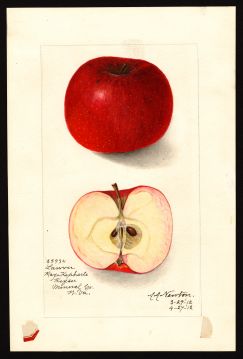 USDA Pomological Watercolor by Newton, Amanda Almira (Keyser, Mineral, West Virginia)
 -
 USDA Pomological Watercolor by Newton, Amanda Almira (Coleman, Kent, Maryland)
 -
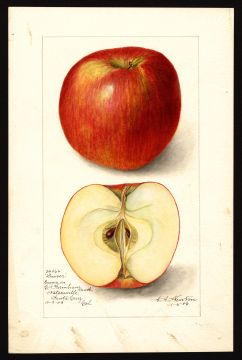 USDA Pomological Watercolor by Newton, Amanda Almira (Watsonville, Santa Cruz, California)
 -
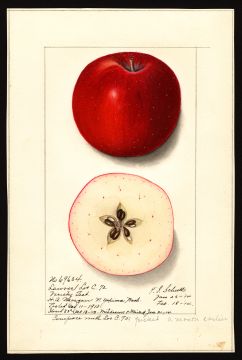 USDA Pomological Watercolor by Schutt, Ellen Isham (Yakima, Yakima, Washington)
 -
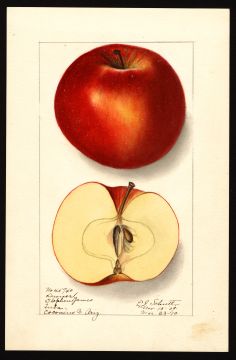 USDA Pomological Watercolor by Schutt, Ellen Isham (Tuba City, Coconino, Arizona)
 -
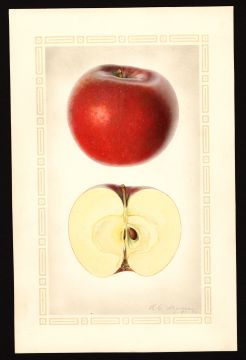 USDA Pomological Watercolor by Steadman, Royal Charles (Cranberry, Avery, North Carolina)
 -
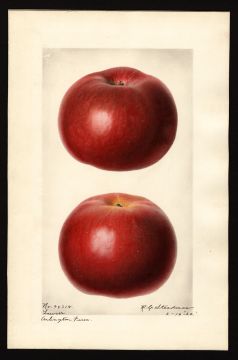 USDA Pomological Watercolor by Steadman, Royal Charles (Arlington, Virginia)


U.S. Department of Agriculture Pomological Watercolor Collection. Rare and Special Collections, National Agricultural Library, Beltsville, MD 20705
Sources
- S.A. Beach, The Apples of New York Vol. 1 (1905). Public domain.
- U.P. Hedrick, Cyclopedia of Hardy Fruits (1922). Public domain.
- J.L. Budd & N.E. Hansen, American Horticultural Manual, Part II: Systematic Pomology (1914). Public domain.
- A.J. Downing, Fruits and Fruit Trees of America (1869). Public domain.
- Granville Lowther (ed.), Encyclopedia of Practical Horticulture (1914). Public domain.
- H.H. Fisher, A Survey of Apple Clones in the United States (USDA ARS, 1963). Public domain.
- John J. Thomas, The American Fruit Culturist (1903). Public domain.
- USDA Pomological Watercolor Collection, U.S. National Agricultural Library.
- 26 historical nursery catalog references (see Variety Finder for the full list).
- Full entry with all citations: Lawver on the Variety Finder
Trees of this Variety in Our Collection
| Orchard | Tag | Condition | |
|---|---|---|---|
| McCoin Upper Tree 42 | McCoin Upper | 42 | good |
| McCoin Upper Tree 43 | McCoin Upper | 43 | good |
| McCoin Upper Tree 44 | McCoin Upper | 44 | good |
| McCoin Upper Tree 45 | McCoin Upper | 45 | fair |