Backhouse's Lord Nelson
Apple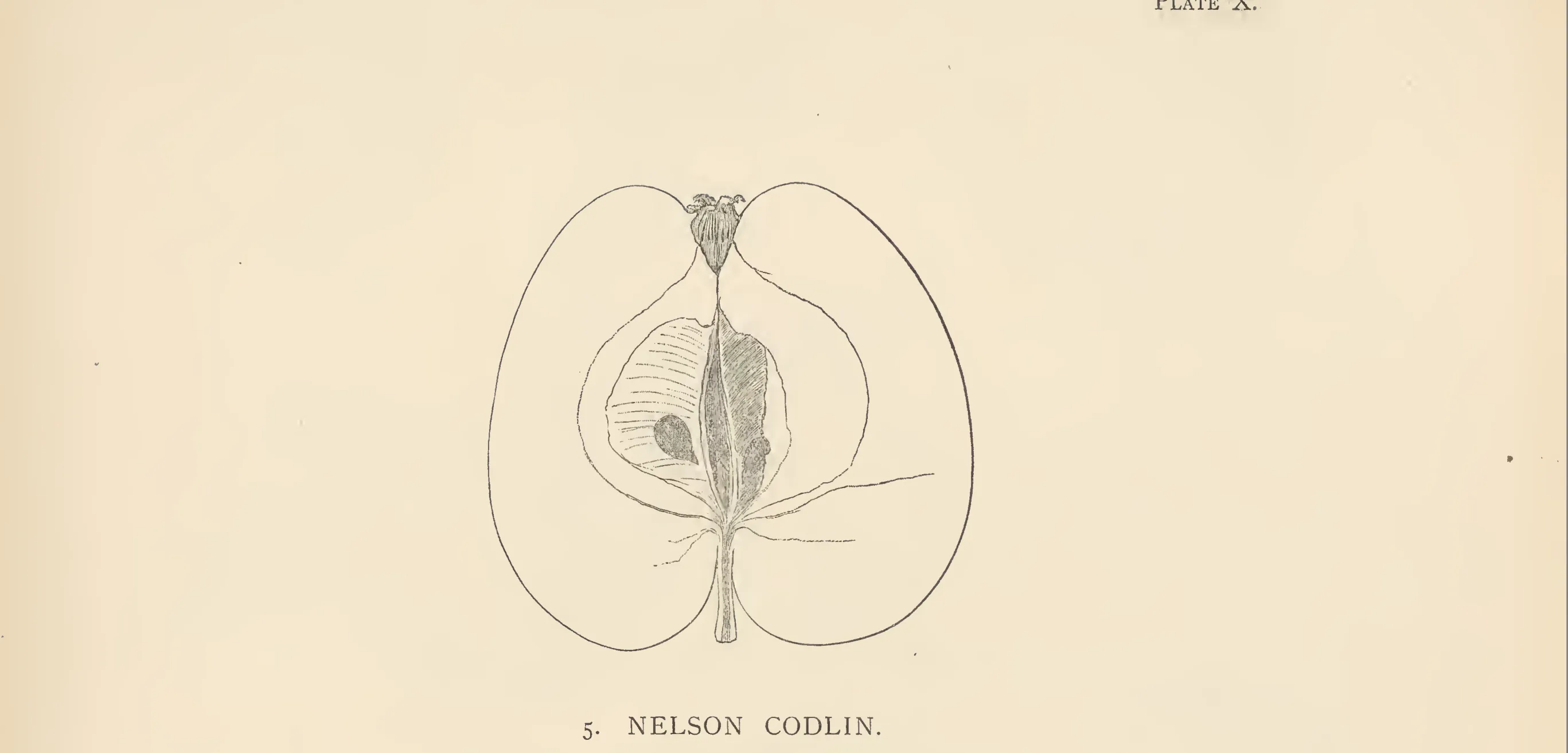
Backhouse's Lord Nelson
Origin/History
Backhouse's Lord Nelson originated in York, England. It was first brought into notice by Mr. John Nelson, a noted Wesleyan preacher in the early days of Wesleyanism, who, while engaged in the work of evangelization in Yorkshire, distributed grafts among his friends; from these circumstances it became known as the Nelson Apple. Mr. Hugh Ronalds, who received it from Mr. Backhouse of York, published it in the Pyrus Malus Brentfordiensis under the name Backhouse's Lord Nelson — a name which the late Mr. James Backhouse disclaimed, saying he preferred that so excellent an apple should rather be the memorial of so excellent a man.
Tree
The tree is a strong, vigorous, and healthy grower, bearing abundantly (Herefordshire Pomona). Bunyard likewise notes vigorous growth and describes it as very fertile, with a medium-sized, oval, sharply bi-serrate leaf. Bunyard further remarks that the tree is remarkable for its magnificent flower.
Fruit
Size
Large and handsome. Bunyard gives dimensions of 3½ inches by 3¼ inches.
Form
The sources vary slightly: the Herefordshire Pomona describes the fruit as conical or oblong; Downing gives roundish conic; Bunyard describes it as oval conical and irregular.
Stem
About a quarter of an inch long (Herefordshire Pomona); Bunyard describes the stem as rather short. Both sources agree the stem is inserted in a deep cavity.
Cavity
Very deep and angular (Herefordshire Pomona); described as uneven by Bunyard.
Calyx
Open, with short segments (Herefordshire Pomona). Bunyard likewise notes the eye as open.
Basin
Deep, plaited, and irregular (Herefordshire Pomona); Bunyard describes it as deep and ribbed.
Skin
On the shaded side, the skin is greenish yellow, strewed with russety specks. When exposed to the sun, it becomes a fine deep yellow, covered with rather large dark spots encircled with a dark crimson ring (Herefordshire Pomona). Downing describes the color as yellowish with a dull green shade. Bunyard gives green to yellow.
Flesh and Flavor
The flesh is yellowish white, delicate, tender, juicy, and sugary (Herefordshire Pomona). Downing agrees it is tender and rates it Good. Bunyard, however, describes the flesh as soft, white, and sub-acid — in contrast to the Herefordshire Pomona's characterization as sugary; both descriptions are recorded here as the sources disagree on this point.
Core and Seeds
Not described in source.
Season
The Herefordshire Pomona gives the season as September to January. Downing gives December to January. Bunyard agrees it keeps until January.
Uses
A very excellent apple; of first-rate quality as a culinary fruit, and also valuable for the dessert (Herefordshire Pomona). Bunyard classifies it primarily as a culinary variety and notes, "Hardly required" — suggesting he considered it largely superseded in the context of a modern collection.
Subtypes/Variants
Not described in source.
Other
Not described in source.
Book Sources
Described in 3 period pomological works
- Downing, Fruits and Fruit Trees of America (1900)
- Bunyard, A Handbook of Hardy Fruits (1920) — listed as NELSON CODLIN
- The Herefordshire Pomona (1876–1885) — listed as Nelson Codlin
Nursery Catalog Sources
Found in 1 catalog (1900)
- Central Experimental Farm , Dominion Department of Agriculture, Agassiz, British Columbia (under test; Bulletin No. 3, Second Series) — 1900 — listed as Nelson Codlin
View original book sources (3)
— Woolhope Naturalists Field Club, The Herefordshire Pomona (1885)
- NELSON CODLIN.
[Syn: Nelson; Nelson's Codlin; Backhouse's Nelson.]
This much esteemed variety was first brought into notice by Mr. John Nelson, a noted Wesleyan preacher in the early days of Wesleyanism, who, while engaged in the work of evangelization in Yorkshire, used to distribute grafts among his friends; from these circumstances it became known as the Nelson Apple. Mr. Hugh Ronalds, who received it from Mr. Backhouse, of York, published it in the Pyrus Malus Brentfordiensis as Backhouse's Lord Nelson, a name which the late Mr. James Backhouse disclaimed, and said he preferred that so excellent an apple should rather be the memorial of so excellent a man.
Description.—Fruit, large and handsome, conical, or oblong. Skin, greenish yellow, strewed with russety specks on the shaded side, but when exposed to the sun, of a fine deep yellow, covered with rather large dark spots, which are encircled with a dark crimson ring. Eye, open, with short segments, set in a deep, plaited, and irregular basin. Stalk, about a quarter of an inch long, inserted in a very deep and angular cavity. Flesh, yellowish white, delicate, tender, juicy, and sugary.
A very excellent apple; of first-rate quality as a culinary fruit, and also valuable for the dessert. It is in season from September to January.
The tree is a strong, vigorous, and healthy grower, and bears abundantly.
— A.J. Downing, The Fruits and Fruit Trees of America (1900)Backhouse's Lord Nelson. Origin, York, England. Tree vigorous. Fruit large, roundish conic, yellowish with dull green shade. Flesh tender. Good. December to January. (Ron.)
— E.A. Bunyard, A Handbook of Hardy Fruits (1920)NELSON CODLIN. Her. Pom., 10. (Backhouse's Lord Nelson, Wilson's Codlin.) Culinary, till January, fairly large, 3½ by 3¼, oval conical, irregular. Colour, green to yellow. Flesh, soft, white, sub-acid. Eye, open in a deep ribbed basin. Stem, rather short in an uneven cavity. Growth, vigorous; very fertile. Leaf, medium, oval, sharply bi-serrate. Origin, named after the Wesleyan preacher Nelson, Hardly required. Remarkable for its magnificent flower.