Baker Sweet
Apple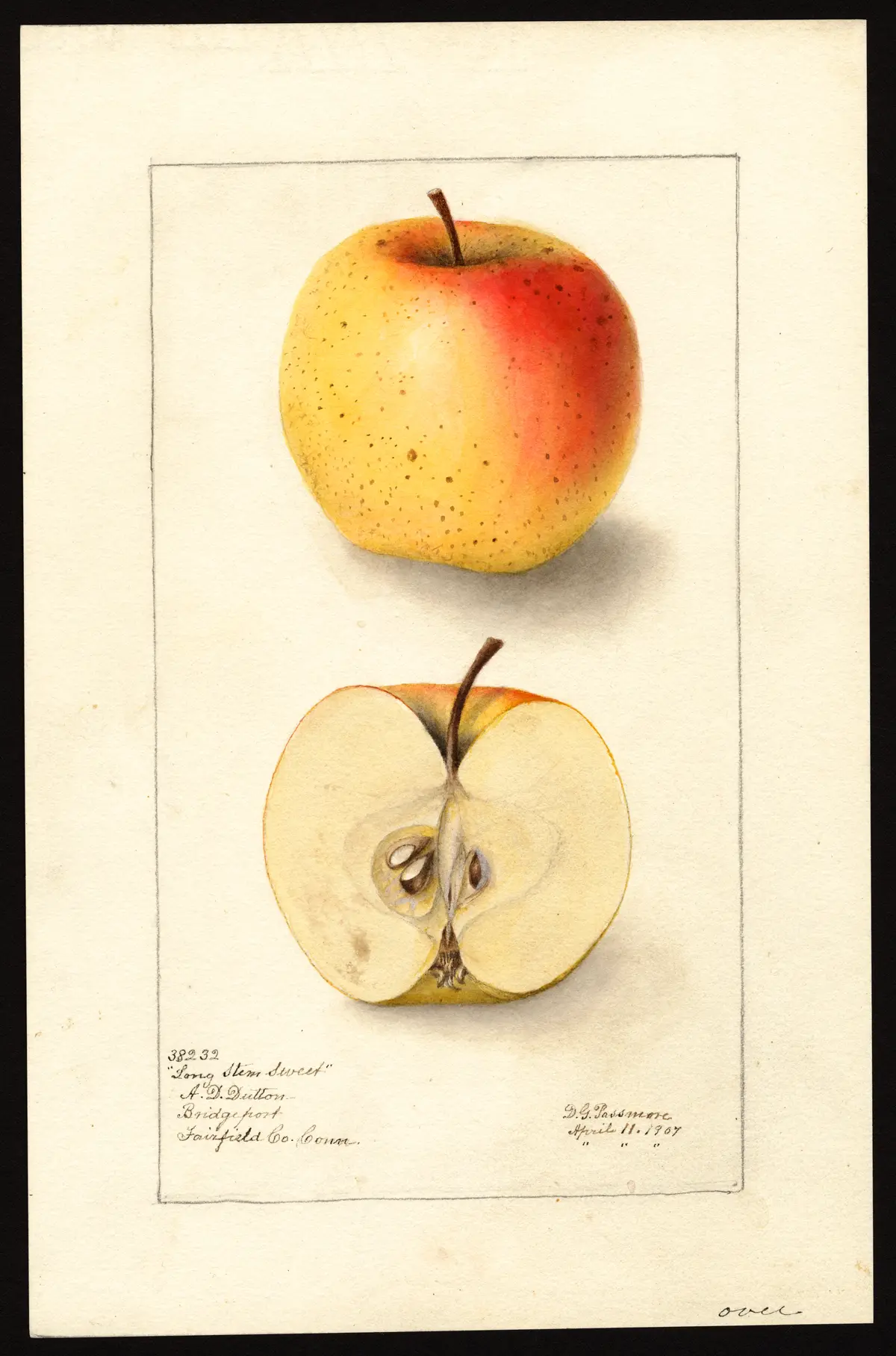
USDA Pomological Watercolor Collection
Baker Sweet
Origin / History
Baker Sweet is an old American variety. Elliott (1865) identifies it as an old fruit of Tolland County, Connecticut. Downing (1900) describes it as an old fruit of Connecticut and Massachusetts, much cultivated there. Beach (1905) records it as an old variety formerly much grown in parts of New England, but little grown in New York state. Beach further notes that because it is sweet, not a late keeper, and drops readily from the tree, it is of little commercial value except where it can be disposed of in local market, notwithstanding that the tree is very productive. It is a good variety for the home orchard where a sweet apple ripening in late autumn is desired.
Tree
Sources differ somewhat on vigor: Elliott describes the tree as a crooked grower and productive. Downing calls it moderately vigorous and slender, somewhat resembling Jonathan, with wood clear reddish brown. Beach describes the tree as medium size, only moderately vigorous or a slow grower, with branches dark, rather slender, somewhat resembling Jonathan (citing Downing). Form spreading. Twigs rather stout. Productive (Elliott, Beach).
Fruit
Size: Above medium (Elliott); medium (Downing, Thomas); large to medium, pretty uniform in size and shape (Beach). Beach also describes it as a golden yellow apple of good size and attractive appearance.
Form: Roundish elongated (Elliott); roundish (Downing, Thomas); roundish to oblate, usually regular (Beach).
Stem: Long (Elliott); stalk long (Downing); short to rather long, rather slender (Beach).
Cavity: Shallow (Elliott); large, smooth (Downing); large, acute to acuminate, deep, rather broad, sometimes partly russeted and with outspreading rays, symmetrical (Beach). Sources thus disagree on depth — Elliott calls it shallow, while Downing and Beach describe it as large/deep.
Calyx: Closed (Elliott, Downing). Beach: calyx pubescent, medium, closed; lobes broad at base, acute. Calyx tube medium, somewhat funnel-shape. Stamens median.
Basin: Rather large (Downing); shallow to moderately deep, narrow to above medium in width, somewhat abrupt, a little furrowed (Beach).
Skin: Golden yellow with some patches of russet (Elliott); golden yellow color, with some patches of russet (Downing); rich yellow (Thomas); moderately thin, tough, nearly smooth except for some patches of russet and conspicuous russet dots, good yellow with shade of brownish-red blush on exposed cheek, prevailing effect good yellow (Beach).
Flesh / Flavor: Yellow, coarse, sweet (Elliott); yellow, rich, exceedingly saccharine and pleasant, good to very good (Downing); rather coarse, rich (Thomas); yellowish, firm, moderately fine, rather tender, rather juicy, very sweet, pleasant, good to very good (Beach). Sources differ on texture — Elliott and Thomas call it coarse, while Beach describes it as moderately fine and rather tender.
Core / Seeds: Core large (Elliott). Beach: core above medium to large, abaxile; cells open, sometimes unsymmetrical; core lines meeting. Carpels very broadly ovate to roundish, tufted. Seeds dark, medium to rather small, plump, acute, tufted.
Season
November and December (Elliott, Downing). Early winter (Thomas). October to December (Beach). Beach notes it is not a late keeper and drops readily from the tree.
Uses
Baking (Elliott). Recommended for the home orchard where a sweet apple ripening in late autumn is desired; of little commercial value except in local market (Beach).
Subtypes / Variants
Not described in source.
Other
Not described in source.
Book Sources
Described in 4 period pomological works
- Beach, The Apples of New York Vol. 2 (1905)
- Thomas, The American Fruit Culturist (1903)
- Downing, Fruits and Fruit Trees of America (1900) — listed as Baker's Sweet
- Elliott, The Western Fruit Book (1865) — listed as Baker's Sweet
Nursery Catalog Sources
Found in 4 catalogs (1891–1912) from Alabama, Illinois, Missouri, Washington
- Missouri Nursery Co. , Louisiana , Missouri — 1891 — listed as Winter Golden Sweet
- J.V. Cotta (Cotta Nursery) , Carroll County , Illinois — 1898 — listed as Winter Golden Sweet
- Alabama Nursery Co. , Huntsville , Alabama — 1900 — listed as Winter Golden Sweet
- Vineland Nurseries Company , Clarkston , Washington — 1912 — listed as Winter Golden Sweet
View original book sources (4)
— F.R. Elliott, The Western Fruit Book (1865)Baker's Sweet. Long Stem Sweet, | Late Golden Sweet, White Golden Sweet. An old fruit of Tolland County, Conn. Tree, crooked grower, productive. Fruit, above medium, roundish elongated ; golden yellow, some patches of russet ; stem, long ; cavity, shallow ; calyx, closed ; flesh, yellow, coarse, sweet ; baking ; core, large. November and December.
— A.J. Downing, The Fruits and Fruit Trees of America (1900)Baker's Sweet. Winter Golden Sweet. Long Stem Sweet. Late Golden Sweet. An old fruit of Connecticut and Massachusetts, and much cultivated there. Tree moderately vigorous, slender, somewhat resembling Jonathan. Wood clear reddish brown. Fruit medium, roundish, of a golden yellow color, with some patches of russet. Stalk long, inserted in a large smooth cavity. Calyx closed. Rather large basin. Flesh yellow, rich, exceedingly saccharine and pleasant. Good to very good. November, December.
— John J. Thomas, The American Fruit Culturist (1903)White Golden Sweet. See Baker's Sweet.
[Additional entry in this volume: "Baker's Sweet", pp. 716–716]
Baker's Sweet, or Winter Golden Sweet. Medium, roundish, rich yellow; rather coarse, rich. Early winter. Conn.
— S.A. Beach, The Apples of New York, Vol. 2 (1905)BAKER SWEET.
REFERENCES. 1. Downing, 1857:117. 2. Warder, 1867:712. 3. Thomas, 1875:492.
SYNONYMS. BAKER SWEET (2, 3). BAKER'S SWEET (1). Late Golden Sweet (1). Long Stem Sweet (1). Winter Golden Sweet (1, 3).
A golden yellow apple of good size and attractive appearance. Because it is sweet, not a late keeper and drops readily from the tree it is of little commercial value except where it can be disposed of in local market, notwithstanding that the tree is very productive. It is a good variety for the home orchard where a sweet apple, ripening in late autumn, is desired.
Historical. This is an old variety, formerly much grown in parts of New England (1). It is but little grown in New York state.
TREE.
Tree medium size, only moderately vigorous or a slow grower; branches dark, rather slender, somewhat resembling Jonathan (1). Form spreading. Twigs rather stout.
FRUIT.
Fruit large to medium, pretty uniform in size and shape. Form roundish to oblate, usually regular. Stem short to rather long, rather slender. Cavity large, acute to acuminate, deep, rather broad, sometimes partly russeted and with outspreading rays, symmetrical. Calyx pubescent, medium, closed; lobes broad at base, acute. Basin shallow to moderately deep, narrow to above medium in width, somewhat abrupt, a little furrowed. Skin moderately thin, tough, nearly smooth except for some patches of russet and conspicuous russet dots, good yellow with shade of brownish-red blush on exposed cheek. Prevailing effect good yellow. Calyx tube medium, somewhat funnel-shape. Stamens median.
Core above medium to large, abaxile; cells open, sometimes unsymmetrical; core lines meeting. Carpels very broadly ovate to roundish, tufted. Seeds dark, medium to rather small, plump, acute, tufted.
Flesh yellowish, firm, moderately fine, rather tender, rather juicy, very sweet, pleasant, good to very good.
Season October to December.