Belle de Boskoop
Apple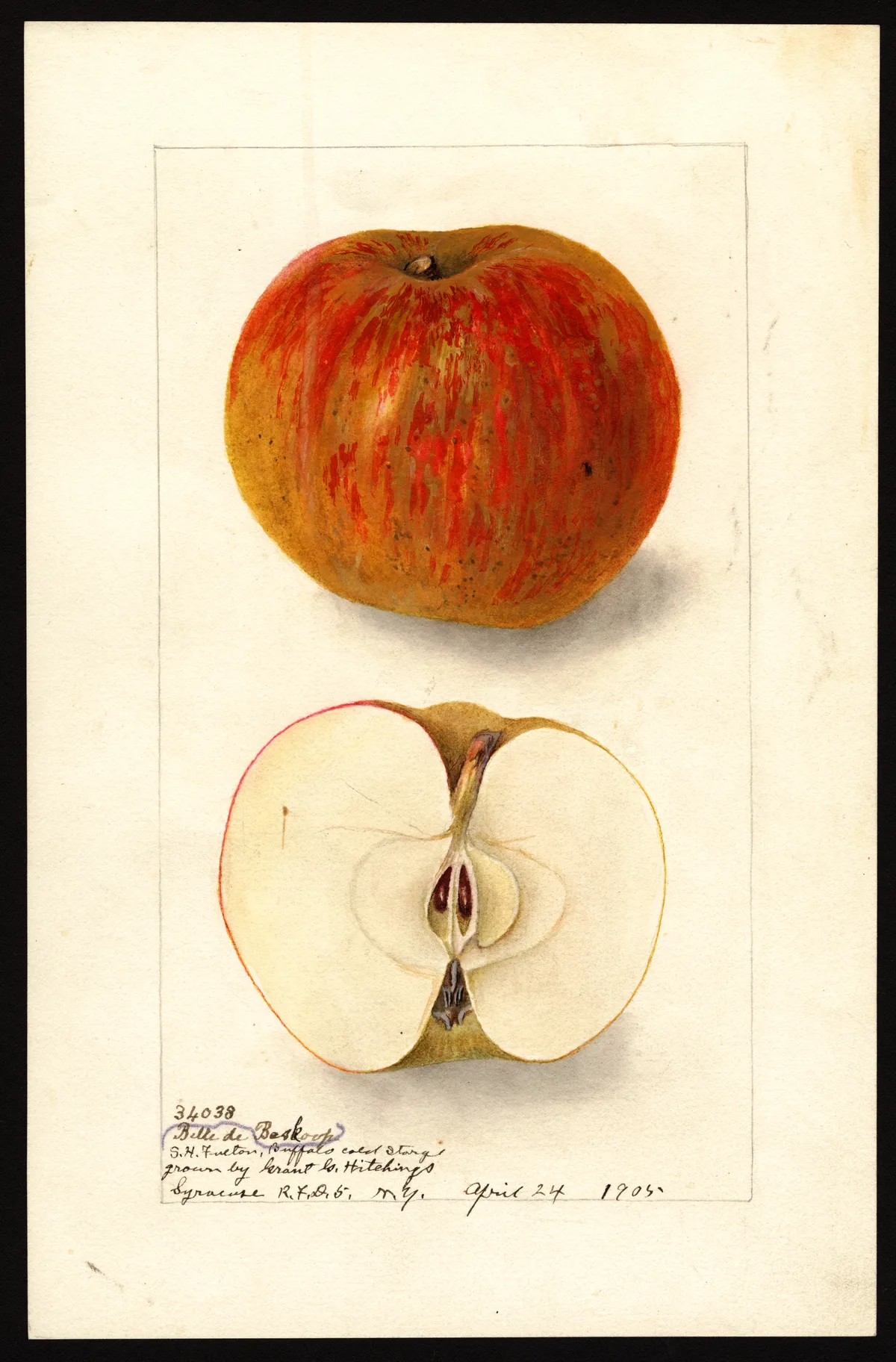
USDA Pomological Watercolor Collection
Belle de Boskoop
Origin/History
Said to be of Russian origin. Downing received trees from France and described it as a new variety at the time of his writing. Thomas likewise notes it as Russian.
Tree
Vigorous and spreading in habit. Comes into bearing moderately early and produces abundantly, though bearing is alternate — good crops in alternate years rather than annually. Described by Downing as a promising variety.
Fruit
Size: Downing describes the fruit as medium to large; Thomas as above medium.
Form: Downing: oblate to roundish oblate, sometimes a little oblique. Thomas describes it as roundish.
Stem: Short and small (Downing).
Cavity: Rather large, often russeted, the russet sometimes extending outward in rays onto the surface of the fruit (Downing).
Calyx: Closed, or partially open (Downing).
Basin: Large, round, deep, slightly corrugated (Downing).
Skin: Yellow ground, shaded with light and dark red over nearly the whole surface, with some rather obscure stripes and splashes on the shaded side. Some specimens more or less mixed with russet. Many small and large yellowish-brown dots present, including some irregular ones (Downing). Thomas agrees: shaded and obscurely striped red on yellow skin.
Flesh and Flavor: A little coarse, crisp, tender, and juicy; brisk subacid, rich, and of very good quality (Downing). Thomas confirms: crisp, juicy, brisk sub-acid, rich, very good.
Core and Seeds: Small and close (Downing).
Season
February to April (Downing). Late winter (Thomas) — consistent.
Uses
Keeps well. Described as a promising variety for its combination of size, quality, and keeping ability.
Subtypes/Variants
Not described in source.
Other
Not described in source.
Book Sources
Described in 2 period pomological works
Nursery Catalog Sources
Found in 15 catalogs (1893–1921) from California, England, Illinois, Oregon, Washington
- Sherwood Hall Nursery Co. , Timothy Hopkins (Menlo Park Nurseries), San Francisco / Menlo Park , California — 1893
- Kelway & Son , Langport, Somerset , England — 1897
- George Bunyard & Co. , Royal Nurseries, Maidstone, Kent , England — 1900
- Washington Nursery Co. , Toppenish , Washington — 1901
- Phoenix Nursery Company (W. E. Rossney , President; Sidney Tuttle, Vice-President), Bloomington , Illinois — 1904
- Washington Nursery Company , Toppenish , Washington — 1909
- James Veitch & Sons , Ltd., Royal Exotic Nursery, Chelsea, London (also Coombe Wood, Langley, and Feltham) , England — 1911
- Pacific Nursery Company , Portland , Oregon — 1912
- Vineland Nurseries Company , Clarkston , Washington — 1912
- Washington Nursery Company , Toppenish , Washington — 1912
- Thomas Rivers & Son , Sawbridgeworth, Hertfordshire , England — 1913
- George Bunyard & Co. , Royal Nurseries, Maidstone, Kent , England — 1914
- Union Nurseries , J.B. Weaver & Sons, Union , Oregon — 1915
- George Bunyard & Co. , Royal Nurseries, Maidstone, Kent , England — 1917
- Benedict Nursery Co. , Portland , Oregon — 1921
View original book sources (2)
— A.J. Downing, The Fruits and Fruit Trees of America (1900)Belle de Boskoop.
A new variety, trees of which I received from France; it is said to be of Russian origin. Tree vigorous, spreading, comes into bearing moderately early, and produces abundantly alternate years of fair fruit, good size, very good quality; keeps well, and is a promising variety.
Fruit medium to large, oblate to roundish oblate, sometimes a little oblique; skin yellow, shaded with light and dark red over nearly the whole surface, with some rather obscure stripes and splashes on the shaded side, some specimens more or less mixed with russet, and many small and large yellowish-brown dots, with some irregular ones; stalk short, small; cavity rather large, often russeted sometimes extending in rays out on the fruit; calyx closed, or partially open; basin large, round, deep, slightly corrugated; flesh a little coarse, crisp, tender, juicy, brisk subacid, rich, and of very good quality; core small and close. Season February to April.
— John J. Thomas, The American Fruit Culturist (1903)Belle de Boskoop. Above medium, roundish, shaded and obscurely striped red on yellow skin; crisp, juicy, brisk sub-acid, rich, very good. Late winter. Russian.