Bergamotte Rouge
Pear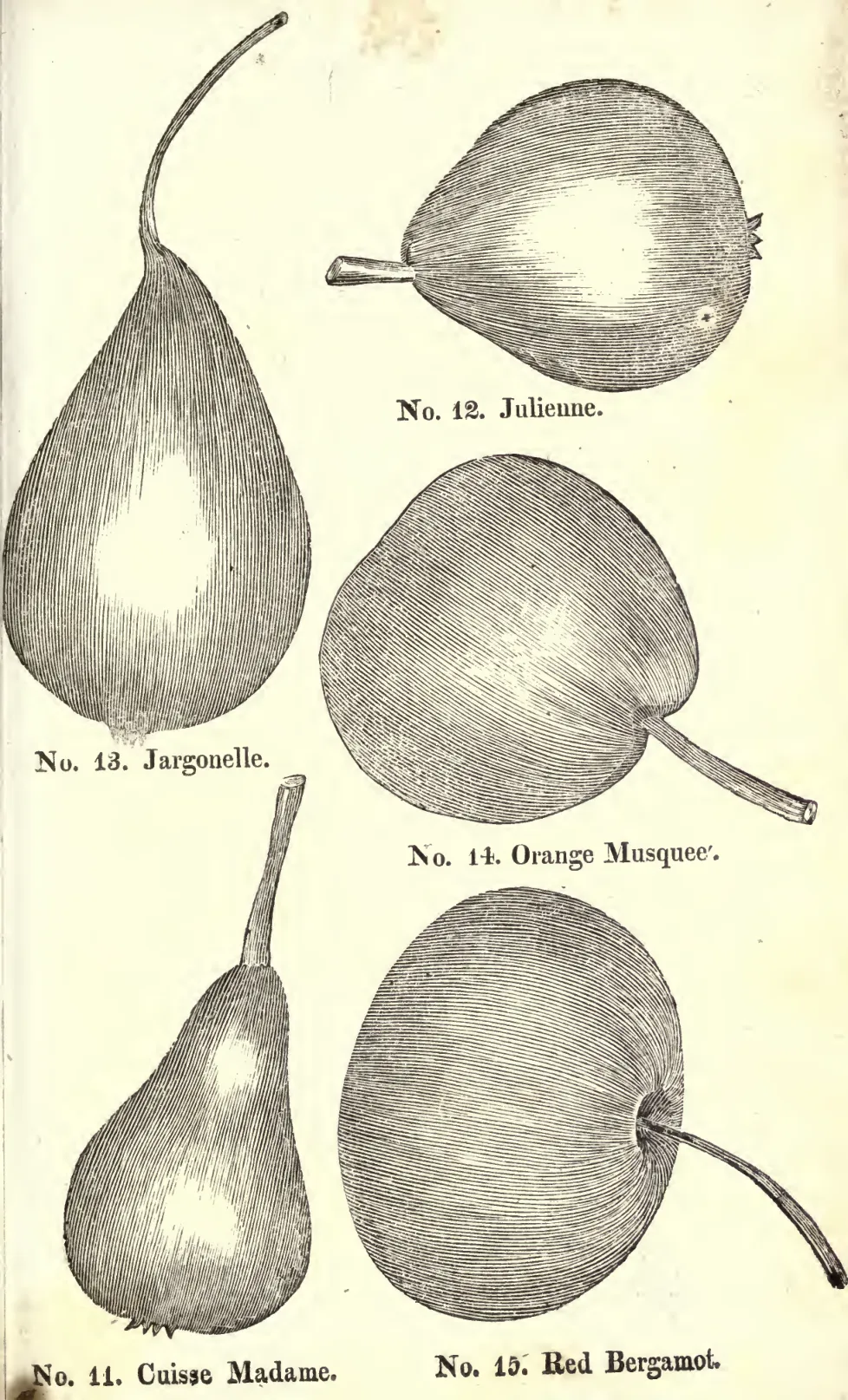
Bergamotte Rouge
Origin / History
Of ancient and unknown origin. Mentioned by Le Lectier in 1628, Merlet in 1675, and Duhamel in 1768, but without history; Hedrick cites Duhamel (Traité des arbres fruitiers, 2:162, Pl. XIX, fig. 6, 1768) and Lindley (Guide to the Orchard and Kitchen Garden, 334, 1831). Coxe (1817) and Downing (1900) list it as "Red Bergamot." Downing calls it "A very old Pear, of little value."
Tree
Vigorous in growth and large in size. Does not bear while young; when more advanced a great bearer (Coxe).
Fruit
Size: Below medium (Downing) to rather large (Hedrick). Coxe: sometimes large, but usually of moderate size.
Form: Round, flattened at both ends (Coxe); roundish, sometimes obovate acute pyriform (Downing); globular, acute-pyriform, irregular, mammillate at the calyx (Hedrick).
Stem: Very long (Coxe).
Cavity: Not described in source.
Calyx: Not described in source.
Basin: Not described in source.
Skin: Ground pale yellow, yellow, or greenish yellow. Cheek next the sun a lively red (Coxe), mostly overspread with dull red in the sun (Downing), or washed with brownish red and marked with stripes of the same color (Hedrick). Hedrick adds that the whole is covered with fine, delicate, cinnamon-colored russet.
Dots: Small russet spots (Coxe); large, gray dots sprinkled over the russet (Hedrick).
Flesh and flavor: Flesh white, coarse, tender (Coxe), soft, melting, gritty (Hedrick). Juicy, very full of juice (Coxe); "juice sufficient" (Hedrick). Sweet, sugary, with a slight musky perfume (Hedrick); "of a fine flavour, rich, and sprightly" (Coxe).
Core and seeds: Not described in source.
Season
August (Coxe); September (Downing, Hedrick).
Uses
"First for both table and kitchen" (Hedrick).
Subtypes / Variants
Not described in source.
Other
Not described in source.
Book Sources
Described in 3 period pomological works
- Hedrick, The Pears of New York (1921)
- Coxe, A View of the Cultivation of Fruit Trees (1817) — listed as Red Bergamot
- Downing, Fruits and Fruit Trees of America (1900) — listed as Red Bergamot
Nursery Catalog Sources
Found in 1 catalog (1900)
- Central Experimental Farm , Dominion Department of Agriculture, Agassiz, British Columbia (under test; Bulletin No. 3, Second Series) — 1900
View original book sources (3)
— William Coxe, A View of the Cultivation of Fruit Trees (1817)
- RED BERGAMOT.
This fruit is sometimes large, but usually of a moderate size ; the form round, flattened at both ends ; the stalk very long, the flesh coarse and tender ; very full of juice, of a fine flavour, rich, and sprightly ; the skin is yellow, the cheek next the Sun of a lively red, dotted with small russet spots ; the time of ripening in August ; the tree is of vigorous growth, and large size ; it does not bear while young, but when more advanced is a great bearer.
— A.J. Downing, The Fruits and Fruit Trees of America (1900)Red Bergamot.
Bergamotte Rouge. Du Colombier. Bergamotte Musquée. De Sicile Musquée. De Sicile. Crassane d'Été. Petit Muscat d'Automne. Bergamotte Dorée.
A very old Pear, of little value.
Fruit below medium, roundish, sometimes obovate acute pyriform, pale yellow, mostly overspread with dull red in sun. Flesh soft, melting, juicy, sweet. September.
— U.P. Hedrick, The Pears of New York (1921)Bergamotte Rouge.
- Duhamel Trait. Arb. Fr. 2:162, Pl. XIX, fig. 6. 1768.
- Lindley Guide Orch. Card. 334. 1831.
This pear is of ancient and unknown origin. It was mentioned by Le Lectier in 1628, Merlet in 1675, and Duhamel in 1768, but without history. Fruit rather large, globular, acute-pyriform, irregular, mammillate at calyx, greenish-yellow, washed with brownish-red on the side next the sun, and marked with stripes of the same color, the whole covered with fine, delicate, cinnamon-colored russet, sprinkled with large, gray dots; flesh white, coarse, melting, gritty; juice sufficient, with a slight musky perfume, sugary; first for both table and kitchen; Sept.