Beurré Blanc Des Capucines
Pear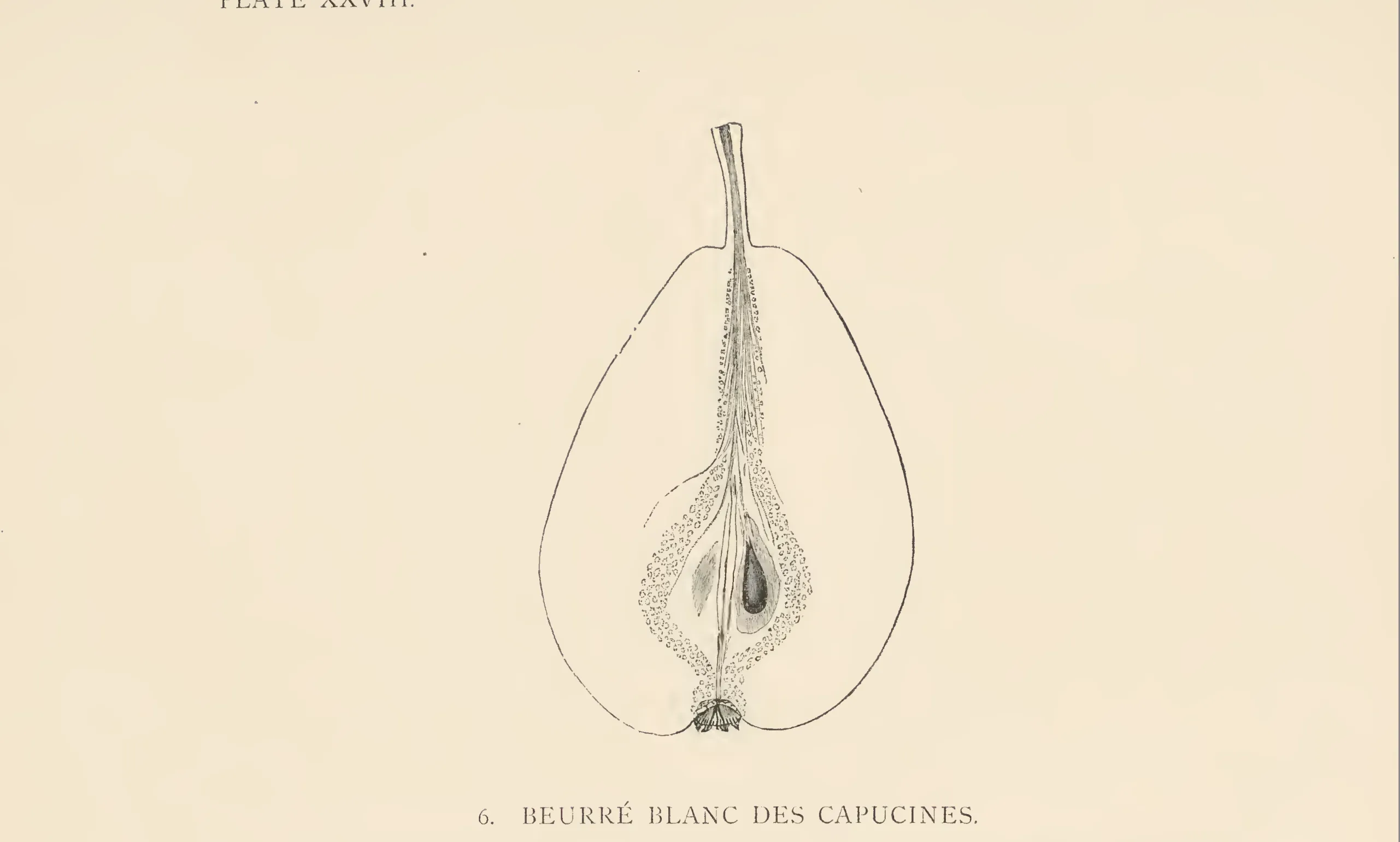
Beurré Blanc Des Capucines
Origin / History
A French pear, confused by many French pomologists with the Amadotte. M. Decaisne figures it as such in the 'Jardin Fruitier du Muséum,' but it is evidently not the Amadotte of Merlet, Miller, Forsyth, and Diel; that is roundish and flattened, while Beurré Blanc Des Capucines is a long pyramidal-shaped fruit. M. Tougard has an Amadotte Blanc, which he makes synonymous with Beurré Blanc des Capucines, and M. Decaisne made the mistake of adopting this as the variety described by Merlet. Jahn, following Decaisne, identifies Beurré Blanc Des Capucines with the Amadotte, which he calls Herbst Amadotte; but Dr. Hogg has shown that there are, without doubt, two distinct varieties. Tougard, Prevost, Decaisne, and Jahn have taken Beurré Blanc Des Capucines for the true Amadotte, and the confusion still exists in the French orchards. It was sent as the true Amadotte by M. Benoit, of Havre, amidst a very fine collection of the best varieties of pears, to the Apple and Pear Show of the Woolhope Club in October 1880.
Tree
Not described in source.
Fruit
Size: Large and handsome.
Form: Somewhat oval, even and regular in outline; described elsewhere as a long pyramidal-shaped fruit.
Stem: Upwards of an inch in length, woody, inserted in a small round cavity.
Cavity: Small, round.
Calyx: Eye small and half open.
Basin: Not described in source.
Skin: Smooth, dull yellow with a greenish tinge, strewed with flakes of russet, and a russet patch round the stalk.
Dots: Not described in source.
Flesh and flavor: Yellowish, coarse-grained and gritty, half melting or crisp, with a cold acidity. Neither Tougard, Decaisne, nor Jahn takes notice of the remarkably high, musky flavor of the fruit; Tougard says "it is slightly acid and astringent," and Jahn that "it has neither perfume nor flavour," characters which agree with Beurré Blanc Des Capucines, not with Amadotte. Far inferior to the true Amadotte.
Core and seeds: Not described in source.
Season
Ripens in October. Must be eaten directly it is ripe, or it will rot at the core.
Uses
Not worth cultivating; inserted in the Pomona to correct an error of Decaisne.
Subtypes / Variants
Not described in source.
Other
Not described in source.
Book Sources
Described in 1 period pomological work
View original book sources (1)
— Woolhope Naturalists Field Club, The Herefordshire Pomona (1885)
- BEURRÉ BLANC DES CAPUCINES.
This French Pear has been confused by many French pomologists, with the Amadotte. M. Decaisne figures it as such in the 'Jardin Fruitier du Muséum,' but it is evidently not the Amadotte of Merlet, Miller, Forsyth, and Diel. This is a long pyramidal-shaped fruit, whilst the true variety is roundish and flattened. M. Tougard has an Amadotte Blanc, which he makes synonymous with Beurré Blanc des Capucines, and M. Decaisne made the mistake of adopting this as the variety described by Merlet. Jahn, following Decaisne, identifies Beurré Blanc des Capucines with the Amadotte, which he calls Herbst Amadotte; but Dr. Hogg has shown that there are, without doubt, two distinct varieties. Neither Tougard, Decaisne, nor Jahn, take notice of the remarkably high, musky flavour of the fruit; but on the contrary, the former says, 'it is slightly acid and astringent;' and the latter, that 'it has neither perfume nor flavour;' characters which agree with Beurré Blanc des Capucines, but not with Amadotte. It is quite evident that Tougard, Prevost, Decaisne, and Jahn, have taken Beurré Blanc des Capucines for the true Amadotte; and the confusion still exists in the French orchards.
Description.—Fruit: large and handsome; somewhat oval, even and regular in its outline. Skin: smooth, of a dull yellow colour, with a greenish tinge, strewed with flakes of russet, and with a russet patch round the stalk. Eye: small and half open. Stalk: upwards of an inch in length, woody, inserted in a small round cavity. Flesh: yellowish, coarse-grained and gritty, half melting or crisp, with a cold acidity.
This Pear is far inferior to the true Amadotte. It ripens in October, and must be eaten directly it is ripe, or it will rot at the core. It is not worth cultivating, and is inserted here to correct once again an error of Decaisne, which was first pointed out by Dr. Hogg—an error which still prevails in France—for it was sent as the true Amadotte by M. Benoit, of Havre, amidst a very fine collection of the best varieties of Pears, to the Apple and Pear Show of the Woolhope Club in October 1880.