Boiken
Apple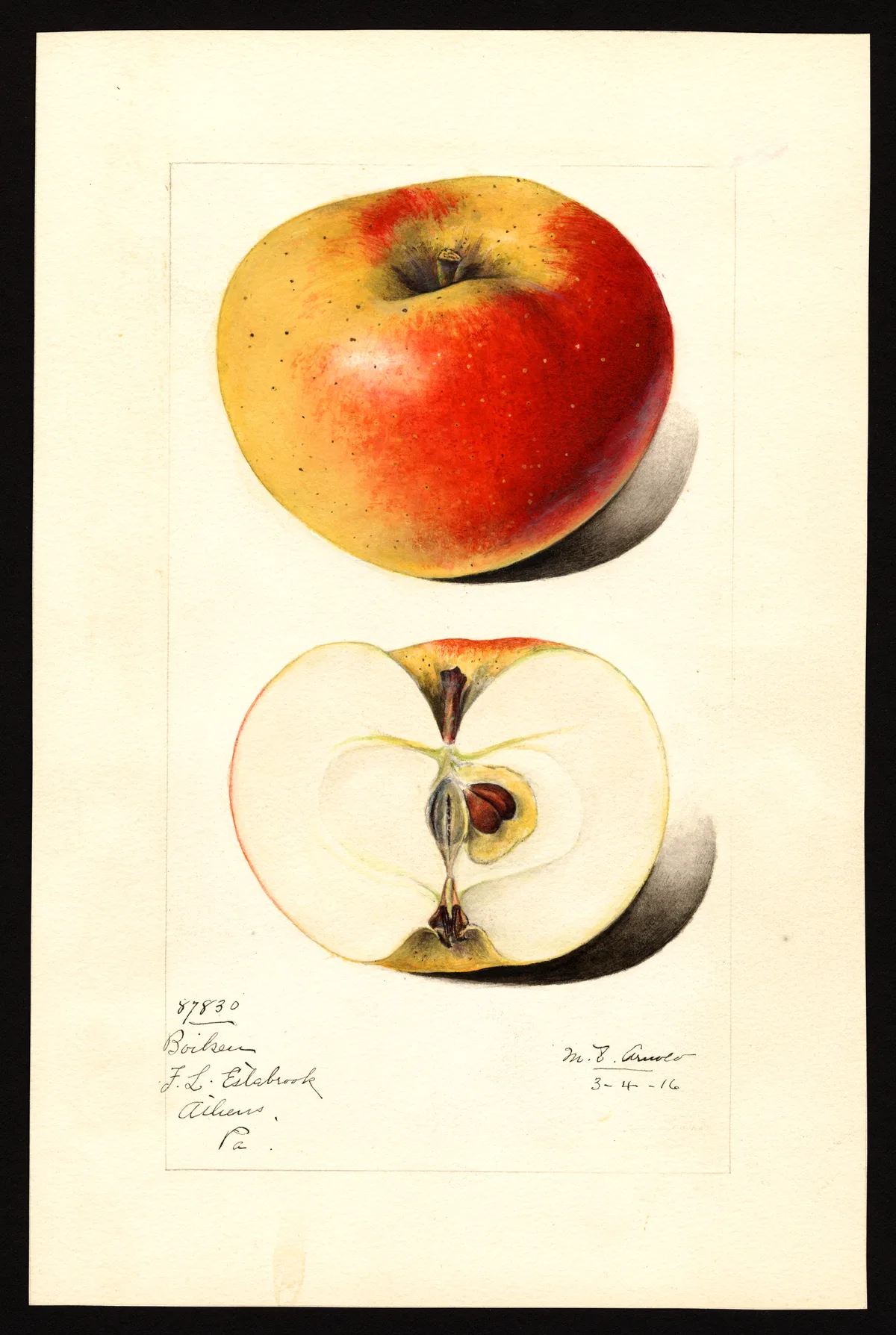
USDA Pomological Watercolor Collection
Boiken
Origin / History
A German variety, long known in cultivation in Prussia, and said to have been named after a former dike warden. Hansen gives his name as Dike-warden Boike, of Germany. Beach's references include Oberdieck (1859), Berghuis (1868, colored plate), Leroy (1873), Lauche (1882, colored plate), Bredsted (1893) and Eneroth-Smirnoff (1901). His American references begin in 1892 with Budd at the Iowa station and Bailey.
The route to America is given two ways. Budd and Hansen (1914) state that the tree was received from Russia, and Thomas classes it as Russian. Hedrick says it came to America from Germany. Beach (1905) says it had been quite extensively disseminated in this country within the last decade, having been introduced some years earlier. Stark Bros. calls it "an old variety of German origin, not long known in this country."
Beach calls it "justly regarded as one of the most valuable of the recent introductions for growing in commercial orchards." His reasons are the vigor and health of the foliage, the hardiness and productiveness of the tree, and the desirable size, attractive appearance and fairly good quality of the fruit. He adds that plantings in New York commercial orchards were being gradually extended. Stark Bros. (1910) reports it "proving valuable throughout the country."
Hedrick (1922) calls it "one of the marvels of the American horticultural press at the close of the nineteenth century." He says it was heralded chiefly for the vigor, health, productiveness and hardiness of the trees and, "more than all else, the early bearing habit of the trees." By his account the variety was then "falling into disrepute," grown chiefly in cold regions and where an early-bearing sort is wanted.
Tree
Tree moderately vigorous, hardy (Stark: "very hardy"; "good tree"). Branches short, stout and crooked. Form somewhat spreading, rather dense. Twigs medium in length or rather long, curved, pretty stout, especially at the tips; internodes short to medium. Bark brownish-red, streaked and conspicuously blotched with grayish scarf-skin; pubescent. Lenticels scattering, rather conspicuous, moderately abundant, irregular in shape and size, often large, oblong, sometimes roundish. Buds large or above medium size, broad, rather plump, obtuse to nearly acute, projecting, free, pubescent.
Leaves large, broad. Hedrick finds them distinctive for their great size and rich green color, and calls them immune to apple-scab. Beach calls the foliage remarkably healthy. Comes into bearing rather young; productive, a good, reliable cropper.
Fruit
Size: Medium to very large; rather uneven in size. Hansen and Thomas call it medium; Beach gives above medium to very large and calls the size desirable.
Form: Oblate to somewhat oblate, conical, broad at the base, often somewhat ribbed, pretty symmetrical; fairly uniform in shape. Thomas gives roundish conic.
Stem: Long to medium; Hansen calls it long. Thomas alone calls it short.
Cavity: Wide to very broad, deep, obtuse to acute, partly colored with thin brownish russet, radiating. Hansen calls it regular; Beach calls it furrowed and sometimes compressed. Thomas calls it large.
Calyx: Large, closed or somewhat open; lobes acute. Calyx tube large, funnel-form or approaching cone-shape, often extending to the core; Hansen calls it conical. Stamens median.
Basin: Furrowed and wrinkled, abrupt, sometimes oblique; medium deep to moderately deep. Hansen calls it wide and Thomas large, while Beach gives moderately wide to rather narrow.
Skin: Tough, smooth, waxy, clear bright pale yellow, often with a sharply contrasting brilliant pinkish-red blush; Hansen says only "sometimes with blush." Thomas gives yellowish green, reddened on the sunny side. Prevailing effect yellow relieved more or less by pinkish-red, not striped. A very attractive apple, decidedly so for a yellow apple, with a beautiful blush.
Dots: Numerous, minute to rather small, not very conspicuous, often submerged. Hansen calls them very obscure and white. Beach finds them often red areolar, with whitish or russet center.
Flesh and flavor: White, firm, crisp, tender, fine-grained, juicy to very juicy. Flavor sprightly, rather brisk subacid; Hansen calls it "refreshing subacid," and Thomas calls the flesh acid. Beach finds it "hardly rich enough in quality or mild enough in flavor to excel as a dessert fruit." Hedrick calls the fruit "so austere as to be hardly fit to eat out of hand."
Beach gives "not high in quality, good" and elsewhere "fairly good quality," and Stark "good quality." Hansen alone gives "very good."
Core and seeds: Core rather large, abaxile, open or partly so. Cells round (Hansen), usually symmetrical (Beach). Core lines clasping. Carpels decidedly concave, very broad, elliptical, slightly emarginate, tufted. Seeds dark, obtuse to acute; short, round and few (Hansen), medium and plump (Beach).
Season
Winter. A late keeper: "very late keeper" (Thomas), "a splendid keeper" (Stark). Beach gives November to February or March, and in cold storage to May or later. He finds it apparently better adapted than Rhode Island Greening for storage.
Uses
Culinary and market. Thomas calls it a good culinary apple, and Beach desirable for culinary use and for market. Hedrick holds that "even cooking does not sufficiently take away the sourness." In demand at evaporators; it makes very light colored evaporated stock. Stark recommends it for home orchard and commercial planting.
Subtypes / Variants
Not described in source.
Other
Thomas figures it (Fig. 456). The Stark entry carries the code "NNCS."
Book Sources
Described in 6 period pomological works
Nursery Catalog Sources
Found in 10 catalogs (1900–1921) from Illinois, Missouri, Oregon, Washington
- Central Experimental Farm , Dominion Department of Agriculture, Agassiz, British Columbia (under test; Bulletin No. 3, Second Series) — 1900
- Benjamin Buckman (personal inventory) , Farmingdale , Illinois — 1901
- Stark Bros. Nurseries & Orchards Co. , Louisiana , Missouri — 1906
- Stark Bros. Nurseries & Orchards Co. , Louisiana , Missouri — 1910
- Stark Bros. Nurseries & Orchards Co. , Louisiana , Missouri — 1911
- Stark Bros. Nurseries & Orchards Co. , Louisiana , Missouri — 1912
- Vineland Nurseries Company , Clarkston , Washington — 1912
- Benjamin Buckman (personal inventory) , Farmingdale , Illinois — 1913
- Union Nurseries , J.B. Weaver & Sons, Union , Oregon — 1915
- Benedict Nursery Co. , Portland , Oregon — 1921
View original book sources (6)
— N.E. Hansen, A Study of Northwestern Apples (1902)Boiken-Named after Dike-warden Boike of Germany-Fruit medium, oblate conical; surface smooth, clear yellow, sometimes with blush ; dots very obscure, many, minute, white; cavity wide, regular, deep, obtuse, with radiating russet; stem long; basin wide, medium deep, wrinkled; calyx open or closed. Core open ; cells round ; tube conical; stamens median; seeds short, round, few; flesh white, firm, juicy, fine grained, sprightly, refreshing subacid, very good. Winter.
— John J. Thomas, The American Fruit Culturist (1903)Boiken. Medium, roundish conic; yellowish green, reddened on sunny side, cavity large; stem short; basin large; flesh white, acid. Very late keeper, good culinary apple. Fig. 456. Russian.
— S.A. Beach, The Apples of New York, Vol. 1 (1905)BOIKEN.
REFERENCES. 1. Oberdieck, Ill. Handb. der Obstk., 1:212. 1859. 2. Berghuis, 1868: col. pl. No. 80. 3. Leroy, 1873:144. 4. Lauche, 1: col pl. No. 5. 1882. 5. Budd, Ia. Sta. Bul., 19:542. 1892. 6. Bailey, An. Hort., 1892:235. 7. Bredsted, 1893:205. 8. Bronson, W. N. Y. Hort. Soc., 1893:113. 9. Troop, Ind. Sta. Bul., 53:124. 1894. 10. Buckman, Rural N. Y., 54:806. 1895. 11. Willard, Rural N. Y., 55:751. 1896. 12. Thomas, 1897:288. fig. 13. Rural N. Y., 57:285. 1898. 14. Ia. Sta. Bul., 41:70, 85. 1899. 15. Rural N. Y., 60:342. 1901. 16. Eneroth-Smirnoff, 1901:274. 17. Hansen, S. D. Sta. Bul., 76:33. 1902. 18. Munson, Me. Sta. Bul., 82:89. 1902. 19. Budd-Hansen, 1903:53. 20. Beach and Clark, N. Y. Sta. Bul., 248:113. 1904.
SYNONYMS. BOIKEN APFEL (2, 4). BOIKENAPPLE (16).
This is a very attractive, bright yellow apple, usually with a beautiful blush. It is justly regarded as one of the most valuable of the recent introductions for growing in commercial orchards, on account of the vigor and health of the foliage, hardiness and productiveness of the tree, and the desirable size, attractive appearance and fairly good quality of the fruit. Its flavor is a rather brisk subacid. It is hardly rich enough in quality or mild enough in flavor to excel as a dessert fruit, but it is desirable for culinary use and for market. It appears to be better adapted than Rhode Island Greening for storage (20). It makes very light colored evaporated stock. The tree comes into bearing rather young and is a good, reliable cropper.
The foliage is remarkably healthy and the fruit is pretty resistant to the scab.
Historical. This is a German variety which has long been known under cultivation in Prussia (1, 2). It is said to have been named after a former dike warden (4). It has been quite extensively disseminated in this country within the last decade, having been introduced some years earlier (8). In New York commercial orchards the plantings of it are now being gradually extended.
TREE. Tree moderately vigorous; branches short, stout and crooked. Form somewhat spreading, rather dense. Twigs medium in length or rather long, curved, pretty stout, especially at the tips; internodes short to medium. Bark brownish-red, streaked and conspicuously blotched with grayish scarf-skin; pubescent. Lenticels scattering, rather conspicuous, moderately abundant, irregular in shape and size, often large, oblong, sometimes roundish. Buds large or above medium size, broad, rather plump, obtuse to nearly acute, projecting, free, pubescent. Leaves large, broad.
FRUIT. Fruit above medium to very large; fairly uniform in shape but rather uneven in size. Form somewhat oblate, being broad at the base, conical, often somewhat ribbed, pretty symmetrical. Stem long to medium. Cavity obtuse to acute, very broad, furrowed, sometimes compressed, partly colored with thin brownish-russet. Calyx large, closed or somewhat open; lobes acute. Basin sometimes oblique, moderately wide to rather narrow, abrupt, moderately deep, furrowed and wrinkled. Skin tough, smooth, waxy, clear bright pale yellow, often with sharply contrasting brilliant pinkish-red blush. Dots numerous, rather small, often red areolar, with whitish or russet center, not very conspicuous, often submerged. Prevailing effect yellow relieved more or less by pinkish-red, not striped. The fruit is decidedly attractive in appearance for a yellow apple. Calyx tube large, funnel-form, or approaching cone-shape, often extending to the core. Stamens median. Core rather large, open or partly so, abaxile; cells usually symmetrical; core lines clasping. Carpels decidedly concave, very broad, elliptical, slightly emarginate, tufted. Seeds medium, plump, obtuse to acute, dark. Flesh white, firm, crisp, tender, fine-grained, very juicy, sprightly, brisk subacid, not high in quality, good. Season November to February or March. In cold storage its season extends to May or later (20).
— J.L. Budd & N.E. Hansen, American Horticultural Manual, Part II: Systematic Pomology (1914)Boiken.—Named after Dike-warden Boike, of Germany; tree received from Russia. Fruit medium, oblate conical; surface smooth, clear yellow, sometimes with blush; dots very obscure, many, minute, white; cavity wide, regular, deep, obtuse, with radiating russet; stem long; basin wide, medium deep, wrinkled; calyx open or closed. Core open; cells round; tube conical; stamens median; seeds short, round, few; flesh white, firm, juicy, fine-grained, sprightly, refreshing subacid, very good. Winter.
— U.P. Hedrick, Cyclopedia of Hardy Fruits (1922)BOIKEN. Boiken was one of the marvels of the American horticultural press at the close of the nineteenth century. The apples are most attractive in color—bright yellow with a beautiful blush—but the variety was heralded in this country chiefly because of the vigor, health, productiveness, hardiness and, more than all else, the early bearing habit of the trees. The leaves are distinctive because of their great size, rich green color, and immunity to apple-scab. Unfortunately, the fruit is so austere as to be hardly fit to eat out of hand; even cooking does not sufficiently take away the sourness. The apples are in demand at evaporators, the cured product being remarkable for its light color. The variety is now falling into disrepute. It is grown chiefly in cold regions, and where an early-bearing sort is wanted. Boiken came to America from Germany, where it has long been cultivated. Tree vigorous, spreading, dense; branches short, stout, crooked. Leaves large. Fruit medium to large, uniform in shape but uneven in size, oblate, broad at the base, conical, often ribbed, symmetrical; stem long; cavity obtuse, very broad, furrowed, sometimes compressed, partly colored with thin brownish-russet; calyx large, closed or open, acute lobes; basin oblique, wide, abrupt, deep, furrowed and wrinkled; skin tough, smooth, waxy, pale yellow, often with sharply contrasting brilliant red blush; dots numerous, small, often red-areolar, with white or russet center, often submerged; prevailing effect yellow with red blush; calyx-tube large, funnelform, often extending to the core; stamens median; core large, open, abaxile; cells usually symmetrical; core-lines clasping; carpels concave, very broad, elliptical, emarginate, tufted; seeds plump, obtuse to acute, dark; flesh white, firm, crisp, tender, fine-grained, very juicy, sprightly, brisk subacid, not high in quality; good; November to February or March.
— Stark Bros. Nurseries & Orchards Co., Stark Bros. Year Book (1910) (1910)An old variety of German origin, not long known in this country. An attractive bright yellow apple, beautifully blushed, proving valuable throughout the country. Brisk, sub-acid, good quality, desirable size, and a splendid keeper. Good tree, healthy foliage, and very hardy. Comes into bearing rather young and is a reliable bearer. Valuable for home orchard and for commercial planting. NNCS