Cross
Apple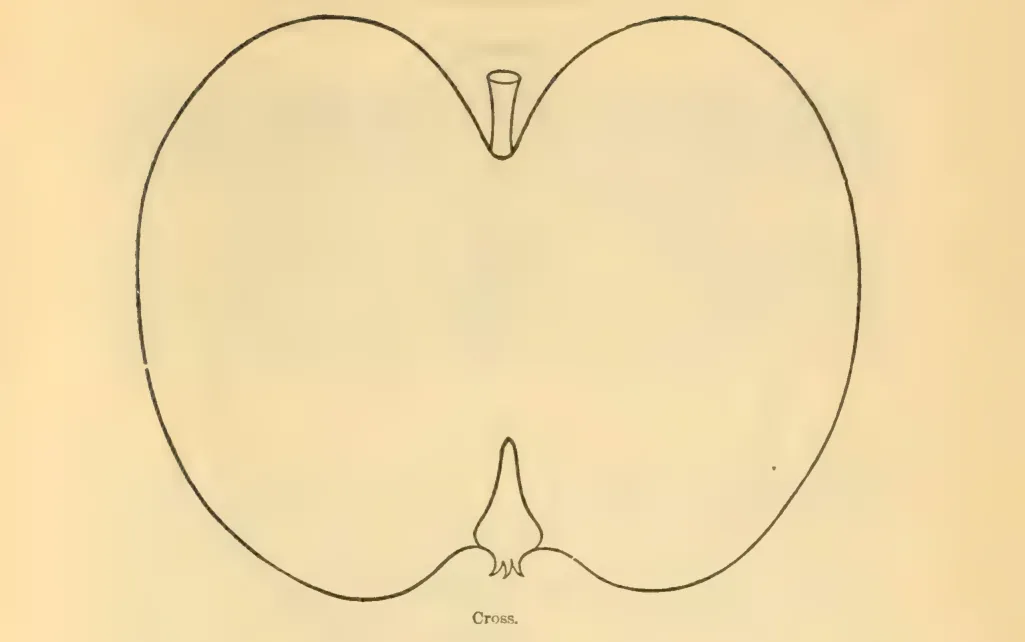
Cross
Origin/History
Cross originated in Russia, from the upper Volga region (Thomas). It was introduced to North American trial as accession No. 413 of the U.S. Department of Agriculture. The Russian Nomenclature Commission applied the name "Cross Apple" to this variety specifically to distinguish it from a separate apple also circulating as Cross (No. 15 M.). Because the name Cross had long been given to yet another apple in Maryland, Budd & Hansen (1914) noted that the designations Nos. 15 and 413 Dept. must be retained for the present to avoid confusion. Prof. Budd separately proposed the name "Large Anis" for this variety (No. 413); Thomas (1903) likewise published it under the heading "Large Anis," with "Cross" noted parenthetically as an alternate designation.
Tree
Described as a vigorous grower (Agassiz, 1900). Not further described in other sources.
Fruit
Size
Large (Thomas); medium to large (Budd & Hansen); above medium (Agassiz).
Form
Sources differ: Thomas describes the fruit as large and irregular conic; Budd & Hansen describe it as regular and oblate; Agassiz describes it as oblate and conical.
Stem
Medium length (Thomas); short (Budd & Hansen).
Cavity
Deep (Thomas); regular, with a radiating patch of russet (Budd & Hansen).
Calyx
Half open (Budd & Hansen). Not described in Thomas or Agassiz.
Basin
Regular and deep (Thomas); wavy, abrupt, with fine wrinkles (Budd & Hansen).
Skin
Ground color yellow (Budd & Hansen; Agassiz), described by Thomas as yellowish green. The surface is mostly covered with mixed dark red and crimson splashes and stripes (Budd & Hansen); Thomas describes it as splashed and striped with red; Agassiz describes it as mottled and streaked with dull red. Dots are minute, white, and obscure (Budd & Hansen); Agassiz notes a few white dots.
Flesh and Flavor
Flesh white (Budd & Hansen; Agassiz), fine-grained (Thomas), juicy (Agassiz). Flavor mild acid, good (Thomas); pleasant subacid, good (Budd & Hansen); mildly sub-acid, quality rated medium (Agassiz).
Core and Seeds
Core closed, meeting. Tube conical. Stamens median. Seeds numerous, short, and plump (Budd & Hansen). Not described in other sources.
Season
September (Agassiz); late fall (Budd & Hansen). Thomas notes that north of parallel 43° the fruit will keep through the winter, implying storage potential into the winter months beyond its harvest season.
Uses
Thomas specifically notes that Cross will prove valuable north of parallel 43° as a winter-keeping variety.
Subtypes/Variants
Not described in source.
Other
Thomas references a figure illustration (Fig. 433) in his volume. The variety was planted at the Central Experimental Farm, Agassiz, British Columbia in the spring of 1895, placing it under trial observation in the Pacific Northwest by the turn of the twentieth century.
Book Sources
Described in 2 period pomological works
- Budd & Hansen, Systematic Pomology (1914) — listed as Cross (No. 413 Dept.)
- Thomas, The American Fruit Culturist (1903) — listed as Large Anis
Nursery Catalog Sources
Found in 3 catalogs (1900–1913) from Illinois
- Central Experimental Farm , Dominion Department of Agriculture, Agassiz, British Columbia (under test; Bulletin No. 3, Second Series) — 1900 — listed as Large Anis
- Benjamin Buckman (personal inventory) , Farmingdale , Illinois — 1901
- Benjamin Buckman (personal inventory) , Farmingdale , Illinois — 1913
View original book sources (3)
— John J. Thomas, The American Fruit Culturist (1903)Large Anis (Cross.) Large, irregular conic; yellowish green, splashed and striped with red; cavity deep, stem medium, basin regular, deep; flesh fine-grained, mild acid, good. Will prove valuable north of parallel 43°, where it will keep through the winter. Fig. 433. From the Upper Volga, Russia.
— J.L. Budd & N.E. Hansen, American Horticultural Manual, Part II: Systematic Pomology (1914)Cross (No. 413 Dept.).—Origin, Russia.—The Russian Nomenclature Commission called this the Cross Apple to distinguish it from Cross (15 M.). Prof. Budd suggests the name Large Anis for Cross 413. As the name Cross has long been given to another apple in Maryland it appears that Nos. 15 and 413 Dept. must be retained for the present.
Fruit medium to large, regular, oblate; surface yellow, mostly covered with mixed dark red and crimson splashes and stripes; dots minute, white, obscure; cavity regular, with a radiating patch of russet; stem short; basin wavy, abrupt, with fine wrinkles; calyx half open. Core closed, meeting; tube conical; stamens median; seeds numerous, short, plump; flesh white, pleasant subacid, good. Late fall.
— Central Experimental Farm, Central Experimental Farm, Agassiz BC — Catalogue of Fruit Trees under Test (Bulletin No. 3, 1900) (1900)Planted Spring 1895. Tree a vigorous grower. Fruit above medium size, oblate, conical. Skin yellow, mottled and streaked with dull red, and with a few white dots. Flesh white, juicy, mildly sub-acid, quality medium. Season September.