DELICIOUS
Apple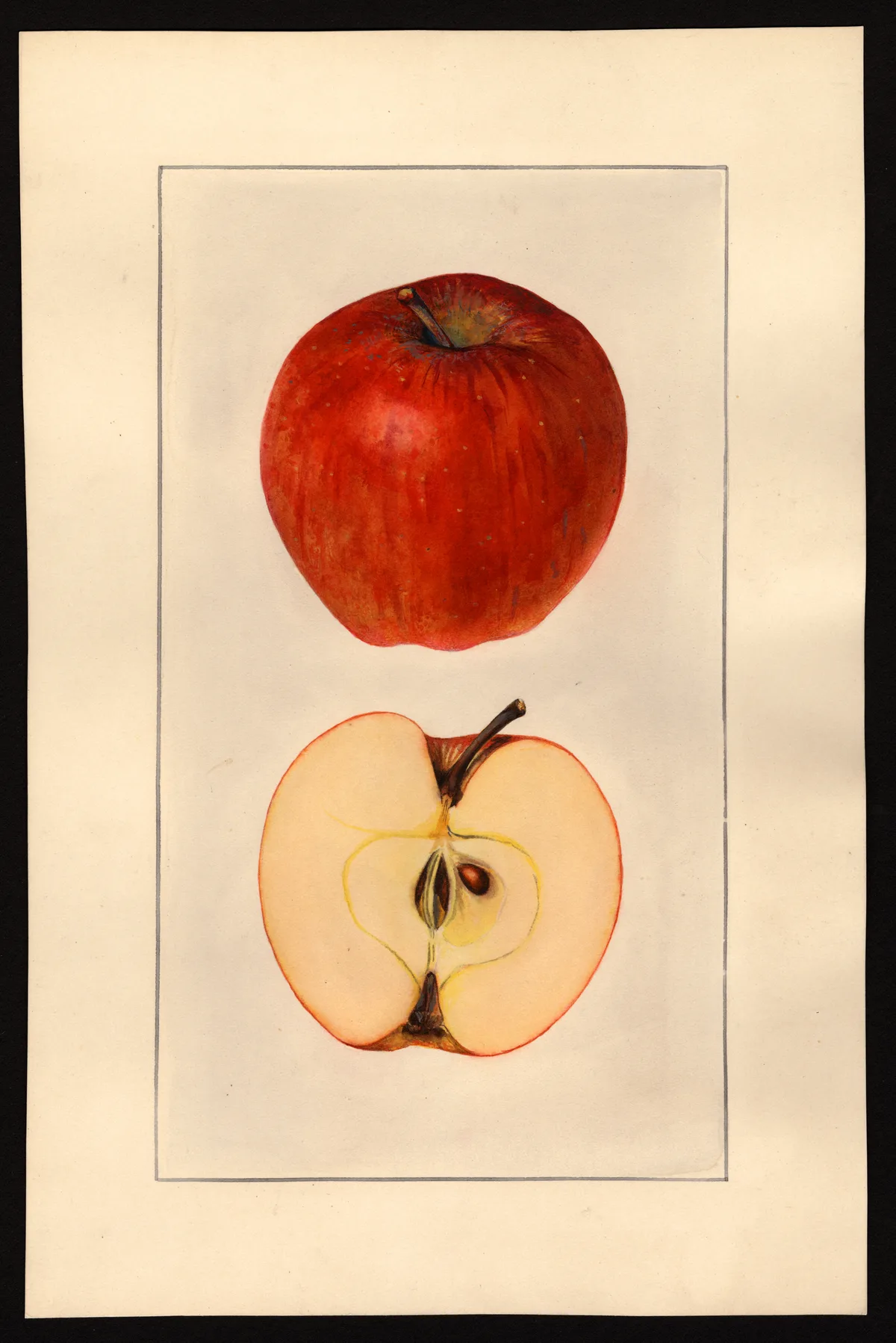
USDA Pomological Watercolor Collection
DELICIOUS
Origin / History
DELICIOUS was discovered in 1881 by Jesse Hiatt of Peru, Iowa (Hedrick; Bunyard), near Des Moines, Iowa (Budd & Hansen), and was introduced commercially in 1895 by Stark Brothers Nurseries of Louisiana, Missouri (Hedrick). Budd & Hansen, writing in 1914, place the origin "about twenty years ago." Bunyard dates the origin to about 1880 and notes that the variety was introduced into England about 1912. Stark Bros. (1910) state that DELICIOUS originated in 1881 in Iowa, and report a belief that the tree grew from seed which had self-seeded on a wild crabapple tree.
In the short time after its 1895 introduction, the variety's culture spread throughout the apple districts of the United States, and Hedrick reports that "no new apple of recent times has been more widely talked about, more generally planted, or better received by consumers and growers alike." It has been extensively planted in the orchards of the West and Northwest and, according to all reports, is proving a commercial success. Lowther (1914) notes it originated in Iowa and has been largely propagated in Missouri and the Pacific Northwest. Stark Bros. report it as proving successful in the regions at the foot of the Wahsatch Mountains and east to the plains of Eastern Colorado, surviving the great frosts of 1899 and 1900, and being planted commercially across Michigan, Southern Idaho, Colorado, and from Minneapolis south to Missouri and Oklahoma; in Colorado it is said to stand "at the very top of the list" and command high prices for shipping and preserving.
Lowther notes that at the time of writing the variety was not yet very well known and its market value not well established, but that it was selling for higher prices than almost any other apple in the markets, with growers uncertain whether this would continue. Bunyard describes the variety as extremely hardy in its native country and likely to prove a valuable fruit for Great Britain.
Tree
Large, vigorous, spreading, hardy, and productive (Hedrick); a vigorous grower, an early and heavy bearer (Lowther); a regular and heavy bearer (Budd & Hansen); growth compact and fertile (Bunyard). Branches smooth, stout. Leaves large, thick, dark green (Hedrick); leaf medium, long, oval, upfolded, deeply curved serrate (Bunyard).
Fruit
Size: Large (Budd & Hansen; Hedrick; Lowther); medium, 2½ by 2¼ inches (Bunyard). Lowther notes the apples range from 72 to 140 per box, and that the fruit varies considerably in size, color and shape in response to its environment. Hedrick observes that, contrary to the usual behavior of apples, the fruit of this variety seems to increase in size and color as the trees grow older.
Form: Roundish-conic to oblong-conic, ribbed (Hedrick); roundish conic, ribbed (Budd & Hansen); oblong conical, with the calyx end irregular in form (Lowther); round, conical, angular (Bunyard). Uniform (Hedrick).
Stem: Long, medium thick (Hedrick); medium, stout (Budd & Hansen); medium (Bunyard).
Cavity: Deep, broad, often furrowed, flaring, greenish (Hedrick); regular, large, deep, gradual, russet (Budd & Hansen); fairly deep (Bunyard).
Calyx / Eye: Calyx medium, nearly closed, with long, narrow, acute lobes (Hedrick); eye medium, closed; calyx segments medium, erect or reflexed at tips (Budd & Hansen); eye slightly open (Bunyard).
Basin: Moderately deep, wide, abrupt, very strongly furrowed and corrugated (Hedrick); regular, large, deep, gradual, with furrows and knobs (Budd & Hansen); rather deep, ribbed (Bunyard).
Skin: Very thick, tough, smooth (Hedrick); medium thick, tenacious, surface smooth except the ribbing (Budd & Hansen).
Color: Light yellow, nearly to almost entirely overspread with dark, attractive red, splashed and mottled with carmine (Hedrick); yellow, washed with mixed red, splashes and broken stripes of bright crimson, with whitish bloom (Budd & Hansen); golden-yellow with dark crimson flush and stripes (Bunyard); yellowish red, sometimes striped and sometimes deep red (Lowther).
Dots: Numerous, small, yellow (Hedrick; Budd & Hansen); some indented (Budd & Hansen).
Flesh / Flavor: Yellowish, firm, a little coarse, tender, juicy, aromatic, pleasant subacid (Hedrick); yellow color, fine, tender, juicy texture, subacid and very pleasant flavor (Budd & Hansen); firm, yellow, juicy and highly flavoured (Bunyard); a mild subacid, very pleasant to the taste and very desirable for dessert (Lowther). Quality good to very good (Budd & Hansen; Hedrick). Hedrick emphasizes that "all who have tasted the apple agree that its rich, distinctive flavor is its chief asset, although it has size and beauty as well."
Core / Seeds: Core medium in size, axile, closed with clasping core-lines; calyx-tube long, wide funnel-shaped; seeds of medium size (Hedrick). Budd & Hansen describe the core as conical, clasping, medium, with seeds plump, medium, and brown.
Season
Early winter (Budd & Hansen); December to last of February (Hedrick); November to January (Bunyard). Lowther reports keeping the fruit in good condition in "common storage" in his own cellar until March, but notes that opinion on storage behavior is not unanimous, paralleling the lack of unanimity on its marketing standard.
Uses
Dessert (Bunyard; Lowther). Lowther notes it is "very desirable for dessert" but "not so highly regarded for cooking, although it is a very good baking apple." Marketed as a shipping apple; Lowther reports having seen them in Eastern and Southern markets shipped from the Pacific Northwest and received in prime condition. Stark Bros. report it as commanding high prices both for shipping and preserving in Colorado.
Subtypes / Variants
Hedrick references the variety under the heading "DELICIOUS. Fig. 16. Stark Delicious," identifying the Stark-introduced strain with the variety itself; no other named subtypes or sports are described in the sources.
Other
Stark Bros. (1910) report that the commercial apple growers of Michigan were then planting DELICIOUS in considerable acreage, predicting that in five years it would equal the leading standard apple of the North in that state. They also reference prize-winning fruit of "tremendous size" and a belief that the original tree may have grown from a seed that self-seeded on a wild crabapple. [NOTE: Source text may be incorrect — the Stark Bros. 1910 passage is partially garbled (e.g., "Mr. Hicit" for Hiatt, "Wahsatch" for Wasatch, and broken phrases such as "duly and long years of profit" and "The apples grow from about 4 in. in about 12 months till the seventh and eighth year a tree is fruit white"); the salvageable content has been retained above.]
Book Sources
Described in 4 period pomological works
Nursery Catalog Sources
Found in 34 catalogs (1896–1965) from California, Illinois, Kansas, Missouri, Oregon, Washington
- Stark Bros. Nurseries & Orchards Co. , Louisiana , Missouri — 1896
- Stark Bros. Nurseries & Orchards Co. , Louisiana , Missouri — 1898
- Central Experimental Farm , Dominion Department of Agriculture, Agassiz, British Columbia (under test; Bulletin No. 3, Second Series) — 1900
- Benjamin Buckman (personal inventory) , Farmingdale , Illinois — 1901
- Stark Bros. Nurseries & Orchards Co. , Louisiana , Missouri — 1906
- J.B. Pilkington , Portland , Oregon — 1907
- Milton Nursery Co. (A. Miller & Sons , Proprietors), Milton , Oregon — 1909
- C.F. Lansing , Salem , Oregon — 1910
- Wapato Nursery , Wapato , Washington — 1910
- Cashmere Nurseries , Cashmere , Washington — 1910
- Island Nurseries & Fruit Farm , Vashon (Vashon Island) , Washington — 1910
- Stark Bros. Nurseries & Orchards Co. , Louisiana , Missouri — 1910
- Island Nurseries & Fruit Farm , Vashon (Vashon Island) , Washington — 1911
- Stark Bros. Nurseries & Orchards Co. , Louisiana , Missouri — 1911
- Ballygreen Nurseries , Hanford , Washington — 1912
- Washington Nursery Company , Toppenish , Washington — 1912
- Stark Bros. Nurseries & Orchards Co. , Louisiana , Missouri — 1912
- Van Holderbeke Nursery Co. , Incorporated, Spokane, Washington (nurseries at Otis Orchards WA, Pasadena WA, Kennewick WA) — 1913
- Benjamin Buckman (personal inventory) , Farmingdale , Illinois — 1913
- Island Nurseries & Fruit Farm , Vashon (Vashon Island) , Washington — 1914
- Ornamental & Fruit Nursery Company , Wapato, County of Yakima , Washington — 1915
- Union Nurseries , J.B. Weaver & Sons, Union , Oregon — 1915
- Holsinger Bros. Nurseries (Holsinger Brothers Nursery) , Rosedale , Kansas — 1916
- Stark Bros. Nurseries & Orchards Co. , Louisiana , Missouri — 1918
- Oregon Nursery Co. , Orenco , Oregon — 1920
- Benedict Nursery Co. , Portland , Oregon — 1921
- Fresno Nursery Co. , Fresno , California — 1924
- Columbia & Okanogan Nursery Co. , Wenatchee , Washington — 1925
- Hudson's Wholesale Nurseries , Tangent , Oregon — 1926
- Stark Bro's Nurseries , Louisiana , Missouri — 1932
- Milton Nursery Co. , Milton-Freewater , Oregon — 1947
- OSU Mid-Columbia Experiment Station — 1965
- Rich & Sons Nursery , Hillsboro , Oregon
- Washington Nursery Company , Toppenish, Washington (on Yakima Indian Reservation) - [undated; companion to the 1912 "Sixth Edition" descriptive catalogue; same cover design and incorporated 1903 date; dated as c.1912]
View original book sources (5)
— J.L. Budd & N.E. Hansen, American Horticultural Manual, Part II: Systematic Pomology (1914)Delicious. — Originated by Jesse Hiatt about twenty years ago near Des Moines, Iowa; tree a regular and heavy bearer.
Fruit large, roundish conic, ribbed; skin medium thick, tenacious; surface smooth except the ribbing; color yellow, washed with mixed red, splashes and broken stripes of bright crimson; bloom whitish; dots numerous, small, yellow, some indented; cavity regular, large, deep, gradual, russet; stem medium, stout; basin regular, large, deep, gradual, furrows and knobs; eye medium, closed; calyx segments medium, erect or reflexed at tips. Core conical, clasping, medium; seeds plump, medium, brown; color yellow; texture fine, tender, juicy; flavor subacid, very pleasant; quality good to very good. Early winter. (U. S. Div. of Pomology.)
— Granville Lowther (ed.), Encyclopedia of Practical Horticulture (1914)The Delicious is one of the new varieties not yet very well known, and its market value not well established. At the present time it sells for higher prices than almost any other apple in the markets; but the fear of growers is, that it will not continue to do so. Perhaps nothing but time can determine this question. Yet the apple has many desirable characteristics. The tree is a vigorous grower, an early and heavy bearer. The apples are large, ranging from 72 to 140 per box. The color is a yellowish red, sometimes striped and sometimes deep red. Form oblong conical, with the calyx end irregular in form. The flavor is a mild subacid, very pleasant to the taste and very desirable for dessert. It is not so highly regarded for cooking, although it is a very good baking apple. For market its standard has not been well established, but we have seen them in the Eastern and Southern markets shipped from the Pacific Northwest and received in prime condition. For keeping in storage the same lack of unanimity of opinion prevails as in the case of marketing. We have kept them in our own cellar in what is termed "common storage," in good condition until March. It originated in Iowa and has been largely propagated in Missouri, and the Pacific Northwest. It varies considerably in size, color and shape, in response to its environment.
— E.A. Bunyard, A Handbook of Hardy Fruits (1920)DELICIOUS. Gard. Mag., 1914, p. 97. Dessert, November to January, medium, 2½ by 2¼, round, conical, angular. Colour, golden-yellow with dark crimson flush and stripes. Flesh, firm, yellow, juicy and highly flavoured. Eye, slightly open in a rather deep ribbed basin. Stem, medium in a fairly deep cavity. Growth, compact ; fertile. Leaf, medium, long, oval, upfolded, deeply curved serrate. Originated in the garden of Mr. Jesse Hiatt, of Peru, Iowa, U.S.A., about 1880, and introduced into England about 1912. Extremely hardy in its native country, and likely to prove a valuable fruit for Great Britain.
— U.P. Hedrick, Cyclopedia of Hardy Fruits (1922)DELICIOUS. Fig. 16. Stark Delicious. A few years ago, Delicious created a sensation in fruit-growing circles. Probably no new apple of recent times has been more widely talked about, more generally planted, or better received by consumers and growers alike. Introduced in 1895, in the short time that has intervened, its culture has spread throughout the apple districts of the United States. In the orchards of the West and Northwest, it has been extensively planted and, according to all reports, is proving a commercial success. All who have tasted the apple agree that its rich, distinctive flavor is its chief asset, although it has size and beauty as well. Contrary to the usual behavior of apples, the fruit of this variety seems to increase in size and color as the trees grow older. The variety was found in 1881 by Jesse Hiatt, Peru, Iowa. Stark Brothers, Louisiana, Missouri, introduced it in 1895. Tree large, vigorous, spreading, hardy, productive; branches smooth, stout. Leaves large, thick, dark green. Fruit large, uniform, roundish-conic to oblong-conic, ribbed; stem long, medium thick; cavity deep, broad, often furrowed, flaring, greenish; calyx medium, nearly closed, with long, narrow, acute lobes; basin moderately deep, wide, abrupt, very strongly furrowed and corrugated; skin very thick, tough, smooth; color light yellow, nearly to almost entirely overspread with dark, attractive red, splashed and mottled with carmine; dots numerous, small, yellow; core medium in size, axile, closed with clasping core-lines; calyx-tube long, wide funnel-shaped; seeds of medium size; flesh yellowish, firm, a little coarse, tender, juicy, aromatic, pleasant subacid; good to very good; December to last of February.
— Stark Bros. Nurseries & Orchards Co., Stark Bros. Year Book (1910) (1910)In the same letter Mr. Hicit described the tree in these wonderful packed regions lying at the foot of the Wahsatch Mountains and east to the plains of Eastern Colorado. After the great frosts, 1899 and 1900, as one on the orchards from Minneapolis to the north, and from Missouri to Oklahoma, should give extra rich, duly and long years of profit. When the Delicious was first taken to the hills of the Southern Idaho orchards, it proved that it originated it is to its heart; in Michigan it is more than profitable and is one of the leading commercial apples, and the demand for it is continuously increasing. In Colorado, it stands at the very top of the list, and will command high prices both for shipping and preserving. All conditions considered, the Delicious is the apple for profit and for any locality where an worthy apple tree is needed. The commercial apple growers of Michigan are just planting it in considerable acreage and we expect that in five years it will equal the "Standard" in Michigan and other apple of the North. The apples grow from about 4 in. in about 12 months till the seventh and eighth year a tree is fruit white. Prize winning of tremendous size. It will be noticed that the Delicious originated in 1881 in Iowa, believed to be from seeds which had self-seeded on a wild crabapple tree.