Doyenné d'Alençon
Pear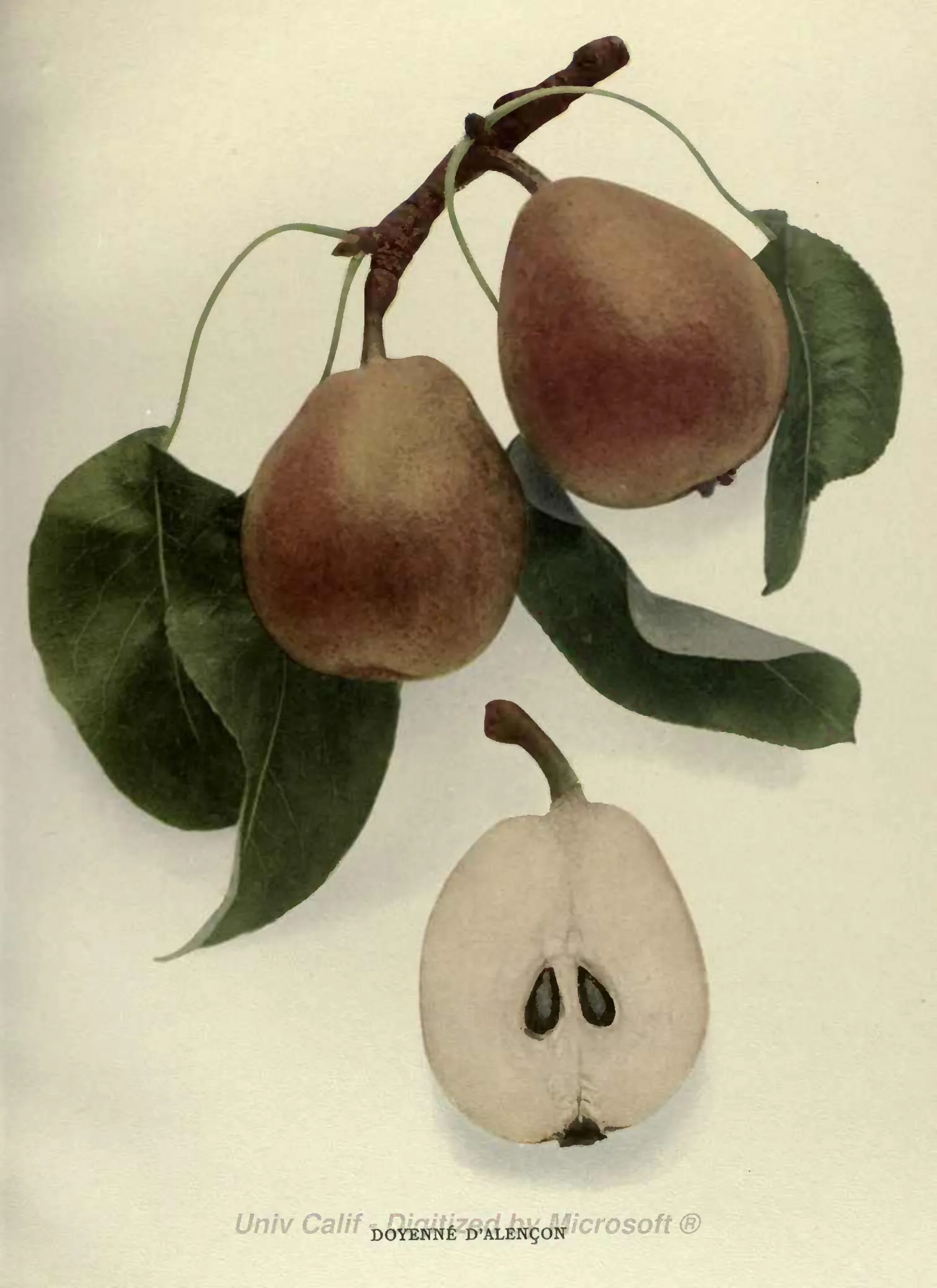
Doyenné d'Alençon
[NOTE: Source text may be incorrect — the Veitch (1911) entry is garbled ("a medium size, greenish pear pear, slightly flesh and juicy. Fine Nov."); only its size, color, juiciness, "Fine," and November date are used here. The fractional measurements in Hedrick's Cyclopedia of Hardy Fruits (1922) are corrupted ("2% inches," "petiole 2% inches long," "stem % inch"); that text condenses Hedrick's Pears of New York (1921), and all measurements below are taken from the 1921 text.]
Origin / History
A foreign pear, an "old French pear" in Hedrick's words, of unknown origin according to Downing. Hedrick reports it to be a wilding discovered by the Abbé Malassis near Alençon, Orne, France, and propagated by M. Thuillier, a nurseryman at Alençon. Bunyard says it is "generally considered to have been discovered in a hedge by M. Thuillier of Alençon," introduced about 1839.
A pear of the same name and season was cited by Le Lectier in 1628. Hedrick places it at Orleans that year, in the orchard of Le Lectier, "the renowned pomologist" ("the renowned French pomologist" in the Cyclopedia). He thinks it probable that the pear M. Thuillier propagated was the one found many years before by Le Lectier.
Hedrick holds that it must have been introduced into America between 1840 and 1850, since the American Pomological Society mentioned it in 1856 as one of the promising new pears. Desportes described it in The Horticulturist that year under the name Doyenné Gris d'Hiver Nouveau, and Elliott (1865) also entered it under that name. The Society added the variety to its fruit-catalog in 1858 and discontinued recommending it in 1897. It was planted for trial at the Central Experimental Farm, Agassiz, British Columbia, in spring 1893.
Thomas says that "although not of the highest flavor, this pear is one of the most valuable and reliable of good-keeping winter pears." Bunyard calls it "a very valuable fruit." Hedrick finds it "worth planting, if the trees can be obtained, because of its very late fruits and long season." He calls the fruits "not remarkable for either taste or appearance, but … good for a winter product when there is little competition with other varieties." He notes that tree and fruit have a family resemblance to Easter Beurré, "the latter, however, is generally a better pear than this one."
Tree
Tree moderately vigorous, medium in size and vigor (Downing, Hedrick). Bunyard calls the growth very slow and the tree a poor grower on hot soils, while at Agassiz it was a strong grower. Upright and dense-topped (Hedrick); Bunyard says it makes a large spreading tree, the branches well spurred. Productive (Downing, Hedrick); fertility good (Bunyard).
Trunk thick, shaggy. Branches stocky, reddish-brown, lightly covered with gray scarf-skin. Young shoots dull olive brown (Downing). Branchlets slender, curved, short, with short internodes, light brown with a faint reddish tinge, smooth, pubescent near the tips of the new growth, with numerous small, raised, conspicuous lenticels. Leaf-buds small, short, sharply pointed, plump, free; leaf-scars with prominent shoulders.
Leaves 2½ in. long, 1¼ in. wide, thin; apex taper-pointed; margin with few glands, coarsely serrate (Hedrick), or crenate (Bunyard); petiole ⅝ in. long, glabrous, slender, with a tinge of red. Bunyard describes the leaf as long, oval, down-hanging, upfolded, turning pale yellow-brown.
Flower-buds small, short, conical, plump, free, borne singly on short spurs. Flowers early, 1⅛ in. across, in dense clusters averaging nine buds to a cluster; pedicels ⅞ in. long, lightly pubescent.
Proves valuable on the quince (Elliott). Hedrick says it is much grown in Europe on the quince and in the various fanciful forms Europeans use in training fruit trees. He advises planting it only on warm soils and in situations where the season is warm and long.
Fruit
Size: Medium. Desportes calls it rather below medium, and Elliott medium or above. Hedrick gives 2½ in. long by 2¼ in. wide; Bunyard gives "3 by 3¼."
Form: Obovate, obtuse-pyriform; roundish oval, inclining to obovate or pyriform, or nearly pyriform (Downing, Agassiz). Thomas says it approaches pyriform when large. Symmetrical, uniform (Hedrick); "very even" (Bunyard). Elliott alone calls it slightly angular, or one side longest.
Stem: Stout, thick, or "pretty large." Short (Desportes, Elliott) to of moderate length. Hedrick gives ⅞ in., curved. Bunyard gives 1 in., often set at an angle.
Cavity: Small and shallow, a slight depression, to medium, the stem moderately sunk. Hedrick describes it as obtuse, symmetrical, often slightly lipped.
Calyx: Very small (Desportes) or small (Bunyard) to medium (Elliott) or large (Hedrick). Open (Downing, Hedrick); nearly closed (Bunyard). Segments persistent (Downing); Desportes finds the calyx often without segments. Hedrick gives the lobes as "not separated at the base, broad, narrow," and the calyx-tube as short, wide, conical.
Basin: Deep, round, upright (Downing). Bunyard calls it wide and shallow. Desportes sets the calyx "in narrow sunken cavity." Hedrick calls the basin narrow, abrupt, smooth, symmetrical; Elliott irregular, abrupt.
Skin: Rough, from "a little rough" (Bunyard) to roughish and rough; thick (Desportes), very thick and tough (Hedrick). Ground color yellow, pale yellow, or pale dull yellow, through pale or dull greenish yellow to dull russety green (Desportes). Netted and patched with russet. Shaded with dull crimson or carmine (Downing); a faint orange blush on the exposed cheek (Hedrick); a red cheek (Agassiz); "sometimes a little flushed" (Bunyard).
Dots: Many, small, brown and russet, sprinkled over the surface. Hedrick calls them numerous, brownish-russet, inconspicuous. Desportes alone calls them coarse, profusely covering the surface.
Flesh and flavor: Flesh white or whitish (Bunyard, Elliott), tinged with yellow (Hedrick), or tinged with orange (Desportes). Somewhat granular, granular at the center (Hedrick), a little coarse to rather coarse-grained, yet melting, tender, buttery, and juicy. Flavor sprightly and vinous, "lively vinous" in Hedrick's phrase, aromatic. Downing calls it "sugary, very rich, sprightly, and highly perfumed." The Agassiz description calls it sweet, "with a pleasant flavour." A little astringent: near the skin (Desportes), "unless well ripened" (Elliott).
Quality "good" (Desportes, Hedrick) to "very good" (Downing; "very good flavour," Bunyard); Veitch gives "Fine." Thomas calls it "not of the highest flavor."
Core and seeds: Core medium (Elliott) or large (Hedrick); Hedrick calls it closed, axile, with clasping core-lines. Seeds long, pointed or acute, dark brown (Elliott); large, wide, plump (Hedrick).
Season
The recorded season runs from November into May or June. Most authors give a season opening in December and closing between January and April. Hedrick says it comes into season under ordinary conditions in December and keeps until March. Desportes says it "keeps easily to May or June, ripens readily," and is free from the objections that rest against some of the latest varieties in this respect. Hedrick, however, says that in some seasons the pears fail to ripen. Elliott gives January to May, and Veitch "Fine Nov."
Uses
Dessert (Bunyard). Hedrick calls the pears "admirably adapted for culinary purposes."
Subtypes / Variants
Not described in source.
Other
Bunyard cites Her. Pom. II. 40. Hedrick also cites the American Pomological Society Report of 1858. His other references include colored plates in the Annales de Pomologie Belge (1860) and the Pomologie de la France (1864). They also include Mas's Le Verger (1866–73), Downing's Fruits and Fruit Trees of America (1869), Leroy's Dictionnaire de Pomologie (1869), the Journal of Horticulture (1871), the Guide Pratique (1876), and Hogg's Fruit Manual (1884).
Book Sources
Described in 7 period pomological works
- Hedrick, The Pears of New York (1921)
- Hedrick, Cyclopedia of Hardy Fruits (1922)
- The Horticulturist (1855) — listed as Doyenne Gris d'hiver Nouveau
- Bunyard, A Handbook of Hardy Fruits (1920)
- Downing, Fruits and Fruit Trees of America (1900)
- Elliott, The Western Fruit Book (1865) — listed as Doyenne Gris d'Hiver Nouveau
- Thomas, The American Fruit Culturist (1903) — listed as Alençon
Nursery Catalog Sources
Found in 5 catalogs (1864–1911) from California, England
- St. Helena Nursery , Howell Prairie, Marion County, OR (Marion Co., Ogn.) — 1864
- Fancher Creek Nursery , Fresno , California — 1886
- George Bunyard & Co. , Royal Nurseries, Maidstone, Kent , England — 1900
- Central Experimental Farm , Dominion Department of Agriculture, Agassiz, British Columbia (under test; Bulletin No. 3, Second Series) — 1900
- James Veitch & Sons , Ltd., Royal Exotic Nursery, Chelsea, London (also Coombe Wood, Langley, and Feltham) , England — 1911
View original book sources (9)
— B. Desportes, The Horticulturist (1856)Doyenne Gris d'hiver Nouveau.— Size— rather below medium. Form—obovate, obtuse, pyriform. Stem—short, stout, inserted in a slight depression. Calyx—very small, in narrow sunken cavity, often without segments. Color— dull russety green, profusely covered with coarse russet dots. Skin—rough and thick. Flesh—tinged with orange, coarse grained, but melting and juicy. Flavor—sprightly, vinous, good, slightly astringent near the skin. Season—keeps easily to May or June, ripens readily, and is free from the objections which rest against some of our latest varieties in this respect.
— F.R. Elliott, The Western Fruit Book (1865)DOYENNE GRIS D'HIVER NOUVEAU.
Doyenné Marbre, St. Michael d'Hiver, Doyenné d'Alencon, Doyenné d'Hiver d'Alencon.
Foreign. Proves valuable on the Quince.
Fruit, medium or above, obovate, obtuse pyriform, slightly angular, or one side longest ; color, pale dull yellow, with many small brown russet specks ; stem, short, stout ; calyx, medium ; basin, irregular, abrupt ; core, medium ; seeds, dark brown, long, pointed ; flesh, whitish, rather coarse-grained, melting, juicy, vinous, a little astringent unless well ripened. January to May.
— A.J. Downing, The Fruits and Fruit Trees of America (1900)Doyenné d'Alençon.
Doyenné d'Hiver d'Alençon. Doyenné Marbré. Doyenné Gris d'Hiver Nouveau. Doyenné d'Hiver Nouveau. St. Michael d'Hiver.
A foreign Pear, of unknown origin. Tree moderately vigorous and productive. Young shoots dull olive brown.
Fruit medium, roundish oval, inclining to obovate or pyriform. Skin rough, yellow, shaded with dull crimson or carmine, sprinkled, netted, and patched with russet brown dots. Stalk of moderate length, pretty large, inserted in a medium cavity. Calyx open. Segments persistent. Basin deep, round, upright. Flesh somewhat granular, buttery, juicy, sugary, very rich, sprightly, and highly perfumed. Very good. December to April.
— John J. Thomas, The American Fruit Culturist (1903)Alençon. (Doyenné d'Hiver Nouveau, Doyenné Gris d'Hiver Nouveau, St. Michael d'Hiver.) Medium, obovate, approaching pyriform when large, skin rough; yellow, with russet or brown dots; stalk medium, stout, moderately sunk, basin deep; flesh somewhat granular, buttery, juicy, rich, sprightly. December to April. Although not of the highest flavor, this pear is one of the most valuable and reliable of good-keeping winter pears.
— E.A. Bunyard, A Handbook of Hardy Fruits (1920)DOYENNE D'ALENCON. Her. Pom. II. 40. G. Dechants Birne von Alençon. Dessert, December to February, 3 by 3¼, pyriform, very even. Skin, a little rough. Colour, pale yellow with many russet dots and patches, sometimes a little flushed. Flesh, white, melting, juicy, very good flavour, with a little astringency. Eye, small, nearly closed in a wide, shallow basin. Stem, 1 in., in a small cavity, often at an angle. Growth, very slow; fertility good. Leaf, long, oval, down hanging, upfolded, crenate, turns pale yellow-brown. Origin, generally considered to have been discovered in a hedge by M. Thuillier of Alençon, and introduced about 1839. There was, however, a pear of the same name and season cited by Le Lectier in 1628. A very valuable fruit, but a poor grower on hot soils. It makes a large spreading tree, branches well spurred.
— U.P. Hedrick, The Pears of New York (1921)DOYENNÉ D'ALENÇON
- Am. Pom. Soc. Rpt. 213. 1856. 2. Ibid. 231. 1858. 3. Ann. Pom. Belge 8:15, Pl. 1860. 4. Pom. France 2: No. 47, Pl. 47. 1864. 5. Mas Le Verger 1:23, fig. 10. 1866-73. 6. Downing Fr. Trees Am. 742. 1869. 7. Leroy Dict. Pom. 2:55, fig. 1869. 8. Jour. Hort. N. S. 20:135. 1871. 9. Guide Prat. 61, 264. 1876. 10. Hogg Fruit Man. 564. 1884.
Marmorirte Schmalzbirne. 11. Dochnahl Fuhr. Obstkunde 2:65. 1856. Dechantsbirne von Alençon. 12. Mathieu Nom. Pom. 201. 1889.
This old French pear is worth planting, if the trees can be obtained, because of its very late fruits and long season. The pears come in season under ordinary conditions in December and keep until March. The fruits are not remarkable for either taste or appearance, but are good for a winter product when there is little competition with other varieties. The pears are admirably adapted for culinary purposes. In some seasons the pears fail to ripen, and the variety should be planted only on warm soils and in situations where the season is warm and long. Tree and fruit have a family resemblance to Easter Beurré; the latter, however, is generally a better pear than this one. This variety is much grown in Europe on the quince, and in the various fanciful forms Europeans make use of in training fruit trees.
Doyenné d'Alençon is reported to be a wilding discovered by the Abbé Malassis near Alençon, Orne, France, and propagated by M. Thuillier, a nurseryman at Alençon. There was, however, a pear of the same name and season found at Orleans in 1628, in the orchard of Le Lectier, the renowned pomologist. It is probable that the pear which M. Thuillier propagated was the one found many years previously by Le Lectier. The variety must have been introduced into America between 1840 and 1850, as it was mentioned by the American Pomological Society in 1856 as one of the promising new pears. In 1858, the Society added the variety to its fruit-catalog, but discontinued recommending it in 1897.
Tree medium in size and vigor, upright, dense-topped, productive; trunk thick, shaggy; branches stocky, reddish-brown lightly covered with gray scarf-skin; branchlets slender, curved, short, with short internodes, light brown, with a faint reddish tinge, smooth, pubescent near the tips of the new growth, with numerous small, raised, conspicuous lenticels.
Leaf-buds small, short, sharply pointed, plump, free; leaf-scars with prominent shoulders. Leaves 2½ in. long, 1¼ in. wide, thin; apex taper-pointed; margin with few glands, coarsely serrate; petiole ⅝ in. long, glabrous, with tinge of red, slender. Flower-buds small, short, conical, plump, free, arranged singly on short spurs; flowers early, 1⅛ in. across, in dense clusters, average 9 buds in a cluster; pedicels ⅞ in. long, lightly pubescent.
Fruit ripe December to February; 2½ in. long, 2¼ in. wide, medium in size, obovate-obtuse-pyriform, symmetrical, uniform; stem ⅞ in. long, thick, curved; cavity obtuse, shallow, symmetrical, often slightly lipped, small; calyx open, large; lobes not separated at the base, broad, narrow; basin narrow, abrupt, smooth, symmetrical; skin very thick, tough, roughish; color dull greenish-yellow, with a faint orange blush on the exposed cheek, marked with many brown and russet dots and netted with russet; dots numerous, small, brownish-russet, inconspicuous; flesh tinged with yellow, granular at the center, tender and melting, juicy, aromatic, with a lively vinous flavor; quality good. Core large, closed, axile, with clasping core-lines; calyx-tube short, wide, conical; seeds large, wide, long, plump, acute.
— U.P. Hedrick, Cyclopedia of Hardy Fruits (1922)DOYENNE D'ALENÇON. This old French pear is worth planting because of its very late fruits and long season. The pears come in season under ordinary conditions in December and keep until March. The fruits are not remarkable for either taste or appearance, but are good for a winter product when there is little competition with other varieties. In some seasons the pears fail to ripen, and the variety should be planted only on warm soils and in situations where the season is warm and long. This variety is much grown in Europe on the quince. A pear of this name and season was found at Orleans in 1628, in the orchard of Le Lectier, the renowned French pomologist.
Tree upright, dense-topped, productive; trunk thick, shaggy; branches stocky, reddish-brown. Leaves 2% inches long, 1% inches wide, thin; apex taper-pointed; margin with few glands, coarsely serrate; petiole 2% inches long, glabrous, with tinge of red, slender. Flowers early, 1% inches across, in dense clusters, average 9 buds in a cluster.
Fruit ripe December-February; 2% inches long, 2% inches wide, obovate-obtuse-pyriform, symmetrical, uniform; stem % inch long, thick, curved; cavity obtuse, shallow, symmetrical, often slightly lipped, small; calyx open, large; lobes not separated at the base, broad; basin narrow, abrupt, smooth, symmetrical; skin very thick, tough, rough; color dull greenish-yellow with a faint orange blush on the exposed cheek, marked with many brown and russet dots and netted with russet; dots numerous, small, brownish-russet; flesh tinged with yellow, granular at the center, tender and melting, juicy, aromatic, with a lively vinous flavor; quality good; core large, closed, axile, with clasping core-lines; calyx-tube short, wide, conical; seeds large, wide, long, plump, acute.
— Central Experimental Farm, Central Experimental Farm, Agassiz BC — Catalogue of Fruit Trees under Test (Bulletin No. 3, 1900) (1900)Planted Spring 1893. Tree a strong grower. Fruit medium size, roundish, oval, nearly pyriform. Skin pale greenish yellow, with a red cheek, and patches of russet. Flesh a little coarse, buttery, juicy, sweet, with a pleasant flavour. Season December and January.
— James Veitch & Sons, Veitch's Fruit Trees (1911) (1911)a medium size, greenish pear pear, slightly flesh and juicy. Fine Nov.