Early Nonpareil
Apple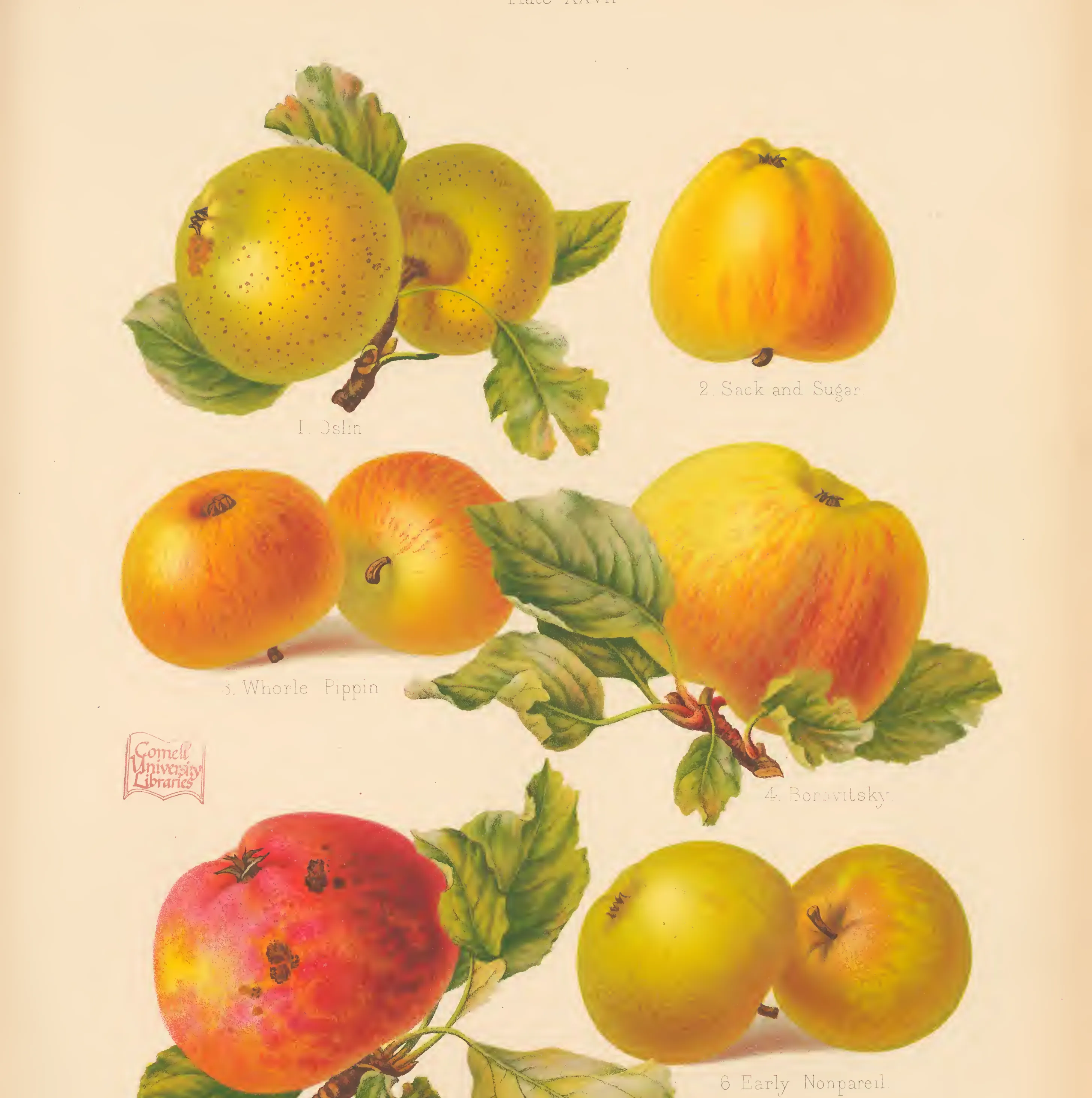
Origin/History
The sources conflict on date of origin. Downing (1900), citing Lindley, states the variety originated about 1780 in Norfolk, England. Bunyard (1920) states it was raised by a Mr. Stagg of Caister, Great Yarmouth (also in Norfolk), about 1870, from a seed of Old Nonpareil — an account consistent with the synonym Stagg's Nonpareil carried by both sources. The variety is described in the Herefordshire Pomona (plate 27) and is known on the continent as Nonpareille hâtive (French) and Früher Nonpareil (German).
Tree
Growth habit is upright. Downing describes the tree as a free grower, hardy, early, and an abundant bearer. Bunyard characterizes growth as moderate, upright, and fertile. Leaf medium, round oval, crenate (Bunyard).
Fruit
Size: Downing (citing Lindley) describes the fruit as medium. Bunyard gives explicit dimensions of 2¼ inches wide by 1¾ inches tall and rates the fruit small.
Form: Roundish oblate (Downing/Lindley). Round, conical, regular (Bunyard).
Stem: Rather long (Bunyard).
Cavity: Small (Bunyard).
Calyx/Eye: Eye slightly open (Bunyard).
Basin: Shallow (Bunyard).
Skin: Dull yellow with gray russet and russet dots (Downing/Lindley). Green to deep yellow with russet (Bunyard).
Flesh/Flavor: Flesh yellowish white (Downing/Lindley) or greenish (Bunyard), tender, juicy, brisk, rich, and aromatic (Downing/Lindley). Bunyard calls it "a delicious fruit."
Core/Seeds: Not described in source.
Season
October–November (Downing/Lindley). October to December (Bunyard).
Uses
Dessert (Bunyard).
Subtypes/Variants
Downing separately records a distinct variety grown in Illinois under the same name, of unknown origin, noting it "is barely possible that this may prove identical with the foregoing" English variety. The Illinois fruit differs in several respects: medium to large (larger than the English form), roundish oblate, strongly ribbed; skin whitish, thinly shaded, striped and splashed with red, with gray dots. Flesh white, sometimes stained next the skin, very tender, juicy, sprightly subacid; rated Good. Core large. Season: September — considerably earlier than the English fruit.
Other
Bunyard notes the variety is "seldom grown now" as of 1920.
Book Sources
Described in 2 period pomological works
USDA Nomenclature (1905)
From W.H. Ragan, Nomenclature of the Apple, USDA Bulletin No. 56
Possibly identical with: preceding
Nursery Catalog Sources
Found in 1 catalog (1900)
- Central Experimental Farm , Dominion Department of Agriculture, Agassiz, British Columbia (under test; Bulletin No. 3, Second Series) — 1900
View original book sources (2)
— A.J. Downing, The Fruits and Fruit Trees of America (1900)Early Nonpareil.
Stagg's Nonpareil. New Nonpareil. Hick's Fancy. Summer Nonpareil. Lacy's Nonpareil.
Originated about 1780, in Norfolk, England. Tree a free upright grower, hardy, early, and abundant bearer.
Fruit medium, roundish oblate, dull yellow with gray russet, and russet dots. Flesh yellowish white, tender, juicy, brisk, rich, aromatic. October, November. (Lind.)
Early Nonpareil.
A variety grown in Illinois, the origin of which we cannot learn. It is barely possible that this may prove identical with the foregoing.
Fruit medium to large, roundish oblate, strongly ribbed, whitish, thinly shaded, striped and splashed with red gray dots. Flesh white, sometimes stained next the skin, very tender, juicy, sprightly subacid. Good. Core large. September.
— E.A. Bunyard, A Handbook of Hardy Fruits (1920)EARLY NONPAREIL. Her. Pom., 27. F., Nonpareille hative; G., Frueher Nonpareil. (Hick's Fancy, Stagg's Nonpareil.) Dessert, October to December, small, 2¼ by 1¾, round, conical, regular. Colour, green to deep yellow, with russet. Flesh, tender, greenish, aromatic. Eye, slightly open in a shallow basin. Stem, rather long, in a small cavity. Growth, moderate, upright; fertile. Leaf, medium, round oval, crenate. Origin, raised by a Mr. Stagg, of Caister Great Yarmouth, about 1870, from a seed of Old Nonpareil. A delicious fruit, seldom grown now.