Edwards
Apple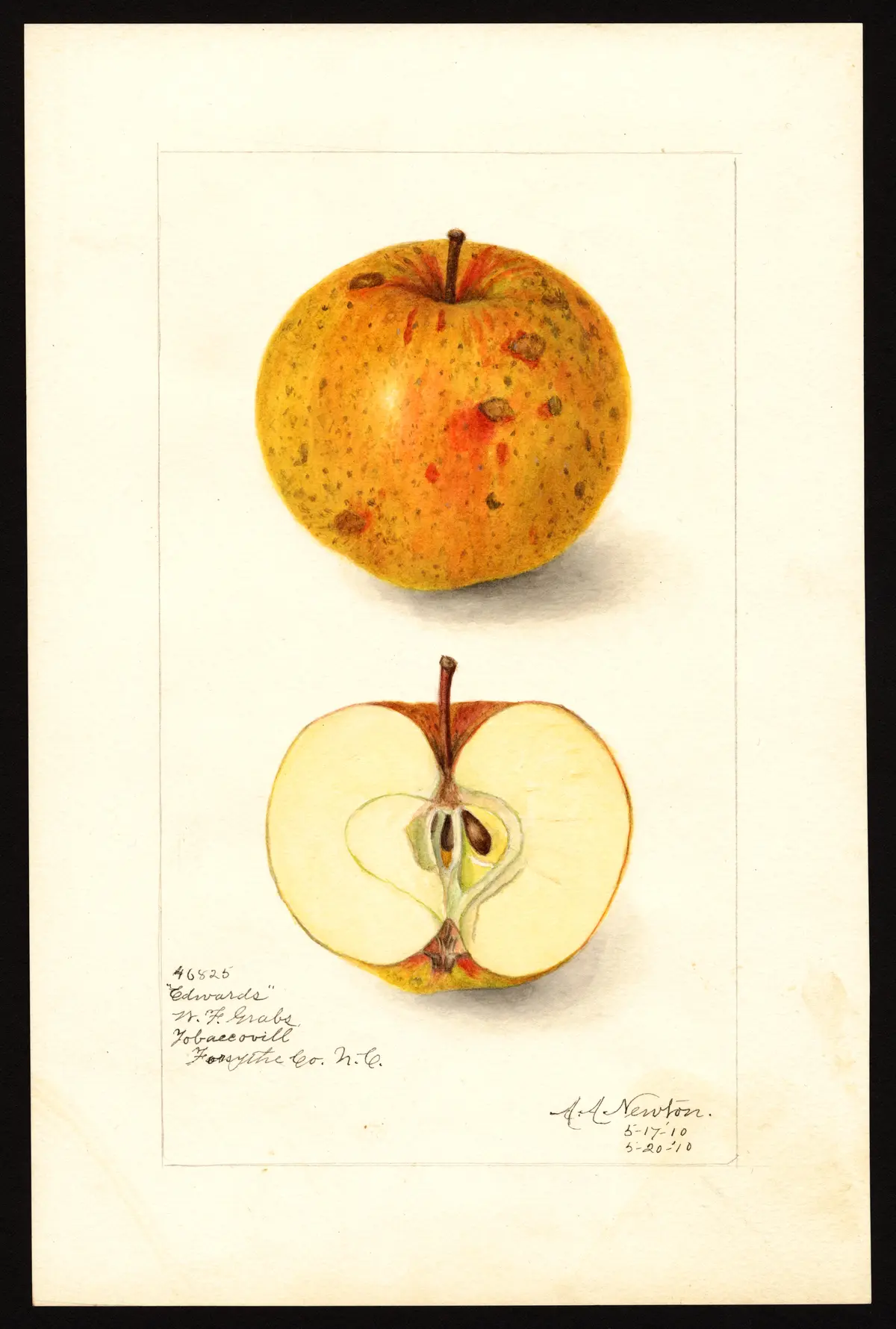
USDA Pomological Watercolor Collection
Edwards
Origin/History
Edwards originated in Chatham County, North Carolina, as a seedling of the Hall apple. Beach (1905) notes it is not well adapted for growing as far north as New York State, where it barely reaches medium size at its best and the color is usually rather dull. Downing's description is attributed to the Country Gentleman.
Tree
Not vigorous, small, and stunted. Form flat, open, spreading, and inclined to droop. Twigs short to medium, straight, slender; internodes medium. Bark olive-green tinged with brownish-red, mottled with scarf-skin; only pubescent near the tips. Lenticels conspicuous, numerous, medium to large, roundish, raised. Buds medium in size, broad, plump, acute, free, not pubescent.
Fruit
Size and Form: Medium or below, uniform in size and shape; Downing describes the fruit as nearly medium. Form oblate to roundish oblate, inclined to conic, often slightly ribbed.
Stem: Long, slender.
Cavity: Obtuse to acute, medium, sometimes russeted.
Calyx: Small, closed.
Basin: Variable, rather shallow to moderately deep, moderately narrow to rather wide, often abrupt, nearly smooth.
Skin: Smooth, thick, tough. Ground color yellowish-green (described by Downing as greenish yellow), blushed with dull brownish-red, faintly striped with carmine; in highly colored specimens becoming deep, bright red. Downing describes the striping as delicate red. Prevailing effect rather dull green, blushed with dull dark red. Dots large and small, pale and russet.
Calyx Tube and Stamens: Calyx tube cone-shaped or somewhat funnel-form. Stamens median to marginal.
Core and Seeds: Core below medium, abaxile; cells sometimes unsymmetrical, partly open; core lines meeting or slightly clasping. Carpels rather flat, roundish obovate to roundish obcordate. Seeds few, dark, medium to large, plump, acute; often some are abortive.
Flesh and Flavor: Tinged with yellow, firm, rather coarse, tender, breaking, moderately juicy, somewhat astringent, sprightly subacid, aromatic; quality good. Downing characterizes the flesh as rich, juicy, and firm.
Season
February to May or later; sometimes keeps through the summer. One of the latest and best keepers.
Uses
Not described in source.
Subtypes/Variants
Not described in source. The name Edwards Favorite appears in Beach as a synonym.
Other
Beach notes that as grown in New York, the fruit barely reaches medium size at its best and often is small, and considers it not well adapted to cultivation that far north. The variety is regarded as good in quality and exceptional for its keeping duration.
Book Sources
Described in 2 period pomological works
Nursery Catalog Sources
Found in 2 catalogs (1901–1913) from Illinois
- Benjamin Buckman (personal inventory) , Farmingdale , Illinois — 1901
- Benjamin Buckman (personal inventory) , Farmingdale , Illinois — 1913
View original book sources (2)
— A.J. Downing, The Fruits and Fruit Trees of America (1900)Edward's. Origin, Chatham Co., N. C. Fruit nearly medium, roundish oblate, greenish yellow, lightly striped with delicate red. Flesh rich, juicy, firm. One of best keepers. (Con. Gent.)
— S.A. Beach, The Apples of New York, Vol. 1 (1905)EDWARDS.
REFERENCES. 1. Downing, 1872:159. 2. Beach and Close, N. Y. Sta. Rpt., 15:271. 1896. 3. Massey, N. C. Sta. Bul., 149:317. 1898. 4. Powell and Fulton, U. S. B. P. I. Bul., 48:40. 1903. 5. Beach and Clark, N. Y. Sta. Bul., 248:118. 1904.
SYNONYM. Edwards Favorite (2).
Fruit good in quality and one of the latest keepers, but as grown here it barely reaches medium size at its best and often is small, and the color is usually rather dull. It is not well adapted for growing as far north as New York state.
Historical. Edwards is said to have originated in Chatham county, N. C., as a seedling of the Hall.
TREE.
Tree not vigorous, small, stunted. Form flat, open, spreading and inclined to droop. Twigs short to medium, straight, slender; internodes medium. Bark olive-green tinged with brownish-red, mottled with scarf-skin; only pubescent near the tips. Lenticels conspicuous, numerous, medium to large, roundish, raised. Buds medium in size, broad, plump, acute, free, not pubescent.
FRUIT.
Fruit medium or below, uniform in size and shape. Form oblate to roundish oblate inclined to conic, often slightly ribbed. Stem long, slender. Cavity obtuse to acute, medium, sometimes russeted. Calyx small, closed. Basin variable, rather shallow to moderately deep, moderately narrow to rather wide, often abrupt, nearly smooth.
Skin smooth, thick, tough, yellowish-green, blushed with dull brownish-red, faintly striped with carmine, in highly colored specimens becoming deep, bright red. Dots large and small, pale and russet. Prevailing effect rather dull green, blushed with dull dark red.
Calyx tube cone-shape or somewhat funnel-form. Stamens median to marginal.
Core below medium, abaxile; cells sometimes unsymmetrical, partly open; core lines meeting or slightly clasping. Carpels rather flat, roundish obovate to roundish obcordate. Seeds few, dark, medium to large, plump, acute; often some are abortive.
Flesh tinged with yellow, firm, rather coarse, tender, breaking, moderately juicy, somewhat astringent, sprightly subacid, aromatic, good.
Season February to May or later; sometimes keeps through the summer.