Eureka
Apple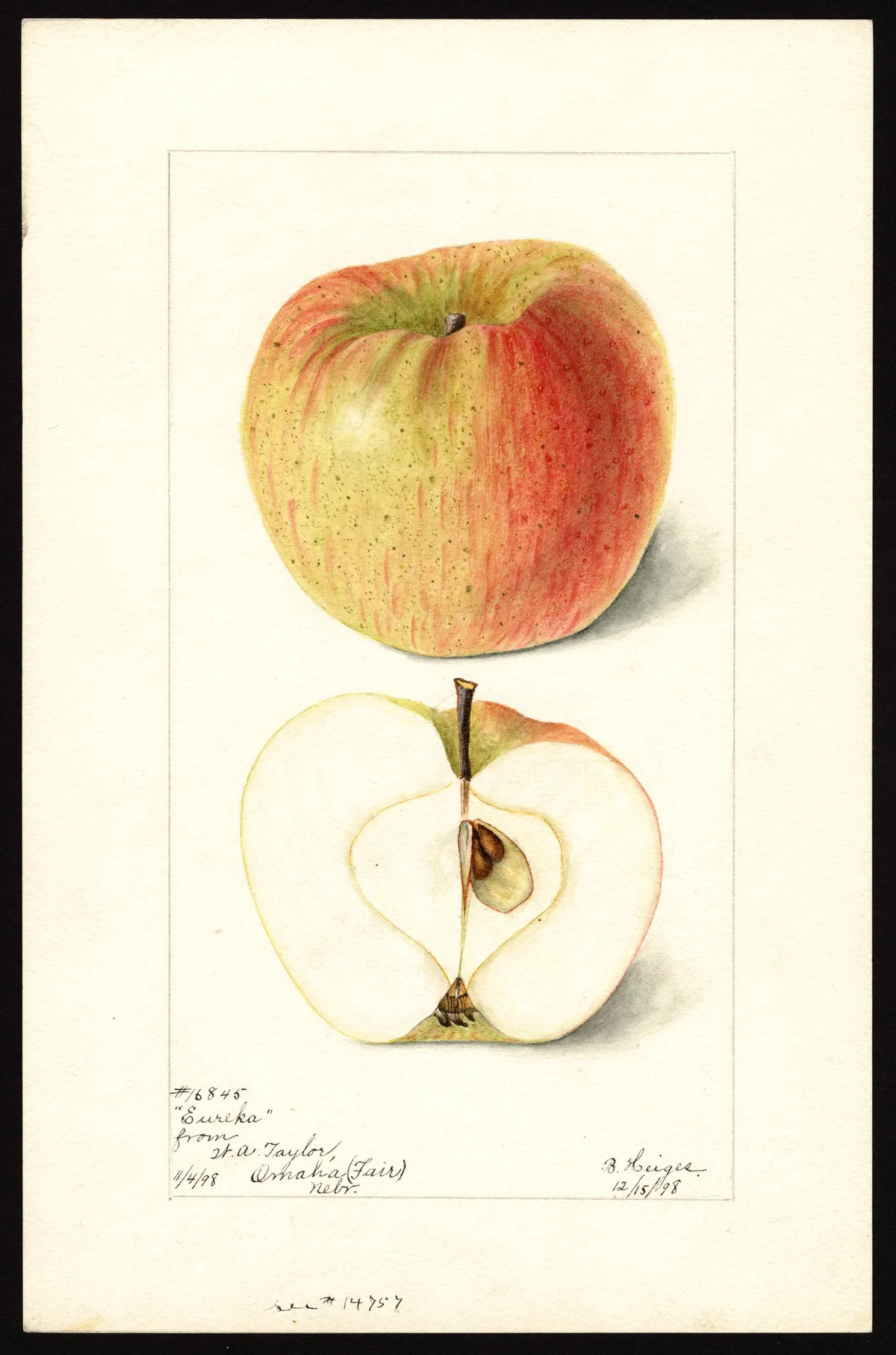
USDA Pomological Watercolor Collection
Eureka
Origin/History
Two distinct varieties share the name Eureka. N.E. Hansen (1902) and Budd & Hansen (1914) both explicitly state that the Wisconsin Eureka "is distinct from the Eureka described by Downing, which is a fall variety of supposed Connecticut origin."
Downing's Eureka (Connecticut): Origin somewhat uncertain, but supposed to be Cheshire, Connecticut.
Wisconsin Eureka: Originated in Wisconsin, from seed of Tolman Sweet.
Tree
Downing describes the tree as thrifty, upright, with rather slender branches forming a handsome round head; an early and prolific bearer on alternate years, esteemed in its locality for market or home use.
Not described in source for the Wisconsin variety.
Fruit
The two varieties differ substantially in nearly every physical character.
Downing's Eureka (Connecticut) — fall variety
Size and Form: Medium, roundish oblate, slightly conical.
Skin: Whitish, shaded, striped, and splashed with pale and dark red.
Stem: Short, small.
Cavity: Small.
Calyx: Closed.
Basin: Small, corrugated.
Flesh: White, fine, tender, juicy, mild subacid, and of very good flavor.
Core: Medium.
Wisconsin Eureka — winter variety
Size and Form: Large, roundish oblate, regular.
Skin: Surface roughened by russet dots and leather-cracking; light yellow, handsomely striped with bright crimson, especially on the sunny side.
Stem: Short.
Cavity: Acuminate, regular, slightly russeted.
Basin: Abrupt, deep, nearly smooth.
Core: Closed.
Seeds: Few, flattened.
Flesh: White, fine grained, moderately juicy, sweet, very good.
Season
Downing's Eureka: September–October.
Wisconsin Eureka: A long winter keeper.
Uses
Downing's Eureka is esteemed in its locality for market or home use.
Not described in source for the Wisconsin variety.
Subtypes/Variants
These are two entirely separate varieties sharing a common name, distinguished by origin, season, size, skin color and pattern, and flesh flavor. Downing's Eureka is a medium, striped red fall apple of Connecticut origin; the Wisconsin Eureka is a large, yellow-and-crimson winter apple bred from Tolman Sweet.
Book Sources
Described in 3 period pomological works
Nursery Catalog Sources
Found in 2 catalogs (1901–1913) from Illinois
- Benjamin Buckman (personal inventory) , Farmingdale , Illinois — 1901
- Benjamin Buckman (personal inventory) , Farmingdale , Illinois — 1913
View original book sources (3)
— A.J. Downing, The Fruits and Fruit Trees of America (1900)Eureka.
Origin somewhat uncertain, but supposed to be Cheshire, Conn. Tree thrifty, upright, rather slender branches, forming a handsome round head; an early and prolific bearer on alternate years, and esteemed in its locality for market or home use.
Fruit medium, roundish oblate, slightly conical; skin whitish, shaded, striped, and splashed with pale and dark red; stalk short, small; cavity small; calyx closed; basin small, corrugated; flesh white, fine, tender, juicy, mild subacid, and of very good flavor; core medium. September, October.
— N.E. Hansen, A Study of Northwestern Apples (1902)Eureka—Originated in Wisconsin, from seed of Tolman Sweet. This is distinct from the Eureka described by Downing which is a fall apple of supposed Connecticut origin—Fruit large, roundish oblate, regular; surface roughened by russet dots and leather-cracking, light yellow, handsomely striped with bright crimson, especially on sunny side; cavity acuminate, regular, slightly russeted; stem short; basin abrupt, deep, nearly smooth. Core closed; seeds few, flattened; flesh white, fine grained, moderately juicy, sweet, very good. A long winter keeper.
— J.L. Budd & N.E. Hansen, American Horticultural Manual, Part II: Systematic Pomology (1914)Eureka. — Originated in Wisconsin, from seed of Tolman Sweet. This is distinct from the Eureka described by Downing, which is a fall variety of supposed Connecticut origin.
Fruit large, roundish oblate, regular; surface roughened by russet dots and leather-cracking, light yellow, handsomely striped with bright crimson, especially on sunny side; cavity acuminate, regular, slightly russeted; stem short; basin abrupt, deep, nearly smooth. Core closed; seeds few, flattened; flesh white, fine grained, moderately juicy, sweet, very good. A long winter keeper.