Evening Party
Apple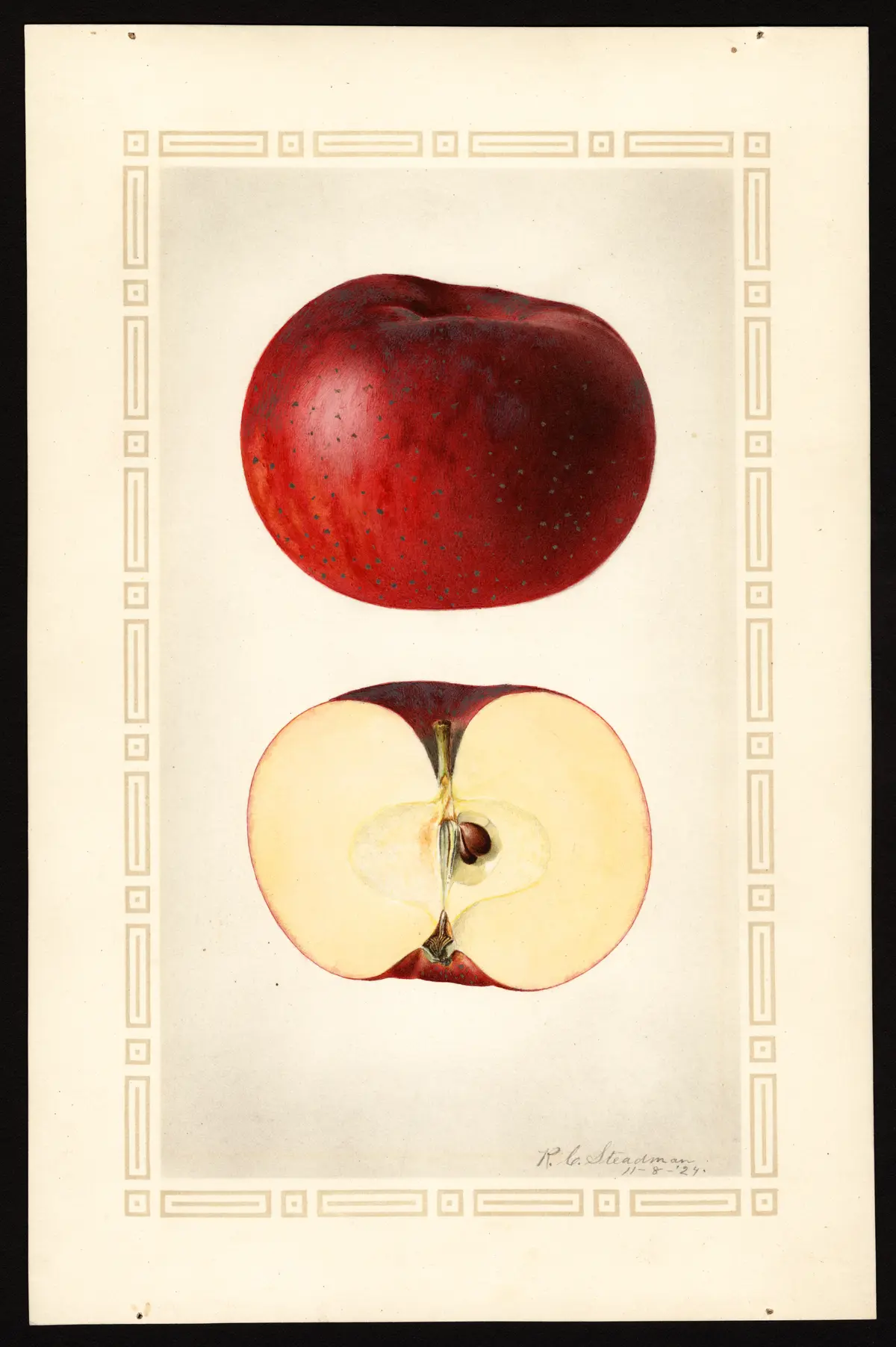
USDA Pomological Watercolor Collection
Evening Party
Origin / History
Evening Party originated in Berks County, Pennsylvania. Warder says it was brought into notice by "the late lamented Dr. Brinkle, of Philadelphia," in his ad-interim reports, and also in Hoffy's Fruits. Beach's earliest reference is Brinckle's colored plate in the Horticulturist of 1855. Elliott in 1865 called it "a new variety that promises valuable for small gardens."
Warder, calling it "this excellent dessert fruit," says it had been "tested with entire satisfaction" by J. D. G. Nelson, President of the Indiana Horticultural Society, "who always has admirers of the fruit exhibited by him at the winter meetings." By 1905 Beach records it as known in cultivation for fifty years, "but little grown in New York," with its cultivation not being extended. Lowther's station table of 1914 lists it from three reporting stations in the Central Division, noted as "reported in more than one division," and from none in the Northern or Southern Divisions.
Tree
Tree vigorous, healthy (Thomas), roundish, upright spreading with slender branches (Downing), or with long spreading branches. Beach calls it medium in size and only moderately vigorous.
Young shoots reddish to dark reddish-brown, slender to rather stout, curved at base, with internodes long to very long. Downing gives the young shoots as dark grayish brown with many small dots. Old wood gray (Elliott). Bark generally dull brownish-red with a rather strong undertone of olive-green in places; scarf-skin uniform, moderately light. Lenticels inconspicuous, raised, numerous, above medium to rather small, roundish. Buds medium size, moderately obtuse, quite pubescent (Beach).
The fruit hangs well to the tree, and the foliage remains until quite late (Downing).
A good bearer (Thomas), productive (Budd and Hansen). Beach reports that some find the tree unproductive, while others report it a biennial bearer producing so abundantly that the fruit is small if it is not thinned and the tree well pruned.
Fruit
Size: Small to above medium, most authors giving small or medium. Beach gives above medium to rather small and says it is usually below medium in size. Thomas alone calls it rather large.
Form: Oblate to roundish, roundish flattened, quite flat, slightly oval (Thomas). Regular (Warder), pretty symmetrical and uniform (Beach), though Downing finds the sides often unequal.
Stem: Short, green, slender to medium in thickness, seldom exserted. Warder alone calls it medium.
Cavity: Deep, round, acute to acuminate, moderately broad to wide, regular and symmetrical, brown (Warder). Usually smooth, occasionally with outspreading russet rays (Beach); sometimes to often russeted (Downing, Thomas).
Calyx: Elliott, Warder, and Downing call it closed; Warder describes a small, closed eye. Beach finds it medium to large, open or partly closed. Segments or lobes long, acuminate, somewhat separated at the base. Calyx tube short, broad, conical; stamens median to marginal (Beach).
Basin: Abrupt, regular, open (Elliott), moderately deep to deep, moderately wide to rather large. Downing calls it even; Beach calls it slightly wrinkled.
Skin: Moderately thin, rather tough, smooth, glossy. Ground yellow, waxen yellow, greenish yellow, or pale yellow. The ground is chiefly shaded, mixed, mottled, blushed, splashed, and striped with red, the stripes carmine (Warder), indistinct and sparing (Beach), or dark crimson (Budd and Hansen). It becomes dark red, almost purplish, in the sun. The deep red color is apt to overspread the basin, while the yellow ground color is conspicuous around the cavity. When highly colored it is "decidedly attractive," but Beach says it often does not color well.
Dots: Numerous, distinct, gray or light, pretty thickly studded, especially near the calyx. Beach describes large pale dots mingled with many that are small, whitish and submerged, or with a minute russet point.
Flesh and flavor: Flesh whitish, yellowish white, light yellow, or tinged with yellow. Fine to very fine-grained, moderately firm, crisp to rather crisp, tender, juicy to very juicy. Flavor subacid, aromatic, vinous. Downing gives "a brisk saccharine, somewhat vinous, aromatic flavor," and Beach "mild subacid mingled with sweet, somewhat aromatic," calling it "a pleasant flavored dessert fruit."
Quality very good to best: "very good" (Downing, Lowther's table), "very good to best" (Beach), "excellent to best" (Budd and Hansen), and "first quality, or very best, for the dessert" (Warder). Downing calls it "an excellent dessert fruit," and Elliott a "fine dessert fruit."
Core and seeds: Core medium to small, regular, touching the eye, somewhat abaxile to axile; axis short. Warder calls the core closed, while Beach finds the cells partly open, usually pretty symmetrical, with core lines meeting or slightly clasping. Carpels roundish to elliptical, slightly tufted (Beach). Seeds short, wide, dark (Warder); medium in size, moderately wide, plump, obtuse to acute (Beach).
Season
Mid-winter, December into March. Most authors give December and January, and Beach says it is in season at Christmas. Elliott alone extends it to March.
Uses
A dessert apple, "for the dessert, or the evening party" (Warder). Warder says it "takes the place at mid-winter which is occupied in summer by the Early Joe, and in autumn by the Jefferies, Dr. Watson and Cooper." Lowther's table gives its use as both kitchen and market. Beach does not recommend it for commercial planting.
Subtypes / Variants
Not described in source.
Other
Figured by Warder (Fig. 91). Beach's references also cite figures in Downing (1857) and Budd-Hansen (1903). They list further notices in Elliott (1859), the Am. Pom. Soc. Cat. (1873), the Mich. Hort. Soc. Rpt. (1881), Thomas (1885), Bailey's An. Hort. (1892), and Buckman in the Rural N. Y. (1895).
Book Sources
Described in 7 period pomological works
- Warder, American Pomology: Apples (1867)
- Beach, The Apples of New York Vol. 1 (1905)
- Downing, Fruits and Fruit Trees of America (1900)
- Budd & Hansen, Systematic Pomology (1914)
- Elliott, The Western Fruit Book (1865)
- Lowther (ed.), Encyclopedia of Practical Horticulture (1914)
- Thomas, The American Fruit Culturist (1903)
Nursery Catalog Sources
Found in 3 catalogs (1900–1913) from Illinois
- Central Experimental Farm , Dominion Department of Agriculture, Agassiz, British Columbia (under test; Bulletin No. 3, Second Series) — 1900
- Benjamin Buckman (personal inventory) , Farmingdale , Illinois — 1901
- Benjamin Buckman (personal inventory) , Farmingdale , Illinois — 1913
View original book sources (7)
— F.R. Elliott, The Western Fruit Book (1865)Evening Party.
From Berks Co., Pa. Fruit, medium, roundish flattened, greenish yellow, shaded with red ; stem, short ; cavity, deep ; calyx, closed ; basin, open ; flesh, juicy, tender, crisp, fine dessert fruit ; core, medium. December to March. Young shoots, reddish ; old wood, gray. A new variety that promises valuable for small gardens.
— John A. Warder, American Pomology: Apples (1867)Evening Party.
This excellent dessert fruit originated in Berks County, Pennsylvania, and was brought into notice by the late lamented Dr. Brinkle, of Philadelphia, in his ad-interim reports, and also in Hoffy's Fruits. It has been tested with entire satisfaction by J. D. G. Nelson, President of the Indiana Horticultural Society, who always has admirers of the fruit exhibited by him at the winter meetings. This apple takes the place at mid-winter which is occupied in summer by the Early Joe, and in autumn by the Jefferies, Dr. Watson and Cooper.
Fig. 91.—EVENING PARTY.
Fruit medium to small, regular, quite flat; Surface smooth, mixed red, and carmine stripes on waxen-yellow ground; Dots numerous, distinct, gray.
Basin abrupt, regular deep; Eye small, closed; Segments long.
Cavity wide, deep, regular, brown; Stem medium, green, slender.
Core small, regular, closed, touching the eye; Axis short; Seeds short, wide, dark; Flesh light yellow, very fine-grained, tender, juicy; Flavor sub-acid, aromatic; first quality, or very best, for the dessert, or the evening party, during December and January.
— A.J. Downing, The Fruits and Fruit Trees of America (1900)Evening Party.
Origin, Berks Co., Pa. Tree vigorous, roundish, upright spreading, with slender branches. Young shoots dark grayish brown, many small dots.
The fruit hangs well to the tree, and the foliage remains until quite late.
Fruit small or medium, oblate, sides often unequal, yellow, chiefly shaded, splashed, and striped with red, becoming dark red in the sun, pretty thickly studded with light dots, especially near the calyx. Stalk short, inserted in a round, deep, acute cavity, sometimes russeted. Calyx closed. Basin rather large and even. Flesh juicy, whitish, tender, crisp, with a brisk saccharine, somewhat vinous, aromatic flavor, an excellent dessert fruit. Very good. December and January.
— John J. Thomas, The American Fruit Culturist (1903)Evening Party. Rather large, oblate, slightly oval; yellow, striped with red; stalk short, inserted in a round, deep cavity, often russeted; calyx closed, basin large; flesh juicy, tender, crisp, with a vinous, aromatic flavor. An excellent dessert fruit. Tree health, vigorous, a good bearer. December and January. Pennsylvania.
— S.A. Beach, The Apples of New York, Vol. 1 (1905)EVENING PARTY.
REFERENCES. 1. Brinckle, Horticulturist, 10:539. 1855. col. pl. 2. Downing, 1857:77. fig. 3. Elliott, 1859:137. 4. Warder, 1867:433. fig. 5. Am. Pom. Soc. Cat., 1873. 6. Mich. Hort. Soc. Rpt., 1881:310. 7. Thomas, 1885:233. 8. Bailey, An. Hort., 1892:238. 9. Buckman, Rural N. Y., 54:806. 1895. 10. Budd-Hansen, 1903:78. fig.
A pleasant flavored dessert fruit which is in season at Christmas. Some find the tree unproductive but others report that it is a biennial bearer producing so abundantly that the fruit is small if it is not thinned and the tree well pruned. When highly colored it is decidedly attractive but often it does not color well and usually is below medium in size. It is not recommended for commercial planting.
Historical. Origin, Berks county, Pa. (4). It has been known in cultivation for fifty years but it is but little grown in New York and its cultivation is not being extended.
TREE.
Tree medium in size, moderately vigorous. Form roundish with long spreading branches. Twigs dark reddish-brown, slender to rather stout, curved at base; internodes long to very long. Bark generally dull brownish-red with a rather strong undertone of olive-green in places; scarf-skin uniform, moderately light. Lenticels inconspicuous, raised, numerous, above medium to rather small, roundish. Buds medium size, moderately obtuse, quite pubescent.
FRUIT.
Fruit above medium to rather small. Form oblate to roundish, pretty symmetrical, uniform. Stem short, medium in thickness, seldom exserted. Cavity acute to acuminate, deep, moderately broad, usually smooth, occasionally with outspreading russet rays, symmetrical. Calyx medium to large, open or partly closed; lobes long, acuminate, somewhat separated at the base. Basin abrupt, moderately deep to deep, moderately wide, slightly wrinkled. Skin moderately thin, rather tough, smooth, glossy, greenish or pale yellow mottled and blushed with red and indistinctly and sparingly striped with carmine becoming a dark, almost purplish, red in the sun; the deep red color is apt to overspread the basin while the yellow ground color is conspicuous around the cavity. Dots large, pale, mingled with many that are small, whitish and submerged or with minute russet point. Calyx tube short, broad, conical. Stamens median to marginal. Core medium to small, somewhat abaxile to axile; cells usually pretty symmetrical, partly open; core lines meeting or slightly clasping. Carpels roundish to elliptical, slightly tufted. Seeds medium in size, moderately wide, plump, obtuse to acute. Flesh tinged with yellow, moderately firm, fine, rather crisp, tender, very juicy, mild subacid mingled with sweet, somewhat aromatic, very good to best. Season December and January.
— J.L. Budd & N.E. Hansen, American Horticultural Manual, Part II: Systematic Pomology (1914)Evening Party.—Origin, Berks Co., Pennsylvania; tree vigorous and productive.
Fruit small to medium, oblate, often unequal, slightly oval; surface smooth, waxen yellow, with dark crimson splashes and stripes, mixed dark red on sunny side; dots many, distinct, gray; cavity deep, acute, wide, regular, often russeted; stem short, slender, green; basin abrupt, smooth, deep, large; calyx small, closed; segments long. Core small, closed, meeting; axis short; flesh yellowish white, fine-grained, tender, juicy, vinous, aromatic subacid, excellent to best. December and January.
— Granville Lowther (ed.), Encyclopedia of Practical Horticulture (1914)Evening Party. Size: medium. Form: flat. Color: red. Quality: very good. Use: both kitchen and market. Season: winter. Northern Division reporting stations: none recorded. Central Division reporting stations: 3 (reported in more than one division). Southern Division reporting stations: none recorded.