Jefferis
Apple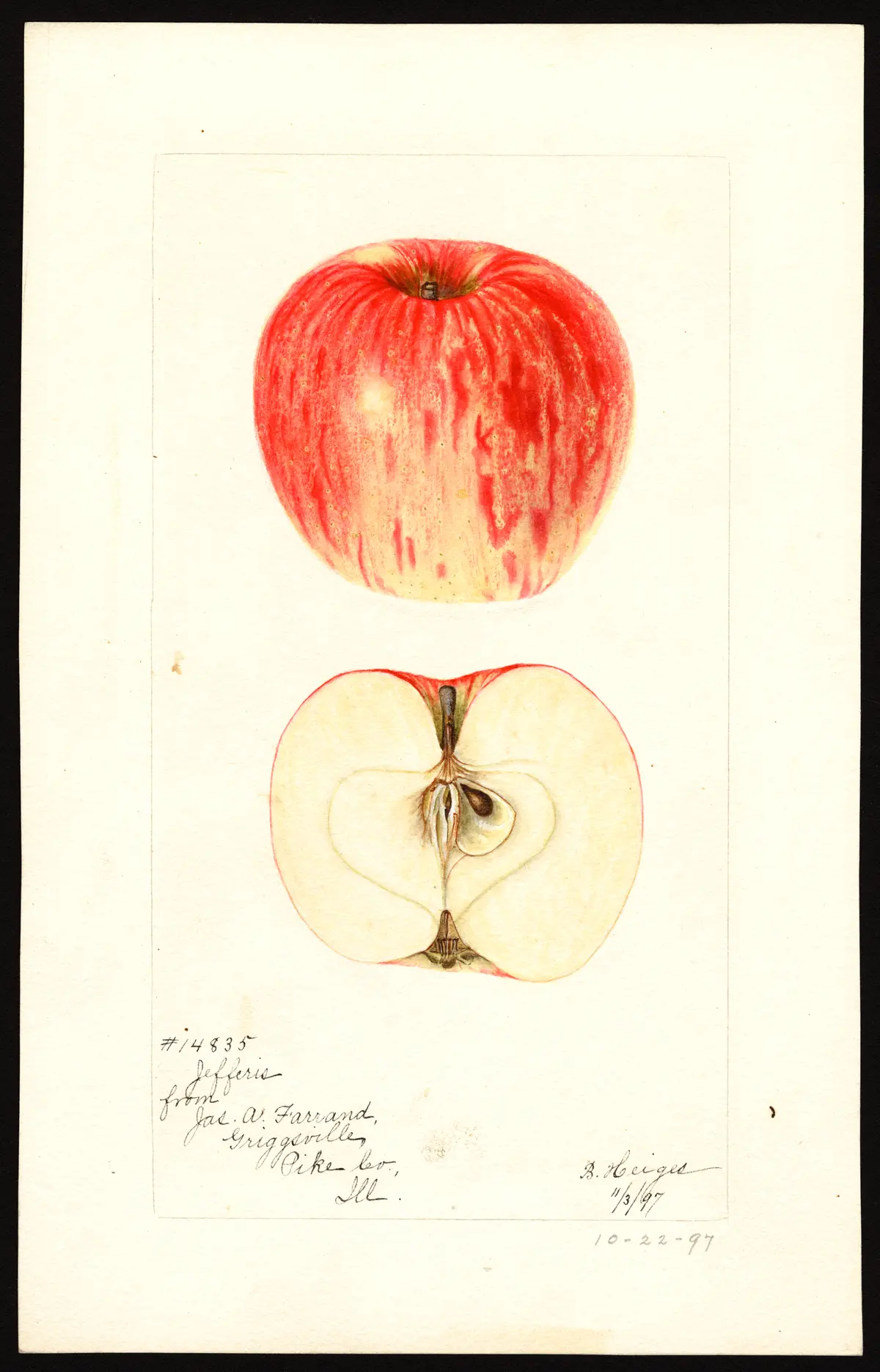
USDA Pomological Watercolor Collection
Jefferis
Origin / History
Jefferis originated with Isaac Jefferis of Newlin township, Chester County, Pennsylvania. It was named after the originator by the Committee of the Pennsylvania Horticultural Society, which awarded the variety the premium for the best seedling apple exhibited in 1848 (Beach; Lowther). It is first recorded in 1848 (Hedrick), with the USDA survey placing the origin in Pennsylvania ca. 1840. The variety was first described by the ad-interim committee of the Pennsylvania Horticultural Society, and also in the Farm Journal for 1853 by David Townsend of Westchester, Pa. (Warder). Thomas gives the origin as West Chester, Pa. By the early twentieth century it was grown in all of the eastern states (Hedrick). USDA ARS clonal records of 1963 document Jefferis material distributed from C & O Nursery Co., Wenatchee, Wash. (Station No. A33325); from Stark Bros. Nursery, Louisiana, Mo. (a seedling under Station No. OhW); from D. Wilson Nursery, Marshalltown, Ia., 1958; from AES Geneva, N.Y., 1958; and from Lloyd Bennett, East Walla Walla, Wash. (Station No. AP-H-95, M-759). Reporting stations included WyC (Cheyenne, Wyo.), PaU (University Park, Pa.), IlU (Urbana, Ill.), OrC (Corvallis, Ore.), NyG (Geneva, N.Y.), WaP (Prosser, Wash.), and WaM (Moxee Quarantine Station, Moxee, Wash.).
Tree
Tree medium in size, healthy, hardy, and moderately vigorous (Beach, Hedrick); described as a moderate grower by Downing, Elliott, Budd-Hansen, and the USDA Wilson Nursery report, and as "rather a vigorous grower" by Lowther. Form upright (Elliott, Hedrick) to roundish, open (Beach, Hedrick). Productive and a constant, abundant bearer (Warder, Elliott, Downing, Budd-Hansen); comes into bearing moderately early and is a reliable cropper, yielding full crops biennially (Beach, Lowther). Hardy far north (Thomas).
Twigs short, straight, slender; internodes long (Beach). Young wood light reddish brown, smooth (Downing). Bark brown mingled with olive-green, lightly streaked with scarf-skin; slightly pubescent (Beach). Lenticels scattering, small, oblong, not raised (Beach). Buds small, plump, obtuse, free, pubescent (Beach). Foliage bright green (Warder).
Fruit
Size
Full medium (Warder); medium (Downing, Beach, Lowther); small to medium and very uniform in size and shape (Beach); small and uniform in size and shape (Hedrick); medium or rather large (Thomas, Budd-Hansen); fruit small, oblate, red in one USDA Stark Bros. report; medium or small, round-oblate, slightly inclined to conical in the USDA D. Wilson Nursery report. Beach and Lowther note the variety is apt to be deficient in size and lacks uniformity, qualities which (with uneven ripening and unattractive color) condemn it for commercial planting though make it most deserving of a place in the home orchard (also Hedrick).
Form
Oblate (Warder); oblate, inclining to conic (Downing); roundish flattened (Elliott); round oblate (Thomas); roundish oblate, very regular (Budd-Hansen); roundish oblate often inclined to conic, regular or obscurely ribbed (Beach); round-oblate, conic, regular or obscurely ribbed (Hedrick).
Stem / Stalk
Medium to long (Warder, Budd-Hansen); medium length, thick to moderately slender (Beach); medium length, thick (Hedrick); very short, slender (Thomas); very short, inserted in a rather large cavity (Downing); half inch, slender (Elliott).
Cavity
Medium, regular, brown (Warder); rather large (Downing); narrow, deep (Elliott); deep (Thomas); rather large, regular, acuminate with slight trace of russet (Budd-Hansen); acute to acuminate, medium in depth to deep, medium to broad, symmetrical, russeted but slightly if at all (Beach); acute, medium in depth, broad, symmetrical (Hedrick).
Calyx / Eye
Eye small, closed (Warder); calyx closed, set in a round open basin (Downing); calyx nearly closed, woolly (Elliott); calyx closed; segments flat convergent, large, leafy (Budd-Hansen); calyx small to medium, closed or partly open; lobes short, rather broad, acute (Beach); calyx small, closed or open; lobes short, broad, acute (Hedrick).
Basin
Wide, regular (Warder, Budd-Hansen); round and open (Downing); deep, regular (Elliott); deep (Thomas); wide, smooth, abrupt, medium deep (Budd-Hansen); moderately shallow to rather deep, moderately wide, somewhat abrupt, smooth or nearly so, symmetrical (Beach); shallow to deep, wide, abrupt, smooth, symmetrical (Hedrick).
Skin
Surface smooth, yellow, mixed and splashed crimson (Warder); yellow, shaded and splashed with crimson, and thickly covered with large whitish dots (Downing); pale yellow, striped and stained with red, becoming dark in the sun, dotted with white spots and russet at stem (Elliott); yellow, red, and deep red, striped (Thomas); surface clear waxen yellow, handsomely shaded, striped and splashed dark crimson (Budd-Hansen); yellow, blushed and splashed with red (Beach, Lowther); skin thin, tough, greenish-yellow or pale yellow more or less blushed and mottled with moderately dull red overlaid with narrow splashes and stripes of carmine (Beach); skin thin, tough, pale yellow, blushed and mottled with dull red overlaid with narrow splashes and stripes of carmine (Hedrick); pale yellow with dull red blush (USDA Wilson Nursery report).
Dots
Large, scattered, yellow (Warder); large, whitish, thickly covering the surface (Downing); white spots with russet at stem (Elliott); numerous, large, whitish (Budd-Hansen); small, scattering, inconspicuous, submerged or russet (Beach, Hedrick).
Flesh and Flavor
Yellow, breaking, fine-grained, juicy; flavor sub-acid, aromatic, delicious; quality very good (Warder). White, tender, juicy, with a rich, mild, subacid flavor; very good (Downing). White, crisp, tender, juicy; "best" (Elliott). Yellowish white, remarkably tender and juicy; flavor very pleasant (Thomas). Yellowish white, very juicy, tender, aromatic, mild subacid, very good (Budd-Hansen). Tender, mild subacid, delicious (Beach, Lowther). Yellowish-white, firm, fine, crisp, tender, very juicy, mild subacid, very good (Beach, Hedrick; the USDA Wilson Nursery report likewise gives "yellow-white, firm, fine, crisp, very juicy, very good"). Hedrick summarizes the fruits as "tender, pleasantly acidulous, rich, delicious." USDA IlU reported "high quality, matures Aug."
Core / Seeds
Core small, closed, regular, clasping; seeds numerous, large, brown (Warder). Core small, closed, clasping; cells obovate, slit; tube funnel-shaped; stamens median; seeds numerous, long-pointed (Budd-Hansen). Calyx tube narrow, conical to funnel-shape; stamens marginal to median; core small, axile, or nearly so; cells slightly open; core lines somewhat clasping or meeting; carpels elliptical to somewhat obovate, emarginate, sometimes tufted; seeds numerous, medium to rather large, wide, long, flat, very irregular, obtuse (Beach). Calyx-tube narrow, conical; stamens marginal; core small, axile; cells open; core-lines clasping; carpels elliptical, emarginate, sometimes tufted; seeds numerous, large, wide, long, flat, very irregular, obtuse (Hedrick).
Season
August, September and October (Warder). September, all month in use (Downing). September and October (Elliott). First of autumn (Thomas). September, October (Budd-Hansen). Begins to ripen in September and continues in season till early winter; commercial limit October (Beach, Lowther — with Lowther adding that as a commercial apple it is not good later than the last of October in the Northern states, and ripens earlier in the Middle and Southern states). September to January (Beach, Hedrick, and the USDA Wilson Nursery report). USDA IlU recorded maturity in August. The variety ripens unevenly (Beach, Lowther, Hedrick).
Uses
Table and market (Warder). An excellent / good variety for the home orchard but not for commercial planting because it ripens unevenly, is apt to be deficient in size, and is not especially attractive in color (Beach, Lowther, Hedrick). Hedrick adds it is "most deserving of a place" in the home orchard.
Subtypes / Variants
Not described in source.
Other
Not described in source.
Book Sources
Described in 9 period pomological works
- Beach, The Apples of New York Vol. 2 (1905)
- Downing, Fruits and Fruit Trees of America (1900)
- Fisher, A Survey of Apple Clones in the United States (1963)
- Thomas, The American Fruit Culturist (1903)
- Warder, American Pomology: Apples (1867) — listed as Jefferies
- Budd & Hansen, Systematic Pomology (1914)
- Elliott, The Western Fruit Book (1865)
- Lowther (ed.), Encyclopedia of Practical Horticulture (1914)
- Hedrick, Cyclopedia of Hardy Fruits (1922)
Nursery Catalog Sources
Found in 31 catalogs (1889–1947) from Illinois, Maryland, Massachusetts, Missouri, New Jersey, Oregon, Pennsylvania, Washington
- Palouse Nursery and Pleasant Dale Fruit Farm , Colfax, Washington Territory (situated two miles northeast of Colfax) - undated (single-page broadside flyer; "Washington Territory" suggests pre — 1889
- William H. Moon Co. , Morrisville, Bucks County , Pennsylvania — 1890
- Rogers Nursery Co. , Moorestown , New Jersey — 1893
- The Vineland Nurseries (Kelsey & Co. , Proprietors), St. Joseph, Missouri (Office: 13th and Atchison Sts., 2 Blocks East of the Citizens St. Car Line) — 1894
- Stark Bros. Nurseries & Orchards Co. , Louisiana , Missouri — 1896
- Reading Nursery , Jacob W. Manning, Proprietor, Reading , Massachusetts — 1898
- Brown Brothers Co. , Continental Nurseries, Rochester, NY (also operated from Toronto, Canada) — 1899
- Central Experimental Farm , Dominion Department of Agriculture, Agassiz, British Columbia (under test; Bulletin No. 3, Second Series) — 1900
- Washington Nursery Co. , Toppenish , Washington — 1901
- Brown Brothers Co. , Continental Nurseries, Rochester, NY (also operated from Toronto, Canada) — 1901
- Benjamin Buckman (personal inventory) , Farmingdale , Illinois — 1901
- Stark Bros. Nurseries & Orchards Co. , Louisiana , Missouri — 1906
- Milton Nursery Co. (A. Miller & Sons , Proprietors), Milton , Oregon — 1909
- Wm. J. Corse (successor to Robert Sinclair / Sinclair Nurseries) , Baltimore , Maryland — 1909
- Washington Nursery Company , Toppenish , Washington — 1909
- Island Nurseries & Fruit Farm , Vashon (Vashon Island) , Washington — 1910
- Stark Bros. Nurseries & Orchards Co. , Louisiana , Missouri — 1910
- Island Nurseries & Fruit Farm , Vashon (Vashon Island) , Washington — 1911
- Stark Bros. Nurseries & Orchards Co. , Louisiana , Missouri — 1911
- Ballygreen Nurseries , Hanford , Washington — 1912
- Pacific Nursery Company , Portland , Oregon — 1912
- Stark Bros. Nurseries & Orchards Co. , Louisiana , Missouri — 1912
- Vineland Nurseries Company , Clarkston , Washington — 1912
- Washington Nursery Company , Toppenish , Washington — 1912
- Van Holderbeke Nursery Co. , Incorporated, Spokane, Washington (nurseries at Otis Orchards WA, Pasadena WA, Kennewick WA) — 1913
- Benjamin Buckman (personal inventory) , Farmingdale , Illinois — 1913
- Oregon Nursery Co. , Orenco , Oregon — 1920
- Columbia & Okanogan Nursery Co. , Wenatchee , Washington — 1925
- Stark Bro's Nurseries , Louisiana , Missouri — 1932
- Milton Nursery Co. , Milton-Freewater , Oregon — 1947
- North-Western Nurseries , Walla Walla , Washington
View original book sources (9)
— John A. Warder, American Pomology: Apples (1867)Jefferies.
This delicious autumn apple originated in Chester County, Pennsylvania, and was first described by the ad-interim committee of the Pennsylvania Horticultural Society; also in the Farm Journal, for 1853, by David Townsend, of Westchester, Pa.
Tree healthy, sufficiently vigorous, shoots slender, foliage bright green; productive, early bearer.
Fruit full medium, oblate, regular; Surface smooth, yellow, mixed and splashed crimson; Dots large, scattered, yellow.
Basin wide, regular; Eye small, closed.
Cavity medium, regular, brown; Stem medium to long.
Core small, closed, regular, clasping; Seeds numerous, large, brown; Flesh yellow, breaking, fine-grained, juicy; flavor sub-acid, aromatic, delicious; Quality very good, for table and market, during August, September and October.
— A.J. Downing, The Fruits and Fruit Trees of America (1900)Jefferis.
Origin, Chester Co., Pa. Growth moderate, very productive. A fair and handsome fruit of excellent quality, in use all of September. Young wood light reddish brown, smooth.
Fruit medium, oblate, inclining to conic, yellow, shaded and splashed with crimson, and thickly covered with large whitish dots. Stalk very short, inserted in a rather large cavity. Calyx closed, set in a round open basin. Flesh white, tender, juicy, with a rich, mild, subacid flavor. Very good. September.
— S.A. Beach, The Apples of New York, Vol. 2 (1905)JEFFERIS.
References. 1. Thomas, 1849:149. 2. Mag. Hort., 18:491. 1852. 3. Am. Pom. Soc. Cat., 1854. 4. Elliott, 1854:139. 5. Mag. Hort., 21:62. 1855. 6. Gregg, 1857:44. 7. Downing, 1857:183. fig. 8. Hooper, 1857:479. 9. Mag. Hort., 24:109. 1858. 10. Hoffy, N. A. Pom., 1860. col. pl. 11. Horticulturist, 17:104, 150. 1862. 12. Warder, 1867:440. fig. 13. Barry, 1883:338. 14. Van Deman, U. S. Pom. Rpt., 1888:570. 15. Lyon, Mich. Hort. Soc. Rpt., 1890:292. 16. Bailey, An. Hort., 1892:242. 17. Burrill and McCluer, Ill. Sta. Bul., 45:309, 323. 1896. 18. Powell, Del. Sta. Bul., 38:18. 1898. 19. Macoun, Can. Dept. Agr. Rpt., 1901:96. 20. Beach, Western N. Y. Hort. Soc. Rpt., 1901:76. 21. Budd-Hansen, 1903:105. 22. Bruner, N. C. Sta. Bul., 182:21. 1903. 23. Farrand, Mich. Sta. Bul., 205:45. 1903. 24. Powell and Fulton, U. S. B. P. I. Bul., 48:145. 1903. 25. Beach and Clark, N. Y. Sta. Bul., 248:126. 1904.
Synonyms. Everbearing (20). Grantham (17). Jefferies (10, 12, 14, 17, 20). Jefferis (3, 4, 7, 13, 15, 16, 18, 19, 21, 22, 23, 24, 25). Jeffries (1, 2, 5, 6, 8, 9, 11).
Fruit of medium size, yellow, blushed and splashed with red; flesh tender, mild subacid, delicious. It begins to ripen in September and continues in season till early winter. Commercial limit October (25). It is an excellent variety for the home orchard but not for commercial planting because it ripens unevenly, is apt to be deficient in size and is not especially attractive in color. The tree is a moderately vigorous grower, hardy, healthy, comes into bearing moderately early and is a reliable cropper yielding full crops biennially.
Historical. Originated with Isaac Jefferies, Newlin township, Chester county, Pa. It was named after the originator by the Committee of the Pennsylvania Horticultural Society which awarded this variety the premium for the best seedling apple exhibited in 1848 (10).
Tree.
Tree medium size, moderately vigorous. Form upright to roundish, open. Twigs short, straight, slender; internodes long. Bark brown mingled with olive-green, lightly streaked with scarf-skin; slightly pubescent. Lenticels scattering, small, oblong, not raised. Buds small, plump, obtuse, free, pubescent.
Fruit.
Fruit small to medium, very uniform in size and shape. Form roundish oblate often inclined to conic, regular or obscurely ribbed. Stem medium length, thick to moderately slender. Cavity acute to acuminate, medium in depth to deep, medium to broad, symmetrical, russeted but slightly if at all. Calyx small to medium, closed or partly open; lobes short, rather broad, acute. Basin moderately shallow to rather deep, moderately wide, somewhat abrupt, smooth or nearly so, symmetrical. Skin thin, tough, greenish-yellow or pale yellow more or less blushed and mottled with moderately dull red overlaid with narrow splashes and stripes of carmine. Dots small, scattering, inconspicuous, submerged or russet. Calyx tube narrow, conical to funnel-shape. Stamens marginal to median. Core small, axile, or nearly so; cells slightly open; core lines somewhat clasping or meeting. Carpels elliptical to somewhat obovate, emarginate, sometimes tufted. Seeds numerous, medium to rather large, wide, long, flat, very irregular, obtuse. Flesh yellowish-white, firm, fine, crisp, tender, very juicy, mild subacid, very good. Season September to January.
— Granville Lowther (ed.), Encyclopedia of Practical Horticulture (1914)Jefferis
Fruit of medium size, yellow, blushed and splashed with red. Flesh tender, mild, subacid, delicious. It begins to ripen in September and continues in season till early winter. As a commercial apple, it is not good later than the last of October, in the Northern states, and it ripens earlier in the Middle and Southern states. It is a good variety for the home orchard, but not for commercial planting, because it ripens unevenly, is likely to be deficient in size, and is not specially attractive in color. The tree is rather a vigorous grower, hardy, healthy, comes into bearing moderately early and is a reliable cropper.
Historical. This variety originated with Isaac Jefferis, Newlin township, Chester county, Pennsylvania. It was named after the originator by the committee of the Pennsylvania Horticultural Society which awarded this variety the premium for the best seedling apple exhibited in 1848.
— F.R. Elliott, The Western Fruit Book (1865)Jefferis. From Chester Co., Pa. Tree, moderate grower, upright habit, constant and abundant bearer. Fruit, roundish flattened, pale yellow, striped and stained with red, becoming dark in the sun, dotted with white spots and russet at stem ; stem, half inch, slender ; cavity, narrow, deep ; calyx, nearly closed, woolly ; basin, deep, regular ; flesh, white, crisp, tender, juicy ; best." September and October.
— John J. Thomas, The American Fruit Culturist (1903)Jefferis. Medium or rather large, round oblate; yellow, red, and deep red, striped; stalk very short, slender; cavity and basin deep; flesh yellowish white, remarkably tender and juicy; flavor very pleasant. Ripens first of autumn. Fig. 390. Origin, West Chester, Pa. Hardy far north.
— J.L. Budd & N.E. Hansen, American Horticultural Manual, Part II: Systematic Pomology (1914)Jefferis. — Origin, Chester Co., Pennsylvania; tree a moderate grower, productive.
Fruit medium or rather large, roundish oblate, very regular; surface clear waxen yellow, handsomely shaded, striped and splashed dark crimson; dots numerous, large, whitish; cavity rather large, regular, acuminate with slight trace of russet; stem medium to long; basin wide; smooth, abrupt, medium deep; calyx closed; segments flat convergent, large, leafy. Core small, closed, clasping; cells obovate, slit; tube funnel-shaped; stamens median; seeds numerous, long-pointed; flesh yellowish white, very juicy, tender, aromatic, mild subacid, very good. September, October.
— U.P. Hedrick, Cyclopedia of Hardy Fruits (1922)JEFFERIS.
Jefferis is one of the best fall apples fruits tender, pleasantly acidulous, rich, delicious. The trees, too, are satisfactory in all respects. But the apples ripen unevenly, are not attractive in color, and lack both size and uniformity, qualities which condemn the variety for any but the home orchard, where it is most deserving of a place.
Jefferis originated with Isaac Jefferis, Chester County, Pennsylvania, and is first recorded in 1848. It is grown in all of the eastern states.
Tree of medium size, vigorous, upright, open. Fruit small, uniform in size and shape, round-oblate, conic, regular or obscurely ribbed; stem of medium length, thick; cavity acute, medium in depth, broad, symmetrical; calyx small, closed or open; lobes short, broad, acute; basin shallow to deep, wide, abrupt, smooth, symmetrical; skin thin, tough, pale yellow, blushed and mottled with dull red overlaid with narrow splashes and stripes of carmine; dots small, scattering, inconspicuous, submerged or russet; calyx-tube narrow, conical; stamens marginal; core small, axile; cells open; core-lines clasping; carpels elliptical, emarginate, sometimes tufted; seeds numerous, large, wide, long, flat, very irregular, obtuse; flesh yellowish-white, firm, fine, crisp, tender, very juicy, mild, subacid; very good; September to January.
— H.H. Fisher (USDA ARS), A Survey of Apple Clones in the United States (1963)Multiple station reports recorded for the variety Jefferis. From C & O Nurs. Co., Wenatchee, Wash.; Station No. A33325; reporting station WyC (U.S. Horticultural Field Station, P.O. Box 1250, Cheyenne, Wyoming). Reporting station PaU (Agricultural Experiment Station, Pennsylvania State University, University Park, Pennsylvania). High quality, matures Aug.; reporting station IlU (Agricultural Experiment Station, University of Illinois, Urbana, Illinois). AES, Geneva, N.Y., 1958; reporting station OrC (Agricultural Experiment Station, Oregon State University, Corvallis, Oregon). From Stark Bros. Nurs., Louisiana, Mo.; seedling; fruit small, oblate, red; flavor good; Station No. OhW. Origin in Pa. ca. 1840; D. Wilson Nurs., Marshalltown, Ia., 1958; fruit medium or small, round oblate, slightly incline to conical; skin thin, tough, pale yellow with dull red blush; flesh yellow-white, firm, fine, crisp, very juicy, very good; Sept.-Jan.; tree medium size, moderately vigorous; reporting station NyG (Agricultural Experiment Station, Department of Pomology, Geneva, New York). From Lloyd Bennett, East Walla Walla, Wash.; Station No. AP-H-95, M-759; reporting stations WaP (Agricultural Research Service, Irrigation Experiment Station, Prosser, Washington) and WaM* (Moxee Quarantine Station, Moxee, Washington).