Fanny
Apple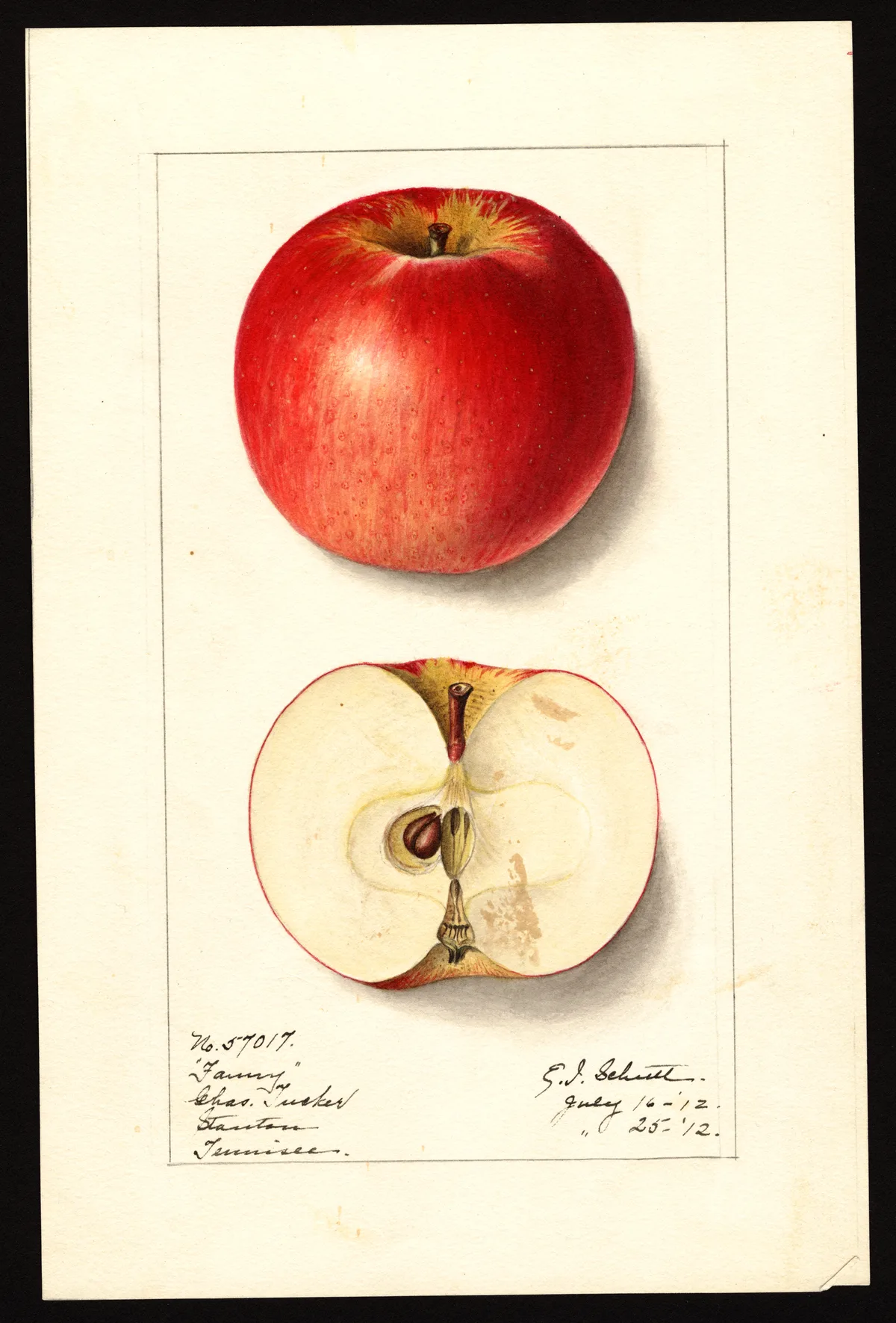
USDA Pomological Watercolor Collection
Fanny
Origin/History
Fanny originated near Strasburgh, Lancaster County, Pennsylvania, on the farm formerly owned by Jacob Beam (Downing). It originated with Dr. John K. Eshelman of Lancaster County, Pennsylvania, previous to 1869, when Downing first called attention to its merits (Beach; Hedrick). Thomas notes it was popular in the East. It had been but little disseminated in New York as of 1905 (Beach). Some regarded it as desirable for commercial planting, but at the New York Agricultural Experiment Station it did not prove so because it was somewhat deficient in size; on account of its beauty and excellent dessert quality it was worthy of being classed among the varieties desirable for the home orchard (Beach). Hedrick similarly concluded the apples are so deficient in size and ripen over so long a period that the variety is of value only for the home orchard.
Tree
Tree vigorous, spreading, very productive (Downing; Budd-Hansen). Beach describes it as moderately vigorous, coming into bearing moderately early, and a reliable annual cropper. Form flat, spreading, open, with moderately long to long, stout branches (Beach; Hedrick). Young wood dark grayish purple, two shades darker than Red Astrachan, and grayish (Downing). Twigs long, curved, moderately stout; internodes long. Bark brown tinged with olive-green, heavily streaked with scarf-skin; much pubescent. Lenticels quite numerous, medium size, round, not raised. Buds medium size, plump, obtuse, free, heavily pubescent (Beach).
Fruit
Size
Sources differ on size. Downing calls the fruit large; Thomas calls it large; Budd-Hansen describe it as above medium to large; Beach describes it as above medium to below medium size, pretty uniform in size and shape; Hedrick gives it as medium size, uniform in size and shape; Lowther lists size as medium. Beach and Hedrick both note the variety is somewhat deficient in size.
Form
Roundish oblate, slightly conic (Downing); roundish (Thomas); roundish oblate, slightly conical (Budd-Hansen); roundish, slightly oblate varying to somewhat oblong or ovate, regular or slightly ribbed (Beach); round-oblate, oblong or ovate, regular or slightly ribbed (Hedrick); flat (Lowther).
Stem
Short, small (Downing); short, slender (Budd-Hansen; Beach; Hedrick). Beach gives stem as short to medium, slender.
Cavity
Large, deep (Downing); large, deep, rather wide (Budd-Hansen); acute to nearly obtuse, medium in width and depth, sometimes russeted (Beach); acute, medium in width and depth, sometimes russeted (Hedrick).
Calyx
Closed, segments short (Downing); half open, segments short (Budd-Hansen); small to medium, closed or partly open; lobes rather short, narrow, acute (Beach); small, closed or partly open; lobes short, narrow, acute (Hedrick). Calyx tube rather wide, slightly funnel-form to conical with pistil point projecting into the base; stamens median to marginal (Beach); calyx-tube wide, funnel-form with pistil point projecting into the base; stamens median (Hedrick).
Basin
Medium, narrow, nearly smooth (Budd-Hansen); shallow to medium in depth, moderately wide, rather abrupt, usually furrowed (Beach); shallow, wide, abrupt, furrowed (Hedrick).
Skin
Deep rich crimson red, moderately sprinkled with light dots (Downing). Deep crimson (Thomas). Yellow, almost or wholly covered with deep rich crimson; dots few, yellow, obscure (Budd-Hansen). Thin, tender, smooth, clear yellow mostly overlaid with bright red indistinctly striped with carmine; dots small, yellowish (Beach). Thin, tender, smooth, yellow overlaid with bright red indistinctly striped with carmine; dots small, yellow (Hedrick). Lowther: striped or splashed (red).
Flesh / Flavor
White, a little stained next the skin, tender, juicy, pleasant subacid; very good (Downing). Tender, sub-acid, very good (Thomas). White, crisp, tender, slightly stained next skin, juicy, pleasant subacid; very good (Budd-Hansen). Whitish slightly tinged with yellow, moderately firm, fine, very tender, juicy, mild subacid; good to very good (Beach). Yellow, firm, fine, very tender, juicy, mild subacid; good to very good (Hedrick). Lowther rates quality as very good and describes the variety as an attractive bright red fruit of good dessert quality (Beach).
Core / Seeds
Core small (Downing; Budd-Hansen). Core below medium, somewhat abaxile (Beach) / abaxile (Hedrick); cells open; core lines clasping. Carpels broadly ovate to elliptical, slightly emarginate (Beach); carpels broadly ovate, emarginate (Hedrick). Seeds medium to large, moderately wide, flat, plump, acute (Beach); seeds large, wide, flat, plump, acute (Hedrick).
Season
August (Downing; Thomas). August, September (Budd-Hansen). Lowther: summer. Beach: begins to ripen about the first of September and continues in season till late fall; season September to November or later. Hedrick: September to November or later; ripens over a long period.
Uses
Dessert/home orchard (Beach; Hedrick). Downing described it as a new apple of great promise as a market sort. Lowther lists its use as both kitchen and market. Beach notes some regard it as desirable for commercial planting, though it did not prove so at the New York Station due to deficient size.
Subtypes/Variants
Not described in source.
Other
Lowther reports it as adapted to Northern Division 1, and reported as adapted to more than one of the three divisions.
Book Sources
Described in 6 period pomological works
Nursery Catalog Sources
Found in 12 catalogs (1886–1913) from Alabama, Illinois, Missouri, Washington
- Huntsville Wholesale Nurseries (Jessie S. Moss , Proprietor; W.F. Heikes, Manager), Huntsville , Alabama — 1886
- Missouri Nursery Co. , Louisiana , Missouri — 1891
- Stark Bros. Nurseries & Orchards Co. , Louisiana , Missouri — 1896
- J.V. Cotta (Cotta Nursery) , Carroll County , Illinois — 1898
- Stark Bros. Nurseries & Orchards Co. , Louisiana , Missouri — 1898
- Benjamin Buckman (personal inventory) , Farmingdale , Illinois — 1901
- Stark Bros. Nurseries & Orchards Co. , Louisiana , Missouri — 1906
- Stark Bros. Nurseries & Orchards Co. , Louisiana , Missouri — 1910
- Stark Bros. Nurseries & Orchards Co. , Louisiana , Missouri — 1911
- Stark Bros. Nurseries & Orchards Co. , Louisiana , Missouri — 1912
- Vineland Nurseries Company , Clarkston , Washington — 1912
- Benjamin Buckman (personal inventory) , Farmingdale , Illinois — 1913
View original book sources (6)
— A.J. Downing, The Fruits and Fruit Trees of America (1900)Fanny.
Originated near Strasburgh, Lancaster Co., Pa., on the farm formerly owned by Jacob Beam. Tree vigorous, spreading, very productive. Young wood dark grayish purple, two shades darker than Red Astrachan, and grayish.
Fruit large, roundish oblate, slightly conic, deep rich crimson red, moderately sprinkled with light dots. Stalk short, small. Cavity large, deep. Calyx closed. Segments short. Flesh white, a little stained next the skin, tender, juicy, pleasant subacid. Very good. Core small. August. A new Apple of great promise as a market sort.
— S.A. Beach, The Apples of New York, Vol. 2 (1905)FANNY.
REFERENCES. 1. Downing, 1869:173. fig. 2. Thomas, 1875:499. 3. Am. Pom. Soc. Cat., 1877:8. 4. Barry, 1883:333. 5. Am. Pom. Soc. Rpt., 1887:93. 6. Bailey, An. Hort., 1892:239. 7. Rural N. Y., 55:642, 706, 707. 1896. fig. 8. Ib., 56:292. 9. Budd-Hansen, 1903:83. fig.
SYNONYMS. None.
This is an attractive bright red fruit of good dessert quality. It begins to ripen about the first of September, and continues in season till late fall. The tree is quite vigorous, comes into bearing moderately early and is a reliable annual cropper. Some regard it as desirable for commercial planting (7, 8), but it has not proved so at this Station because it is somewhat deficient in size. On account of its beauty and excellent dessert quality it is worthy of being classed among the varieties desirable for the home orchard.
Historical. Originated with Dr. John K. Eshelman, Lancaster Co., Pa. (7). It has been as yet but little disseminated in New York.
TREE.
Tree moderately vigorous with moderately long, stout branches. Form flat, spreading, open. Twigs long, curved, moderately stout; internodes long. Bark brown tinged with olive-green, heavily streaked with scarf-skin; much pubescent. Lenticels quite numerous, medium size, round, not raised. Buds medium size, plump, obtuse, free, heavily pubescent.
FRUIT.
Fruit above medium to below medium size, pretty uniform in size and shape. Form roundish, slightly oblate varying to somewhat oblong or ovate, regular or slightly ribbed. Stem short to medium, slender. Cavity acute to nearly obtuse, medium in width and depth, sometimes russeted. Calyx small to medium, closed or partly open; lobes rather short, narrow, acute. Basin shallow to medium in depth, moderately wide, rather abrupt, usually furrowed. Skin thin, tender, smooth, clear yellow mostly overlaid with bright red indistinctly striped with carmine. Dots small, yellowish. Calyx tube rather wide, slightly funnel-form to conical with pistil point projecting into the base. Stamens median to marginal. Core below medium, somewhat abaxile; cells open; core lines clasping. Carpels broadly ovate to elliptical, slightly emarginate. Seeds medium to large, moderately wide, flat, plump, acute. Flesh whitish slightly tinged with yellow, moderately firm, fine, very tender, juicy, mild subacid, good to very good.
Season September to November or later.
— Granville Lowther (ed.), Encyclopedia of Practical Horticulture (1914)Fanny: size medium; form flat; color striped or splashed (red); quality very good; use both kitchen and market; season summer; Northern Division 1 (reported as adapted to more than one of the three divisions).
— John J. Thomas, The American Fruit Culturist (1903)Fanny.* Fruit large, roundish; skin deep crimson; flesh tender, sub-acid, very good. Season, August. Popular in the East. Pennsylvania.
— J.L. Budd & N.E. Hansen, American Horticultural Manual, Part II: Systematic Pomology (1914)Fanny. — Origin, Pennsylvania; tree vigorous, spreading, very productive.
Fruit above medium to large, roundish oblate, slightly conical; surface yellow, almost or wholly covered with deep rich crimson; dots few, yellow, obscure; cavity large, deep, rather wide; stem short, slender; basin medium, narrow, nearly smooth; calyx half open; segments short. Core small; flesh white, crisp, tender, slightly stained next skin, juicy, pleasant subacid; very good. August, September.
— U.P. Hedrick, Cyclopedia of Hardy Fruits (1922)FANNY. The fruits of Fanny are beautiful and most excellent in quality, and the trees are very satisfactory; but the apples are so deficient in size and ripen over so long a period that the variety is of value only for the home orchard. Fanny originated at Lancaster, Pennsylvania, with Dr. John K. Eshelman, previous to 1869, when Downing called attention to its merits.
Tree vigorous, flat, spreading, open, with long, stout branches. Fruit medium size, uniform in size and shape, round-oblate, oblong or ovate, regular or slightly ribbed; stem short, slender; cavity acute, medium in width and depth, sometimes russeted; calyx small, closed or partly open; lobes short, narrow, acute; basin shallow, wide, abrupt, furrowed; skin thin, tender, smooth, yellow overlaid with bright red indistinctly striped with carmine; dots small, yellow; calyx-tube wide, funnel-form with pistil point projecting into the base; stamens median; core below medium, abaxile; cells open; core-lines clasping; carpels broadly ovate, emarginate; seeds large, wide, flat, plump, acute; flesh yellow, firm, fine, very tender, juicy, mild subacid; good to very good; September to November or later.