Fireside
Apple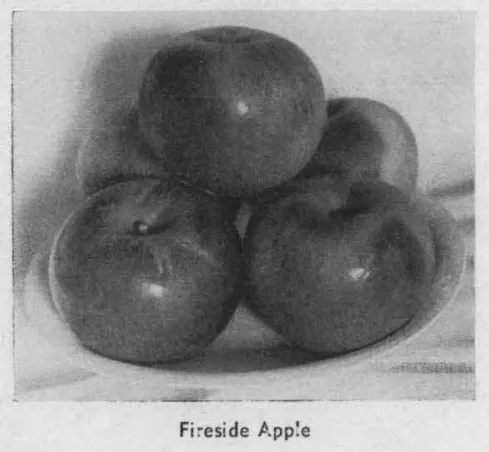
Fireside
Origin / History
Originated at the Minnesota Experiment Station as Minn. No. 993; parentage unknown. Introduced 1943 (introduced commercially in 1943, Zielinski). Following its introduction Fireside was widely planted in both home and commercial orchards, and proved highly productive and popular with consumers as a dessert fruit because of its rich, nonacid (subacid) quality (Alderman, Wilcox and Weir).
Tree
Tree large, vigorous, hardy and productive; habit moderately spreading, developing a slightly flattened head. Proved highly productive. Moderately susceptible to scab and fire blight, slightly susceptible to cedar rust. Late in ripening; Zielinski says it requires a long season to mature properly. Fruit hangs well on the trees and is easily picked (Zielinski). Promising in Oregon (Zielinski).
Fruit
Size: Large to very large, 2½ to 3½ inches in diameter (Zielinski); sometimes variable in size (Alderman, Wilcox and Weir).
Form: Roundish to slightly oblate, or round to conic; regular and uniform (Zielinski).
Stem: Slender, medium length.
Cavity: Deep, flaring, greenish.
Calyx: Closed to nearly closed; tube conic.
Basin: Medium to deep, medium-wide.
Skin: Medium-tough to thick and tough. Ground yellow, one-half to almost completely covered with bright, attractive medium red when well developed, lightly striped or splashed with dark red; Zielinski describes the color as medium dullish red, lightly striped with darker red bands. Color development may be lacking in northern sections (Alderman, Wilcox and Weir). In Oregon the fruit lacks a vivid, clear red color, many fruits tend to crack around the stem, and the fruit is susceptible to sunscald (Zielinski).
Dots: Small, russet.
Flesh and flavor: Flesh yellowish, firm to very firm, medium-tough to moderately tender, medium coarse (Zielinski), medium-juicy to only moderately juicy. Flavor very rich, pleasant mild subacid; Zielinski adds "rather sweet." Quality excellent for eating and fair for culinary use (Alderman, Wilcox and Weir); "good," especially for dessert purposes, but only fair for cooking (Zielinski).
Core and seeds: Core small.
Season
Late in ripening. Season November to April (Alderman, Wilcox and Weir). Ripens November 10 to 20; a winter variety, holding in storage until April or May (Zielinski).
Uses
Dessert fruit; fair for culinary use, only fair for cooking (Zielinski).
Subtypes / Variants
Not described in source.
Other
Not described in source.
Book Sources
Described in 2 period pomological works
View original book sources (2)
— W.H. Alderman, A.N. Wilcox & T.S. Weir, Fruit Varieties Developed at the University of Minnesota Fruit Breeding Farm (1957)Fireside. Minn. No. 993. Parentage unknown. Introduced 1943. Following its introduction in 1943, Fireside was widely planted in both home and commercial orchards. It proved to be highly productive and popular with consumers as a dessert fruit because of its rich, nonacid (subacid) quality. It is late in ripening, the fruits are sometimes variable in size and in northern sections may be lacking in color development. The tree is moderately susceptible to scab and fire blight, slightly susceptible to cedar rust. The tree is large, vigorous, hardy and productive; habit is moderately spreading, developing a slightly flattened head. The fruit is large, roundish to slightly oblate; the color when well developed is a bright, attractive medium-red, lightly striped or splashed with dark red, one-half to almost completely covering a yellow ground; dots small, russet; stem slender, medium length; cavity deep, flaring, greenish; basin medium to deep, medium-wide; calyx closed to nearly closed, tube conic; core small; skin medium-tough; flesh yellowish, firm, medium-tough, medium-juicy; flavor very rich, pleasant mild subacid; quality excellent for eating, fair for culinary use, season November to April.
— Quentin B. Zielinski, Apple Varieties for Oregon (1964)Fireside
This variety originated at the Minnesota Experiment Station of unknown parentage. Fireside was introduced commercially in 1943. The fruit is large to very large—2½ to 3½ inches in diameter—round to conic, regular, and uniform. Skin is thick and tough, medium dullish red, lightly striped with darker red bands. The flesh is yellowish, medium coarse, moderately tender, very firm, only moderately juicy, and rather sweet. The general quality is rated good, especially for dessert purposes, but only fair for cooking. This variety ripens late—November 10 to 20—and requires a long season to mature properly. The fruit hangs well on the trees and is easily picked. This winter variety holds in storage until April or May. It is promising in Oregon, but the fruit lacks a vivid, clear, red color. One apparent defect of Fireside under Oregon conditions is the tendency for many of the fruits to crack around the stem. Another disorder is susceptibility of the fruit to sunscald.