Garden Royal
Apple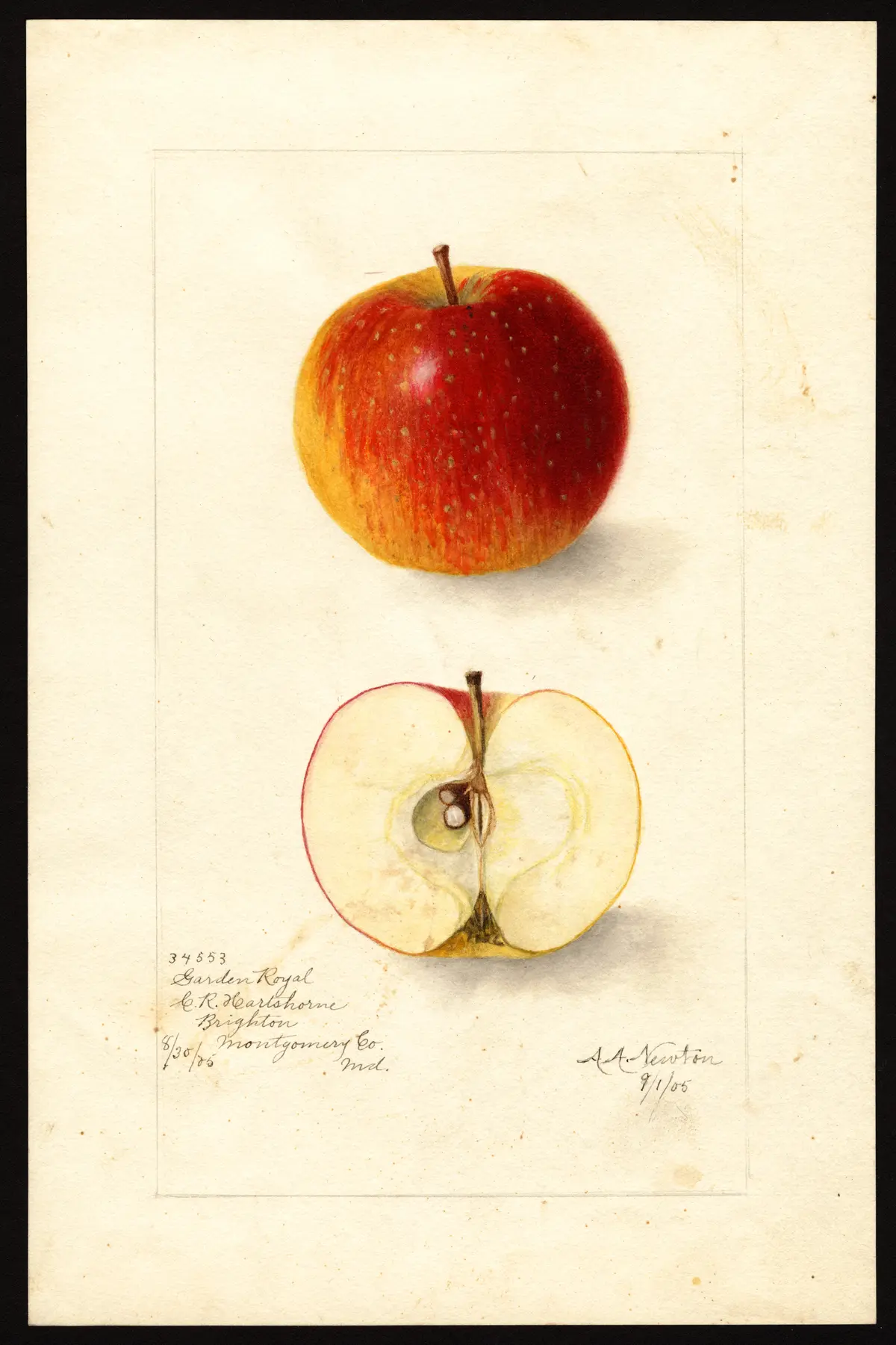
USDA Pomological Watercolor Collection
Garden Royal
Origin / History
Garden Royal originated on the farm of Bowker, Sudbury, Massachusetts (Downing; Budd-Hansen; Thomas; Beach), over a century before Hedrick's 1922 writing. Warder (1867) reported receiving the apple from quite distant points — Chillicothe, Ohio, and Salem, Indiana — and noted its origin as unknown at that time, observing it to be quite distinct in season from the Beefsteak or Garden of Downing, while corresponding closely in description with the Garden Royal of Elliott (a fruit Warder himself had not seen). Elliott described it simply as "American. Originated in Mass." References trace back to Manning, Mag. Hort. 13:438 (1847) and Hovey 14:18 (1848); it was listed in the American Pomological Society Catalogue in 1854. By Beach's time (1905) it was occasionally found in New York home orchards but was little propagated by nurserymen and seldom planted. Hedrick (1922) reported its cultivation confined to New England and New York.
Tree
Of moderate, very upright growth, forming a beautiful roundish, regular even head, very productive (Downing; Budd-Hansen). Beach describes the full-grown tree as of medium size, moderately vigorous, with roundish head, hardy, healthy and long-lived, coming into bearing young and a reliable biennial cropper; Hedrick echoes this as medium size, vigorous, round-headed, hardy, healthy, long-lived, early to bear and reliable in biennial bearing. Young shoots dark dull reddish brown, slightly grayish or imperfect downy (Downing). Elliott describes the tree as slender, a slow grower while young; hardy, and making a tree of medium size, annually productive; suited to small orchards or gardens where a delicious fruit is desired for table use. Thomas calls it "a poor grower, but a first-rate dessert fruit."
Fruit
Size: Medium or below (Downing; Beach; Budd-Hansen; Lowther — "medium"); rather below medium (Elliott); below medium (Thomas); pretty large (Warder); small (Hedrick). Beach notes the fruit is too small for commercial planting.
Form: Roundish, flat, regular (Warder); roundish oblate, very slightly conic (Downing; Budd-Hansen); round, slightly oblate, often a little inclined to conic, regular or obscurely ribbed (Beach); round or oblate-conic, regular or obscurely ribbed (Hedrick); roundish, inclining to flat, very regular (Elliott); roundish, slightly flattened at ends, even and regular (Thomas); roundish (oblate) (Lowther).
Stem / Stalk: Short to medium, sometimes knobby (Warder); medium, slender (Downing; Budd-Hansen); short to medium, straight, rather slender (Beach); short, straight, slender (Hedrick); short, slender (Elliott); short, or half to three-fourths of an inch long, slender (Thomas).
Cavity: Deep, acute, regular, green (Warder); deep, acute (Downing; Budd-Hansen); acute, sometimes approaching acuminate, rather deep and broad, slightly furrowed, often faintly russeted (Beach); acute, deep and broad, furrowed, often russeted (Hedrick); narrow (Elliott); acute (Thomas).
Calyx: Open or partially closed, with segments sometimes a little recurved/reflexed (Downing; Budd-Hansen); small to above medium, open or partly closed, with lobes often separated at base, rather short, acute (Beach); small, open or partly closed, with lobes separated, short, acute (Hedrick); large, open (Elliott; Thomas). The calyx tube is medium size, funnel-shape (Beach; Hedrick); stamens median to nearly marginal (Beach), median (Hedrick).
Basin: Wide, regular, small, closed (Warder); shallow, slightly uneven (Downing; Budd-Hansen); moderately shallow, rather wide, obtuse to somewhat abrupt, slightly wrinkled (Beach); shallow, wide, obtuse, wrinkled (Hedrick); shallow (Elliott); very shallow (Thomas).
Skin / Color: Surface smooth, yellowish-green, slightly shaded red, with scattered stripes of carmine; dots minute, black (Warder). Greenish yellow, shaded, striped, and splashed with rich red, a little dull or grayish toward the stalk; sprinkled with light and gray dots (Downing); surface greenish yellow, shaded, striped and splashed with rich red, a little dull or grayish toward the stalk; dots few, light and gray (Budd-Hansen). Beach describes the skin as thin, greenish-yellow, sometimes entirely overspread with red, irregularly striped and splashed with carmine, with dots numerous, rather conspicuous, medium or above, often irregular, russet or yellowish — and the overall appearance as "very handsome deep yellow striped with orange-red and dark crimson." Hedrick agrees: skin thin, greenish-yellow, sometimes entirely overspread with red, irregularly striped and splashed with carmine; dots numerous, conspicuous, often irregular, russet or yellow; the apples handsomely colored a deep yellow striped with orange-red and dark crimson — "a most prepossessing apple." Elliott: yellowish ground with dull red stripes, becoming brighter in the sun. Thomas: small, broken, red stripes on yellow ground, deep red to the sun. Lowther: yellow-red.
Flesh / Flavor: Pale yellow or whitish, tender, fine-grained, juicy; flavor sub-acid, aromatic, saccharine, agreeable; quality very good to best (Warder). Yellow, very tender, juicy, rich, mild subacid, aromatic; best (Downing; Budd-Hansen). Tinged with yellow, fine, tender, juicy, agreeable mild subacid, aromatic; very good (Beach); flesh yellow, fine, tender, juicy, agreeable, mild subacid, aromatic; very good (Hedrick). Beach also characterizes it as "very tender, aromatic and with a delicate, pleasant acid flavor"; Hedrick as "very tender and aromatic and has a pleasant acid flavor." Elliott: yellowish white, fine-grained, tender, mild, sub-acid. Thomas: yellowish white, exceedingly tender, and fine-grained; flavor mild, sub-acid, fine. Lowther rates quality "best." Considered by many one of the very best dessert apples of late summer and early autumn (Beach).
Core / Seeds: Core wide, closed or open, regular, clasping the eye; seeds small, pointed, brown (Warder). Core small (Downing; Budd-Hansen). Core small, axile; cells closed or slightly open; core lines clasping; carpels small, elliptical, emarginate (Beach; Hedrick).
Season
August to October (Warder); last of August, September (Downing; Budd-Hansen; Elliott); late August and September (Beach; Hedrick); late summer (Thomas); summer (Lowther). Beach and Hedrick both note the season is early and short, limiting commercial value.
Uses
Dessert, kitchen, market (Warder); family use (Lowther); a delicious fruit for table use in small orchards or gardens (Elliott); a first-rate dessert fruit (Thomas); one of the very best dessert apples of late summer and early autumn (Beach); a very good home variety for late summer and early autumn but too small and short-seasoned for commercial value (Beach; Hedrick). Warder pronounces it "worthy of cultivation."
Subtypes / Variants
Not described in source.
Other
Lowther's tabular adaptation codes: N. Div.: 6* (reported as adapted to more than one division); C. Div.: 2* (reported as adapted to more than one division). Beach (1905) records "SYNONYMS. None." Warder noted the variety is "quite distinct in season from the Beefsteak or Garden of Downing."
Book Sources
Described in 8 period pomological works
- Downing, Fruits and Fruit Trees of America (1900)
- Thomas, The American Fruit Culturist (1903)
- Warder, American Pomology: Apples (1867)
- Beach, The Apples of New York Vol. 2 (1905)
- Budd & Hansen, Systematic Pomology (1914)
- Elliott, The Western Fruit Book (1865)
- Lowther (ed.), Encyclopedia of Practical Horticulture (1914)
- Hedrick, Cyclopedia of Hardy Fruits (1922)
Nursery Catalog Sources
Found in 3 catalogs (1887–1913) from California, Illinois
- Santa Rosa Nurseries (Luther Burbank) , Santa Rosa , California — 1887
- Benjamin Buckman (personal inventory) , Farmingdale , Illinois — 1901
- Benjamin Buckman (personal inventory) , Farmingdale , Illinois — 1913
View original book sources (8)
— John A. Warder, American Pomology: Apples (1867)Garden. GARDEN ROYAL.
This fine apple has been received from quite distant points, Chillicothe, Ohio, and Salem, Indiana. It is quite distinct in season from the Beefsteak or Garden of Downing, but in description corresponds very closely with the Garden-Royal of Elliott, which fruit I have not seen. Origin unknown.
Fruit pretty large, roundish, flat, regular; Surface smooth, yellowish-green, slightly shaded red, scattered stripes, carmine; Dots minute, black.
Basin wide, regular, small, closed.
Cavity deep, acute, regular, green; stem short to medium, sometimes knobby.
Core wide, closed or open, regular, clasping the eye; seeds small, pointed, brown; flesh pale yellow or whitish, tender, fine-grained, juicy; Flavor sub-acid, aromatic, saccharine, agreeable; Quality very good to best; Use dessert, kitchen, market; Season August to October; worthy of cultivation.
— A.J. Downing, The Fruits and Fruit Trees of America (1900)Garden Royal.
Originated on the farm of Bowker, Sudbury, Mass. Tree of moderate, very upright growth, forming a beautiful roundish, regular even head, very productive. Young shoots dark dull reddish brown, slightly grayish or imperfect downy.
Garden Royal.
Fruit medium or below. Form roundish oblate, very slightly conic. Color greenish yellow, shaded, striped, and splashed with rich red, a little dull or grayish toward the stalk. Sprinkled with light and gray dots. Stalk medium, slender. Cavity deep, acute. Calyx open or partially closed. Segments sometimes a little recurved. Basin shallow, slightly uneven. Flesh yellow, very tender, juicy, rich, mild subacid, aromatic. Best. Core small. Last of August, September.
— S.A. Beach, The Apples of New York, Vol. 2 (1905)GARDEN ROYAL.
REFERENCES. 1. Manning, Mag. Hort., 13:438. 1847. 2. Hovey, Ib., 14:18. 1848. fig. 3. Thomas, Cultivator, 5:212. 1848. 4. Cole, 1849:106. fig. 5. Thomas, 1849:139. fig. 6. Barry, 1851:284. 7. Am. Pom. Soc. Cat., 1854. 8. Elliott, 1854:81. 9. Mag. Hort., 21:63. 1855. 10. Downing, 1857:79. 11. Warder, 1867:719. 12. Lyon, Mich. Hort. Soc. Rpt., 1890:292. 13. Bailey, An. Hort., 1892:239. 14. Rural N. Y., 60:247. 1901. 15. Budd-Hansen, 1903:88. fig. 16. Farrand, Mich. Sta. Bul., 205:44. 1903.
SYNONYMS. None.
Garden Royal is not a good variety for commercial planting because the fruit is too small and its season early and short, but by many it is considered one of the very best dessert apples of late summer and early autumn. The fruit is of regular form, very handsome deep yellow striped with orange-red and dark crimson. The flesh is very tender, aromatic and with a delicate, pleasant acid flavor; season, August and September. The tree when full grown is of medium size, moderately vigorous, with roundish head. It appears to be hardy, healthy and long-lived, comes into bearing young and is a reliable biennial cropper.
Historical. Origin Sudbury, Mass. (2). It is occasionally found in this state in home orchards. It is now little propagated by nurserymen and seldom planted.
FRUIT.
Fruit medium or below. Form round, slightly oblate, often a little inclined to conic, regular or obscurely ribbed. Stem short to medium, straight, rather slender. Cavity acute sometimes approaching acuminate, rather deep and broad, slightly furrowed, often faintly russeted. Calyx small to above medium, open or partly closed; lobes often separated at base, rather short, acute. Basin moderately shallow, rather wide, obtuse to somewhat abrupt, slightly wrinkled. Skin thin, greenish-yellow, sometimes entirely overspread with red, irregularly striped and splashed with carmine. Dots numerous, rather conspicuous, medium or above, often irregular, russet or yellowish. Calyx tube medium size, funnel-shape. Stamens median to nearly marginal. Core small, axile; cells closed or slightly open; core lines clasping. Carpels small, elliptical, emarginate. Flesh tinged with yellow, fine, tender, juicy, agreeable mild subacid, aromatic, very good. Season late August and September.
— Granville Lowther (ed.), Encyclopedia of Practical Horticulture (1914)Garden Royal. Size: medium. Form: roundish (oblate). Color: yellow-red. Quality: best. Use: family. Season: summer. N. Div.: 6* (reported as adapted to more than one division). C. Div.: 2* (reported as adapted to more than one division).
— F.R. Elliott, The Western Fruit Book (1865)Garden Royal.
American. Originated in Mass. Tree, slender, slow grower while young; hardy, and makes a tree of medium size, annually productive; suited to small orchards or gardens where a delicious fruit is desired for table use. Fruit, rather below medium; form, roundish, inclining to flat, very regular; color, a yellowish ground, with dull red stripes, becoming brighter in sun; stem, short, slender: cavity, narrow; calyx, large, open; basin, shallow; flesh, yellowish white, fine-grained, tender, mild, sub-acid. Last of August and September.
— John J. Thomas, The American Fruit Culturist (1903)Garden Royal. Below medium, roundish, slightly flattened at ends, even and regular; surface with small, broken, red stripes on yellow ground, deep red to the sun; stalk short, or half to three-fourths of an inch long, slender, cavity acute; calyx large, open; basin very shallow; flesh yellowish white, exceedingly tender, and fine-grained; flavor mild, sub-acid, fine. A poor grower, but a first-rate dessert fruit. Late summer. Origin, Sudbury, Mass.
— J.L. Budd & N.E. Hansen, American Horticultural Manual, Part II: Systematic Pomology (1914)Garden Royal. — Origin, Sudbury, Massachusetts; tree of moderate, very upright growth, forming a beautiful, roundish, even head, very productive.
Fruit medium, or below, roundish oblate, very slightly conical; surface greenish yellow, shaded, striped and splashed with rich red, a little dull or grayish toward the stalk; dots few, light and gray; cavity deep, acute; stem medium, slender; basin shallow, slightly uneven; calyx open or partially closed; segments sometimes a little reflexed. Core small; flesh yellow, very tender, juicy, rich, mild subacid, aromatic, best. Last of August, September.
— U.P. Hedrick, Cyclopedia of Hardy Fruits (1922)GARDEN ROYAL. Garden Royal is a very good home variety for late summer and early autumn, but the apples are too small and the season is too short for commercial value. The fruits are regular in form and handsomely colored a deep yellow striped with orange-red and dark crimson — a most prepossessing apple. The flesh is very tender and aromatic and has a pleasant acid flavor. The variety originated at Sudbury, Massachusetts, over a century ago. Its cultivation is confined to New England and New York.
Tree of medium size, vigorous, round-headed, hardy, healthy, long-lived, comes into bearing young and is reliable in biennial bearing. Fruit small, round or oblate-conic, regular or obscurely ribbed; stem short, straight, slender; cavity acute, deep and broad, furrowed, often russeted; calyx small, open or partly closed; lobes separated, short, acute; basin shallow, wide, obtuse, wrinkled; skin thin, greenish-yellow, sometimes entirely overspread with red, irregularly striped and splashed with carmine; dots numerous, conspicuous, often irregular, russet or yellow; calyx-tube funnel-shape; stamens median; core small, axile; cells closed or slightly open; core-lines clasping; carpels small, elliptical, emarginate; flesh yellow, fine, tender, juicy, agreeable, mild subacid, aromatic; very good; late August and September.