Golden Noble
Apple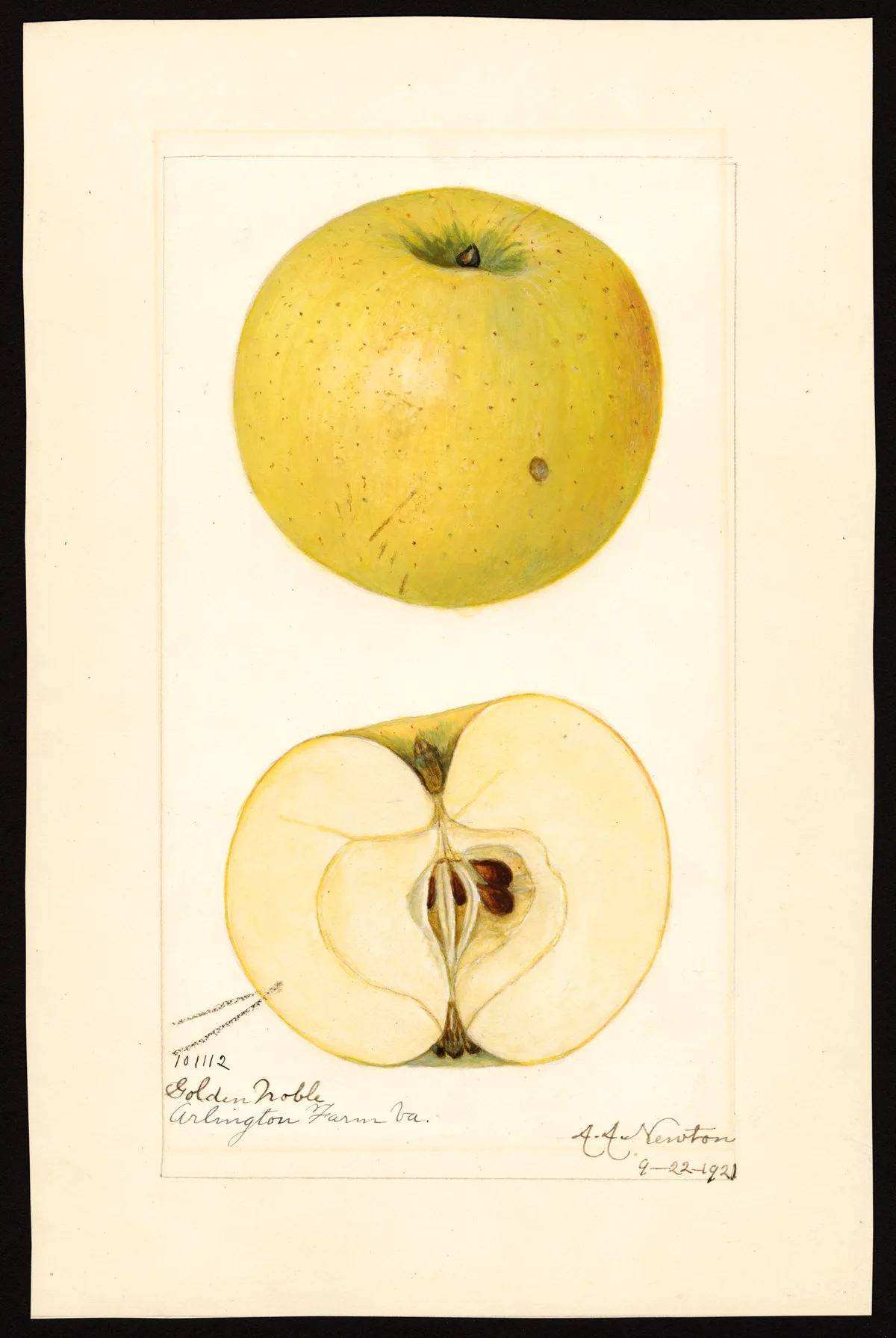
USDA Pomological Watercolor Collection
Golden Noble
Origin and History
The origin of Golden Noble is not certainly known. It was first brought to notice by Sir Thomas Harr of Stow Hall, Norfolk, whose gardener procured it from a tree supposed to be the original, growing in an old orchard at Downham; it was communicated to the Horticultural Society of London in 1820, and is probably therefore an old variety (Herefordshire Pomona). Bunyard confirms the year 1820 and likewise records the origin as uncertain. Downing describes it simply as an old English variety. According to Boisbunel, Golden Noble is identical to the Drap d'Or of France — though not the Drap d'Or of Hogg; see the Revue Horticole, 1883 (Bunyard). The variety has at various times also been recorded under the names Lord Clyde, Lord Stanwick, John Peel, and Rutlandshire Foundling (Bunyard).
Tree
The tree grows freely and bears abundantly (Herefordshire Pomona). Growth is vigorous and the tree fertile (Bunyard). Herefordshire Pomona recommends that it be grown much more generally, both for its own considerable merits and for its marketable qualities.
Leaf (Bunyard): rather large, little upfolded, regularly crenate, pea green.
Fruit
Size and Form
Herefordshire Pomona describes the fruit as handsome and large, round and slightly narrowing towards the eye. Downing, citing Lindley, similarly calls it pretty large and roundish conical. Bunyard, by contrast, gives measured dimensions of 2½ inches by 2¼ inches and describes the form as round, slightly flattened, and regular — conflicting with the narrowing-towards-eye character noted by the other two sources, and rating the size as only medium where those sources say large or pretty large.
Stem
The stalk is short (Herefordshire Pomona; Bunyard). Herefordshire Pomona records a distinctive feature: a fleshy growth on one side of the stalk that connects it with the fruit.
Cavity
Rather wide and slightly russeted (Bunyard).
Calyx
The eye is small (Herefordshire Pomona; Bunyard). Bunyard specifies that the eye is closed; he notes that this closed eye is the character by which Golden Noble may be distinguished from Queen Caroline.
Basin
Herefordshire Pomona describes the basin as round and deep, surrounded with plaits. Bunyard describes it as shallow and plaited. The two sources agree on the plaited character but conflict directly on depth.
Skin
Smooth, clear bright yellow, without any blush of red, but bearing a few small reddish spots and here and there a small patch of thin russet (Herefordshire Pomona). Downing (via Lindley) likewise gives bright yellow with a few small reddish spots and patches of russet. Bunyard concurs: clear yellow with slight russet.
Flesh and Flavor
The flesh is yellow and tender across all three sources. Herefordshire Pomona characterizes the juice as pleasant and acid, the texture as perfectly melting, and the overall flavor as richly acid. Downing (via Lindley) describes the flesh as pleasant and subacid — a notably less acid characterization than that of Herefordshire Pomona. Bunyard describes the flesh simply as acid.
When baked or cooked, the flesh turns a clear amber color (Herefordshire Pomona); Bunyard adds that it cooks frothily and produces a golden color.
Core and Seeds
Not described in source.
Season
Herefordshire Pomona gives the season as the end of September to the middle of December, and names Golden Noble the best apple of that period. Bunyard extends the season to September through January. Downing records November and December only.
Uses
A culinary variety, valued for cooking (Downing; Bunyard). Herefordshire Pomona notes its merits both for the table and for market. Bunyard calls it one of the very best cooking apples for color and flavor.
Subtypes and Variants
Not described in source.
Other
Herefordshire Pomona judges Golden Noble to be "the best in its season." Bunyard cites the Herefordshire Pomona entry as number 23 (Her. Pom., 23).
Book Sources
Described in 3 period pomological works
Nursery Catalog Sources
Found in 9 catalogs (1897–1917) from England, Illinois
- Kelway & Son , Langport, Somerset , England — 1897
- George Bunyard & Co. , Royal Nurseries, Maidstone, Kent , England — 1900
- Central Experimental Farm , Dominion Department of Agriculture, Agassiz, British Columbia (under test; Bulletin No. 3, Second Series) — 1900
- Benjamin Buckman (personal inventory) , Farmingdale , Illinois — 1901
- James Veitch & Sons , Ltd., Royal Exotic Nursery, Chelsea, London (also Coombe Wood, Langley, and Feltham) , England — 1911
- Thomas Rivers & Son , Sawbridgeworth, Hertfordshire , England — 1913
- Benjamin Buckman (personal inventory) , Farmingdale , Illinois — 1913
- George Bunyard & Co. , Royal Nurseries, Maidstone, Kent , England — 1914
- George Bunyard & Co. , Royal Nurseries, Maidstone, Kent , England — 1917
View original book sources (3)
— Woolhope Naturalists Field Club, The Herefordshire Pomona (1885)
- GOLDEN NOBLE. [Syn: Edelapfel gelber] The origin of this apple is not known. It was first brought into notice by Sir Thomas Harr, of Stow Hall, Norfolk. His gardener procured it from a tree, supposed to be the original, in an old orchard at Downham, and communicated it to the Horticultural Society of London in 1820. It is probably therefore an old variety. Description.—Fruit: handsome, large, round, and slightly narrowing towards the eye. Skin: smooth, clear bright yellow, without any blush of red, but a few small reddish spots, and here and there a small patch of thin russet. Eye: small, set in a round and deep basin, surrounded with plaits. Stalk: short, with a fleshy growth on one side of it, which connects it with the fruit. Flesh: yellow, tender, with a pleasant acid juice, perfectly melting, with a rich acidity, and baking of a clear amber colour. A very attractive and valuable apple, in season from the end of September to the middle of December, and the best in its season. The tree grows freely and bears abundantly. It should be grown much more generally than it is, as well for its own great merits as for its marketable qualities.
— A.J. Downing, The Fruits and Fruit Trees of America (1900)Golden Noble. An old English variety, valuable for cooking. Lindley describes it as pretty large, roundish conical, bright yellow with a few small reddish spots and patches of russet. Flesh yellow, tender, pleasant, subacid. November, December.
— E.A. Bunyard, A Handbook of Hardy Fruits (1920)GOLDEN NOBLE. Her. Pom., 23. G., Gelber Edel Apfel. (Lord Clyde, Lord Stanwick, John Peel, Rutlandshire Foundling.) Culinary, September to January, medium, 2½ by 2¼, round, slightly flattened, regular. Colour, clear yellow, with slight russet. Flesh, tender, yellow, acid. Eye, small, closed, in a shallow plaited basin. Stem, very short in a rather wide slightly russet cavity. Growth, vigorous; fertile. Cooks frothily and of golden colour. Leaf, rather large, little upfolded, regularly crenate, pea green. Origin, uncertain: brought to notice in 1820. According to Boisbunel, this is the Drap d'Or of France (not of Hogg). See Revue Horticole, 1883. One of the very best cooking apples for colour and flavour. Can be distinguished from Queen Caroline by its closed eye.