Waltham Abbey Seedling
Apple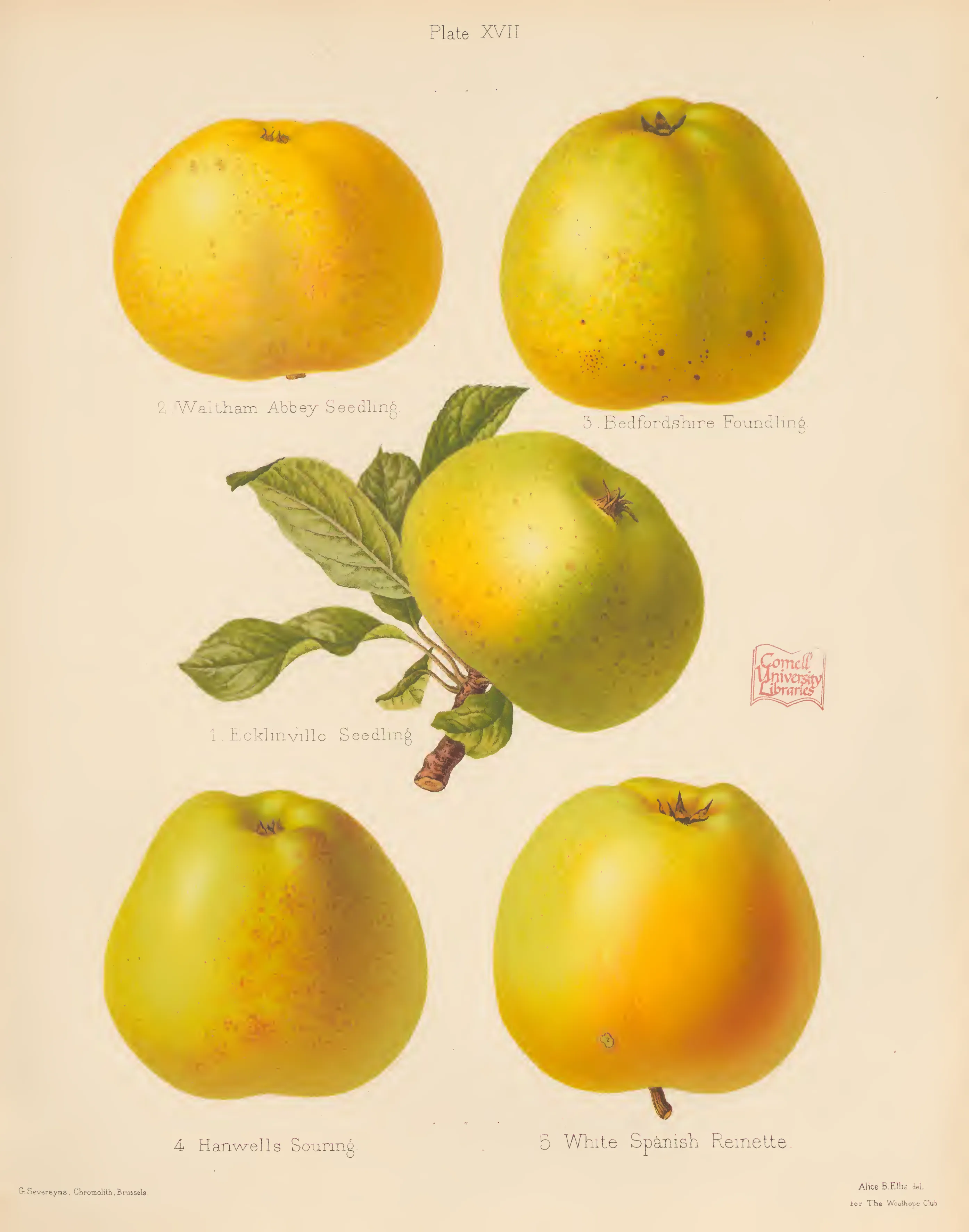
Waltham Abbey Seedling
Origin and History
This apple was raised about 1810 from seed of the Golden Noble by Mr. John Barnard of Waltham Abbey in Essex. It was introduced by Barnard at a meeting of the London Horticultural Society in 1821. Though descended from the Golden Noble, it is quite distinct from its parent.
Tree
Remarkable for its very small foliage, though it bears abundant fruit of good useful size.
Fruit
Size and Form: Large, roundish, inclining to ovate. (Differs from the parent Golden Noble, which is quite round.)
Skin: Pale yellow, assuming a deeper tinge as it attains maturity. Faint blush of red where exposed to the sun. Strewed all over with minute russety dots, and occasionally a few patches of thin russet.
Stem: Short, deeply inserted, and surrounded with rough russet.
Eye: Large and open, set in a shallow and even basin.
Flesh and Flavor: Yellowish, tender, juicy, sweet, and pleasantly flavored. When cooked, it assumes a clear, pale amber color.
Core and Seeds: Not described in source.
Season
September to Christmas.
Uses
A culinary apple of first-rate quality. Requires but little sugar when cooked. Has inherited from its parent Golden Noble the notable merit of becoming translucent when cooked.
Subtypes and Variants
Not described in source.
Book Sources
Described in 1 period pomological work
Nursery Catalog Sources
Found in 4 catalogs (1900–1917) from England
- George Bunyard & Co. , Royal Nurseries, Maidstone, Kent , England — 1900
- James Veitch & Sons , Ltd., Royal Exotic Nursery, Chelsea, London (also Coombe Wood, Langley, and Feltham) , England — 1911
- George Bunyard & Co. , Royal Nurseries, Maidstone, Kent , England — 1914
- George Bunyard & Co. , Royal Nurseries, Maidstone, Kent , England — 1917
View original book sources (1)
— Woolhope Naturalists Field Club, The Herefordshire Pomona (1885)
- WALTHAM ABBEY SEEDLING.
This apple was raised about the year 1810 from the seed of the Golden Noble, by Mr. John Barnard, of Waltham Abbey in Essex; and was introduced by him at a meeting of the London Horticultural Society in 1821. It resembles its parent the Golden Noble, but is yet quite distinct from it.
Description.—Fruit: large roundish, inclining to ovate, in which respect it differs from the Golden Noble, which is quite round. Skin: pale yellow, assuming a deeper tinge as it attains maturity, with a faint blush of red where exposed to the sun, and strewed all over with minute, russety dots, and occasionally a few patches of thin russet. Eye: large and open, set in a shallow and even basin. Stalk: short, deeply inserted, and surrounded with rough russet. Flesh: yellowish, tender, juicy, sweet and pleasantly flavoured; when cooked it assumes a clear, pale amber colour.
The Waltham Abbey Seedling is a culinary apple of first rate quality; it requires but little sugar when cooked, and has inherited from its parent, the Golden Noble, the great merit of becoming translucent. It is in season from September to Christmas. The tree is remarkable for its very small foliage, though the fruit is abundant and of a good useful size.