Golden White
Apple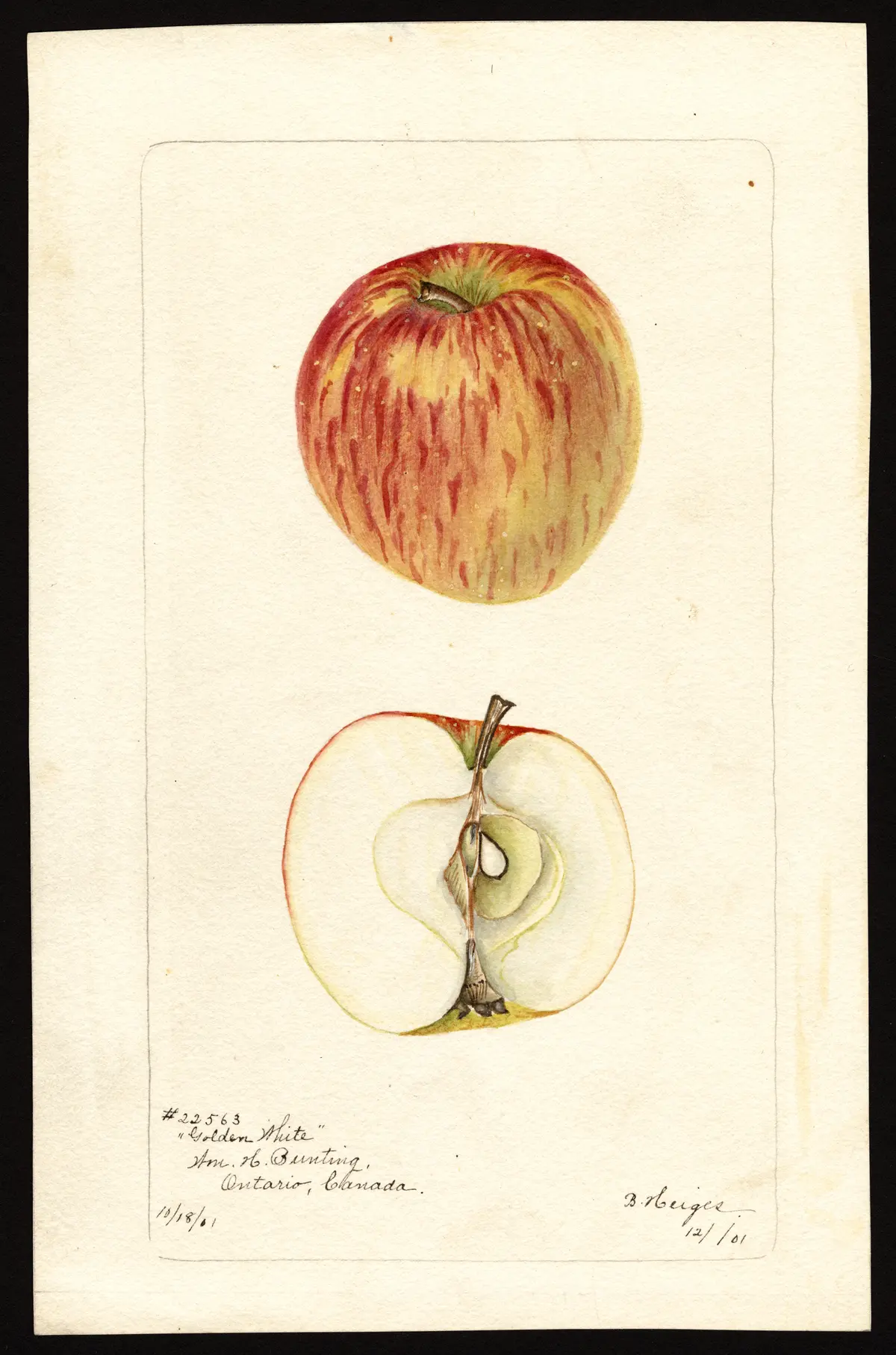
USDA Pomological Watercolor Collection
Golden White
Origin/History
A Russian apple. The name is not descriptive of the fruit, but was retained provisionally by the Russian Nomenclature Commission until the true name could be ascertained. Received for testing at the New York Agricultural Experiment Station from T. H. Hoskins, Newport, Vermont, in 1888 (Beach, 1905).
The variety was tested under numbers 978, 979, and 981, which Hansen (1902) identifies as all belonging to the same group and all alike in fruit; these numbers correspond to accessions from Tuttle and Mitchell. J. B. Mitchell reported: "Nos. 978, 979 and 981 are all alike; the buds are very prominent, thick and woolly. I quit propagating the trees, but people who had bought trees kept coming to me for more, so I began again two years ago." A. G. Tuttle noted: "In my neighborhood Golden White is a very good apple."
J. Sexton observed that Nos. 4 Orel and 5 Orel are like Mallett 980 in leaf and like Golden White in fruit.
Tree
Form and habit: Tree rather small, a slow grower with short, stout branches. Form spreading, open. Hansen (1902) notes the tree is an irregular grower (Beach, 1905).
Twigs: Short, curved, stout, with large terminal buds; internodes short (Beach, 1905).
Bark: Dull brown mingled with olive-green, coated with gray scarf-skin; heavily pubescent (Beach, 1905).
Lenticels: Scattering, large, oval or elongated, raised (Beach, 1905).
Buds: Large, prominent, broad, plump, obtuse, free, much pubescent (Beach, 1905). Mitchell independently described the buds as very prominent, thick, and woolly (Hansen, 1902).
Bearing: The tree comes into bearing rather young and yields full crops biennially (Beach, 1905).
Fruit
Size: Hansen (1902) and Budd & Hansen (1914) describe the fruit as large (size 5 to 6 on the Russian scale). Beach (1905) describes it as medium size.
Form: Hansen (1902) and Budd & Hansen (1914) describe the form as roundish, somewhat tapering, sometimes angular. Beach (1905) describes it as oblate inclined to conic, flattened at the base, ribbed.
Stem: Short to medium (Hansen, 1902); small to medium (Beach, 1905).
Cavity: Hansen (1902) and Budd & Hansen (1914) describe the cavity as shallow, wide, with a radiating patch of russet. Beach (1905) describes it as small, acuminate, narrow, moderately shallow, russeted.
Calyx: Half open (Hansen, 1902; Budd & Hansen, 1914); open or partly open (Beach, 1905).
Calyx tube: Funnel-shaped (Hansen, 1902; Budd & Hansen, 1914); large, cone-shape to funnel-form (Beach, 1905). Stamens median (Budd & Hansen, 1914).
Basin: Hansen (1902) and Budd & Hansen (1914) describe the basin as shallow, narrow, corrugated. Beach (1905) describes it as large, irregular, moderately deep, wrinkled.
Skin: Hansen (1902) and Budd & Hansen (1914) describe the surface as yellow, with dark crimson splashes, mixed and marbled. The Russian Nomenclature Commission description records the color as light yellow, striped and splashed with red. Beach (1905) describes the skin as greenish-yellow, nearly overlaid with red and striped with carmine, with the prevailing effect red or striped red.
Dots: Large, grayish white, distinct (Hansen, 1902; Budd & Hansen, 1914); numerous, large, light (Beach, 1905).
Flesh: Hansen (1902) and Budd & Hansen (1914) describe the flesh as yellowish white. Beach (1905) describes it as white with a faint salmon tinge, fine-grained, and moderately juicy.
Flavor: Subacid, pleasant; quality good (Hansen, 1902; Budd & Hansen, 1914). Subacid, fair or sometimes good in quality (Beach, 1905).
Core and seeds: Core medium size, somewhat abaxile; cells usually symmetrical, closed or partly open; core lines clasping. Carpels roundish, emarginate, tufted. Seeds above medium, plump, wide, obtuse (Beach, 1905).
Season
Late fall, ripening between Oldenburg and Longfield (Hansen, 1902; Budd & Hansen, 1914). Beach (1905) gives the season as September and October.
Uses
Not described in source.
Subtypes/Variants
Hansen (1902) identifies a Golden White Group comprising several closely related or identical accessions: Golden White No. 978 (Tuttle and Mitchell), Long White No. 979 (Tuttle and Mitchell), White Russet No. 981 (Tuttle and Mitchell), Nos. 4 and 5 Orel (of Budd), No. 56 Vor. (noted as spurious), Winter Stripe, and Avenarius No. 15 (Department, of Patten). The variety was found evidently not desirable for planting in New York (Beach, 1905).
Other
Beach (1905) cites the following references in the literature: Gibb, Iowa Horticultural Society Report, 1883:447; Brodie, Montreal Horticultural Society Report, 1885:72; Hoskins, Michigan Horticultural Society Report, 1886:221; Montreal Horticultural Society Report, 1885–87:16; Canadian Horticulturist, 13:157, 332 (1890); Beach and Paddock, New York Station Annual Report, 14:252 (1895); Beach, Western New York Horticultural Society Report, 1896:50; Budd–Hansen, 1903:91. The synonym Bed Solotofskaja is cited by Gibb (1883) in Beach's references.
Book Sources
Described in 3 period pomological works
Nursery Catalog Sources
Found in 3 catalogs (1900–1913) from Illinois
- Central Experimental Farm , Dominion Department of Agriculture, Agassiz, British Columbia (under test; Bulletin No. 3, Second Series) — 1900
- Benjamin Buckman (personal inventory) , Farmingdale , Illinois — 1901
- Benjamin Buckman (personal inventory) , Farmingdale , Illinois — 1913
View original book sources (3)
— N.E. Hansen, A Study of Northwestern Apples (1902)Golden White (Nos. 978, 979, 981)—Origin, Russia. This name is not descriptive, but was retained for the present by the Russian Nomenclature Commission—Fruit large, roundish, somewhat tapering, sometimes angular; surface yellow, with dark crimson splashes, mixed and marbled; dots large, grayish white, distinct; cavity shallow, wide, with radiating patch of russet; stem medium; basin shallow, narrow, corrugated; calyx half open. Calyx tube funnel-shaped; stamens median; flesh yellowish white, pleasant subacid, good. Late fall, between Oldenburg and Longfield.
Golden White. (Nos. 978, 979, 981)
GOLDEN WHITE GROUP.
Large. Long White, 979, of Tuttle and Mitchell; Golden White, 978, of Tuttle and Mitchell; White Russet, 981, of Tuttle and Mitchell; Nos. 4 and 5, Orel, of Budd; No. 56, Vor., (spurious); Winter Stripe; Avenarius No. 15, Department, of Patten.
The name does not describe the apple, but it is adopted until the true name can be ascertained.
DESCRIPTION:
Golden White (Nos. 978, 979, 981)—Size 5 to 6; form, roundish, slightly angular; color, light yellow, striped and splashed with red; dots, white; cavity, wide, regular; stem, short to medium; basin, shallow, slightly corrugated; calyx, half open; flesh, yellowish white; flavor, subacid; season, fall; origin, Russia; tree, irregular grower.
J. B. Mitchell: Nos. 978, 979 and 981 are all alike; the buds are very prominent, thick and woolly. I quit propagating the trees, but people who had bought trees kept coming to me for more, so I began again two years ago.
J. Sexton: No. 4 Orel and 5 Orel are like Mallett 980 in leaf and like the above three in fruit.
A. G. Tuttle: In my neighborhood Golden White is a very good apple." (Rus. Nom. Com.)
— S.A. Beach, The Apples of New York, Vol. 2 (1905)GOLDEN WHITE.
REFERENCES. 1. Gibb, Ia. Hort. Soc. Rpt., 1883:447. 2. Brodie, Montreal Hort. Soc. Rpt., 1885:72. 3. Hoskins, Mich. Hort. Soc. Rpt., 1886:221. 4. Montreal Hort. Soc. Rpt., 1885-7:16. 5. Can. Hort., 13:157, 332. 1890. 6. Beach and Paddock, N. Y. Sta. An. Rpt., 14:252. 1895. 7. Beach, W. N. Y. Hort. Soc. Rpt., 1896:50. 8. Buad-Hansen, 1903:91.
SYNONYMS. Bed Solotofskaja (1). GOLDEN WHITE (1, 2, 3, 4, 5, 6, 7, 8). No. 978 (3, 5, 8). No. 979 (8). No. 981 (8).
Fruit of medium size, greenish-yellow, streaked with bright red in the sun, subacid, fair quality; season September. The tree comes into bearing rather young, and yields full crops biennially. Evidently not desirable for planting in New York.
Historical. A Russian apple received for testing at this Station from T. H. Hoskins, Newport, Vt., in 1888.
TREE.
Tree rather small, a slow grower with short, stout branches. Form spreading, open. Twigs short, curved, stout, with large terminal buds; internodes short. Bark dull brown mingled with olive-green, coated with gray scarf-skin; heavily pubescent. Lenticels scattering, large, oval or elongated, raised. Buds large, prominent, broad, plump, obtuse, free, much pubescent.
FRUIT.
Fruit medium size. Form oblate inclined to conic, flattened at the base, ribbed. Stem small to medium. Cavity small, acuminate, narrow, moderately shallow, russeted. Calyx open or partly open. Basin large, irregular, moderately deep, wrinkled. Skin greenish-yellow nearly overlaid with red and striped with carmine. Dots numerous, large, light. Prevailing effect red or striped red. Calyx tube large, cone-shape to funnel-form. Core medium size, somewhat abaxile; cells usually symmetrical, closed or partly open; core lines clasping. Carpels roundish, emarginate, tufted. Seeds above medium, plump, wide, obtuse. Flesh white with faint salmon tinge, fine-grained, moderately juicy, subacid, fair or sometimes good in quality. Season September and October.
— J.L. Budd & N.E. Hansen, American Horticultural Manual, Part II: Systematic Pomology (1914)Golden White (Nos. 978, 979, 981).— Origin, Russia. This name is not descriptive but was retained for the present by the Russian Nomenclature Commission.
Fruit large, roundish, somewhat tapering, sometimes angular; surface yellow, with dark crimson splashes, mixed and marbled; dots large, grayish white, distinct; cavity shallow, wide, with radiating patch of russet; stem medium; basin shallow, narrow, corrugated; calyx half open. Calyx tube funnel-shaped; stamens median; flesh yellowish white, pleasant subacid, good. Late fall, between Oldenburg and Longfield.