Grise-Bonne
Pear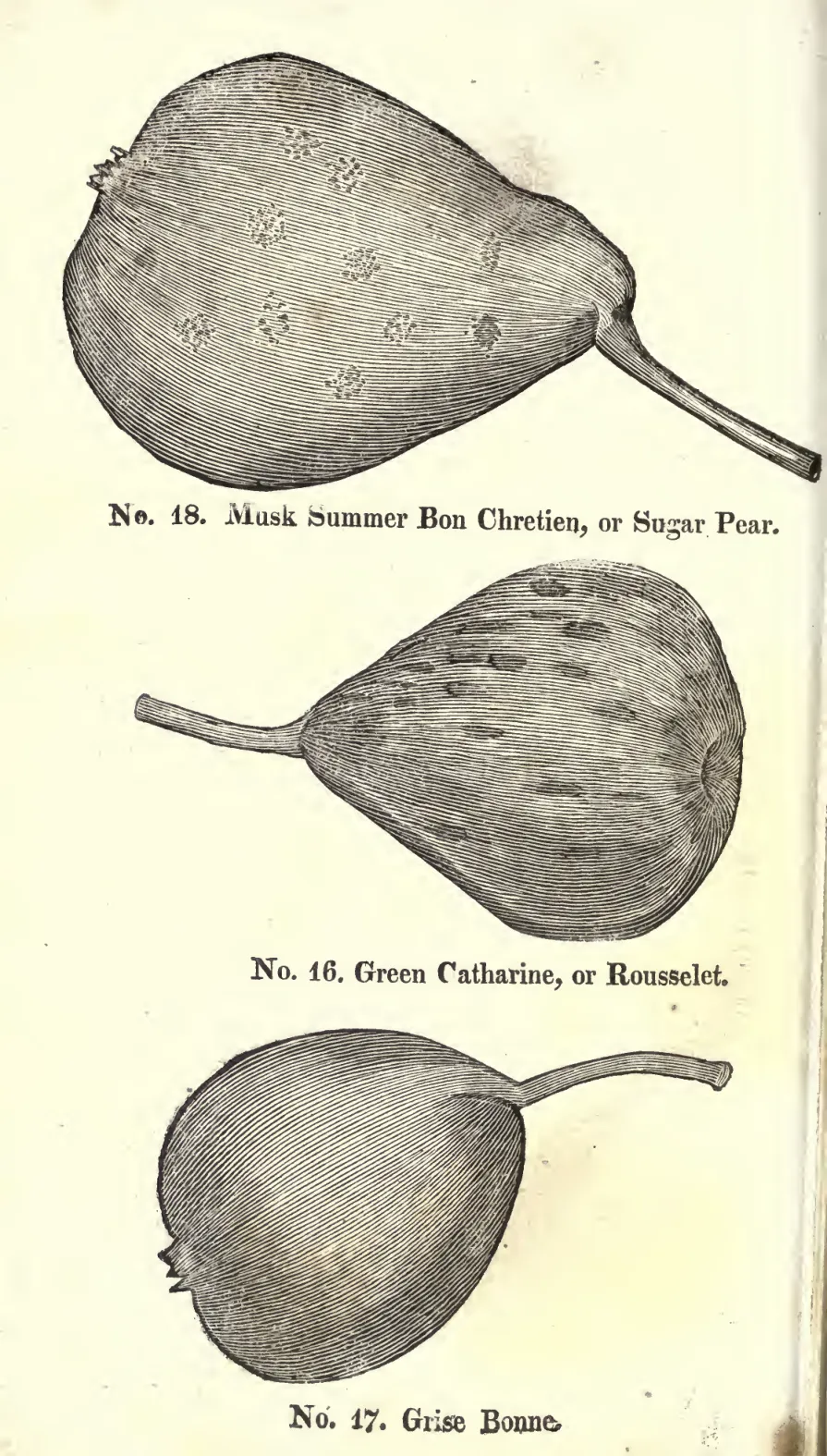
Grise-Bonne
Origin / History
Coxe (1817) gives the name as "Grise-Bonne, or Good Grey Pear". Hedrick (1921) cites Duhamel, Trait. Arb. Fr. 2:245 (1778); Dochnahl, Fuhr. Obstkunde 2:16 (1856); and Leroy, Dict. Pom. 2:238, with figure (1869). The Dutch pomologist Pierre Van den Hoven, writing in the middle of the eighteenth century, affirmed that Grise-Bonne was the Sucrée Grise de Hollandaise and the Pirum Falernum of the Romans. In 1586 Jacques Daléchamp thought he had found the Falernum in the French Autumn Bergamote. In 1783 Henri Manger declared it still cultivated under the name Bourdon, the Orange Musquee. In 1802 Sickler wrote that the Bergamote d'été appeared to him to be the Falernum.
Tree
Not described in source.
Fruit
Size: Small (Coxe, Elliott); medium (Hedrick).
Form: Regular, diminishing with a gentle swell towards the stem (Coxe); pyriform (Elliott). Hedrick calls the form variable, sometimes irregular-turbinate, long and ventriculous, at other times regular-turbinate.
Stem: Long (Coxe).
Cavity: Not described in source.
Calyx: Not described in source.
Basin: Blossom end rather flat, with no hollow at the crown (Coxe).
Skin: Green (Coxe, Elliott); Hedrick gives clear green, russeted with gray, clouded with pale yellow on the shaded side.
Dots: Black spots (Coxe); Hedrick gives large dots of golden or orange-yellow.
Flesh and flavor: Flesh white, fine, dense, semi-breaking, watery, free from grit (Hedrick); Coxe has it large grained and juicy, of a pleasant taste. Juice very abundant, sugary, acidulous, musky (Hedrick). Quality "second" (Hedrick).
Core and seeds: Not described in source.
Season
Ripens in August: from the beginning to the middle of the month (Coxe); middle August (Elliott); August (Hedrick).
Uses
Not described in source.
Subtypes / Variants
Not described in source.
Other
Not described in source.
Book Sources
Described in 3 period pomological works
- Coxe, A View of the Cultivation of Fruit Trees (1817) — listed as Grise-Bonne, Or Good Grey Pear
- Elliott, The Western Fruit Book (1865) — listed as Grise Bonne
- Hedrick, The Pears of New York (1921)
View original book sources (3)
— William Coxe, A View of the Cultivation of Fruit Trees (1817)
- GRISE-BONNE, OR GOOD GREY PEAR.
This is rather a small pear, the form regular, diminishing with a gentle swell towards the stem, which is long; the blossom end rather flat, with no hollow at the crown; the skin green, dotted with black spots—the flesh large grained and juicy, of a pleasant taste—ripens from the beginning to the middle of August.
[Additional entry in this volume: "Grise Bonne", pp. 277–277]
No. 17. Grise Bonne
— F.R. Elliott, The Western Fruit Book (1865)Grise Bonne. Small, pyriform, green. Middle August.
— U.P. Hedrick, The Pears of New York (1921)Grise-Bonne.
- Duhamel Trait. Arb. Fr. 2:245. 1778.
- Leroy Diet. Pom. 2:238, fig. 1869. Franzosische Gute Graue Sommerbirne.
- Dochnahl Fuhr. Obstkunde 2:16. 1856.
The Dutch pomologist Pierre Van den Hoven writing in the middle of the eighteenth century affirmed that the Grise-Bonne was the Sucrée Grise de Hollandaise and the Pirum Falernum of the Romans. It may be noted that in 1586 Jacques Daléchamp thought he had found the Falernum in the French Autumn Bergamote; and, again, in 1783 Henri Manger declared it to be still cultivated under the name Bourdon, the Orange Musquee; similarly Sickler wrote in 1802 that the Bergamote d'été appeared to him to be the Falernum.
Fruit medium; form variable, sometimes irregular-turbinate, long and ventriculous, at other times regular-turbinate, clear green, russeted with gray, clouded with pale yellow on the shaded side and covered with large dots of golden or orange-yellow; flesh white, fine, dense, semi-breaking, watery, free from grit; juice very abundant, sugary, acidulous, musky; second; Aug.