Harrison
Apple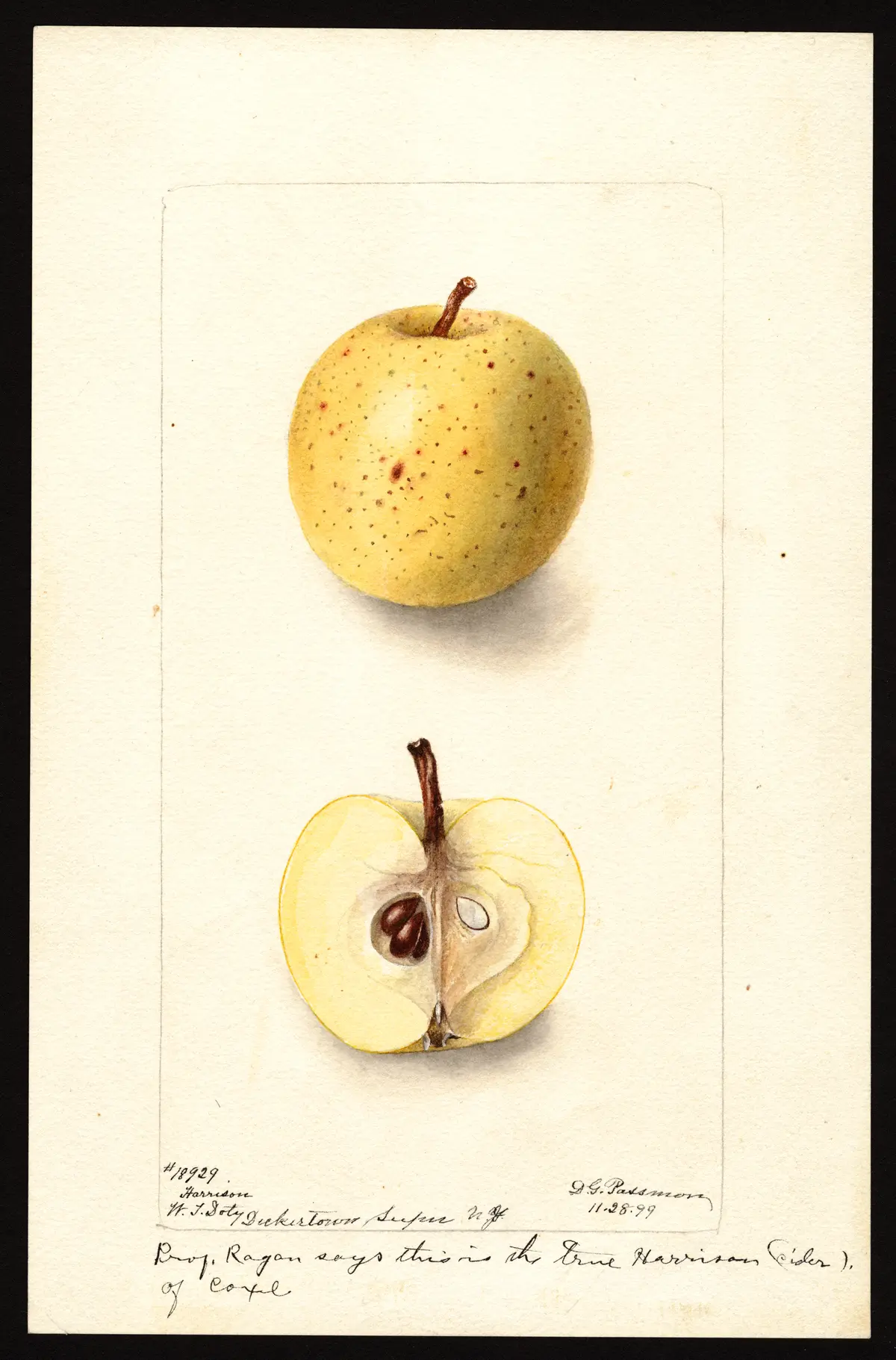
USDA Pomological Watercolor Collection
Origin/History
The Harrison originated in Essex County, New Jersey, and takes its name from a family in that county (Coxe). It has long been the most celebrated cider apple of Newark, New Jersey, cultivated in high perfection and to a great extent in that neighborhood, particularly on the Orange mountain (Coxe). New Jersey is the most celebrated cider-making district in America, and the Harrison has enjoyed the highest reputation as a cider fruit (Downing). It is from this variety, mixed with a small proportion of Campfield, that the celebrated Newark cider is made (Elliott). The variety has been carried westward over a great extent of territory, where it succeeds admirably well, and where the necessities of the people have brought to light its good properties for the kitchen as well as for the cider mill (Warder).
Tree
Vigorous, large, spreading, and productive (Warder). Strong and vigorous growth, throwing out numerous suckers from the limbs; the wood is hard (Coxe). Hardy (Elliott). Grows thriftily and bears very large crops (Downing). Certain bearers (Coxe). One tree in an orchard in Essex County produced upwards of 100 bushels in a single year, 87 of which were gathered when fully ripe, the remainder fallen fruit, carefully measured to ascertain the quantity (Coxe).
Fruit
Size: Sources differ. Below middling size (Coxe). Small (Warder). Medium (Downing). Medium or small (Elliott).
Form: Rather long, and pointed towards the crown (Coxe). Round-conical, somewhat angular and irregular (Warder). Ovate or roundish oblong (Downing). Roundish ovate (Elliott).
Stem: Long — hence the variety is often called the "long stem" (Coxe). Long, red, knobby (Warder). One inch or more long (Downing). One inch (Elliott).
Cavity: The ends are deeply hollowed (Coxe). Medium, regular, brown (Warder). Wide (Elliott).
Calyx: Closed (Elliott). Eye small, closed; segments long (Warder).
Basin: None, or very shallow, plaited (Warder). Shallow, furrowed (Elliott). The ends are deeply hollowed (Coxe) — note Coxe describes both ends as deeply hollowed, which may refer to both cavity and basin.
Skin: Yellow, with many small but distinct black spots, which give a roughness to the touch (Coxe). Surface not smooth, yellow, rarely blushed; frequent rose-colored spots and marks radiating from the cavity over the base of the fruit; dots small, distinct, gray (Warder). Yellow, with roughish, distinct black specks (Downing). Yellow, with black specks, light-suffused shade around (Elliott).
Flesh/Flavor: Rich, yellow, firm and tough; the taste pleasant and sprightly, but rather dry (Coxe). Yellow, compact, dry till ripe, then juicy; flavor acid to sub-acid, very rich, saccharine; quality good (Warder). Yellow, rather dry and tough, but with a rich flavor (Downing). Yellow, firm, spicy, sub-acid (Elliott).
Core/Seeds: Core regular, heart-shaped, closed, scarcely meeting the eye; seeds numerous, small (Warder). Core large; seeds long, ovate (Elliott).
Season
The apples fall about the first of November; they ripen at that time, but will keep well when housed (Coxe). Falls easily from the tree about the first of November, and keeps well (Downing). November to March (Elliott). Keeps well; suitable for dessert in April (Warder).
Uses
Preeminently a cider apple. Produces a high-colored, rich, and sweet cider of great strength, commanding a high price in New York, frequently ten dollars and upwards per barrel when fined for bottling (Coxe). Ten bushels are required for a barrel of cider; one barrel will produce fourteen quarts of distilled spirits (Coxe). Downing also gives ten bushels per barrel, producing a high-colored cider of great body. Generally grown for cider, but in the absence of better fruit, and kept until March, it becomes "very good" for dessert (Elliott). Also suitable for cooking and for dessert in April (Warder). The fruit is remarkably free from rot (Coxe, Downing).
Subtypes/Variants
Not described in source.
Other
Not described in source.
Book Sources
Described in 4 period pomological works
View original book sources (4)
— William Coxe, A View of the Cultivation of Fruit Trees (1817)NO. 83. HARRISON.
This is the most celebrated of the cider apples of Newark in New-Jersey: it is cultivated in high perfection, and to a great extent in that neighbourhood, particularly on the Orange mountain; the shape is rather long, and pointed towards the crown—the stalk long; hence it is often called the long stem—the ends are deeply hollowed; the skin is yellow, with many small but distinct black spots, which give a roughness to the touch: the flesh is rich, yellow, firm and tough; the taste pleasant and sprightly, but rather dry—it produces a high coloured, rich, and sweet cider of great strength, commanding a high price in New-York, frequently ten dollars and upwards per barrel when fined for bottling. The trees are certain bearers; the apples fall about the first of November; they are below the middling size, remarkably free from rot; ripen at that time, but will keep well when housed. The tree is of strong and vigorous growth, throwing out numerous suckers from the limbs—the wood is hard—ten bushels are required for a barrel of cider—one barrel will produce fourteen quarts of distilled spirits: it obtained its name from a family in Essex county New-Jersey, where it originated, and is very extensively cultivated. One tree of this kind this year, in an orchard in Essex county, produced upwards of 100 bushels, 87 of which were gathered when fully ripe, the others were fallen fruit, carefully measured to ascertain the quantity.
— John A. Warder, American Pomology: Apples (1867)Harrison.
This famous Jersey cider apple, from Essex County in that State, has been carried westward over a great extent of territory, where it succeeds admirably well, and where the necessities of the people have brought to light its good properties for the kitchen as well as for the cider mill.
Tree vigorous, large, spreading, productive.
Fruit small, round-conical, somewhat angular and irregular; Surface not smooth, yellow, rarely blushed; frequent rose-colored spots, and marks radiating from the cavity over the base of the fruit; Dots small, distinct, gray.
Basin none, or very shallow, plaited; Eye small, closed; Segments long.
Cavity medium, regular, brown; Stem long, red, knobby.
Core regular, heart-shaped, closed, scarcely meeting the eye; Seeds numerous, small; Flesh yellow, compact, dry till ripe, then juicy; flavor acid to sub-acid, very rich, saccharine; Quality good; Use, especially for cider, also for cooking and for dessert in April. Keeps well.
— A.J. Downing, The Fruits and Fruit Trees of America (1900)Harrison.
New Jersey is the most celebrated cider-making district in America, and this Apple, which originated in Essex County of that State, has long enjoyed the highest reputation as a cider fruit. Ten bushels of the Apples make a barrel of cider. The tree grows thriftily and bears very large crops.
Fruit medium size, ovate or roundish oblong. Skin yellow, with roughish, distinct black specks. Stalk one inch or more long. Flesh yellow, rather dry and tough, but with a rich flavor, producing a high-colored cider, of great body. The fruit is very free from rot, falls easily from the tree about the first of November, and keeps well.
— F.R. Elliott, The Western Fruit Book (1865)Harrison.
Generally grown for cider, but, in absence of better fruit, and kept until March, it becomes "very good" for dessert. Tree, thrifty, hardy, very productive. Fruit, medium or small, roundish ovate ; yellow, with black specks, light-suffused shade around ; stem, one inch ; cavity, wide ; calyx, closed ; basin, shallow, furrowed ; flesh, yellow, firm, spicy, sub-acid ; core, large; seeds, long, ovate, November to March. It is from this variety, mixed with a small proportion of Campfield, that the celebrated Newark cider is made.